

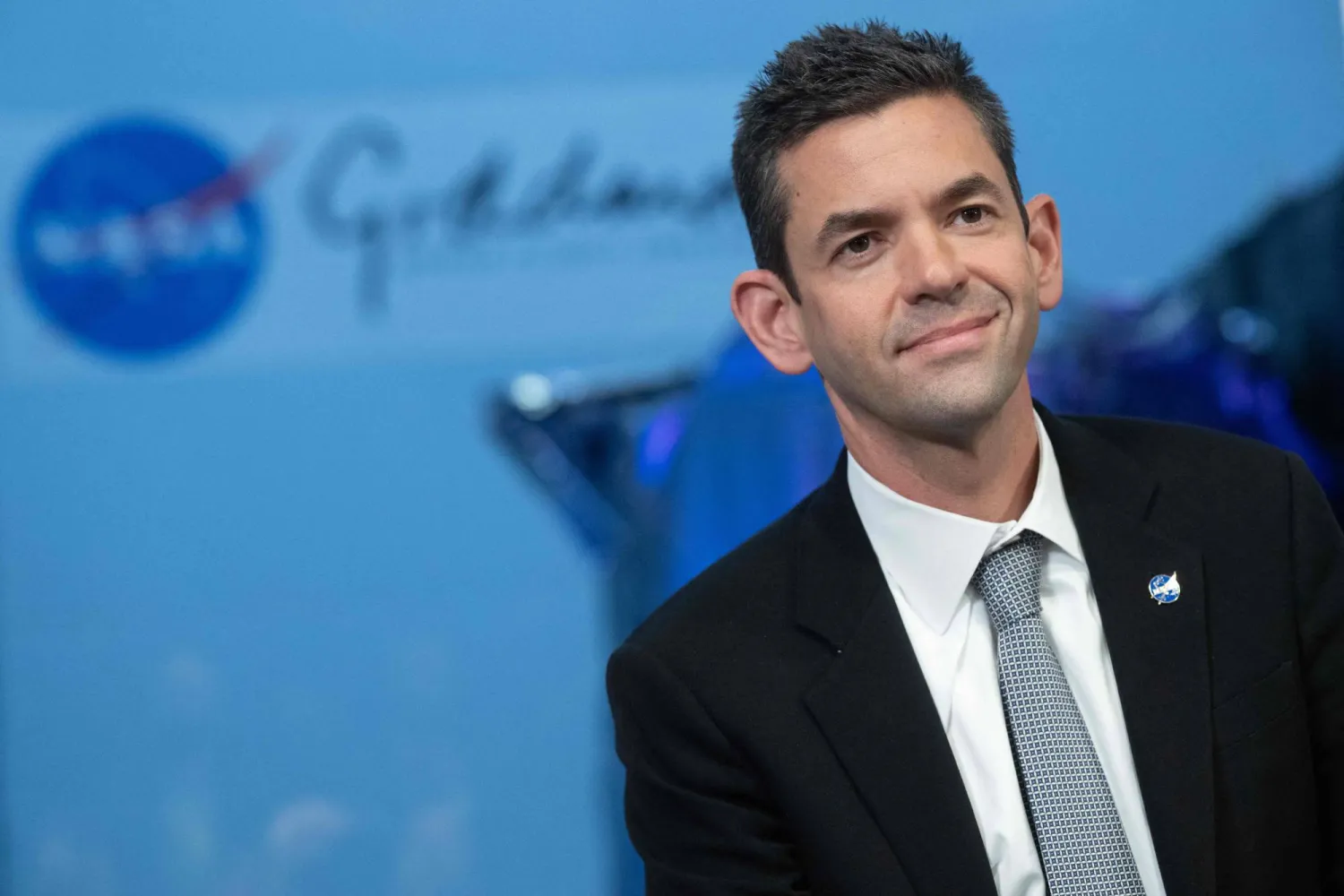

NASA Unveils New Space Telescope to Give 'Atlas of the Universe'

NASA Administrator Jared Isaacman speaks about the Nancy Grace Roman Space Telescope after it was unveiled to the public at NASA's Goddard Space Flight Center in Greenbelt, Maryland on April 21, 2026. (Photo by SAUL LOEB / AFP)
TT

NASA Unveils New Space Telescope to Give 'Atlas of the Universe'

NASA Administrator Jared Isaacman speaks about the Nancy Grace Roman Space Telescope after it was unveiled to the public at NASA's Goddard Space Flight Center in Greenbelt, Maryland on April 21, 2026. (Photo by SAUL LOEB / AFP)

NASA unveiled a new telescope on Tuesday to scan vast swathes of the universe for planets outside our solar system and probe the mysteries of dark matter and dark energy.

The Roman space telescope is expected to discover tens of thousands of planets, possibly offering clarity about how many could be out there.

"Roman will give the Earth a new atlas of the universe," NASA administrator Jared Isaacman told a news conference at the Goddard Space Flight Center in Maryland, where the telescope went on display.

The 12-meter (39-feet), silvery contraption with massive solar panels will be transported to Florida ahead of a launch into space aboard a SpaceX rocket planned for September at the earliest.

Roman, which took more than $4 billion and over a decade to build, is named after astronomer Nancy Grace Roman, nicknamed the "Mother of Hubble" for her role in developing the landmark space telescope.

Thirty-six years after Hubble launched into space, revolutionizing astronomical observations, NASA hopes Roman will help to shed light on questions that remain unresolved.

Boasting a field of view at least 100 times larger than Hubble's, the telescope will sweep across vast regions of space from its position 1.5 million kilometers (930,000 miles) from Earth.

The telescope will send 11 terabytes of data a day down to Earth, said Mark Melton, a systems engineer at Goddard Space Flight Center.

"In the first year, we'll have sent down more data than Hubble will have for its entire life," he told AFP.

The telescope's wide-angle lens will allow NASA to conduct a census of the objects that make up our universe, said Nicky Fox, associate administrator for NASA's Science Mission Directorate.

"Roman will discover tens of thousands of new planets outside our solar system. It will reveal billions of galaxies, thousands of supernovae and tens of billions of stars," she said.

This wealth of information will enable NASA to tease out areas of interest that can then be investigated by complementary telescopes, such as the James Webb Space Telescope.

But Roman will also study the invisible -- dark matter and dark energy, whose origins remain unknown but which are thought to constitute 95 percent of our universe.

Dark matter is believed to be the glue that holds galaxies together, while dark energy pulls them apart by making the universe expand faster and faster over time.

Thanks to its infrared vision, the telescope will be able to observe light emitted by celestial bodies billions of years ago, effectively looking back in time to hopefully discover more about the two phenomena.

Complementing the work of Europe's Euclid space telescope and the Vera Rubin Observatory in Chile, Roman will probe "how the dark matter structures itself throughout cosmic time" and "calculate how fast galaxies are moving away from us," Darryl Seligman, an assistant professor of physics and astronomy at Michigan State University, told AFP.

These discoveries could fundamentally change our understanding of the structure of our universe, said astrophysicist Julie McEnery, who led the Roman project.

"If Roman wins a Nobel Prize at some point, it's probably for something we haven't even thought about or questioned yet," said Melton.




Red Sea Destination Announces Opening of Global Resort on Shura Island

The resort offers a comprehensive wellness retreat experience through 180 upscale rooms, suites, and villas - SPA
TT

Red Sea Destination Announces Opening of Global Resort on Shura Island

The resort offers a comprehensive wellness retreat experience through 180 upscale rooms, suites, and villas - SPA

Red Sea Global announced that Miraval The Red Sea will begin welcoming guests starting May 15. The launch marks the first international expansion of the luxury “Miraval” brand outside the United States, reinforcing the status of the Red Sea destination as a leading global tourism hub, especially after occupancy rates across the destination reached 82% during the final days of Ramadan, SPA reported.

The resort offers a comprehensive wellness retreat experience through 180 upscale rooms, suites, and villas.

CEO of Red Sea Global John Pagano stated that attracting a prestigious brand such as “Miraval” reflects the strong global confidence in the Kingdom’s tourism offerings.

He noted that the momentum witnessed by the destination has been clearly reflected in strong occupancy rates and early bookings for the Eid season.

Resort guests will enjoy a variety of activities and culinary experiences inspired by locally sourced ingredients.


Czech Police Seek Thief who Stole Saint's Skull


Police officers patrol the Czech-Slovak green border near Stary Hrozenkov, Czech Republic, September 29, 2022. REUTERS/Radovan Stoklasa
TT

Czech Police Seek Thief who Stole Saint's Skull


Police officers patrol the Czech-Slovak green border near Stary Hrozenkov, Czech Republic, September 29, 2022. REUTERS/Radovan Stoklasa

An unidentified thief stole the skull of Czech saint Zdislava of Lemberk from a glass shrine in a northern Czech church, causing "incalculable" historic damage, police said late on Tuesday.

St Zdislava of Lemberk (estimated 1220-1252), a noblewoman known for her merciful and charitable deeds, was canonized by Pope John Paul II in 1995.

The theft in the basilica of St Lawrence and St Zdislava in the northern town of Jablonne v Podjestedi was committed after 1600 GMT, said police spokeswoman Dagmar Sochorova.

"An unknown culprit broke a shrine in which the skull was stored and ran away from the site," AFP quoted her as saying.

Police published "low quality footage" depicting the culprit clad "probably" in black and wearing "probably" white shoes, and asked the public for help.

"The value of the stolen skull is currently being investigated. However, its historic value is obviously incalculable," Sochorova added.

Prague Archbishop Stanislav Pribyl, who also heads the Litomerice diocese in charge of the Jablonne church, said the news was "devastating".

Placed on an altar in a side chapel, the skull "was the subject of adoration for pilgrims travelling to Jablonne where Zdislava lived and worked more than 750 years ago," he said.

"I can't believe that someone commits a daylight robbery to steal from a church a relic whose value is above all historic," added Pribyl, who was named Prague archbishop in February.


Saudi Arabia: KAUST Study Reveals How Plants Protect Photosynthesis During Extreme Heat

The research team identified a protective mechanism within chloroplasts. SPA
TT

Saudi Arabia: KAUST Study Reveals How Plants Protect Photosynthesis During Extreme Heat

The research team identified a protective mechanism within chloroplasts. SPA

King Abdullah University of Science and Technology (KAUST) has completed a research study identifying how plants protect photosynthesis under high temperatures, an outcome that could support the development of more resilient crops in desert climates.

The research team identified a protective mechanism within chloroplasts, lead researcher Professor Monika Chodasiewicz said, noting that it helps preserve and restore the plant’s ability to convert sunlight into chemical energy.

The findings are particularly significant, as heat is one of the main threats to plant productivity, and protecting photosynthesis is essential for sustaining plant growth and crop yields, Chodasiewicz added.

She explained that the chlorophyll protein forms protective granules, revealing their previously unclear functional significance. The findings provide new insights that could be applied for future crop breeding and biotechnology, Chodasiewicz said.

The results also contribute to the emerging field of phase-separated biomolecular condensates in plant biology, while supporting broader priorities related to sustainable agriculture, climate adaptation, and food security.
