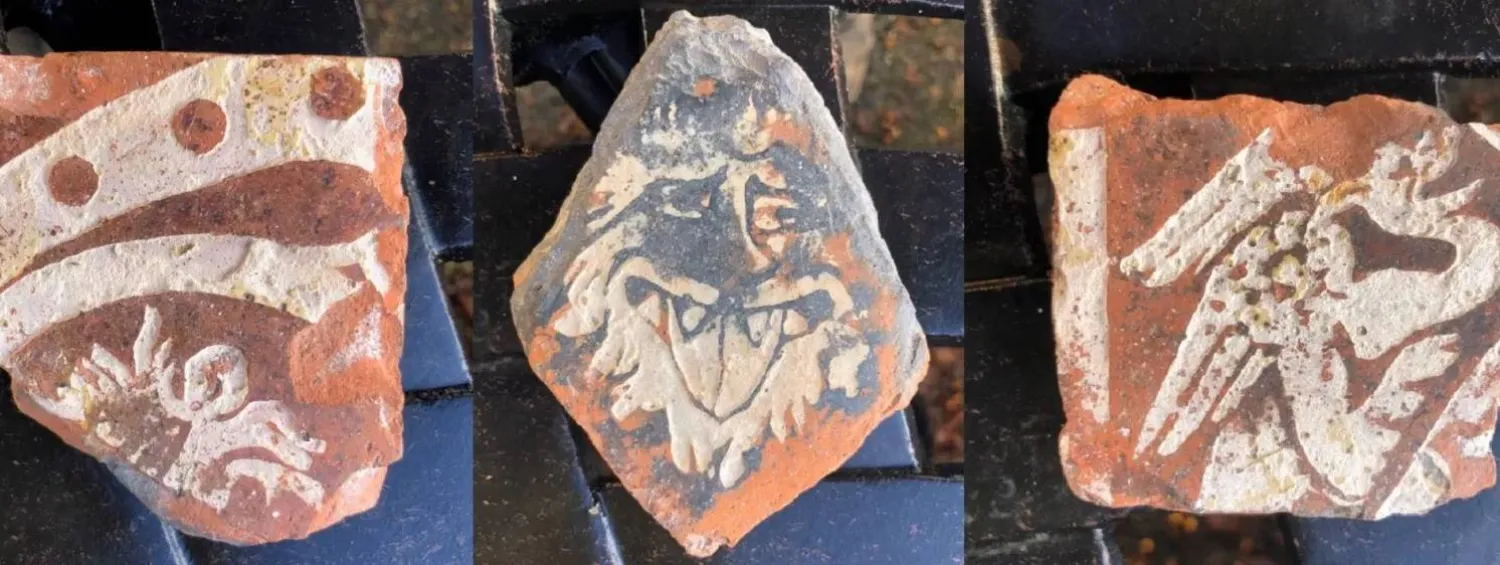
60 Years Later… Man Returns Tiles from Medieval Priory

English Heritage was particularly thrilled that one of the fragments had a dragon motif on it, which was previously unknown at the site. (English Heritage)
TT

60 Years Later… Man Returns Tiles from Medieval Priory

English Heritage was particularly thrilled that one of the fragments had a dragon motif on it, which was previously unknown at the site. (English Heritage)

Fragments of a priory’s medieval tiled floor that spent almost 60 years stashed in a toffee tin after being pocketed by a nine-year-old boy during a family outing have finally been handed back, according to The Guardian.

The three pieces of decorative clay tiles, dating from the late 13th to early 14th century, were taken as a souvenir by Simon White during a family visit to Wenlock Priory in Shropshire in the late 1960s.

White, now a 68-year-old retired chartered surveyor, found the fragments in an old toffee tin during a house move and owned up to English Heritage. He told officials he recalled his father encouraging him to take the pieces but had always felt a little uneasy and was delighted when he rediscovered them.

“I can remember the day this all happened with my father standing guard,” he said. “Heaven knows what he would have said if we’d been caught. What happened to the tiles afterwards I’m not really sure, but they survived numerous house moves and assorted family upheavals only to turn up in my loft earlier this year in a battered tin.”

With the help of family diaries, White worked out that they probably came from Wenlock Priory and contacted the site’s custodians, English Heritage.

Matty Cambridge, assistant curator at the charity, said medievalists had concluded White was right to pinpoint Wenlock as the scene of the act. She said tiles like the ones White had taken were only known to have existed at three places in Shropshire: Haughmond Abbey, Bridgnorth Friary and Wenlock Priory.

Cambridge added: “Given Bridgnorth Friary has no in situ tile and wasn’t excavated until after Simon’s trip, and Haughmond Abbey only has a small patch of tile still at the site, we can narrow down the tiles found to Wenlock Priory.”


Mexico City is Sinking So Quickly, it Can be Seen from Space

Uneven buildings and grounds at the Templo Mayor shows a city sinking, July 28, 2016, in Mexico City. (AP Photo/Ross D. Franklin)
TT

Mexico City is Sinking So Quickly, it Can be Seen from Space

Uneven buildings and grounds at the Templo Mayor shows a city sinking, July 28, 2016, in Mexico City. (AP Photo/Ross D. Franklin)

Mexico City is sinking by nearly 10 inches (about 25 centimeters) a year, according to new satellite imagery released this week by NASA, making it one of the world’s fastest-subsiding metropolises.

One of the world's most sprawling and populated urban areas, at 3,000 square miles (about 7,800 square kilometers) and some 22 million people, the Mexican capital and surrounding cities were built atop an ancient lake bed.

Many downtown streets were once canals, a tradition that continues in the rural fringes.

Extensive groundwater pumping and urban development have dramatically shrunk the aquifer, meaning that Mexico City has been sinking for more than a century, leaving many monuments and older buildings — like the Metropolitan Cathedral, where construction began in 1573 — visibly tilted to the side. The contracting aquifer has also contributed to a chronic water crisis that is only expected to worsen.

“It damages part of the critical infrastructure of Mexico City, such as the subway, the drainage system, the water, the potable water system, housing and streets,” said Enrique Cabral, a researcher studying geophysics at the National Autonomous University of Mexico. “It’s a very big problem.”

Mexico City is sinking so fast that the subsidence can be spotted from space.

In some parts it is happening at an average rate of 0.78 inches (2 centimeters) a month, according to NASA’s newly released report, such as at the main airport and the iconic monument commonly known as the Angel of Independence.

Overall that means a yearly subsidence rate of about 9.5 inches (24 centimeters). Over the course of less than a century, the drop has been more than 39 feet (12 meters), according to Cabral.

“We have one of the fastest velocities of land subsidence in the whole world,” The Associated Press quoted him as saying.

The NASA estimates are based on measurements taken between October 2025 and January 2026 by a powerful satellite known as NISAR, which can track real-time changes on the Earth’s surface and is a joint initiative between NASA and the Indian Space Research Organization.

NISAR scientist Paul Rosen said that by capturing details of the Earth from space, the project is also “telling us something about what’s actually happening below the surface.”

“It’s basically documentation of all of these changes within a city,” Rosen said. He added: “You can see the full magnitude of the problem.”

With time the team hopes to be able to zoom in even more on specific areas and someday get measurements on a building-by-building basis.

More broadly, researchers hope to apply the technology around the world to track things like natural disasters, changes in fault lines, the effects of climate change in regions like Antarctica and more.

Rosen said it could be used to bolster alert systems, letting scientists alert governments to the need for evacuations in cases of volcano eruptions, for example.

For Mexico City the technology amounts to a big advance in studying the subsidence issue and mitigating its worst effects, according to Cabral.

For decades the government has largely ignored the problem other than stabilizing foundations under monuments like the cathedral. But following recent flare-ups of the water crisis, Cabral said, officials have begun to fund more research.

Imagery from the NISAR satellite and the data that comes with it will be key for scientists and officials as they plan on how to address the problem.

“To do long-term mitigation of the situation,” Cabral said, “the first step is to just understand.”


Sweet Dreams: Seoul Holds ‘Power Nap Contest’ in Sleep-Deprived South Korea

 Participants take a nap during the 2026 Hangang Nap Competition at Yeouido Hangang Park in Seoul, South Korea, Saturday, May 2, 2026. (AP)
Participants take a nap during the 2026 Hangang Nap Competition at Yeouido Hangang Park in Seoul, South Korea, Saturday, May 2, 2026. (AP)
TT

Sweet Dreams: Seoul Holds ‘Power Nap Contest’ in Sleep-Deprived South Korea

 Participants take a nap during the 2026 Hangang Nap Competition at Yeouido Hangang Park in Seoul, South Korea, Saturday, May 2, 2026. (AP)
Participants take a nap during the 2026 Hangang Nap Competition at Yeouido Hangang Park in Seoul, South Korea, Saturday, May 2, 2026. (AP)

Under hazy spring ‌sunshine on Saturday, hundreds of young Seoulites turned up at a park by the Han River at the invitation of the city government to try to do something many overworked South Koreans never get enough of - sleep.

The Seoul Metropolitan Government staged its third annual spring event, dubbed a power nap contest, from 3 p.m. (0600 GMT), under a refreshed set of admission requirements for would-be participants: wear outfits befitting either a sleeping beauty or prince, come tired, with a full belly.

For a metropolis that famously runs on 24-hour shopping malls, competitive hustle ‌and iced Americanos, ‌the underlying exhaustion on the lawn was palpable.

"Between ‌exam ⁠prep and part-time ⁠jobs, I survive on three or four hours of sleep a night, patching it up with desk naps during the day," said Park Jun-seok, who showed up draped in the silken, crimson robes of a Joseon Dynasty monarch.

"I'm here to show off my napping skills, and to demonstrate exactly how a king sleeps," said Park, a ⁠20-year-old university student.

Nearby, Yoo Mi-yeon, 24, an English ‌teacher from Ilsan north of Seoul, stood ‌out in a plush, oversized koala-themed onesie.

"I've always suffered from insomnia, ‌I struggle to fall asleep, and wake up easily," she said. "Koalas ‌are famous for their deep slumber. I came dressed as one hoping to borrow a little of their magic."

Now in its third consecutive year, the sleep competition underscores a chronic issue for South Koreans. Data show South Korea ‌is one of the most overworked and sleep-deprived nations among Organization for Economic Cooperation and Development members, ⁠and, as ⁠a consequence, people have some of the fewest sleep hours.

As the clock struck three and eye masks descended across the park, officials went around to measure participants' heart rate to make sure they had a stable reading - an indicator of deep, peaceful sleep.

The winner of the contest was a man in his 80s.

Hwang Du-seong, a 37-year-old office worker, was a runner-up.

"I was completely drained, having done night shifts often on top of going to work everyday plus I also drive a lot for work. So when I saw the contest I was determined to sleep to fully recharge amid river breeze, and I'm very happy to be placed second place, luckily."


Humpback Whale Stranded in Germany Released into North Sea

01 May 2026, Denmark, Skagen: An aerial view of the the humpback whale towed in its barge by the tugboat Fortuna B along the Danish coast, just south of Skagen in the Skagerrak, through the Baltic Sea. (dpa)
TT

Humpback Whale Stranded in Germany Released into North Sea

01 May 2026, Denmark, Skagen: An aerial view of the the humpback whale towed in its barge by the tugboat Fortuna B along the Danish coast, just south of Skagen in the Skagerrak, through the Baltic Sea. (dpa)

A humpback whale that had been struggling to survive after beaching near the German coast was Saturday released into the North Sea off Denmark after being transported in a barge, a member of a rescue mission said.

Dubbed "Timmy" by the German media, the whale was first spotted stuck on a sandbank on March 23 near the city of Luebeck before freeing itself and then becoming stuck again several times.

The whale left the barge it had been towed on from Wismar Bay on the Baltic coast at around 8:45 am (0645 GMT), said Karin Walter-Mommert from the rescue initiative.

It is now swimming on its own and freely, and at least for the time being, in the right direction, she said.

At the start of April, German officials gave up on trying to rescue the animal, saying they believed it could not be saved.

But this triggered an outcry and authorities were persuaded to approve a privately financed rescue plan proposed by two wealthy entrepreneurs.

The barge idea was hatched after their initial attempt to save the whale with inflatable cushions and pontoons was unsuccessful.

The rescue effort was seen as a long shot and criticized by experts who said it would only cause the animal more distress.

The whale's ordeal has sparked a media frenzy -- with non-stop coverage from TV channels, online outlets and social media influencers -- but has also led to angry spats and conspiracy theories.