
Troubled Waters: Jakarta Battles Deadly, Invasive Suckerfish

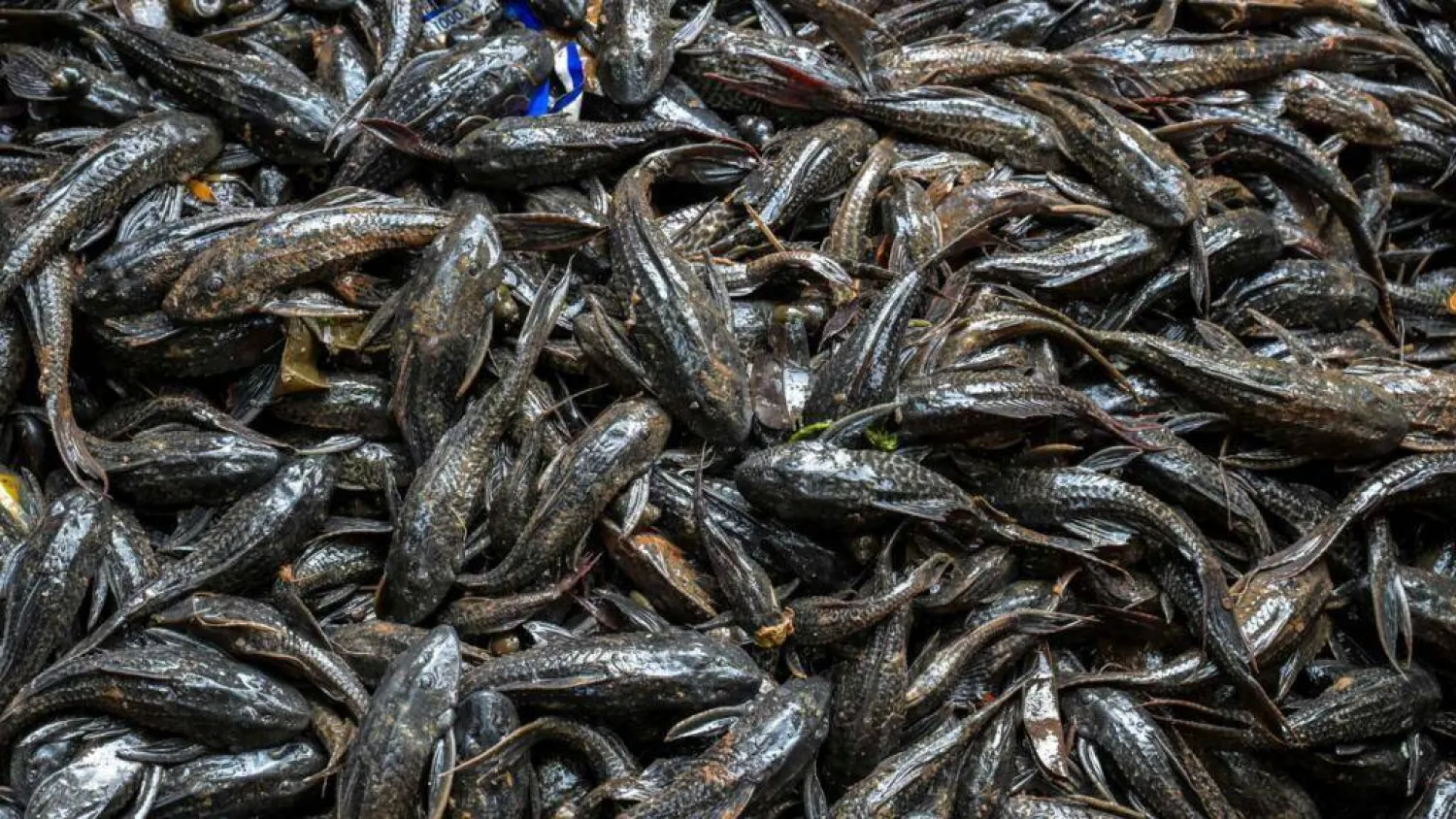
The sapu-sapu was introduced to Indonesia from South America, brought in to keep aquariums algae free but chucked into rivers as they outgrew their tanks. BAY ISMOYO / AFP
TT

Troubled Waters: Jakarta Battles Deadly, Invasive Suckerfish

The sapu-sapu was introduced to Indonesia from South America, brought in to keep aquariums algae free but chucked into rivers as they outgrew their tanks. BAY ISMOYO / AFP

Mounds of slimey carcasses pile up on a riverbank in Jakarta where authorities are fighting an uphill battle against a fast-breeding invasive fish flourishing in Java island's heavily polluted waterways.

The sapu-sapu, a sucking fish introduced from South America decades ago to keep Southeast Asian aquariums algae-free, has made a home in Javan rivers, many after being thrown out for outgrowing their tanks.

Unlike in the Amazon River where it has natural predators, the sapu-sapu quickly took over in Java, outbreeding indigenous freshwater fish, eating their eggs and outcompeting them for food.

Residents and campaigners have complained about the stinky, unsightly pileups of fishy remains, and the potential health risk for those who consume snacks made from polluted sapu-sapu stock.

Invasive species are spreading ever faster across the globe and cost well over $400 billion a year in damages and lost income, according to a 2023 United Nations assessment.

Surprisingly adept at living in polluted water, the sapu-sapu -- also known as suckermouth catfish, janitor fish or pleco -- can grow to half a meter (20 inches) in length and a female can lay thousands of eggs every year.

"That there are thousands of (sapu-sapu) fish in some of these river bodies, where, you know, the rivers are like dark black, almost smelling like rotten eggs... is completely crazy," clean river campaigner Gary Bencheghib told AFP.

Killing sapu-sapu is not addressing the real problem, he added in a phone interview, nearly halfway through a 1,200-kilometer (746-mile) run from Bali to Jakarta to raise money for river cleanups and having witnessed the crisis at several stops along the way.

The real solution is cleaning up "the waste it lives off... that you find in these polluted waters," said Bencheghib, co-founder of the Sungai Watch NGO.

- 'A dangerous snack' -

More than half of Indonesia's rivers are heavily polluted, and two of the country's major river systems are among the dirtiest in the world, according to data from the UN Environment Program.

Nationwide, only about 7.4 percent of municipal wastewater is safely collected and treated.

Greater Jakarta, a water-stressed metropolis of 42 million people, is particularly affected.

But sapu-sapu are able to live in oxygen-poor and polluted waters, digging holes into riverbanks to lay their eggs and weakening walls that have been known to collapse as a result.

In recent weeks, Jakarta has embarked on a killing campaign involving residents, sanitation workers, fisheries ministry workers and even soldiers.

In two weeks, about 5.3 tons of the fish have been removed from rivers in South Jakarta alone, mayor Muhammad Anwar told AFP while overseeing an operation at Babakan Lake this week.

The sapu-sapu are caught in nets, separated from indigenous fish that are thrown back, then decapitated to make sure they are dead, and buried in mass graves.

Some activists have criticized the procedure as wasteful, arguing the skin could be used for fish leather products and the rest processed into fertilizer or animal feed.

But others say the fish are too contaminated to be useful, and definitely not fit for human consumption.

"It contains... heavy metals and is dangerous to humans," Anwar said.

Tests conducted for scientific studies have found traces of lead and mercury as well as E.coli bacteria beyond safe levels in sapu-sapu.

"In some places, it is consumed as a dangerous snack called siomay (steamed fish dumpling) and pempek (fish cakes)," the mayor said.

"Please be careful when buying fish cakes. Don't be led by the (cheap) price."


Prince William to Sell Parts of Royal Estate to Reinvest in Local Communities

Football - FA Cup - Final - Chelsea v Manchester City - Wembley Stadium, London, Britain - May 16, 2026 William, Prince of Wales, before the start of the match. (Reuters)
TT

Prince William to Sell Parts of Royal Estate to Reinvest in Local Communities

Football - FA Cup - Final - Chelsea v Manchester City - Wembley Stadium, London, Britain - May 16, 2026 William, Prince of Wales, before the start of the match. (Reuters)

Britain's Prince ‌William will sell off parts of his vast Duchy of Cornwall estate over the next decade to help fund plans to invest more than 500 million pounds ($670 million) in local communities, including affordable housing and environmental projects.

The sales were reported by the Times newspaper to equate to 20% of the estate which is one of Britain's biggest landowners with a portfolio that includes ‌large swathes ‌of land as well as commercial ‌and ⁠residential properties.

"The Duchy ⁠should exist to make a positive impact, particularly in the communities where we can make the biggest difference," said Will Bax, Chief Executive of the Duchy of Cornwall.

"That ambition requires significant investment and, in some cases, means rebalancing what ⁠we own in order to ‌be as impactful as ‌possible to our communities, now and in the future."

Bax ‌said the money would be "largely funded ‌by reinvesting capital from across the Duchy, alongside development income, partnerships and some borrowing."

William, who received a private income of more than 20 million pounds from the ‌Duchy last year, and his father King Charles have in recent years ⁠faced ⁠criticism over the way their estates have been managed. Aides say William has been looking closely at management of the Duchy since inheriting it in 2022.

In 2024, a Sunday Times report and separate TV documentary accused Charles and his heir William of making millions from the country's health service, army and schools from charges imposed by their respective estates.

The Duchy subsequently reduced rents significantly for a number of charity and community tenants.


Escaped Tiger Shot Dead by German Police

Local media say the tiger belongs to controversial trainer Carmen Zander, also known as Germany's "Tiger Queen" - AFP
TT

Escaped Tiger Shot Dead by German Police

Local media say the tiger belongs to controversial trainer Carmen Zander, also known as Germany's "Tiger Queen" - AFP

German police said Monday they had shot dead a tiger that escaped from an enclosure run by a woman nicknamed the "Tiger Queen" after it attacked one of the keepers.

Police told AFP that the animal had seriously injured a 72-year-old man, who was being treated in hospital after the attack in the eastern city of Leipzig.

The incident happened Sunday on the city's outskirts and involved an "escaped tiger which was killed by police using firearms," the police spokesman said.

Police said they were "able to locate the animal in an allotment complex" nearby and that it had to be killed "to prevent danger to those present".

One allotment gardener told the Bild newspaper: "First we heard sirens and then right afterwards a helicopter came and lots of police", who warned the allotment owners to stay inside.

"Then there were suddenly several shots."

The animal belonged to tiger trainer Carmen Zander, who told Bild that the tiger shot dead was called Sandokan.

According to Zander's website, Sandokan was a nine-year-old, 280-kilogram (615 pound) Bengal-Siberian mix.

The website describes the animal as "a scaredy-cat" that could "quickly become overwhelmed and insecure" and could therefore attack "more quickly and unexpectedly" than the other animals.

Zander, known as the "Tiger Queen", has faced criticism in the past for the conditions in which the animals are kept at her enclosure.

Animal rights group PETA charged that veterinary authorities "share responsibility for this tragic incident" by having failed to act against the facility sooner and demanded that the remaining animals there be confiscated.

The district authority said in a statement to AFP that it had "for some time been working to improve the housing conditions of the tigers" at the site.

Zander had been instructed to comply with regulations "so that all animals have access to the necessary indoor and outdoor space, or to adjust the number of animals to the space currently available".


Japan Arrests Americans over Stunt at Baby Monkey Punch's Zoo

Tourists have flocked to the Ichikawa City Zoo to see the macaque named Punch, who was abandoned by his mother shortly after his birth. Yuichi YAMAZAKI / AFP
TT

Japan Arrests Americans over Stunt at Baby Monkey Punch's Zoo

Tourists have flocked to the Ichikawa City Zoo to see the macaque named Punch, who was abandoned by his mother shortly after his birth. Yuichi YAMAZAKI / AFP

Two American nationals were arrested in Japan after a stunt in which one entered the monkey enclosure at a zoo where a baby macaque named Punch became a global internet sensation this year, police said Monday.

One of the men, who identified himself as a 24-year-old college student, was arrested Sunday after climbing over a fence and dropping into a dry moat surrounding the monkey exhibit at Ichikawa City Zoo outside Tokyo.

The other man, who was filming the act, identified himself as a 27-year-old singer.

Images on social media showed a person scaling the fence in a costume that included a smiley face head with sunglasses, prompting the monkeys to scatter.

The men did not come close to the animals, and were quickly apprehended by zoo officials, said an official at Ichikawa Police who spoke with AFP on a traditional condition of anonymity.

The two men face charges of forcible obstruction of business, which they refute, the police official said.

The duo did not have formal identifications with them and initially tried to lie to police about their names, he added.

The arrests follow a massive surge in domestic and international visitors to the zoo, driven by Punch's viral fame.

The baby monkey became an internet star this year after the zoo posted photos of Punch clutching an IKEA plush orangutan for comfort after being rejected by his mother.

Punch was raised in an artificial environment after being born in July, and began training to rejoin his troop earlier this year.

Punch's predicament sparked huge interest online, spawning a devoted fanbase under the hashtag #HangInTherePunch.

An unprecedented number of tourists are flocking to Japan, but some residents have become fed up with unruly behavior.

Last year, a Ukrainian YouTuber with more than 6.5 million subscribers was arrested after livestreaming himself trespassing in a house in the Fukushima nuclear exclusion zone.

And a US livestreamer known as Johnny Somali was arrested in 2023 for allegedly trespassing onto a construction site.