


India’s Lifeline Ferry Across Strategic Archipelago

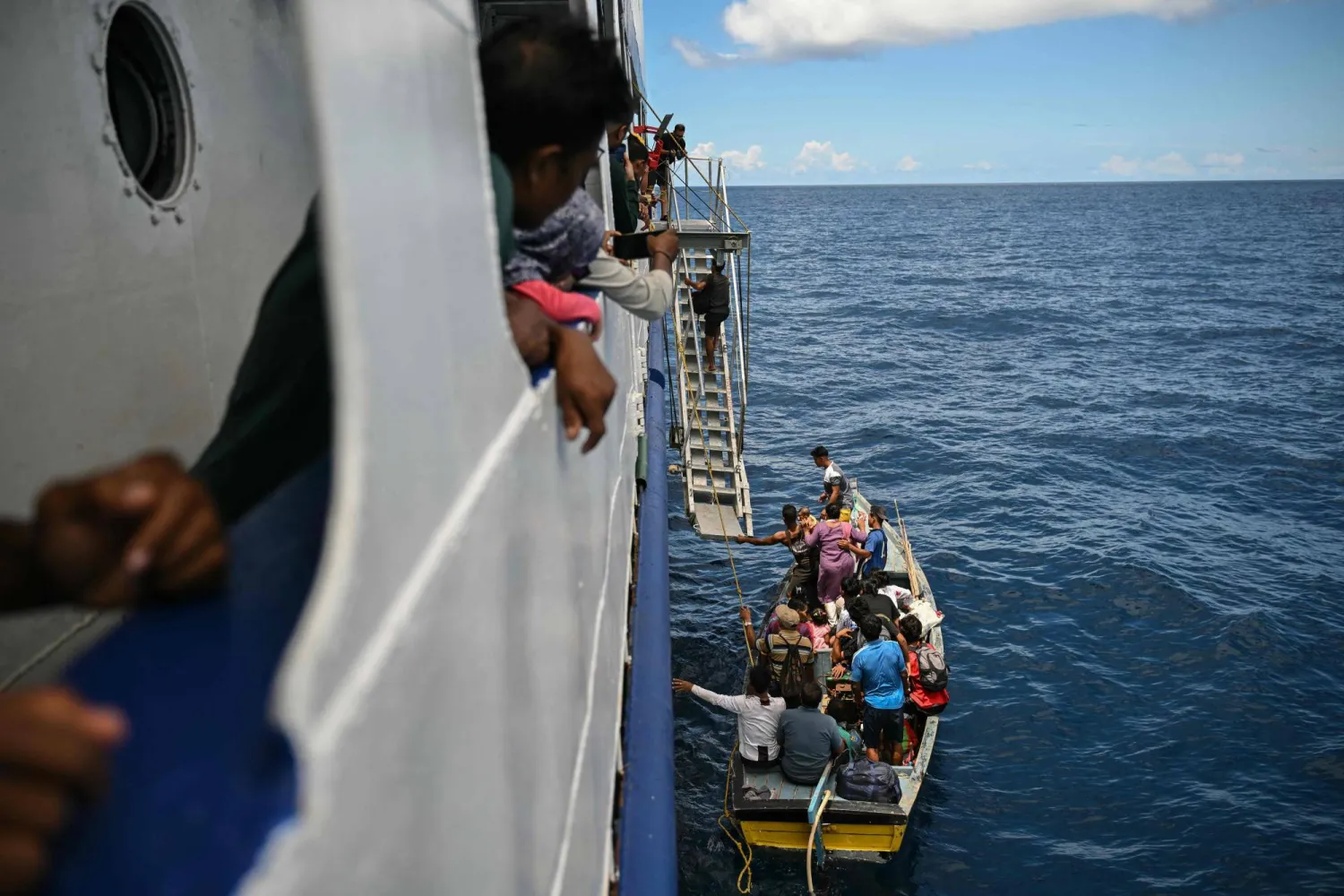
This photograph taken on March 30, 2026 shows passengers boarding the MV Kalighat vessel near Chowra in the waters of India's Andaman and Nicobar Islands. (AFP)
TT

India’s Lifeline Ferry Across Strategic Archipelago

This photograph taken on March 30, 2026 shows passengers boarding the MV Kalighat vessel near Chowra in the waters of India's Andaman and Nicobar Islands. (AFP)

Leaping from a small boat in choppy waters off India's Andaman and Nicobar Islands, George Washington jumps on board the only ferry service connecting hundreds of communities across the strategic archipelago.

"These ships are a lifeline for the people," 18-year-old Washington told AFP, travelling between two tiny green specks in the 800-kilometer-long (500-mile) Indian Ocean chain, from Chowra to the slightly larger Car Nicobar.

"If I had missed this one, I'd have to wait for the next one for a few days," Washington said, after clambering onboard the government-run MV Kalighat, an 85 meter-long (278 foot) cargo and passenger vessel.

Washington's journey lasted about five hours on the ferry service that takes up to 50 hours from end to end.

Running from the archipelago's capital Sri Vijayapuram in the north to the southern tip of Campbell Bay, the ferry serves as both a passenger and cargo ship linking the 836-island archipelago.

At each stop, passengers like Washington or others laden with sacks of coconuts or pineapples for the market get on and off.

At bigger ports, a few cargo containers are loaded or unloaded.

Many islands like Chowra -- a three-kilometer-long (two-mile) forest speck in a vast blue sea -- lack deep-water jetties.

So passengers must reach ocean-going ferries by smaller tenders.

Recalling one such journey, islander Tony Usman said "it was very scary", as the poor weather made the transfer from a small boat to the ferry treacherous.

"I hope that more ships are added and the jetty too is expanded, which is in a bad state," said Usman, 15, who was also travelling from Chowra to his home at Car Nicobar.

India hopes to change that soon.

- 'Touch every island' -

As part of a $9-billion plan, New Delhi is building a megaport, an airport and city on the Great Nicobar island, at the southern end of the archipelago.

The colossal construction is projected to expand the population and bring tourists to the archipelago, located more than 2,500 kilometers (1,555 miles) from India's mainland.

New Delhi sees development there as a way to counter China's growing regional influence.

Giant container ships ply sea lanes skirting the archipelago's southern tip, where roughly a third of global maritime trade transits between Asia, Africa, the Gulf and the Red Sea.

Vijay Kumar, the archipelago's director of shipping, said port facilities would be upgraded and new vessels deployed within two years.

"We are going to augment facilities -- either by reconstruction, or construction of new jetties," he said, underlining that his service's mandate is to "touch every island".

"We shall line up 10 plus new vessels for the region."

For now, the slow ferry remains the main form of long-distance transport serving the archipelago's estimated 420,000 residents, as government-run helicopters remain out of reach for most.

Passengers bring their own food or distraction for their long trips, with some playing carom -- a popular board game -- to pass the time, while goats tied up at a corner graze on a handful of hay.

Harjinder Pal Kaur, 66, says the ferry has already come a long way from the 1970s, when she settled on the Great Nicobar island.

At that time, there was only one boat a month, and the journey took up to six days without any air conditioning, while passengers today can pay for more comfortable sleeping cabins.

"We spent so many months with no fresh rations as the ships failed to reach here, or the limited vegetables they were carrying were spoiled during the long journey," she recalled.

Kalighat crew member Vincent Soreng said the journeys offer a rare window into island life.

"You learn so much about life observing all the people and hearing their stories along the way," Soreng said.




Help Wanted: Australian Conservation Group Seeks New Koala Rescue Dog

This handout photo from the International Fund for Animal Welfare (IFAW) taken on November 10, 2023, shows Bear, a koala detection dog who recently retired, during a training session at an unknown location.  (Photo by Handout / International Fund for Animal Welfare (IFAW) / AFP)
This handout photo from the International Fund for Animal Welfare (IFAW) taken on November 10, 2023, shows Bear, a koala detection dog who recently retired, during a training session at an unknown location. (Photo by Handout / International Fund for Animal Welfare (IFAW) / AFP)
TT

Help Wanted: Australian Conservation Group Seeks New Koala Rescue Dog

This handout photo from the International Fund for Animal Welfare (IFAW) taken on November 10, 2023, shows Bear, a koala detection dog who recently retired, during a training session at an unknown location.  (Photo by Handout / International Fund for Animal Welfare (IFAW) / AFP)
This handout photo from the International Fund for Animal Welfare (IFAW) taken on November 10, 2023, shows Bear, a koala detection dog who recently retired, during a training session at an unknown location. (Photo by Handout / International Fund for Animal Welfare (IFAW) / AFP)

An Australian animal welfare group is seeking a heroic dog with an appetite for adventure for a full-time position as a koala rescuer.

The successful pooch will replace the world-famous Bear, credited with saving over 100 koalas from bushfires during a decade of service.

"Bear set the gold standard for koala detection dogs," the International Fund for Animal Welfare (IFAW) Oceania head of programs Josey Sharrad said, according to AFP.

"He's leaving very big boots to fill, but now it's time to find his successor to follow in his pawprints and keep protecting koalas."

The ideal candidate will be a rescue pup with a lot of energy and an "obsessive" personality -- attributes that might make it hard to find a home but which make it perfect for saving koalas, IFAW said.

"By only recruiting a rescue dog, it's a win-win -- giving a dog the chance of a new life while helping our iconic koalas," Innovation for Conservation director and handler Russell Miller said.

Other key attributes are a love of play, confidence and a gentle temperament towards fellow animals is crucial.

They must also be medium sized -- "not too small that they struggle in the bush, not too big that the handlers can't carry them when needed", according to the IFAW job ad.

Interviews were being held in eastern Australia's Sunshine Coast but applications by video are also welcome.

Bear's skills saved over 100 koalas as the Black Summer bushfires raged across Australia's eastern seaboard from late 2019 to early 2020, razing millions of hectares, destroying thousands of homes and blanketing cities in noxious smoke.

The tail-wagging detective with a "joyful and goofy" personality retired with an extensive list of accolades -- including an Animal of the Year award and Puppy Tales Photos Australian Dog of the Year award.


2 Humpback Whales Set Records Swimming between Australia and Brazil

This photo provided by the Pacific Whale Foundation in May 2026, shows a humpback whale breaching off the coast of Australia. (Pacific Whale Foundation via AP)
TT

2 Humpback Whales Set Records Swimming between Australia and Brazil

This photo provided by the Pacific Whale Foundation in May 2026, shows a humpback whale breaching off the coast of Australia. (Pacific Whale Foundation via AP)

Scientists have spotted two humpback whales that made separate, record-breaking crossings between Australia and Brazil.

The whales were identified by their distinctive tail markings at the two locations about 9,000 miles (14,500 kilometers) apart. They traveled in opposite directions and journeyed farther than any humpback known so far.

“It’s a very rare event, but it is a really wonderful demonstration of just how wide-ranging these animals are,” said Phillip Clapham, former head of a NOAA whale research program who was not involved with the new findings.

Humpback whales are known for roaming long distances across major oceans in predictable patterns, typically following migration routes learned from their mothers. They feed on krill and small fish in the warmer months and breed in tropical waters over winter.

It's difficult to track the movements of creatures that spend most of their lives underwater. In the new study, scientists analyzed over 19,000 whale images taken in the past four decades by research groups and citizen scientists, The Associated Press reported.

Recognition software helped to identify the whales based on their tails' color patterns and jagged edges. Researchers pinpointed two different whales at breeding sites in eastern Australia and Brazil over the years, suggesting they had crossed from one place to the other.

One whale traveled just over 9,300 miles (15,000 kilometers), outranking previous recordholders including a humpback that swam from Colombia to Zanzibar.

The findings were published Tuesday in the journal Royal Society Open Science.

Since the photos only depict the whales at the beginning and end of their journeys, researchers don't know the exact route they took.

Whales don't typically travel between mating sites so it's not yet clear why these two separately embarked on their journeys. They may have met other whales on shared feeding grounds and split off instead of returning to where they came from, study co-author Stephanie Stack with the Pacific Whale Foundation said in an email.

“Finding not one but two individuals that have crossed between Australia and Brazil challenges what we thought we knew about how separate these populations really are,” Stack said.

Such odysseys are more difficult for whales in the Northern Hemisphere, where massive continents make traveling across oceans tougher.

Scientists said the record journey shows just how far humpback whales can go. These methods can also help keep track of them as climate change warms oceans, possibly changing where krill live and where humpbacks might go to feed and breed.


Animal Welfare Groups: 3 South African Zoo Elephants Are Depressed, Sue to Move Them

FILE - Charley, an ageing four-ton African elephant, is trained to enter a transport container, on Aug. 9, 2024 at the Pretoria, South Africa's, National Zoological Gardens. (AP Photo, File)
TT

Animal Welfare Groups: 3 South African Zoo Elephants Are Depressed, Sue to Move Them

FILE - Charley, an ageing four-ton African elephant, is trained to enter a transport container, on Aug. 9, 2024 at the Pretoria, South Africa's, National Zoological Gardens. (AP Photo, File)

The mental well-being of three elephants in a zoo in South Africa is the subject of an unusual court case, with animal welfare groups saying they are depressed and should be moved to a larger conservation park where they can be happy.

The case this week will ask a South African court to decide if the state is meeting its legal obligations with regard to the welfare of the animals and the conditions in which they are kept, according to David Bilchitz, a board member at Animal Law Reform South Africa, one of the groups bringing the case.

Experts would show in court that the elephants are unhappy, The Associated Press quoted Bilchitz as saying. The animal welfare groups said a part of the South African Constitution puts an obligation on authorities to look after animals.

The zoo in question in Johannesburg is publicly owned and has defended its management of the elephants, saying they are well cared for.

Bilchitz said elephants have highly complex social structures and specific physical and mental needs, and generally live in herds of 20-50 animals that roam large areas in the wild.

He said that the three elephants at the zoo — named Lammie, Ramadiba and Mopane — live in an enclosure not much bigger than a soccer field with none of the typical stimulation that elephants need, like trees to forage from and mud pools to bathe in.

“They are sad, depressed and frustrated,” Bilchitz told AP. “They are listless and stand around.”
He said the elephants had shown signs of psychological distress, like standing and rocking and other “repetitive compulsive behavior.”

Johannesburg Zoo said in a statement that there had been a “media scourge” over the condition of the elephants and maintained they were healthy and also popular with zoo staff and visitors. It also said that relocating elephants from zoos to semiwild sanctuaries is not always successful.

There is a kind of precedent for the case. In 2024, an old bull elephant called Charley was relocated from another South African zoo to a game reserve after he outlived his elephant companions at the zoo and animal experts believed he was lonely.

The zoo agreed that Charley should be taken to the reserve to retire after he spent decades in captivity, including around 16 years in a circus.