

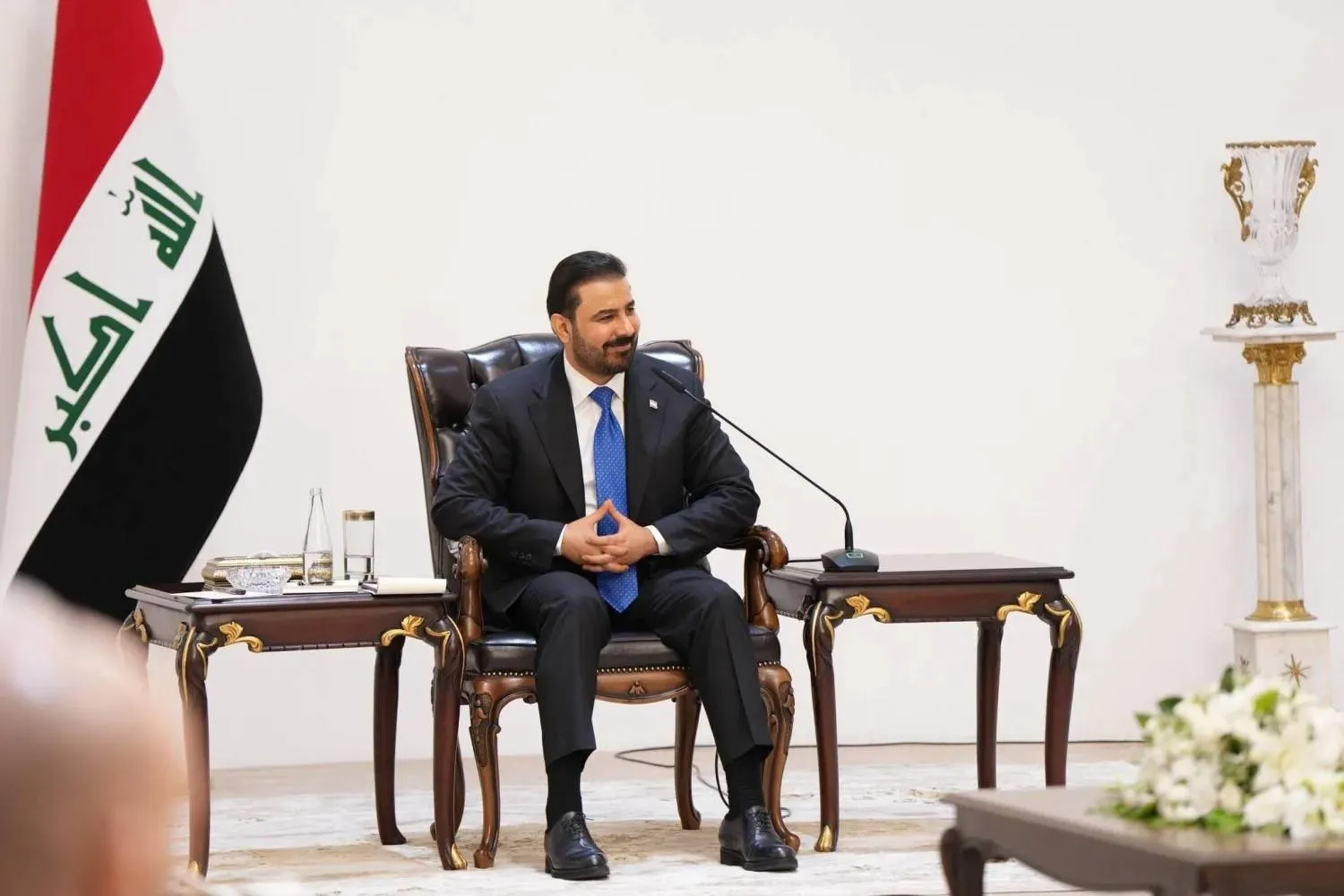

Zaidi Urges Sharaa to Boost Baghdad-Damascus Coordination

Iraqi Prime Minister Ali al-Zaidi (Iraqi Prime Minister’s Office)
TT

Zaidi Urges Sharaa to Boost Baghdad-Damascus Coordination

Iraqi Prime Minister Ali al-Zaidi (Iraqi Prime Minister’s Office)

Iraqi Prime Minister Ali al-Zaidi has sent a message to Syrian President Ahmed al-Sharaa calling for stronger ties and closer security and economic coordination.

The move reflects Baghdad’s push to rebuild regional relations while, at home, working to bring weapons under state control and prepare for a planned visit to the United States.

The message was delivered by Hamid al-Shatri, head of Iraq’s National Intelligence Service.

The Iraqi prime minister’s media office said late Wednesday that Zaidi’s message stressed the need to develop relations between Baghdad and Damascus and step up coordination to confront regional challenges and crises, particularly in security and economic affairs, in line with the two countries’ shared interests.

The statement said Sharaa thanked Zaidi and the Iraqi government, and affirmed Syria’s commitment to working with Iraq to address common challenges arising from recent regional developments.

He also stressed the importance of strengthening bilateral cooperation, especially on security and the economy.

The message comes as Iraq seeks to repair ties with its Arab neighbors under a broader approach built around three tracks: asserting state authority by “confining weapons to the hands of the state,” expanding regional outreach, and diversifying the economy by drawing foreign investment.

Zaidi to Washington

Baghdad has yet to set a date for Zaidi’s visit to the United States, which follows an invitation from US President Donald Trump. Iraqi officials say the visit is tied to a set of files the government has begun pursuing under fixed timelines, led by the effort to bring weapons under state control.

Government spokesman Haider al-Aboudi told a news conference that the deadline for carrying out the weapons-control plan expires next September, coinciding with the scheduled withdrawal of international coalition forces from Iraq.

The timing is significant. It would complete arrangements agreed by the previous government, including ending the mission of the coalition formed to fight ISIS, moving Baghdad’s relationship with Washington into a bilateral framework based on the 2009 Strategic Framework Agreement, and ending the work of the United Nations Assistance Mission for Iraq, known as UNAMI.

The Iraqi government hopes to make tangible progress on the weapons file before the Washington visit. But positions taken by some Iran-backed armed factions have added pressure.

Kataib Hezbollah and Harakat al-Nujaba, two of Iraq’s most prominent armed factions, have issued statements that raised questions over the future of the government’s weapons-control measures.

The Shiite Coordination Framework had granted the prime minister a mandate over the mechanisms and procedures for confining weapons to the state. The move was seen as a withdrawal of the political cover long enjoyed by some armed factions, potentially putting them on a direct collision course with the government.

At the same time, influential forces within the Coordination Framework, which holds about 80 parliamentary seats, are seeking to expand their presence in government and secure ministerial posts after earlier US reservations about their participation eased.

The government says its handling of these files is based on a “national vision” backed by parliament. Aboudi said the government remains fully committed to confining weapons to the state according to the timelines set in its program.
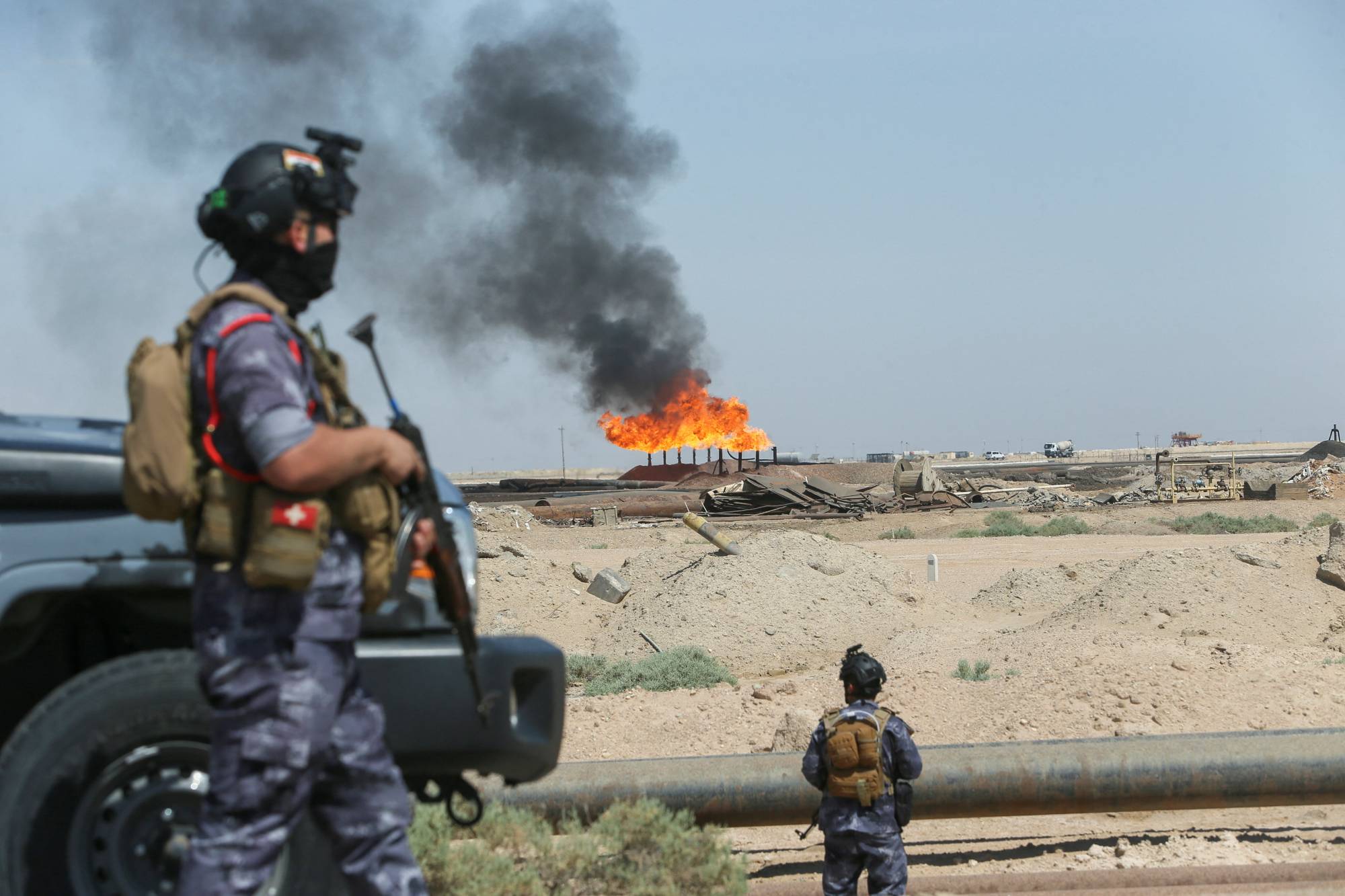
Gas flares burn at the Rumaila oil field during an armed patrol by Iraqi Energy Police in Basra, Iraq, June 8, 2026. REUTERS/Essam Al-Sudani

Regional outreach for development

On the economic front, Baghdad is betting on major investment projects to reinforce long-term stability.

Aboudi said the “Development Fund” is an investment vehicle separate from the state budget, funded by international contributions from friendly countries, with guarantees ranging from $100 billion to $150 billion, to support development and sustainable stability.

Observers say the three files, security, regional outreach, and economic development, form the broad framework for Iraq’s current domestic and foreign moves.

Political science professor Talib Mohammed Karim told Asharq Al-Awsat that Zaidi’s expected visit to Washington cannot be separated from the changes underway in Iraq and the wider region.

He said Baghdad is working on three parallel tracks: strengthening state authority by confining weapons to the state, opening up regionally, including through improved ties with Syria, and diversifying the economy by reducing dependence on oil and attracting investment.

Karim said the visit matters because of its timing, as the balance of power in the Middle East is being reshaped after years of conflict. Iraq, he said, has a chance to move from being shaped by regional developments to helping shape stability, drawing on its geography and balanced relations with different sides.

Relations with Washington

Former prime minister Adil Abdul Mahdi also called for stronger Iraqi-US ties while preserving the agreements signed between the two countries.

Abdul Mahdi said he hoped Zaidi would succeed in his mission, adding that it was too early to judge the current government, which remains at the start of its four-year term.

He said Iraq needs friendly relations with the US and other countries while honoring existing agreements between Baghdad and Washington. He said the end of next September would mark a decisive point with the completion of the international coalition’s withdrawal from Iraqi territory.

Abdul Mahdi said stronger political and economic ties between Iraq and the US would serve mutual interests, citing the importance of Washington’s international role and Baghdad’s regional standing, as well as the shared benefits that closer relations could bring.



Israeli Strikes Kill Two People in Gaza, Including a 10-Year-Old, Medics Say

A Palestinian inspects a destroyed area following an Israeli airstrike in southern Gaza City, 12 July 2026. (EPA)
TT

Israeli Strikes Kill Two People in Gaza, Including a 10-Year-Old, Medics Say

A Palestinian inspects a destroyed area following an Israeli airstrike in southern Gaza City, 12 July 2026. (EPA)

An Israeli strike ‌and gunfire killed at least two Palestinians, including a 10-year-old boy, in the Gaza Strip on Tuesday, Gazan health officials said.

The deaths add to a toll of more than 1,100 Palestinians killed by Israeli attacks since an October ceasefire between Israel and Hamas took effect, according to health officials in the enclave.

The truce halted major fighting but has failed to stop sporadic violence. Four Israeli ‌soldiers have been ‌killed by fighters in Gaza over ‌the ⁠same period.

Medics said ⁠Muataz Abu Shaar, 10, was shot earlier on Tuesday by Israeli gunfire in Rafah, south Gaza. He was pronounced dead at the hospital.

Nearby in Khan Younis, an Israeli airstrike killed a 36-year-old man and left three people wounded, medics ⁠added.

The Israeli military did not immediately ‌comment on either incident.

The latest ‌violence comes as Hamas leaders visited Cairo for further ‌talks on implementing the second phase of ‌US President Donald Trump's Gaza peace plan.

The discussions include Hamas disarmament and Israeli army withdrawals, according to sources close to the talks, who added that there had not ‌yet been a breakthrough.

Hamas says Israel's violations of the ceasefire are ⁠a key obstacle ⁠to implementing the second phase of Trump's plan.

Nearly all of Gaza's 2 million people, most of whom have been displaced several times, now live on a tiny strip of land along the coast, mainly in makeshift tents or damaged buildings, under Hamas control.

Hamas-led fighters killed 1,200 people during their cross-border attack into Israel on October 7, 2023, according to Israeli tallies. The Gazan health ministry said more than 73,000 Palestinians have been killed in the territory since then.


Lebanon, Israel Hold US-Brokered Talks in Rome to Implement Framework Deal

 A motorcade arrives at the United States' Embassy in Rome, Italy, where ambassadors-level talks between Israel and Lebanon are expected to take place, Tuesday, July 14, 2026. (AP)
A motorcade arrives at the United States' Embassy in Rome, Italy, where ambassadors-level talks between Israel and Lebanon are expected to take place, Tuesday, July 14, 2026. (AP)
TT

Lebanon, Israel Hold US-Brokered Talks in Rome to Implement Framework Deal

 A motorcade arrives at the United States' Embassy in Rome, Italy, where ambassadors-level talks between Israel and Lebanon are expected to take place, Tuesday, July 14, 2026. (AP)
A motorcade arrives at the United States' Embassy in Rome, Italy, where ambassadors-level talks between Israel and Lebanon are expected to take place, Tuesday, July 14, 2026. (AP)

Lebanon and Israel resumed talks on Tuesday in the Italian capital, with Beirut hoping for progress towards securing an Israeli withdrawal from south Lebanon under a US-brokered deal, although expectations for swift progress were low.

US-led diplomacy has emerged since Hezbollah and Israel returned to war on March 2 amid the wider regional conflict, moving forward despite strong objections from the Iran-backed group, which believes only Iranian pressure on Washington can secure an end to the war and Israeli withdrawal.

Iran demanded an end to the war in Lebanon as part of its interim deal with Washington signed last month, but the agreement has been shaken over the last week by renewed US-Iranian hostilities in the Gulf.

Israel's military is occupying what it describes as a "buffer zone" about 10 km (6 miles) into Lebanon along the entire length of the ‌Israeli border. Israeli ‌officials say the zone is necessary to protect northern Israeli communities from attacks launched ‌by ⁠Hezbollah.

A meeting in ⁠Washington on June 26 produced an agreement that called for an end to the Lebanon conflict, the disarmament of armed groups - an apparent reference to Hezbollah - as well as the deployment of Lebanese troops to the south and the progressive withdrawal of Israeli forces.

But deadly Israeli strikes have continued and Hezbollah has rejected the agreement as well as efforts to disarm it. Israel, meanwhile, has said its troops would remain in southern Lebanon as long as Hezbollah remained armed.

Lebanese and Israeli officials will meet at the US embassy in Rome on Tuesday and Wednesday to set out how to implement the framework deal, Lebanese officials ⁠told Reuters.

One of the officials said moving the talks to Rome would make ‌it easier for both countries' delegations to consult their governments for guidance as ‌they negotiated.

Italian Foreign Minister Antonio Tajani said on Monday that Italy had offered to host the talks to continue work towards ‌a genuine ceasefire in Lebanon.

"We are also very pleased that Rome can serve as the venue for these meetings. In ‌this way, our capital becomes a capital of peace," Tajani said ahead of a European Union meeting in Brussels on Monday.

PILOT ZONES ON THE TABLE

In comments published by his office on Monday, Lebanese President Joseph Aoun said he hoped the Rome meeting would yield "tangible and practical steps on the ground" to implement the agreement and that it would see Israel begin its troop pull-out so ‌that the Lebanese army could deploy to the south.

One of the Lebanese officials said the country's delegation to Tuesday's talks would seek the gradual and sequential withdrawal of ⁠Israeli troops "one zone after another," ⁠referring to the "pilot zone" project under which Hezbollah would disarm, Israeli forces would withdraw and Lebanese troops would deploy area by area in southern Lebanon.

The June 26 agreement said two zones had been identified as a starting point. A US official said last week that the US military's Central Command (CENTCOM) was coordinating with both Lebanon and Israel to launch the pilot zones.

A US military delegation was in Lebanon at the weekend to discuss the plan in detail with Lebanon's army, sources told Reuters.

Israel's military has forced the local Lebanese population from their homes and carried out controlled explosions of entire villages. It says it is destroying infrastructure, including underground tunnels, used by Hezbollah.

More than 4,000 Lebanese have been killed and more than a million displaced by Israel's campaign in Lebanon since March, according to Lebanon's health ministry. The toll does not say how many combatants may be among the dead and Hezbollah has not disclosed figures on its war dead. Reuters reported on May 3 that several thousand Hezbollah fighters had been killed.

At least 32 Israeli soldiers and four Israeli civilians have been killed by Hezbollah, most of them in southern Lebanon since the latest fighting erupted.


Trump Rolls Out the White House Welcome Mat for New Iraqi PM

Iraqi Prime Minister Ali al-Zaidi departs on his visit to the US. (INA)
TT

Trump Rolls Out the White House Welcome Mat for New Iraqi PM

Iraqi Prime Minister Ali al-Zaidi departs on his visit to the US. (INA)

President Donald Trump is welcoming Iraq's new prime minister to the White House on Tuesday after strongly backing the political neophyte in his bid for office.

Ali al-Zaidi, a businessman with no political background, emerged as a consensus candidate in Iraq after months of deadlock over the premiership following last year’s parliamentary elections.

When al-Zaidi was formally installed as prime minister-designate in April, Trump said in a social media post that it was the “beginning of a tremendous new chapter between our Nations — Prosperity, Stability, and Success like never seen before.”

But Trump’s interest and involvement in the next leadership in Iraq began long before that statement.

Iraq’s dominant parliamentary bloc, the Coordination Framework — a coalition of Shiite parties allied with Iran — initially said it would back former Prime Minister Nouri al-Maliki, whom the Trump administration views as too close to Tehran.

The US president publicly announced his opposition to al-Maliki and threatened to cut off aid to Iraq if he was appointed, adding that “if we are there to help, Iraq has ZERO chance of Success, Prosperity, or Freedom.”

The issue of Iran is likely to loom large in the discussions Tuesday.

Iraq has been under pressure to disarm a network of Iran-backed armed factions operating in the country, some of which launched attacks on US bases and diplomatic facilities after the US and Israel launched their war against Iran in February.

Officially, the Iraqi government has given non-state armed groups until the end of September to disarm, but some of the most powerful factions have said they have no intention of doing so.

A Trump administration official said ahead of the Oval Office meeting that the US will make “informed” decisions based on Iraq’s efforts to disarm Iranian-backed factions inside its borders. The official was granted anonymity to discuss the administration’s strategy ahead of al-Zaidi’s visit.

Renad Mansour, director of the Iraq Initiative at the Chatham House think tank, said he expects that “the US will put significant pressure on al-Zaidi” to move ahead with disarmament during his Washington visit “and al-Zaidi will respond by saying, ‘But I need support — intelligence support, technical support, armed support.’”

“There is a scenario in which, if the Iraqi government starts going after these groups, they will also go after the government,” Mansour said. “And this is a scenario that I think that the Iraqi government is apprehensive about.”

Al-Zaidi received Trump’s blessing, despite the fact that he was chairman of a bank — Al-Janoob Islamic Bank — that was among the financial institutions banned by Iraq’s central bank in 2024 from dealing in dollars amid pressure from the US to crack down on money laundering and funneling of funds to Iran.

Since taking office, al-Zaidi has made a public show of cracking down on corruption. His government has conducted raids and arrested dozens of current and former lawmakers and government officials accused of corruption, including a number affiliated with former Prime Minister Mohammed Shia al-Sudani.

The Iraqi premier’s delegation to Washington includes a number of Iraqi businessmen as well as government officials, and al-Zaidi’s office said in a statement that the aim of the visit is to “strengthen economic and development partnerships, attract investment, and expand the role of US companies in implementing infrastructure projects” and to further develop the oil-rich country’s energy sector.