Brazilian Amazon Waters Recover after Two Years of Drought

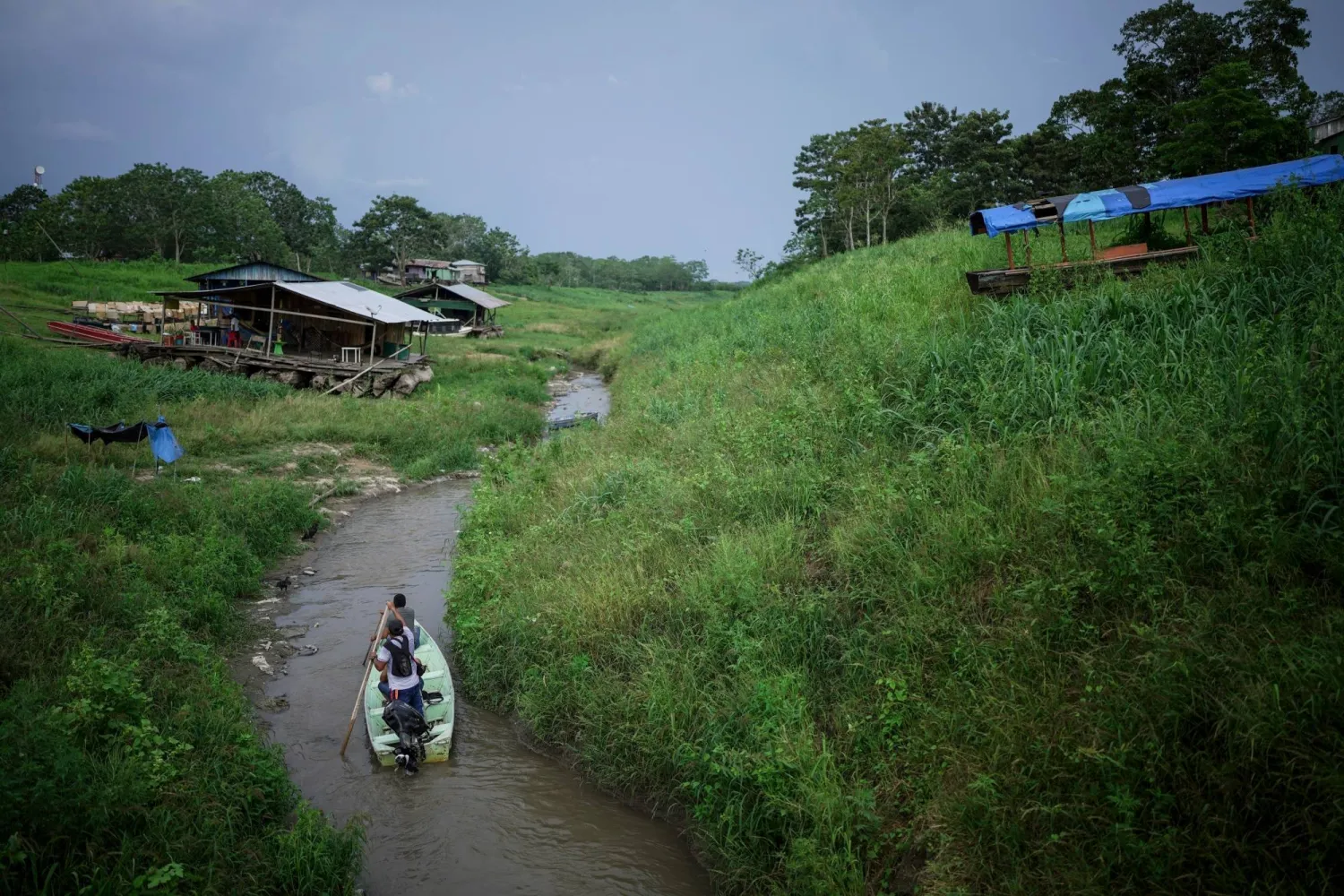
FILE - People maneuver by boat through the low water levels of a tributary that connects with the Amazon River, in Isla de la Fantasia, on the outskirts of Leticia, Colombia, Oct. 20, 2024. (AP Photo/Ivan Valencia, File)
TT

Brazilian Amazon Waters Recover after Two Years of Drought

FILE - People maneuver by boat through the low water levels of a tributary that connects with the Amazon River, in Isla de la Fantasia, on the outskirts of Leticia, Colombia, Oct. 20, 2024. (AP Photo/Ivan Valencia, File)

Water levels in the Brazilian Amazon recovered in 2025 following two consecutive years of severe drought, but long-term prospects remain "concerning," a monitoring network said in a report published Tuesday.

Brazil holds about 12 percent of the planet's freshwater, nearly two-thirds of which is found in the Amazon region.

The Amazon recorded water levels 2.6 percent above its historical average in 2025 due to increased rainfall compared to the previous year, according to MapBiomas, a network of organizations that tracks changes in land cover and use.

Despite the rebound, the network warned the situation "remains concerning" as severe weather events become increasingly common, AFP reported.

"Extreme weather events are becoming increasingly frequent, and there are signs of instability in the hydrological regime, driven by both climate change and changes in land use," said Bruno Ferreira of the MapBiomas Amazon team.

Brazil's vast territory includes several different biomes, including forests, wetlands and grasslands.

The report noted Brazil's Pantanal -- the wetland region south of the Amazon Basin -- ended 2025 with water levels 56 percent below its historical average.

Although conditions improved compared to 2024 -- a year that saw the region's most severe drought in decades -- the wetlands region remained the country's most stressed ecosystem.

The arrival of El Nino, a natural climate occurrence that warms surface temperatures in the central and eastern equatorial Pacific Ocean, typically causes droughts in parts of the Amazon and threatens to worsen the situation.

The climate phenomenon began last week and could become one of the most intense on record by the end of the year, according to the US National Oceanic and Atmospheric Administration.


Scientists Identify 64,000 sq Miles of Coral Reef Capable of Surviving Climate Crisis

FILE PHOTO: Fish swim at a coral reef inside a 'Rahui' or restricted area in Teahupo'o, Tahiti, French Polynesia, August 4, 2024.  REUTERS/Carlos Barria/File Photo
FILE PHOTO: Fish swim at a coral reef inside a 'Rahui' or restricted area in Teahupo'o, Tahiti, French Polynesia, August 4, 2024. REUTERS/Carlos Barria/File Photo
TT

Scientists Identify 64,000 sq Miles of Coral Reef Capable of Surviving Climate Crisis

FILE PHOTO: Fish swim at a coral reef inside a 'Rahui' or restricted area in Teahupo'o, Tahiti, French Polynesia, August 4, 2024.  REUTERS/Carlos Barria/File Photo
FILE PHOTO: Fish swim at a coral reef inside a 'Rahui' or restricted area in Teahupo'o, Tahiti, French Polynesia, August 4, 2024. REUTERS/Carlos Barria/File Photo

Scientists have identified nearly 166,000 sq km (64,000 sq miles) of coral reefs that are capable of surviving and recovering from climate change, three times more than previously estimated, research showed on Tuesday.

The world's coral reefs, which sustain a quarter of all marine life, have come under severe stress as a result of violent tropical storms, pollution and mass "bleaching" events caused by soaring ocean temperatures, with some scientists warning that they are facing irreversible decline.

But an analysis of 45,000 coral surveys together with decades of climate and ocean data has identified climate-resilient ⁠reefs across 71 ⁠countries and 100 territories, including in parts of the Caribbean and the Pacific and Atlantic oceans that have not previously been recognized.

"Coral reefs are often framed as ecosystems beyond saving," said Emily Darling, director of coral conservation at the Wildlife Conservation Society (WCS) and one of the report's ⁠authors.

"This research shows otherwise: we know where the hope is and what we need now is political will."

Countries are currently drawing up action plans aimed at bringing 30% of their land and marine environments under formal protection by the end of the decade, a target known as "30 by 30", and the new research will enable governments to consider the location of coral reefs in their planning.

"Only 28% of the reefs currently fall within protected and conserved ⁠areas, so ⁠the opportunity is clear, and so is the urgency, especially as we face an upcoming super El Nino event," Reuters quoted Darling as saying at a briefing.

Stacy Jupiter, co-author and executive director of the WCS's Global Marine Program, said the data could give governments the information required to decide where limited funds are deployed and give the more resilient reefs the best possible chance of surviving.

"In certain cases, where reefs are below certain benchmarks for ecosystem function, it may be a case of triage, where we may need to leave those places," she said.


Spanish Prehistoric Cave Suggests Human Settlement More Than 4,000 Years Ago

The cave is located in the Nuria Valley in the Girona region of Spain (Shutterstock)
TT

Spanish Prehistoric Cave Suggests Human Settlement More Than 4,000 Years Ago

The cave is located in the Nuria Valley in the Girona region of Spain (Shutterstock)

A mysterious ancient settlement has been discovered surprisingly high in the Pyrenean mountains in Spain, according to BBC Science Focus.

Documented in a new study, the prehistoric cave known as Cova 338 sits 2,235 meters above sea level, in the Nuria Valley – making it the highest altitude dwelling of its kind to date in this area.

For decades, archaeologists have thought that areas above 2,000 meters were only used by people passing through. But the new discovery suggests that, over the course of 5,000 years (between the 5th and 1st millennia BC), multiple populations actually occupied the caves for long periods of time.

Excavations of the cave took place between 2021 and 2023, and have posed a major logistical challenge, as access to the cave is only possible on foot from the Nuria Valley, with no motorized support allowed.

This has required all materials and sediments generated during the digs to be transported manually.

The main conclusion of the study was published last May in the magazine, Frontiers in Environmental Archaeology. It documented high-mountain prehistoric occupations of significant intensity, characterized by repeated activities and the direct exploitation of mineral resources within the cave.

Lead author of the study, Carlos Tornero, professor in the Department of Prehistory at the Universitat Autònoma de Barcelona (UAB), said: “For a long time, these spaces were assumed to be marginal. What we document here is recurrent occupation, with complex activities and a clear exploitation of mineral resources.”

In the layers of the excavations, researchers found remains of fires and animal bones, ceramic fragments and even two pendants: one from a marine shell and one from a brown bear tooth.

The cave also contained a collection of green minerals, which the researchers think are likely malachite – a copper carbonate mineral – suggesting some of the earliest evidence of copper extraction in Western Europe.


Wisconsin Beagle Research Facility that Drew Protests is Closing as Rescue Group Takes in Dogs

A woman pets one of the beagles transferred from Ridglan Farms on Monday, June 15, 2026, in Marshall, Wis. (Big Dog Ranch Rescue via AP)
TT

Wisconsin Beagle Research Facility that Drew Protests is Closing as Rescue Group Takes in Dogs

A woman pets one of the beagles transferred from Ridglan Farms on Monday, June 15, 2026, in Marshall, Wis. (Big Dog Ranch Rescue via AP)

A Wisconsin beagle breeding and research facility that’s been the site of recent violent protests is closing, and its remaining dogs are being taken in by a Florida rescue group.

Big Dog Ranch Rescue announced Monday that it has reached an agreement for the permanent closure of Ridglan Farms and the transfer of its 475 remaining beagles starting this week.

“Not one dog will remain,” Lauree Simmons, the group’s founder, said in a news conference at a farm in Wisconsin. “No more breeding, no more testing, no more anything.”

Yearslong opposition to the facility came to head in April when a large group of animal welfare activists stormed the property in an attempt to take away beagles, prompting police to use tear gas and pepper spray as they made dozens of arrests.

Some protesters were also arrested in March after they broke in and took 30 dogs from the facility, which is located in Blue Mounds, a small town about 25 miles (40 kilometers) southwest of the capital, Madison.

Big Dog Ranch Rescue said some of the beagles will go to rescue groups while others will be sent to its Florida and Alabama campuses where they will be spayed, neutered, and prepared for adoption.

The group bought roughly 1,500 of the facility’s more than 2,000 beagles in April for an undisclosed price.

About 200 dogs were being transferred Monday, according to Simmons. Another 125 will be moved Tuesday. The transfer of the remaining beagles will happen in August, as they are still puppies.

According to The Associated Press, Simmons called on protesters to refrain from further demonstrations as it says Ridglan Farms has committed to permanently closing its dog breeding, sales, research and testing operations.

“Our focus now should be on supporting these dogs as they transition into their new lives,” Simmons said. “These dogs will get to experience safety and a normal life for the first time.”

Simmons said her group is also “working closely” with the Trump administration to stop funding studies that subject dogs to “invasive and painful experimentation.”

Trump’s Health and Human Services secretary, Robert F. Kennedy, Jr., called Monday’s deal a “major win for animal welfare” in a post on X.

Ridglan Farms, in a statement, said all the dogs being transferred are “happy, healthy animals” with “extensive” state and federal inspection documentation.

“We hope these dogs will continue to flourish in their new homes,” the company said, adding that it hopes that the “years-long harassment campaign targeting the research facility’s owners, staff and neighbors comes to an end.”

Animal activists for years had sought to have dogs at the facility adopted, not sold to other research facilities.

Beagles are the most common breed of dog used for animal testing, primarily because of their smaller size and gentle temperament, according to Big Dog Ranch Rescue.

Ridglan Farms agreed in October to give up its state breeding license as of July 1 as part of a deal to avoid prosecution on felony animal mistreatment charges.

The firm has denied mistreating animals, but a special prosecutor determined that Ridglan Farms was performing eye procedures that violated state veterinary standards.