


Ancient Teeth from Siberia Rewrite the Plague’s Timeline, Dating Back to over 5,500 Years Ago

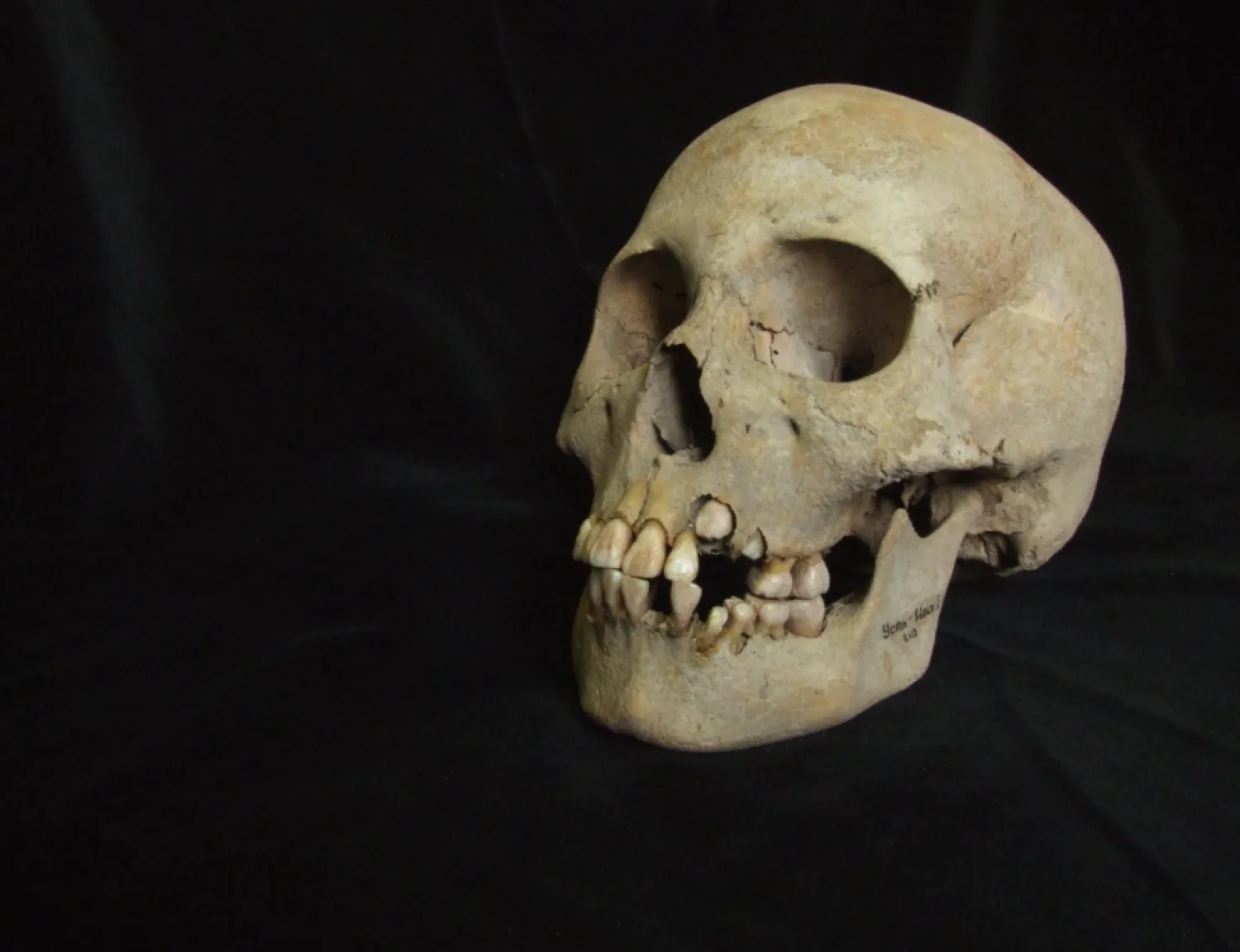
This 2006 image from Angela Lieverse shows the skull of a young girl who was buried with victims of the plague in Siberia. (Angela Lieverse via AP)
TT

Ancient Teeth from Siberia Rewrite the Plague’s Timeline, Dating Back to over 5,500 Years Ago

This 2006 image from Angela Lieverse shows the skull of a young girl who was buried with victims of the plague in Siberia. (Angela Lieverse via AP)

Scientists have found the oldest known evidence of the plague, which sparked deadly outbreaks dating back about 5,500 years ago — some 200 years earlier than previously thought.

The disease has sickened humans for thousands of years and wiped out a significant chunk of Europe's population in the 14th century during what's known as the Black Death. Though rare, the plague is still around today and is treated with antibiotics.

“To understand our own history, we believe that understanding the history of plague is extremely important,” said study co-author Eske Willerslev, an evolutionary geneticist with the University of Copenhagen in Denmark.

Willerslev and other researchers looked for traces of plague-causing bacteria in remains from four cemeteries near Siberia's Lake Baikal. They found remnants of plague DNA in teeth from 18 ancient hunter-gatherers, The AP news reported.

Dating the carbon in the bones revealed that the plague triggered two outbreaks, with the first cases detected around 5,500 years ago.

The team found that the prehistoric plague developed in stages and infected several small families. It likely spread from marmots — large native rodents — when people ate their raw organs or touched infected hides during butchery. The disease also traveled between people through coughing and sneezing, the authors said.

Many of those who died were young children aged 8 to 11. Three young girls were buried side by side, two of whom were likely cousins. An aunt and nephew were found together, but her niece was in a different shared grave, according to the study published Wednesday in the journal Nature.

“People were around to bury the dead who knew who these people were when they were alive. And that’s a really human element to all of the scientific work,” said study co-author Ruairidh Macleod, who studies ancient DNA at the University of Oxford.

Kids may have been at greater risk because their immune systems weren’t as strong, researchers said.

The presence of multiple victims suggests that the prehistoric plague was capable of causing both individual cases and outbreaks, said geneticist Aida Andrades Valtueña with the Max Planck Institute for Evolutionary Anthropology. She had no role in the study.

Researchers found that this type of ancient plague evolved long before bubonic plague, which was responsible for the Black Death that struck medieval Europe. But there's evidence that earlier plagues were just as deadly. The disease decimated not only crowded cities, but also small, nomadic hunter-gatherer groups.

Knowing this can help us “understand the steps that the bacterium took to become the deadly pathogen we know today, and that can provide clues on how pathogens may emerge in the future,” Andrades Valtueña said in an email.



King Abdulaziz Royal Reserve Records 34 New Bird Species for First Time

Among the notable species recorded for the first time were the Rüppell's Vulture - SPA
TT

King Abdulaziz Royal Reserve Records 34 New Bird Species for First Time

Among the notable species recorded for the first time were the Rüppell's Vulture - SPA

The King Abdulaziz Royal Reserve Development Authority announced a significant environmental achievement during the first half of 2026, recording 34 new bird species added for the first time to the reserve's biodiversity list, raising the total number of recorded bird species to 225—a 15% increase in the reserve's documented avian diversity.

The authority explained that this achievement stems from continuous improvement in field monitoring efficiency and comprehensive geographic coverage within the reserve's boundaries, enhancing the accuracy of biodiversity documentation, SPA reported.

Spokesperson of the authority Abdulaziz Al-Furaih stated that the new findings reflect the accelerating development of the reserve's environmental monitoring programs, noting that documenting this number of new species is an important scientific indicator of ecosystem health and habitat integrity within the reserve, reinforcing its standing as one of the region's leading environments supporting biodiversity and migratory bird routes, in line with Saudi Vision 2030 and the Saudi Green Initiative.

Among the notable species recorded for the first time were the Rüppell's Vulture, the rare Red Phalarope, and the Pectoral Sandpiper, alongside migratory and rare birds including the Rose-colored Starling, Yellow Wagtail, Eurasian Skylark, and Song Thrush, reinforcing the reserve's scientific value as an international biodiversity observatory.

The monitoring results also confirmed the documentation of species of high conservation value listed on the IUCN Red List, most notably the African Vulture, classified as critically endangered, alongside near-threatened species such as the Western Orphean Warbler and the White-winged Lark.


Satellite Observations Detect 'Urban Pulse' of Six Global Cities

General view of the Burj Khalifa and the downtown skyline in Dubai, United Arab Emirates, September 30, 2021. REUTERS/Mohammed Salem/File Photo Purchase
TT

Satellite Observations Detect 'Urban Pulse' of Six Global Cities

General view of the Burj Khalifa and the downtown skyline in Dubai, United Arab Emirates, September 30, 2021. REUTERS/Mohammed Salem/File Photo Purchase

While a city is not a living organism, it behaves very much like one. Its metabolic processes may be manifested in growth spurts, metamorphosis over time and even decay. Researchers using satellite imagery have tracked the vital signs of six major global cities, detecting a distinctive "urban pulse" in each.

The researchers looked at Dubai, Lagos, Mexico City, Mumbai, Seattle and Shenzhen using a new way to document dynamic changes unfolding in each of these cities in near real-time.

Historically, experts have relied upon aggregated and infrequent data to document urbanization, such as a yearly census, annual economic figures or a map showing how a city's footprint has changed over a decade - essentially using specific outcomes as metrics. But the scientists behind the new study said such an approach provides an incomplete understanding of a city and can miss the nuances as a metropolis evolves, Reuters reported.

"We got the inspiration from the human pulse, which tells us different information about our health than weight or height," said study lead author Zhe Zhu, a professor of remote sensing and director of the Global Environmental Remote Sensing Laboratory at the University of Connecticut's Department of Natural Resources and the Environment.

"The urban pulse measures the high-frequency process of development, and therefore we can spot early warning signs of economic stress or stagnation before they become full-blown crises," Zhu said. "We compare traditional metrics to looking at a heart attack - the outcome - whereas the 'urban pulse' is like monitoring the daily lifestyle and vital signs leading up to that heart attack - the process."

The biggest takeaway from the study, published in the journal Proceedings of the National Academy of Sciences, is that urbanization is not smooth and steady, the researchers said.

"Urbanization is actually 'spiky,' meaning that it happens in abrupt, intense bursts, or 'cyclical,' moving through boom-and-rest phases that don't match annual seasons, or 'asynchronous,' as different neighborhoods in the exact same city develop at completely different, uncoordinated times," said study senior author Karen Seto, a Yale University professor of geography and urbanization science.

"This is important because, for decades, researchers have characterized cities through static maps," Seto said.

CITIES WITH DIFFERENT CONDITIONS

The researchers used dense and high-frequency satellite imagery from the US space agency NASA's Landsat and the European Space Agency's Sentinel-2 satellites. They tracked physical changes in the cities such as new building construction, demolition, major infrastructure improvements and expansion into green spaces.

"We selected cities with a wide range of political-economic conditions including the state-led development of Shenzhen, the market-driven growth of Seattle, the informal expansion of Lagos and the megaprojects of Dubai," Zhu said.

Shenzhen, formerly a small fishing village near Hong Kong that has become a megacity, exhibited the highest magnitude and intensity of growth, characterized by massive and clustered spikes reflecting rapid, state-led mobilization of capital.

Dubai, the most populous city in the United Arab Emirates, also showed huge growth.

In Nigeria's largest city Lagos, the "pulse" was highly fragmented, with long periods of inactivity punctuated by brief and intense surges.

Seattle, the largest metropolis in the US Pacific Northwest, reflected a market-driven pulse of redevelopment and densification.

Mumbai, India's financial and commercial powerhouse, and Mexico City, North America's most populous city, proved to be highly resilient and showed less disruption during global shocks such as the COVID-19 pandemic than the others.

"Just as a human pulse reacts to illness, our data captured the exact moment COVID-19 triggered a synchronized 'cardiac arrest' in development worldwide. But the recovery was entirely unequal," Zhu said.

"Shenzhen saw a sharp, coordinated dip followed by a rapid rebound. Lagos experienced a muted pulse that transitioned into smaller, incremental changes. Meanwhile, cities like Mumbai and Mexico City showed much less of an impact. It showed us that global shocks don't manifest the exact same way in every city's 'body,'" Zhu said.

The researchers see practical applications for their method.

"For urban planners and policymakers, it functions as a diagnostic tool. Instead of reacting to a crisis after the fact, they can see exactly when and where a neighborhood's 'pulse' is slowing down and intervene early to prevent infrastructure collapse or economic decay. It also prevents cities from overheating their labor and material markets," Seto said.


India Learns to Live with Hotter Summers

Herdsman Sawai Singh Bhati (C) sits under the shade of a tree in 44 degrees Celsius temperatures, near his house in Sanwata village, Rajasthan. Manan VATSYAYANA / AFP
TT

India Learns to Live with Hotter Summers

Herdsman Sawai Singh Bhati (C) sits under the shade of a tree in 44 degrees Celsius temperatures, near his house in Sanwata village, Rajasthan. Manan VATSYAYANA / AFP

On India's hot plains, scorching summers have become increasingly harder to endure, requiring adaptations and forcing life into the hours of dark before the sun turns punishing.

"We try to adjust, but the traditional ways to combat heat are not working," said 26-year-old herdsman Sawai Bhati Singh, who lives outside the desert city of Jaisalmer, in the western state of Rajasthan.

"Every year the heat is increasing."

His home, made of thick stone blocks with few windows, helps keep some of the furnace-like heat out. But temperatures inside are still stifling.

The South Asian country is no stranger to scorching summers, but years of scientific research have found climate change is causing heatwaves to become longer, more frequent and more intense, AFP said.

Temperatures in Singh's village of Sanwata hit 45C in early June, as is often during the summer. The highest temperature recorded in the area has been 49C.

Singh is worried about the health of his two young sons, aged two and four, playing barefoot in the dust.

In a separate kitchen hut with a thatched roof for ventilation, his wife and mother struggle as they cook on a wood fire.

Water is drawn from a nearby well and cooled in bottles wrapped in woven jute string, using evaporation to lower the temperature.

Singh's herd of goats and cattle struggles too.

"They stay in the shade," he said. "The heat impacts the eating, and that lowers their milk."

But temperatures are becoming harder to endure. The family bought their first air cooler, which uses wet fibers, last year.

"We never needed it before, but last year was hot, so we bought one," he said. "Now we have two."

A world away, along the lush green banks of the Yamuna river floodplains near the capital, New Delhi, farmer Bhole Shankar faces a different version of the same crisis.

New Delhi hit 46.5C this summer, still below the sizzling 49.9C record measured in 2024.

"Living on the floodplain feels cooler than being stuck in the middle of houses," 36-year-old Shankar said, standing outside a hut made of plastic sheeting on bamboo poles. "But on some days, day and night feel the same."

Shankar, his wife and their three sons, aged between nine and 16, live beneath the city's power lines -- but their hut is not connected. A solar panel provides enough power to run a small fan, pushing hot air.

The family shifts its routine, working in the fields before dawn, resting in the shade during the fiercest heat, and returning to check crops towards dusk.

The family roll up the tent's plastic wall and sleep on traditional rope-lattice beds, which both allow air to circulate.

"Each passing year feels hotter," he said. "We try to keep in the shade, but when you are a farmer, that's hard."