


Taiwan’s Migrating Crab Population Rebounds Thanks to Safer Road Crossings

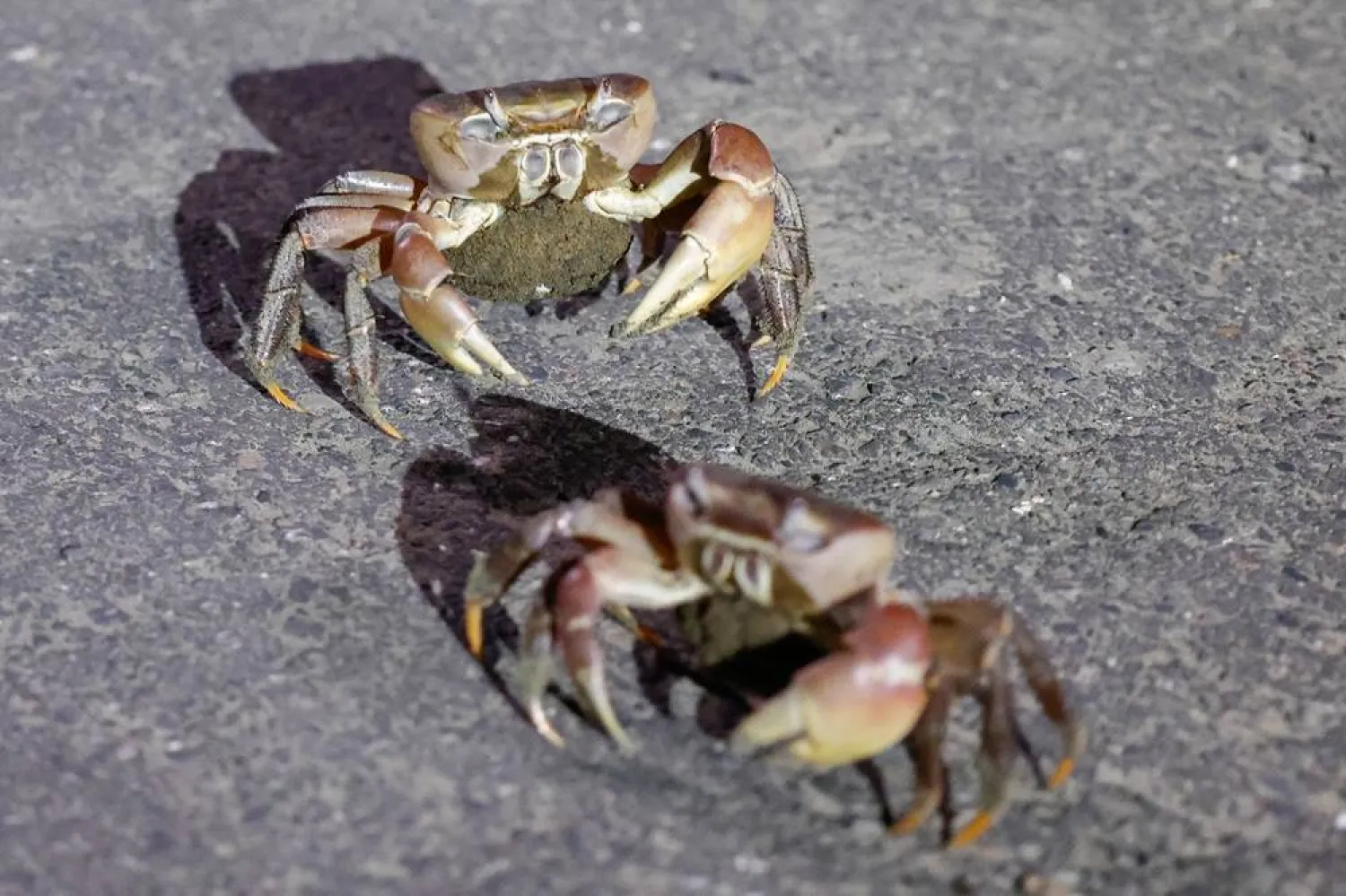
Pregnant mangrove land crabs during the annual breeding season at Taijiang National Park in Tainan, Taiwan, July 3 2026. (Reuters)
TT

Taiwan’s Migrating Crab Population Rebounds Thanks to Safer Road Crossings

Pregnant mangrove land crabs during the annual breeding season at Taijiang National Park in Tainan, Taiwan, July 3 2026. (Reuters)

Road closures and bamboo bridges have helped protect Taiwan's largest terrestrial crab species during breeding season when they return to the sea to lay eggs.

Taijiang National Park in the southern Taiwan city of Tainan is the mangrove land crab's most important habitat and has the island's largest population.

During the July-to-September breeding season, female crabs come ‌down to ‌the sea to release their ‌eggs, ⁠but because their migration ⁠route crosses roads, it leaves them vulnerable to being run over.

Taijiang National Park Director Chen Jun-shan said the road closures and bamboo bridges have helped reduce roadkill and contributed to a rise in observed crab ⁠numbers from more than 5,000 annually in ‌earlier years to ‌more than 10,000 last year.

"As for the ‌mangrove land crab, it can return all ‌of these nutrient sources back into the land, allowing the coastal forest to become more abundant," Chen said. "So if you protect the land crabs, the ‌entire coastal forest belt can be protected."

While the environment got short ⁠shrift ⁠during Taiwan's rapid industrialization from the 1960s to 1980s, it is now a priority for the government, with a network of protected areas and national parks across the island drawing visitors.

The Tainan park is also home to black-faced spoonbill birds, a species listed as "vulnerable" by the International Union for Conservation of Nature and Natural Resources, but which has bounced back from near extinction.



For First Time, NASA to Light Fire on Moon

NASA is planning an experiment to light a fire on the moon. That may sound weird, but researchers say it could improve mission safety for years to come (NASA)
TT

For First Time, NASA to Light Fire on Moon

NASA is planning an experiment to light a fire on the moon. That may sound weird, but researchers say it could improve mission safety for years to come (NASA)

NASA wants to set fire to the moon. If conducted, the experiment would be the first time humanity has set fire to another planet, according to The Independent.

The goal is to better understand how flames could behave during emergency situations on future crewed Artemis program missions to Mars and beyond, according to the space agency.

Those missions will help to expand the reach of humanity and what we know about our solar system.

“Since fire can be a catastrophic hazard for spaceflight and extreme human exploration, FM2 is a critical step in determining material flammability and safety for future missions,” NASA says on the “Flammability of Materials on the Moon,” or “FM2,” experiment’s webpage.

One of the problems is that some materials that are not flammable on Earth could be flammable in space, NASA notes. That’s because the materials may burn at lower oxygen concentrations in lunar gravity than in our gravity.

“Like there are some materials that, as they’re burning, they tend to kind of like come off in clumps, almost like little tear drops. And you can imagine that, if you’re in a microgravity or partial-gravity environment, those little teardrops are basically turning into little fireballs that could float away and catch something else on fire,” Emily Johnson, the experiment’s project manager, explained in a 2025 podcast.

“So understanding the different properties of the different materials at the different scales of flames is also incredibly important,” she said.

Flames behave differently on the moon than on Earth. The classic shape of a flame on Earth is created when gravity pulls cooler and denser air to the bottom. That doesn’t happen to flames on the moon or in weightless microgravity on the International Space Station.

“In microgravity, this flow doesn’t occur and on the space station, low-momentum flames tend to be rounded or even spherical,” according to a NASA blog post from 2023.

In lunar gravity, which is around a sixth of Earth’s gravity, the flames are a little more rounded than those on Earth.

So, what will this experiment look like in reality? Well, good news, nobody is building a bonfire.

Instead, scientists are sending a robotic, self-contained combustion chamber – a cylindrical metal chamber – to the lunar surface on a mission carrying commercial payloads.

The chamber carries four test samples to light, which are made of cotton and fiberglass and acrylic rods.

It contains an oxygen sensor, an instrument that measures electromagnetic radiation and cameras that record how the fire behaves in lunar gravity, including how fast it spreads.

There have been plenty of microgravity fire tests on Earth over the last few decades, but tests have shown that NASA needs more information.

“Direct lunar access offers the best way to assess flammability of materials on the moon. An extensive materials qualification test series there would be ideal, but such tests will need to be put off until an extended human presence on the moon is established,” NASA researchers wrote in a paper published earlier this year.

The paper said the new experiment would help to fill critical knowledge gaps in spacecraft fire safety. New findings could lead to updated standards for spacecraft materials.

The mission could launch as soon as later this year, according to the paper.


Study Points to Likely Route for Hannibal’s Legendary Alpine Crossing

The successful crossing of the Alps allowed Hannibal to bypass Roman defenses and pull off a string of stunning victories on the Italian peninsula during the Second Punic War. (AFP)
TT

Study Points to Likely Route for Hannibal’s Legendary Alpine Crossing

The successful crossing of the Alps allowed Hannibal to bypass Roman defenses and pull off a string of stunning victories on the Italian peninsula during the Second Punic War. (AFP)

Just how Hannibal managed to lead war elephants and a full army over the Alps to attack the Romans remains a mystery, but a new modern biology study points to a potential route.

The bold and legendary crossing in 218 BC, which allowed the ancient Carthaginian leader to strike Rome from the north, has long remained one of the most astounding and celebrated achievements in warfare.

Calculations about the energy requirements of Hannibal's force -- especially the elephants -- points to the Col de la Traversette as the most likely route, according to a study released on Monday by a group of German and British researchers.

The Col de la Traversette is a high-altitude mountain pass in the Cottian Alps at 2,947 meters (9,669 feet) on the border between modern-day France and Italy.

Researchers from the German Centre for Integrative Biodiversity Research (iDiv), the University of Jena and the University of Oxford used route models and elevation data to weigh the physical demands on Hannibal's army of roughly 40,000 men, thousands of horses and a reported 37 war elephants, using body mass data from modern African elephants.

"The new analysis does not eliminate all ambiguity, but it does strengthen the case for the Traversette route by demonstrating that it would better accommodate the demands of moving a large army that included elephants through extremely difficult alpine terrain," said co-author Emilio Berti of iDiv and the University of Jena.

Other routes considered -- such as the Col de Montgenevre, the Col du Clapier, and the Col du Mont Cenis -- would have required 11 percent, 16 percent, and 19 percent more energy, respectively, for the army to traverse.

The study also highlighted the immense physical strain the march through the Alps almost certainly imposed on Hannibal's army.

According to the models, the soldiers on the Traversette route would have lost around 19 percent of their body fat reserves, which could explain the high death toll.

In contrast, calculations for the war elephants indicated a loss of only about four percent of their energy reserves.

Many of the animals reportedly survived the mountain crossing.

The successful crossing of the Alps allowed Hannibal to bypass Roman defenses and pull off a string of stunning victories on the Italian peninsula during the Second Punic War.

Rome, however, managed to weather the setbacks and defeat Carthage in the conflict as well as the subsequent Third Punic War.


King Abdulaziz Royal Reserve Records First Sighting of Red Phalarope

The red phalarope is a migratory seabird that spends most of its life cycle on the open ocean and breeds in Arctic regions. - SPA
TT

King Abdulaziz Royal Reserve Records First Sighting of Red Phalarope

The red phalarope is a migratory seabird that spends most of its life cycle on the open ocean and breeds in Arctic regions. - SPA

The King Abdulaziz Royal Reserve Development Authority announced that a specialized research team has documented the first confirmed sighting of a red phalarope (Phalaropus fulicarius) within the reserve, marking one of the rarest bird records ever documented in Saudi Arabia and the Arabian Peninsula, SPA reported.

Authority spokesperson Abdulaziz Al-Furaih said the bird was documented in February 2026 at the Sudair Artificial Wetland within the reserve.

The red phalarope is a migratory seabird that spends most of its life cycle on the open ocean and breeds in Arctic regions. Its appearance in an inland wetland in the Kingdom is considered an exceptional event, reflecting the reserve's growing environmental significance and its ability to attract rare species that migrate over long distances.

The discovery builds on a series of scientific achievements recorded in the reserve in recent years, including the documentation of rare species and the first confirmed breeding records of other species.

These accomplishments reinforce the reserve's position as a national platform for environmental research and monitoring and underscore its pivotal role in supporting the Kingdom's wildlife conservation and ecosystem sustainability objectives.