


Study Shows Prehistoric People Targeted Female Mammoths

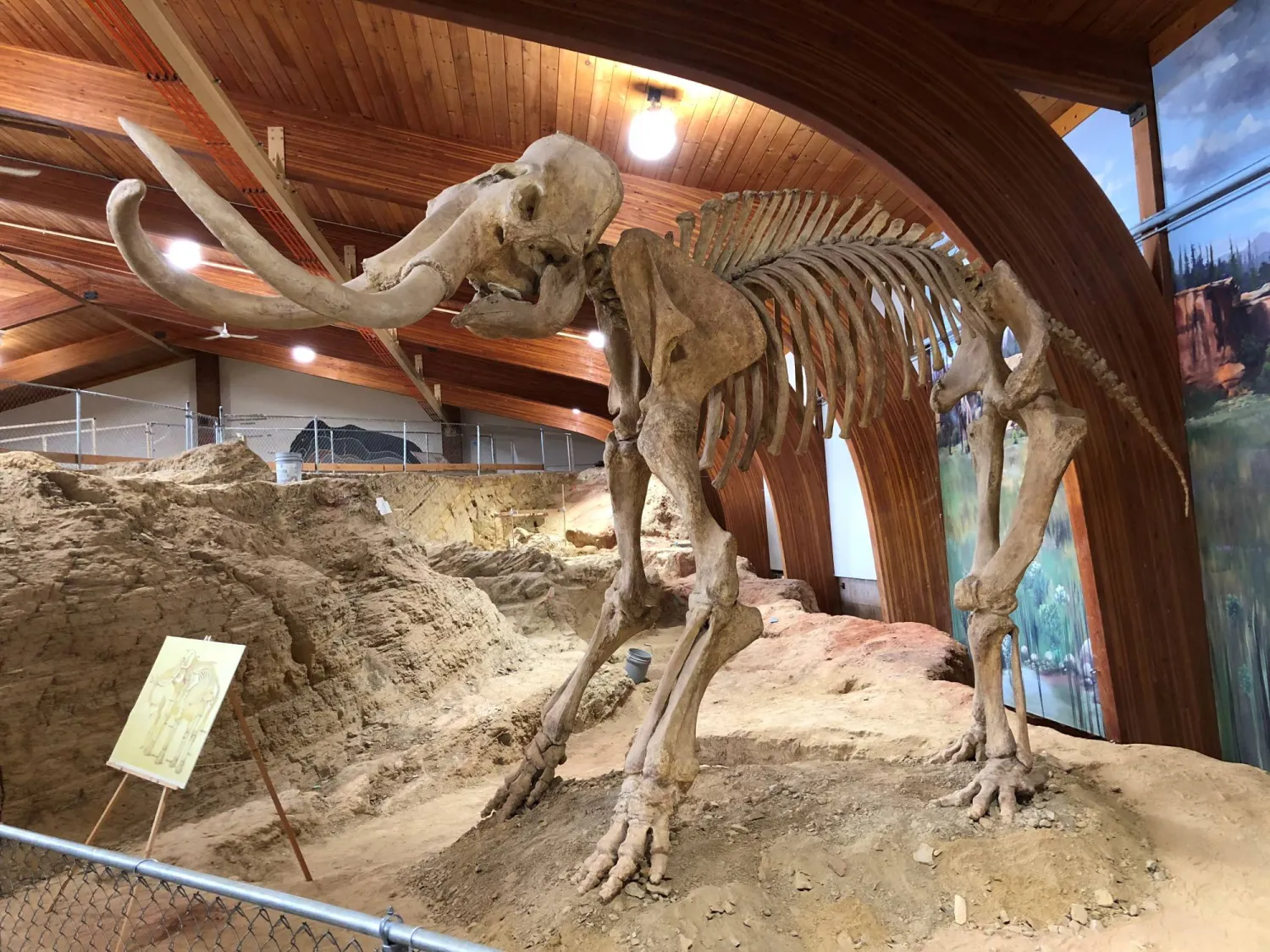
FILE PHOTO: The skeleton of a mammoth, one of the large mammals that roamed North America during the last Ice Age, is displayed at the Mammoth Site where numerous mammoth fossils have been excavated in Hot Springs, South Dakota, US August 31, 2018. REUTERS/Will Dunham/File Photo
TT

Study Shows Prehistoric People Targeted Female Mammoths

FILE PHOTO: The skeleton of a mammoth, one of the large mammals that roamed North America during the last Ice Age, is displayed at the Mammoth Site where numerous mammoth fossils have been excavated in Hot Springs, South Dakota, US August 31, 2018. REUTERS/Will Dunham/File Photo

Woolly mammoths were a favorite hunting target for Ice Age people in Eurasia and North America for many reasons. A single animal would provide a large amount of meat and fat. Its hide could be used for clothing. Its bones and tusks could be shaped into tools, weapons and art. And the largest bones could be used as building material for shelters or other structures.

New research shows that these prehistoric people were highly selective in the mammoths they hunted. Using genetic data from bones accumulated by people at 11 sites in Poland, Austria, the Czech Republic, Germany and Russia, scientists have discovered that they mainly killed female mammoths.

Some 70% of the mammoths whose bones were studied from these accumulation sites were females, with 30% males. In comparison, 66% of mammoth bones recovered from natural settings were from males, and 34% females.

The researchers used ancient DNA from 521 mammoths spanning approximately the past 50,000 years across Eurasia and North America, including 100 mammoths from 10 bone accumulation sites in Central and Eastern Europe as well as one in Siberia, alongside ⁠421 mammoths from ⁠natural settings.

So what accounts for this sex disparity?

"That's a great question, and one we're still actively investigating," said Hannah Moots, a postdoctoral researcher at the Centre for Palaeogenetics, a collaboration between Stockholm University and the Swedish Museum of Natural History, and lead author of the study published in the journal Current Biology.

"One possibility is that if woolly mammoths lived in female-led herds like modern elephants, those groups may have moved across the landscape in more predictable, seasonal ways.

Today, female elephant herds have relatively stable home ranges and movement patterns, whereas adult males are more solitary and often roam much more widely. That predictability may have made female-led herds easier for Ice Age people to locate repeatedly," Reuters quoted Moots as saying.

The ⁠herds were most likely matriarchal, comprising adult females, plus juveniles of both sexes.

"One could also speculate that it would have been easier to pin down a herd with juveniles, where the females would have been reluctant to run away," Centre for Palaeogenetics evolutionary geneticist and study co-senior author Love Dalén said.

Dalén noted that female mammoths generally were smaller than males and perhaps somewhat easier to kill. An adult male weighed up to about 6 tons and stood up to about 11 feet (3.4 meters) tall at the shoulder, compared to about 4 tons and about 9.5 feet (2.9 meters) for an adult female.

The people who inhabited the mammoth regions were nomadic hunter-gatherers who collected edible plants and hunted various Ice Age mammals, also including woolly rhinoceroses, caribou, bison, deer and others. Some of the mammoth bones from the accumulation sites had projectile points embedded in them.

The landscape itself may have been used against the mammoths, with hunters driving them into traps or natural hazards such as cliffs or swampland.

"I think ancient humans likely hunted mammoths by using terrain to their advantage. For example, I ⁠could imagine them using landscape features ⁠such as mud or bogs to help immobilize the animals before attacking them using spears, darts or arrows," Center for Palaeogenetics evolutionary geneticist and study co-senior author David Díez-del-Molino said.

The largest mammoth-hunting site in the study was called Kraków Spadzista in southern Poland, dating to about 25,000 to 30,000 years ago. It contains the remains of more than 100 mammoths, stone tools and evidence of mammoth butchery.

Mammoths vanished in mainland North America and Eurasia some 10,000 to 12,000 years ago at the end of the Ice Age, when the climate warmed rapidly and the open grasslands where mammoths had found food were replaced by forests and wet tundra. The role of humans in their extinction is a matter of debate.

The very last mammoths inhabited Wrangel Island, a lonely outpost off the coast of Siberia, before finally disappearing around 4,000 years ago. Other research showed that despite its small size and high inbreeding levels, this population was stable until right before its extinction.

In the new study, the researchers identified one Wrangel Island mammoth with a genetic condition called "X0/XX mosaicism," possessing a sex chromosome combination that made it neither biologically female nor biologically male. In humans, this is called Turner syndrome.

"It's unclear whether this X0/XX mosaicism is related in any way to the small size of the Wrangel Island population, or whether it is simply a developmental event that could have occurred in any mammoth population," Moots said.



Etna Ash Keeps Catania Airport Shut Until Friday, Disrupting Summer Travel

 A drone view of volcanic ash and lava during an eruption at Mount Etna, forcing authorities to suspend flights at Catania airport, in Sicily, Italy, August 12, 2026. (Reuters)
A drone view of volcanic ash and lava during an eruption at Mount Etna, forcing authorities to suspend flights at Catania airport, in Sicily, Italy, August 12, 2026. (Reuters)
TT

Etna Ash Keeps Catania Airport Shut Until Friday, Disrupting Summer Travel

 A drone view of volcanic ash and lava during an eruption at Mount Etna, forcing authorities to suspend flights at Catania airport, in Sicily, Italy, August 12, 2026. (Reuters)
A drone view of volcanic ash and lava during an eruption at Mount Etna, forcing authorities to suspend flights at Catania airport, in Sicily, Italy, August 12, 2026. (Reuters)

Flights at Catania airport in Sicily will remain suspended until early Friday because of ash from Mount Etna's ongoing volcanic activity, which has forced hundreds of flights to be cancelled or rerouted over the past week.

All arrivals and departures at the island hub, Italy's fifth-busiest airport by passenger traffic, will be ‌suspended through 2 ‌a.m. local time on ‌August ⁠14, airport operator ⁠SAC said in a statement late on Wednesday.

Passengers were advised to check the status of their flights with their airlines before travelling to the airport.

The prolonged restrictions come at ⁠the height of the summer holiday ‌season, affecting thousands ‌of passengers, and have placed additional pressure ‌on Sicily's other airports.

Mount Etna, Europe's ‌highest and most active volcano, frequently disrupts operations at Catania airport, whose operator launched the sale of a stake of at ‌least 51% in May.

Marco Viccaro, president of the Italian Volcanological Association, ⁠said ⁠the activity at Etna, which began on August 6, is more energetic than previous episodes and is continuing in a sustained way.

"This suggests that deeper, gas-rich magma is playing a more active role, making the fragmentation process more efficient and leading to increased ash production, which is severely disrupting air traffic to and from Catania airport," he added.


Canadian Wildfire That Forced 20,000 to Flee May Signal ‘New Normal’

Smoke rises from the Brunswick Creek wildfire, looking north over the Fraser River near Boston Bar, British Columbia, Canada, August 11, 2026 in an aerial photograph. (BC Wildfire/Handout via Reuters)
TT

Canadian Wildfire That Forced 20,000 to Flee May Signal ‘New Normal’

Smoke rises from the Brunswick Creek wildfire, looking north over the Fraser River near Boston Bar, British Columbia, Canada, August 11, 2026 in an aerial photograph. (BC Wildfire/Handout via Reuters)

A wildfire that forced more than 20,000 people from their homes in western Canada moved so quickly that crews had to abandon firefighting to help residents escape, a pace British Columbia’s premier said Wednesday may represent a “new normal.”

The Bald Range wildfire erupted Friday near Summerland, a community of about 12,000 in British Columbia’s Okanagan region. By Wednesday, it had grown to about 184 square kilometers (71 square miles) after destroying homes and killing an 80-year-old woman.

"There’s an important set of lessons for us to take about how quickly this moved and that this may be our new normal for fire speed," Premier David Eby said. He said the blaze outpaced wildfire modeling and left some residents with little time to evacuate.

Officials have begun damage assessments, but the area remained unsafe Wednesday and there was no timeline for residents to return.

Crews were clearing vegetation to help slow the fire’s spread as officials warned that thunderstorms could bring erratic winds and increase fire activity. Highway 97, a major route through the area, remained closed.

Eby visited an evacuation reception center in Penticton, where he said he met people devastated by the loss of their homes.

“A lot of emotions in there, obviously,” he told reporters, calling the woman’s death a “tragic loss.”

Summerland pharmacist Jonathan Kiesman said he was worried about displaced patients getting their medications and said seeing the fire approach the community “almost brought tears to my eyes.”

Officials said they were withholding broader details on property losses until residents could be notified directly.

“The last thing that I would want is somebody to have the shock of finding out on social media or on television about their home being lost,” British Columbia Emergency Management Minister Kelly Greene said.

Eby said the province would review the response, including whether changes are needed to wildfire planning, building standards and vegetation management near communities.

Given the drought and summer heat, he warned, “this is very unlikely to be the last significant fire we see this summer.”

Summerland Mayor Doug Holmes warned that recovery would be long and difficult.

Canada has endured a series of severe wildfire seasons in recent years, with smoke repeatedly drifting into the United States. In record-setting 2023, fires burned more than 14.6 million hectares (36 million acres), an area roughly the size of Illinois.

Canada has warmed faster than the global average in recent decades, while the amount of land burned by wildfires has increased substantially. Much of the country’s forest is remote and dominated by spruce and pine, conditions that can make fires difficult to contain once they become established.


Afghan Students Divided over Smartphone Ban at Universities

The Taliban authorities have taken steps to control Afghans' access to technology. Wakil KOHSAR / AFP
TT

Afghan Students Divided over Smartphone Ban at Universities

The Taliban authorities have taken steps to control Afghans' access to technology. Wakil KOHSAR / AFP

Forced to leave their smartphones off campus, Afghan university students are divided over whether the new anti-tech rule has disrupted their studies or done wonders for their concentration.

Soon after Supreme Leader Hibatullah Akhundzada ordered government workers to stop using smartphones in June, the ban was also imposed in the world of academia.

A 29-year-old student in the capital Kabul said a staffer had "visited the classrooms and announced that from now onwards, we are not allowed to bring smartphones to the university".

In the western city of Herat, notices posted on the walls of a university and its dorm warned that anyone caught with a smartphone on campus would face "legal action".

No reason was given to students who spoke to AFP, some of whom requested anonymity for security reasons.

At Kandahar University in southern Afghanistan, spokesman Nazir Ahmad Qadari said the move aimed to ensure students "pay attention to their lectures, studies and practical work".

Fifty-eight percent of countries ban mobile phones in schools, citing classroom distraction and risks to wellbeing, according to a March report by UNESCO which made no mention of university bans.

The Taliban authorities have ruled for nearly five years and have taken steps to control Afghans' access to technology without saying why.

Last year, broadband access was restricted in several provinces for weeks, before the government unexpectedly cut off the internet and phone networks nationwide for two days.

Despite this, smartphones are widely used and billboards in cities advertise the latest internet deals.

- 'Can't study properly' -

At universities, the ban has restricted access to online research and course materials, with one Herat student saying he had used his phone to help with about half the syllabus.

"If the explanation was not good, we used our phones to take photos and videos of the slides or the writing on the board, so we could review them later," the 21-year-old said.

That view was shared in the northern city of Mazar-i-Sharif, where a 22-year-old journalism student told AFP: "We can't study properly without smartphones".

The human rights director for the United Nations mission in Afghanistan (UNAMA), Fiona Frazer, said there "may be sound reasons to manage students' use of technology".

However, UNAMA had concerns about government restrictions that limit "access to information, freedom of expression" and the ability to participate fully in daily life.

Back in Kabul, the 29-year-old student said time-saving artificial intelligence tools are now out of reach, while people now have to carry dozens of physical books around campus instead of using e-books.

There is no ban on laptops, but many students cannot afford one.

The student, who is also a freelance translator, has also found it hard to concentrate on lectures knowing he could be missing out on work opportunities.

"I need to check my emails and WhatsApp every other minute, because I receive messages from my clients... if I don't answer, I can lose the offer," he said.

Although he can pay the 10 Afghanis ($0.15) fee to store his smartphone at the university entrance, he said it's difficult for others "because most of the students are not financially stable".

- Improved grades -

A second Kabul student, 28, said he had bought a basic phone which he was allowed to use on campus to make calls.

But he complained of the extra expense and being "deprived of the current technology".

However, not everyone opposes the ban.

In Kandahar, home of the supreme leader, medical student Sanaullah Yousufzai said the rule had improved relations between teachers and students.

"We can better focus on the lessons and lectures; there are no more interruptions due to calls," said Yousufzai.

But the 25-year-old remained worried that he might not be able to reach his family in an emergency.

For journalism student Mohammad Hakim Haqmal, 22, the change had seen his score improve from 75 to 80 percent.

Although his classmates had been using their phones to get information for their studies, they were also wasting time on social media.

After the ban, "they tried harder, studied well, and got better results".