


The Last Trio: S.Africa's Zoo Elephants Await their Fate

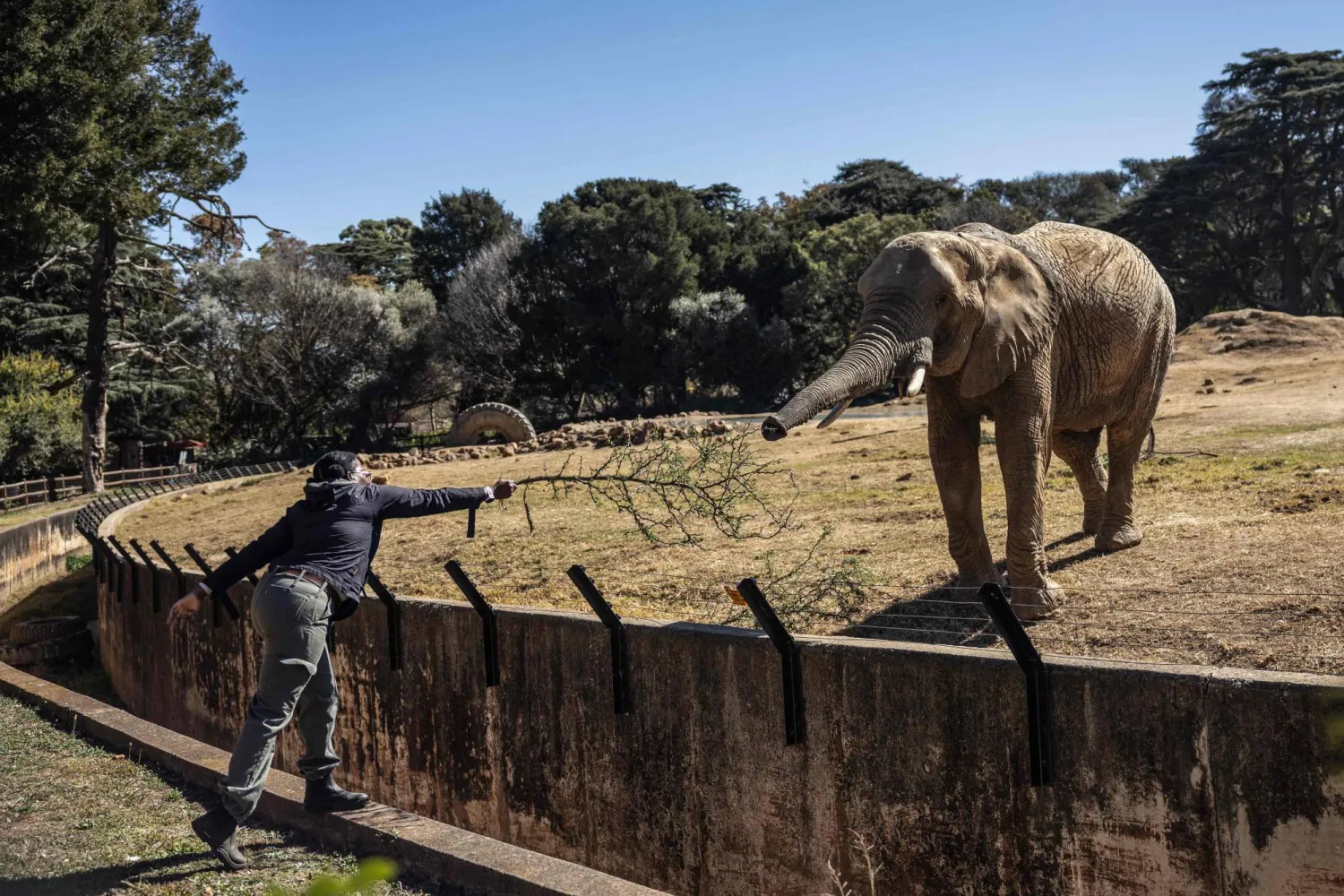
Pinky Modina, Pachydermist at the Johannesburg Zoo, feeds Ramadiba one of the three remaining elephants in Johannesburg on July 24, 2026. (Photo by Phill MAGAKOE / AFP)
TT

The Last Trio: S.Africa's Zoo Elephants Await their Fate

Pinky Modina, Pachydermist at the Johannesburg Zoo, feeds Ramadiba one of the three remaining elephants in Johannesburg on July 24, 2026. (Photo by Phill MAGAKOE / AFP)

The last three elephants still in a traditional South African zoo entered their enclosure in single file, fruit and vegetables scattered on the ground to encourage natural foraging.

For visitors to the popular Johannesburg Zoo, it was a chance to see Africa's largest land animal in real life.

But for animal welfare campaigners, it is a scene of cruelty that they have petitioned the courts to end by ordering the trio's release into a rewilding sanctuary.

In a case supported by international elephant experts, the campaigners told a court in May that observation showed that Lammie, aged 47, Ramadiba, 28, and Mopane, 26, were distressed and depressed.

"These elephants are highly intelligent, socially complex and sentient beings who are living in conditions that are damaging to their well-being, and who are, as a result, in a state of distress," said the three parties behind the case.

The court should "authorize their immediate release to a suitable sanctuary... where they can rehabilitate", they argued.

Judgment is expected in the coming weeks, said Megan Carr, senior researcher at the EMS Foundation that is part of the application.

Carr told AFP the three elephants were the only ones remaining in an urban zoo environment on the entire continent.

"They are the last three elephants showcased within an exhibition in a traditional zoo-type setting in South Africa and Africa," she said.

The legal bid for their freedom follows campaigners' success in having a 42-year-old elephant released from the national zoo in Pretoria and into a private reserve in 2024, after years of negotiation with the South African government.

The animal had spent 40 years at the facility.

When an AFP team visited Johannesburg Zoo, a group of small children pressed towards a viewing area shouting, "Elephant! Elephant!" as the three animals shuffled around their enclosure.

Lammie, focused only on the food, was born at the zoo, one of a handful in South Africa and among a plethora of state-run and private animal sanctuaries or game reserves. Ramadiba and Mopane arrived in 2019.

The trio are well cared for and had recently been given a clean bill of health, said Johannesburg city parks spokeswoman Jenny Moodley.

The facility could accommodate up to five elephants, and two keepers were dedicated to each animal, with food hidden around the enclosure to encourage foraging and walking, said an official not authorized to speak to the media.

Johannesburg City Parks and Zoo does not want the trio freed, saying they are suited to captive life, especially Lammie, who has never lived elsewhere.

Should they be relocated, the zoo would not be able to offer important research and education possibilities to the public, managing director Thanduxolo Mendrew said in papers for the court case, which was launched after negotiations failed.

Having the animals among the zoo's offerings allowed school children, especially from poorer backgrounds, to see them live, he said.

Carr responded: "Why would you show your child a compromised elephant when it is much easier for them to look at elephants on a video or a TV program?"

"They need a vast amount of space in order to remain healthy and fit, and no enclosure is able to offer that to an elephant."

The elephants share two holding bomas or enclosures at night, each measuring 160 square meters (1,700 square feet), smaller than an average tennis court, according to campaigners.

During the day, they are allowed to roam in an unshaded enclosure several times larger, around the size of a football pitch.

South Africa is home to about 44,000 African savannah elephants, about 6,000 owned privately or by communities, the government said in August last year.



Etna Ash Keeps Catania Airport Shut Until Friday, Disrupting Summer Travel

 A drone view of volcanic ash and lava during an eruption at Mount Etna, forcing authorities to suspend flights at Catania airport, in Sicily, Italy, August 12, 2026. (Reuters)
A drone view of volcanic ash and lava during an eruption at Mount Etna, forcing authorities to suspend flights at Catania airport, in Sicily, Italy, August 12, 2026. (Reuters)
TT

Etna Ash Keeps Catania Airport Shut Until Friday, Disrupting Summer Travel

 A drone view of volcanic ash and lava during an eruption at Mount Etna, forcing authorities to suspend flights at Catania airport, in Sicily, Italy, August 12, 2026. (Reuters)
A drone view of volcanic ash and lava during an eruption at Mount Etna, forcing authorities to suspend flights at Catania airport, in Sicily, Italy, August 12, 2026. (Reuters)

Flights at Catania airport in Sicily will remain suspended until early Friday because of ash from Mount Etna's ongoing volcanic activity, which has forced hundreds of flights to be cancelled or rerouted over the past week.

All arrivals and departures at the island hub, Italy's fifth-busiest airport by passenger traffic, will be ‌suspended through 2 ‌a.m. local time on ‌August ⁠14, airport operator ⁠SAC said in a statement late on Wednesday.

Passengers were advised to check the status of their flights with their airlines before travelling to the airport.

The prolonged restrictions come at ⁠the height of the summer holiday ‌season, affecting thousands ‌of passengers, and have placed additional pressure ‌on Sicily's other airports.

Mount Etna, Europe's ‌highest and most active volcano, frequently disrupts operations at Catania airport, whose operator launched the sale of a stake of at ‌least 51% in May.

Marco Viccaro, president of the Italian Volcanological Association, ⁠said ⁠the activity at Etna, which began on August 6, is more energetic than previous episodes and is continuing in a sustained way.

"This suggests that deeper, gas-rich magma is playing a more active role, making the fragmentation process more efficient and leading to increased ash production, which is severely disrupting air traffic to and from Catania airport," he added.


Canadian Wildfire That Forced 20,000 to Flee May Signal ‘New Normal’

Smoke rises from the Brunswick Creek wildfire, looking north over the Fraser River near Boston Bar, British Columbia, Canada, August 11, 2026 in an aerial photograph. (BC Wildfire/Handout via Reuters)
TT

Canadian Wildfire That Forced 20,000 to Flee May Signal ‘New Normal’

Smoke rises from the Brunswick Creek wildfire, looking north over the Fraser River near Boston Bar, British Columbia, Canada, August 11, 2026 in an aerial photograph. (BC Wildfire/Handout via Reuters)

A wildfire that forced more than 20,000 people from their homes in western Canada moved so quickly that crews had to abandon firefighting to help residents escape, a pace British Columbia’s premier said Wednesday may represent a “new normal.”

The Bald Range wildfire erupted Friday near Summerland, a community of about 12,000 in British Columbia’s Okanagan region. By Wednesday, it had grown to about 184 square kilometers (71 square miles) after destroying homes and killing an 80-year-old woman.

"There’s an important set of lessons for us to take about how quickly this moved and that this may be our new normal for fire speed," Premier David Eby said. He said the blaze outpaced wildfire modeling and left some residents with little time to evacuate.

Officials have begun damage assessments, but the area remained unsafe Wednesday and there was no timeline for residents to return.

Crews were clearing vegetation to help slow the fire’s spread as officials warned that thunderstorms could bring erratic winds and increase fire activity. Highway 97, a major route through the area, remained closed.

Eby visited an evacuation reception center in Penticton, where he said he met people devastated by the loss of their homes.

“A lot of emotions in there, obviously,” he told reporters, calling the woman’s death a “tragic loss.”

Summerland pharmacist Jonathan Kiesman said he was worried about displaced patients getting their medications and said seeing the fire approach the community “almost brought tears to my eyes.”

Officials said they were withholding broader details on property losses until residents could be notified directly.

“The last thing that I would want is somebody to have the shock of finding out on social media or on television about their home being lost,” British Columbia Emergency Management Minister Kelly Greene said.

Eby said the province would review the response, including whether changes are needed to wildfire planning, building standards and vegetation management near communities.

Given the drought and summer heat, he warned, “this is very unlikely to be the last significant fire we see this summer.”

Summerland Mayor Doug Holmes warned that recovery would be long and difficult.

Canada has endured a series of severe wildfire seasons in recent years, with smoke repeatedly drifting into the United States. In record-setting 2023, fires burned more than 14.6 million hectares (36 million acres), an area roughly the size of Illinois.

Canada has warmed faster than the global average in recent decades, while the amount of land burned by wildfires has increased substantially. Much of the country’s forest is remote and dominated by spruce and pine, conditions that can make fires difficult to contain once they become established.


Afghan Students Divided over Smartphone Ban at Universities

The Taliban authorities have taken steps to control Afghans' access to technology. Wakil KOHSAR / AFP
TT

Afghan Students Divided over Smartphone Ban at Universities

The Taliban authorities have taken steps to control Afghans' access to technology. Wakil KOHSAR / AFP

Forced to leave their smartphones off campus, Afghan university students are divided over whether the new anti-tech rule has disrupted their studies or done wonders for their concentration.

Soon after Supreme Leader Hibatullah Akhundzada ordered government workers to stop using smartphones in June, the ban was also imposed in the world of academia.

A 29-year-old student in the capital Kabul said a staffer had "visited the classrooms and announced that from now onwards, we are not allowed to bring smartphones to the university".

In the western city of Herat, notices posted on the walls of a university and its dorm warned that anyone caught with a smartphone on campus would face "legal action".

No reason was given to students who spoke to AFP, some of whom requested anonymity for security reasons.

At Kandahar University in southern Afghanistan, spokesman Nazir Ahmad Qadari said the move aimed to ensure students "pay attention to their lectures, studies and practical work".

Fifty-eight percent of countries ban mobile phones in schools, citing classroom distraction and risks to wellbeing, according to a March report by UNESCO which made no mention of university bans.

The Taliban authorities have ruled for nearly five years and have taken steps to control Afghans' access to technology without saying why.

Last year, broadband access was restricted in several provinces for weeks, before the government unexpectedly cut off the internet and phone networks nationwide for two days.

Despite this, smartphones are widely used and billboards in cities advertise the latest internet deals.

- 'Can't study properly' -

At universities, the ban has restricted access to online research and course materials, with one Herat student saying he had used his phone to help with about half the syllabus.

"If the explanation was not good, we used our phones to take photos and videos of the slides or the writing on the board, so we could review them later," the 21-year-old said.

That view was shared in the northern city of Mazar-i-Sharif, where a 22-year-old journalism student told AFP: "We can't study properly without smartphones".

The human rights director for the United Nations mission in Afghanistan (UNAMA), Fiona Frazer, said there "may be sound reasons to manage students' use of technology".

However, UNAMA had concerns about government restrictions that limit "access to information, freedom of expression" and the ability to participate fully in daily life.

Back in Kabul, the 29-year-old student said time-saving artificial intelligence tools are now out of reach, while people now have to carry dozens of physical books around campus instead of using e-books.

There is no ban on laptops, but many students cannot afford one.

The student, who is also a freelance translator, has also found it hard to concentrate on lectures knowing he could be missing out on work opportunities.

"I need to check my emails and WhatsApp every other minute, because I receive messages from my clients... if I don't answer, I can lose the offer," he said.

Although he can pay the 10 Afghanis ($0.15) fee to store his smartphone at the university entrance, he said it's difficult for others "because most of the students are not financially stable".

- Improved grades -

A second Kabul student, 28, said he had bought a basic phone which he was allowed to use on campus to make calls.

But he complained of the extra expense and being "deprived of the current technology".

However, not everyone opposes the ban.

In Kandahar, home of the supreme leader, medical student Sanaullah Yousufzai said the rule had improved relations between teachers and students.

"We can better focus on the lessons and lectures; there are no more interruptions due to calls," said Yousufzai.

But the 25-year-old remained worried that he might not be able to reach his family in an emergency.

For journalism student Mohammad Hakim Haqmal, 22, the change had seen his score improve from 75 to 80 percent.

Although his classmates had been using their phones to get information for their studies, they were also wasting time on social media.

After the ban, "they tried harder, studied well, and got better results".