


New Space Object ‘Black Hole Star’ Discovered by Astronomers

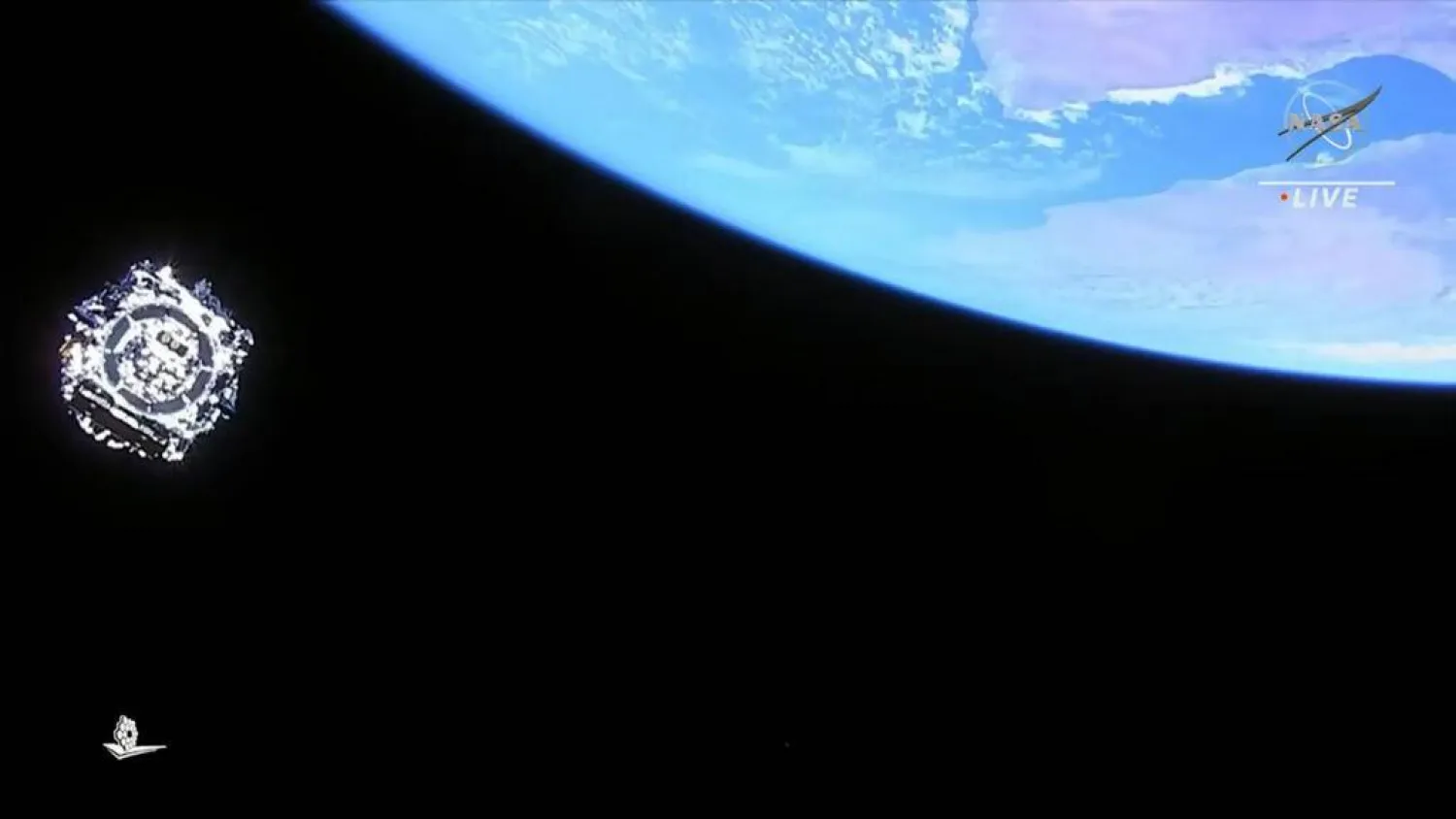
 The James Webb Space Telescope, which spotted the new astronomical object called a "black hole star". (NASA TV/AFP file)
The James Webb Space Telescope, which spotted the new astronomical object called a "black hole star". (NASA TV/AFP file)
TT

New Space Object ‘Black Hole Star’ Discovered by Astronomers

 The James Webb Space Telescope, which spotted the new astronomical object called a "black hole star". (NASA TV/AFP file)
The James Webb Space Telescope, which spotted the new astronomical object called a "black hole star". (NASA TV/AFP file)

Astronomers announced Wednesday they had discovered a new type of astronomical object called a "black hole star", potentially solving a mystery involving strange red dots spotted in the early universe.

The object looks like a star the size of our solar system, but produces 100 billion times more energy than any star -- a mighty blast of power closer to what is produced by a black hole.

The black hole star, which dates from 660 million years after the Big Bang, was spotted by a US-led team of astronomers using the James Webb Space Telescope, according to a study published in the journal Nature.

Since history's most powerful telescope went online in 2022, it has been spotting many extremely bright cosmic objects dubbed "little red dots" in the early universe that have baffled scientists.

"What exactly these objects are has been one of the most debated topics of the JWST era," lead study author Rohan Naidu of Hawaii University said in a statement.

The team had been trying to find clues for a different mystery: why JWST keeps finding bright galaxies in the universe's infancy, when it was thought to have been too early for them to have become so huge.

But while looking through the images, they spotted a little red dot.

- 'Pure black hole star light' -

"When we see something very red in the universe, we often assume that it is surrounded by dust, like soot or ash," said Robert Simcoe, a study co-author from the Massachusetts Institute of Technology.

"The same way that the wildfire smoke from Canada recently made the sky in Boston look bright red, astronomical objects can also appear redder than their intrinsic color when you see them through a veil of dust," he added.

However, when the team sifted through their data, they found that at certain wavelengths, the object's light simply disappeared.

To their surprise, this suggested that it is not dust making this object appear red -- it is hydrogen gas.

This explained the object's color, but not how it could be pumping out so much energy.

"You can't be powering this by nuclear fusion, which is the energy source that sits at the heart of all the stars," Naidu explained.

Using modelling simulations, they determined the most likely scenario was that the object is powered by a central black hole surrounded by a cocoon of gas that makes it resemble a star.

The team named the object MoM-BH*-1. The BH and asterix is for black hole star -- and the number one suggests they believe there are more out there.

"Every little red dot is consistent with being a black hole star," Naidu said.

"What is special about MoM-BH*-1 is, the black hole star is essentially completely outshining its surrounding host galaxy, such that we're seeing pure black hole star light."



Greece Passes Social Media Ban for Children Under 15

FILE PHOTO: Instagram app icon is seen on a smartphone in this illustration taken October 27, 2025. REUTERS/Dado Ruvic/Illustration/File Photo
TT

Greece Passes Social Media Ban for Children Under 15

FILE PHOTO: Instagram app icon is seen on a smartphone in this illustration taken October 27, 2025. REUTERS/Dado Ruvic/Illustration/File Photo

Greece's parliament approved a bill on Friday that bans the use of social media platforms for children under 15 amid growing concerns over their impact on the health and safety of minors.

The ban comes ‌into force ‌on January 1, ‌2027, said Reuters.

Australia was the ⁠first country to pass legislation to curb the use of social media by minors, doing so last year. A similar law ⁠passed in France ‌was struck ‌down by the country's Constitutional Council ‌in August

Greek Prime ‌Minister Kyriakos Mitsotakis said social media platforms have 2-1/2 months to devise a way ‌to verify users' ages and protect their privacy

Greece ⁠is ⁠among seven European Union countries seeking an age verification solution with the European Commission

Greece says it is standing by parents to help curb the "endless scrolling" that deprives children of sleep, concentration and time with their friends


370 Books in 20 Months: S.African Author Defends Her Use of AI

Coral Hart says she has been heavily criticized for using AI to produce books. GIANLUIGI GUERCIA / AFP
TT

370 Books in 20 Months: S.African Author Defends Her Use of AI

Coral Hart says she has been heavily criticized for using AI to produce books. GIANLUIGI GUERCIA / AFP

South African writer Coral Hart has published more than 370 books since February 2025 using artificial intelligence, a process she passionately defends despite criticism and threats.

"Grifter", "villain" -- insults abound on social media to describe the author who, in her forties, has become the symbol of AI's arrival in publishing.

Coral Hart -- a pseudonym she uses to protect her real name -- told AFP in an interview she had received "tens of thousands" of hate messages and several death threats.

In this hostile environment, few authors using AI agree to speak publicly and show their faces, AFP said.

"I chose to be the one to step up and say, these are conversations we need to start having," Hart said.

"This is here... They're not going to switch it off or unplug it because a bunch of authors said so."

Before she started writing with AI around 20 months ago, Hart had been working in publishing for 14 years and written several dozen works without the technology.

It took her three months to familiarize herself with the various AI models and build a framework capable of producing a book.

Now she juggles between ChatGPT, which is "really good at dialogue, terrible at prose"; Claude, "really good story structure, terrible at sex drives"; and others like Grok, "completely unhinged" but good on "spicy scenes".

"If you say, ChatGPT, write me a book, or, Claude, write me a book, you're going to get a flaming dumpster fire of trash back because it doesn't have anything (to work with)," Hart said.

The author defines the story concept, a style, details of the characters, and chapter outlines. And only then will her system generate the books.

Hart said when she started, "we could write one paragraph at a time. I usually took two or three prompts to do that."

"I can now draft the whole book in one sequence."

Since last year, AI models have "improved vastly", Hart said. "The prose has improved. The syntax has improved. The sentence structure has improved."

- 'Books are selling' -

The first draft of a book is generally not good, the writer said.

It is run through AI for "developmental edits" and then again "to fix any continuity issues, story issues, flat middles, character arcs that are incomplete, plot threads that have been dropped, people whose eye color has changed."

At the end of this process, a human proofreader reads through the text to fix any "AI tells that have slipped through" and do some rewriting. "And it's usually ready to go."

Although one of her novels made it into Amazon's top 100 bestsellers, the vast majority of her 371 titles -- many of them romance -- are tailored to certain readers based on rigorous market research.

She has sold more than one million books, by her own estimate, in digital, print and audio formats, earning more than $1 million so far this year.

The South African now heads an operation that has trained several hundred people in her method and is preparing to launch software for AI authors called Authorythm.

As for her own production, she mentions her use of AI only when required by a sales platform.

"For the last 16 years, nobody's asked me what my creative process was," said Hart, who publishes under more than 10 other pen names.

Now, she was ready to make it public "for the right reasons".

Regularly accused of contributing to "AI slop" -- low-quality AI-generated content in text, video, music, or images -- Hart points to the ultimate yardstick: "Books are selling."

"Readers don't read rubbish books; they return them," she said.

The writer has followed the debate around a novel by Haitian-Canadian Thelyson Orelien that was withdrawn from the shortlist for France's Goncourt prize after accusations that he used AI, which his publisher confirmed on Wednesday.

Critics had praised the book and sales were strong before the controversy, she said, asking: "If you need an AI label to hate something, do you hate it, or do you hate AI?"


India Stirs Up Its Gastronomy with French Cooking Schools

The boom in French cooking schools in India reflects a growing demand for high-end hospitality workers in the world's most populous country. Arun SANKAR / AFP
TT

India Stirs Up Its Gastronomy with French Cooking Schools

The boom in French cooking schools in India reflects a growing demand for high-end hospitality workers in the world's most populous country. Arun SANKAR / AFP

Fiercely proud of its culinary traditions, India is increasingly open to foreign influences, with French cooking schools attracting students eager to make their mark on the country's growing fine-dining sector.

"Ten or 15 years ago, there were far fewer young people dreaming of becoming chefs," said Aabhas Jain, director of bakery and pastry training at Ecole Ducasse, a French culinary school also operating in India.

"But with the rise of social media... today's students have greater ambitions in this profession," added Jain, 36, who is also part of the Indian School of Hospitality (ISH) in Gurugram, just outside New Delhi.

In the world's most populous country, the need for high-end hospitality workers is immense, fueled by economic growth and the rise of a middle class that travels more and increasingly eats at plush establishments.

"There are plenty of job opportunities," said Saurav Chhabra, head of French hotel school Vatel's Indian campus, which has been based in Gurugram since 2015 in partnership with Sushant University.

"Employers' expectations are very high, particularly in five-star hotel chains."

- 'Braising, blanching' -

Culinary and pastry courses, once relatively rare in India, have proliferated over the past decade, with foreign private schools helping drive its high-end hospitality sector.

Such is the enthusiasm that France is considering opening vocational schools, notably in Puducherry, the former French colonial port in India's southeast.

Ecole Ducasse has more than 600 students, most from affluent backgrounds.

Indian chefs who have worked at prestigious restaurants, including overseas, teach their respective specialties: Indian, European, Mediterranean and Asian cuisine, as well as bakery and pastry-making.

Siddhant Marwah, a final-year student, joined the school to acquire "French techniques that represent the quintessence of culinary expertise."

As he puts the finishing touches to a gratin dauphinois -- a dish of sliced potatoes baked in cream -- he explains that French and Indian cuisines share techniques such as "braising, blanching, and slow cooking in stews."

While France boasts its beef bourguignon, India is not to be outdone with goat nihari, a meat dish cooked for hours in a spicy broth.

Drawn by the opportunities for travel and meeting people that a career as a chef offers, Marwah already dreams of opening his own restaurant in India.

Nearby, Amitabh Sukhwal has just enrolled at Vatel, whose tuition fees are considerably lower than those at Ecole Ducasse.

The school has around 120 students, many from modest backgrounds.

Sukhwal, 18, who calls himself a "lover of the French language", plans to go to France in four years to pursue a master's degree, gain experience abroad and then draw on it to open his own hotel in India.

He learned French through interactions with guests at the small hotel run by his parents in Chittorgarh, Rajasthan and is now honing his skills at his new school, where French-language classes are compulsory.

- 'In vogue' -

A majority of the students interviewed by AFP at the two schools plan to remain in India.

After working for many years in India's luxury hotels, chef Shikha Gupta, who teaches bakery and pastry-making at Vatel, is pleased to see her classes have "as many men as women."

"Over the past 10 to 12 years, attitudes have changed and many women have chosen to enter the culinary profession," said Ecole Ducasse's Aabhas Jain.

"We now see near parity, or even a ratio of 60 percent women to 40 percent men."

Anusha Nagia, who joined Ecole Ducasse in 2024, hopes to open a restaurant in India and one day earn a Michelin star, perhaps by betting on fusion cuisine, which is "very much in vogue."

While chicken chasseur is one of her favorite French dishes, she fondly recalls a galantine -- a French preparation of stuffed meat -- in which she and her classmates incorporated the spicy flavors of chicken tikka.