


Whales Spark Joy in New York but Face Threats from Boat Traffic

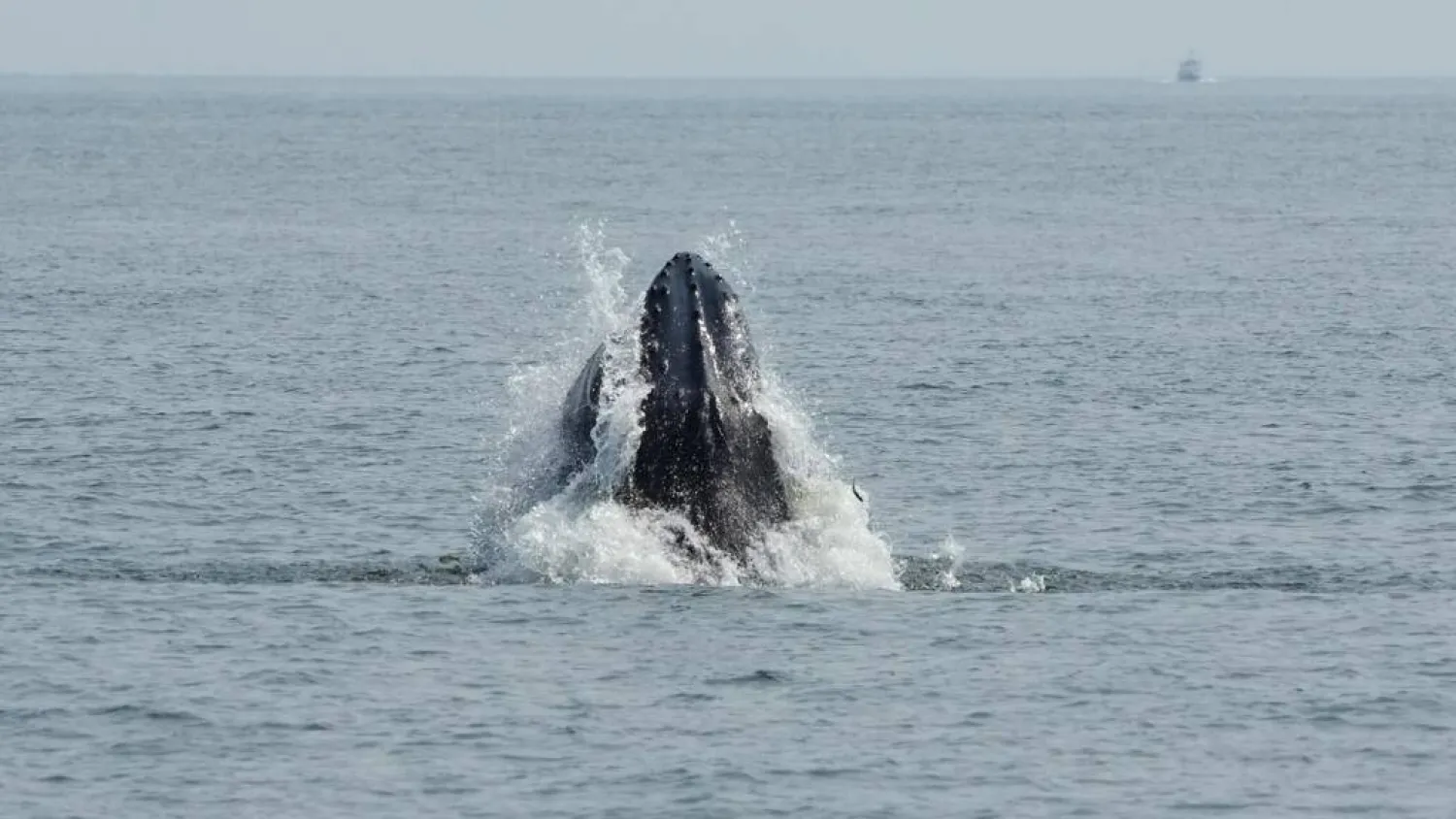
A humpback whale surfaces in the Atlantic Ocean off the coast of New York City on August 13, 2026. TIMOTHY A. CLARY / AFP
TT

Whales Spark Joy in New York but Face Threats from Boat Traffic

A humpback whale surfaces in the Atlantic Ocean off the coast of New York City on August 13, 2026. TIMOTHY A. CLARY / AFP

"WHALE AT ONE O'CLOCK!"

Eager cruise passengers zipping around New York's southern shores rush to the starboard bow: a humpback whale is up for air, a breathtaking sighting set against Manhattan's iconic skyline.

Such scenes are no longer uncommon in the city's waterways, sparking excitement for animal lovers but also forcing new policy efforts to protect whales venturing into one of the busiest port regions in the United States, said AFP.

Once hunted to near extinction, the rebound of humpback whales is considered among the conservation movement's greatest success stories.

And a growing cohort of mostly juvenile humpbacks are thriving off New York's coast, where food is now plentiful.

"People fly to different parts of the world to go on safari, and what I think a lot of people don't realize is that the marine safari is right out here," said Carl LoBue, New York oceans director at The Nature Conservancy.

The marine scientist who grew up on nearby Long Island told AFP that in the past, whale sightings were an "incredibly unusual event."

LoBue now spots the marine mammals basically every time he's out on the water. He generally sees humpbacks but sometimes other species including the still critically endangered North Atlantic Right whale.

The new normal is "spectacular," he said.

"I never thought that I would see whales like this off the coast of New York."

- Cleaner water, climate change and more fish -

Humpbacks were once mainly migratory visitors, traversing the New York Bight -- the marine region that extends off the city, Long Island and New Jersey -- while traveling between foraging grounds further north and breeding areas in the Caribbean.

But more recently, a confluence of factors has made New York's coast less of a highway and more of a stomping ground.

One is the resurgence of whale populations thanks to government action including the Endangered Species Act, as well as a cleaner habitat supported by air and water protections.

Another is the existence of relatively new statutes that support growing schools of the Atlantic menhaden, an oily fish with a variety of industrial uses like commercial bait and omega-3 supplements.

It is also a staple for whales, dolphins and seabirds.

Humpbacks, which can grow to the size of a large city bus, can feast on some 3,000 pounds (1360 kilograms) of fish a day.

Climate change also plays a role in the surge of New York-area whale sightings.

Warming waters are impacting bait fish distributions, encouraging whales to stray from tradition to find food, said Chris St. Lawrence, a naturalist who conducts whale watching tours and also works for Gotham Whale, a marine research organization that tracks whales in the Bight.

When Gotham began formally monitoring in 2012, they had just five whales in their catalog.

Today, St. Lawrence said the organization sees 80 to 100 unique whales annually, and just identified its 500th individual whale seen around New York City since tracking began.

Some routinely put on a show: NYC0318, a whale also seen by AFP on a recent outing, often charms whale watchers with sensational lunge-feeds, breaching the water and prompting shrieks of delight.

- Maritime traffic dangers -

Gotham is able to distinguish between the animals largely thanks to "fluke prints": whales have unique patterns on the underside of their tails, similar to human fingerprints, St. Lawrence explained.

But many whales are also identifiable by their scars, including from collisions with everything from tankers, cargo and cruise ships to fishing boats and recreational vessels.

Because while New York offers bountiful food, it also hosts heavy maritime traffic, posing fresh threats to the whale population.

In 2016, humpbacks in the New York area were delisted as endangered, but just one year later the US National Oceanic and Atmospheric Administration (NOAA) declared an "Unusual Mortality Event" along the Atlantic coast.

The designation under the US Marine Mammal Protection Act tracks unexpected die-offs and triggers investigation. For humpbacks, it remains in effect.

Vessel strikes and entanglements are leading causes of whale deaths, according to advocacy groups and government trackers worldwide.

Just this month, New York Governor Kathy Hochul signed the Whale Awareness Act, which requires integrating marine mammal protection efforts and education into state boater safety courses and vessel registration.

LoBue has worked to develop educational materials, including an online course that teaches seafarers how to recognize whale behavior, report sightings and avoid collision.

He noted that even the most seasoned fishermen "didn't grow up driving boats around whales because they didn't used to be here."

"We're all needing to learn some new skills," he said.

"Nobody wants to hit a whale."


Cooking Was Already an Artform in Bronze Age Syria

What they once ate now tells the story of how they lived (SPA)
TT

Cooking Was Already an Artform in Bronze Age Syria

What they once ate now tells the story of how they lived (SPA)

While the folk of Bronze Age Europe were mostly making do with simple stews and bread, people in Syria were already importing ingredients and using pots of differing temperatures to support “sophisticated” cuisine, researchers said on Friday.

The evidence from Danish experts suggests people living in what is now the city of Hama 4,500 years ago were already enjoying dishes of simmered goat, gazelle and cereals, AFP reported.

The city’s cooks used pots with different heating properties depending on the type of meal they were about to prepare, much as we choose between cast-iron or non-stick frying pans today.

Mette Marie Hald, from the National Museum of Copenhagen, and her team reached the conclusion after examining animal bones, plant remains and fats from inside cooking pots found in the city.

“It feels a bit modern, actually, the way that you have different pots and you have different sort of serving wares,” the archaeobotanist told AFP.

Locally produced pots were made from clay and calcite, while others were made from clay mixed with basalt and were imported from as far away as China.

Meals could be prepared with imported ingredients such as gazelle, which itself came from much further east.

Hald said the evidence of “sophisticated cooking” they had uncovered in Hama was supported by recipes written down in much later periods.

Danish archaeologists started digging in Hama in the first half of the 20th century, she said, so there has been quite a lot of research on everyday life there.

But she added that they had not really focused on food culture before.

“This is a period of kingdoms, well-organised cities and stratified societies,” she said.

“In that way, it’s not surprising that they also knew sophisticated cooking. I think the surprising element is we can actually prove it.”


Lady Gaga Welcomes First Child

(FILES) US actress and singer Lady Gaga attends the US premiere of Warner's "Joker: Folie a Deux" at the TCL Chinese theater in Hollywood, California, September 30, 2024. (Photo by Chris DELMAS / AFP)
TT

Lady Gaga Welcomes First Child

(FILES) US actress and singer Lady Gaga attends the US premiere of Warner's "Joker: Folie a Deux" at the TCL Chinese theater in Hollywood, California, September 30, 2024. (Photo by Chris DELMAS / AFP)

Pop superstar Lady Gaga welcomed her first child with fiance Michael Polansky, US media reported Friday.

The 40-year-old "Bad Romance" singer, whose real name is Stefani Germanotta, began dating Polansky in 2020, and became engaged to the entrepreneur in 2024.

A source confirmed news of the child's birth to Page Six and People, but no additional details about the baby, including its name, sex or date of birth, were immediately available.

The musician affectionately referred to as "Mother Monster" by her fans has spoken in recent years about her desire to have a child.

She wrapped up her most recent world tour, the Mayhem Ball, in April, and her latest album "Mayhem" garnered multiple Grammy nominations, winning the award for "Best Pop Vocal Album" earlier this year.


Coastal Erosion Forces Cancellation of California Music Festival

MALIBU, CALIFORNIA - SEPTEMBER 10: People gather near erosion damage along a beach access road to Point Dume, which remains closed due to the erosion from powerful surf and high tides earlier this summer, on September 10, 2026 in Malibu, California. Mario Tama/Getty Images/AFP
TT

Coastal Erosion Forces Cancellation of California Music Festival

MALIBU, CALIFORNIA - SEPTEMBER 10: People gather near erosion damage along a beach access road to Point Dume, which remains closed due to the erosion from powerful surf and high tides earlier this summer, on September 10, 2026 in Malibu, California. Mario Tama/Getty Images/AFP

A music festival set to feature The Killers, Olivia Dean and Jack White was cancelled Friday because the California beach where it was to be held has been eaten away by coastal erosion.

The two-day Ocean Way Festival had been planned for later this month in Santa Monica, but waves up to 15 feet (4.5 meters) and storm runoff has left the beach in the city near Los Angeles badly degraded, forcing local officials to pull the plug.

"Storm surf generated by Hurricane Marie and runoff from a storm drain outfall eroded a large portion of the festival site," AFP quoted a statement from the city of Santa Monica as saying.

The storm, which churned the waters of the Pacific over the last week, stripped sand off the beach, making it no longer safe to hold the festival there, the city said.

"The surf took the beach we planned this on, and we cannot put tens of thousands of festival-goers on that sand until it's safe," said Mayor Caroline Torosis.

The coastal city of Santa Monica -- the official end point of Route 66 -- has a wide stretch of golden sand and a large wooden pier that features frequently in American television shows and movies.

News of the festival cancellation came days after the pounding surf opened a huge sinkhole on the driveway of a beachfront home belonging to Oscar-winning US actor Nicolas Cage.

Officials in Malibu, which sits just north of Santa Monica, have ordered the evacuation of 31 homes because of the danger posed by the hole.

Further south, at least seven homes in Dana Point were declared uninhabitable after the coast on which they sit rapidly eroded, with one house collapsing into the sea.

A similar problem has occurred in nearby Laguna Beach.

The waters of the Pacific Ocean have been unsettled in recent weeks by a series of tropical storms, with some of them developing into hurricanes.

Scientists say a near-record strength El Nino climate episode is warming the ocean's waters and creating extra volatility.

While the phenomenon is part of a natural cycle, human-caused climate change is thought to be super-charging the heating and exacerbating its effects.
