


'How Many Will Die?': The Mysterious Ailment Killing Kenyan Elephants

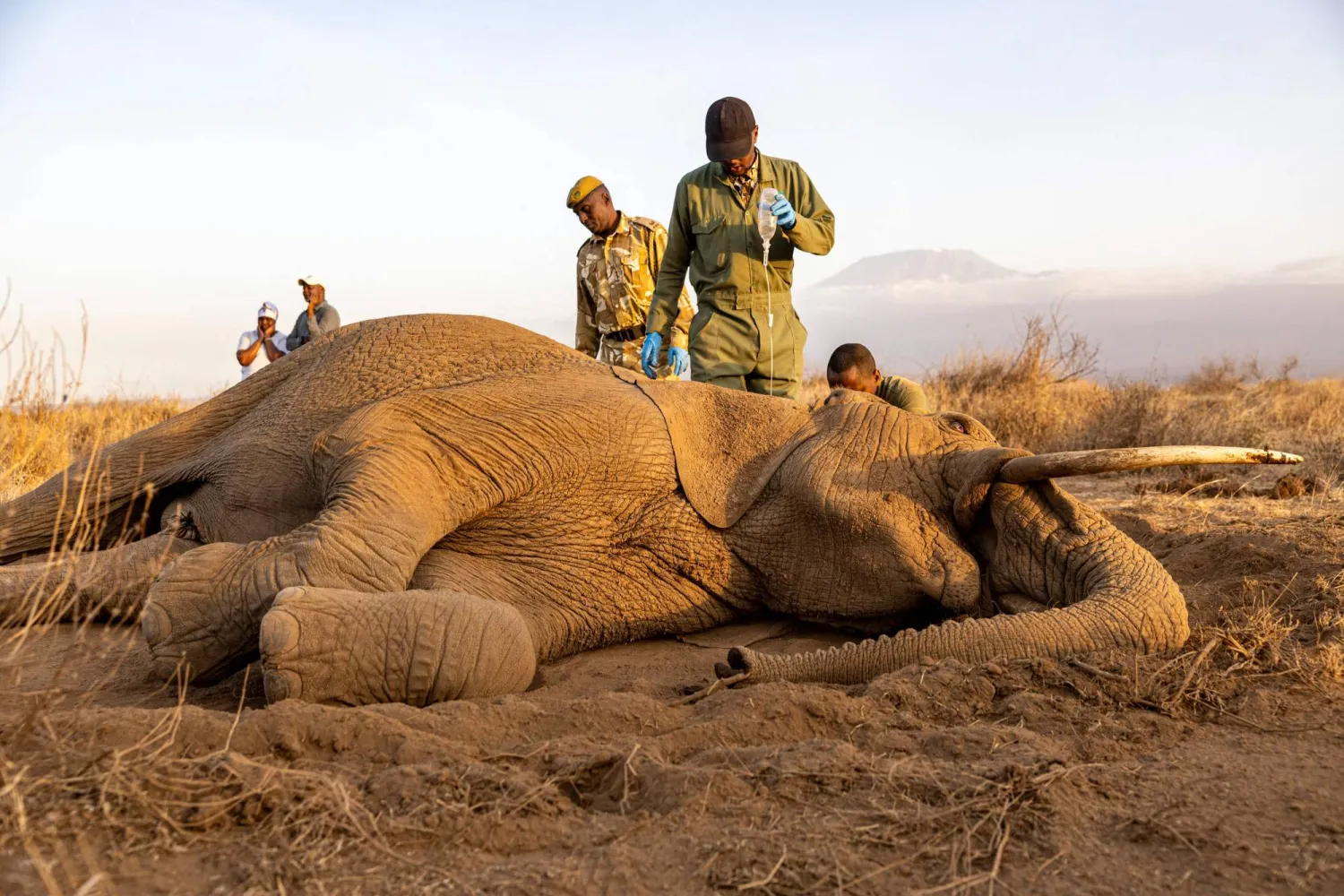
Veterinary officers from the Sheldrick Wildlife Trust and Kenya Wildlife Service (KWS) attend to a male elephant lying on the ground after falling ill at Kitenden B Community Conservancy in Amboseli, Kajiado County, on August 12, 2026. (Photo by SIMON MAINA / AFP)
TT

'How Many Will Die?': The Mysterious Ailment Killing Kenyan Elephants

Veterinary officers from the Sheldrick Wildlife Trust and Kenya Wildlife Service (KWS) attend to a male elephant lying on the ground after falling ill at Kitenden B Community Conservancy in Amboseli, Kajiado County, on August 12, 2026. (Photo by SIMON MAINA / AFP)

Lying on the ground and kicking up a cloud of dust, the elephant slowly exhausted himself in futile attempts to stand, the latest victim of a mysterious ailment in southern Kenya.

Distressed vets administered a glucose injection -- the only option, given that the cause of the ailment remains unknown -- to the 11-year-old male, known as Genghis Khan, who was struggling to breathe and died on Tuesday.

The mystery affliction has killed at least 20 pachyderms, mostly females or young males, since June in Kenya. All of the animals have identical symptoms, including partial paralysis.

Elephant herds have made Amboseli -- overlooked by Africa's highest peak, Mount Kilimanjaro in Tanzania -- a lucrative tourist hotspot and the mysterious deaths in the region are a sensitive issue in a country where tourism is a huge source of revenue.

"You would find one struggling for a day, struggling for two or even three days. Until they completely die," said Patrick Papatiti, head of operations for Olgulului communal lands, which includes the Kitenden B reserve where Genghis Khan was found.

In late July, the Kenya Wildlife Service (KWS) said toxicology reports found high concentrations of cyanide in the animals' carcasses, suggesting possible pesticide poisoning from nearby farms' crops.

While observers still question the possible cause of death, several specialists interviewed by AFP dismiss poisoning.

"It's a disease," said Papatiti, who was born and raised in the local Maasai community, insisting there was "no way" cyanide was involved.

He is one of the very few local voices publicly rejecting the KWS preliminary findings, pointing out that no other animals have died.

Notably, neither scavengers nor flies that fed on the supposedly poisoned carcasses have perished -- creatures that typically succumb after consuming poisoned animals.

"If another animal feeds on that carcass and it is not dying, then definitely it is not a chemical," Joel Nyika, the Amboseli ecosystem manager for the Kajiado County authorities, told AFP.

He dismisses the theory, also put forward by the KWS, that the cyanide might have come from a type of foliage, noting local livestock would have died as well.

"As wildlife managers, we believe it could be a disease that is only affecting these elephants."

On August 7, the KWS said their "findings to date do not indicate an infectious or transmissible disease", assuring tourists that they could continue to visit.

But in the Kimana reserve, AFP journalists saw six carcasses on one day -- some fresh, others older -- with rangers also observing partial paralysis, preventing the animals from standing.

Maasai farmers, like 52-year-old Noah Saatia, rejected the possibility of poison -- pointing out to AFP they eat the same things -- and expressed anger over the animals' deaths.

"When they die, it hurts us," he told AFP, standing in his crop of maize, protected from animals by fences.

"We don't know the cause of the elephant deaths... But they are not dying because of food -- that's for sure."

Some of the deaths occurred only days earlier.

The carcass of a four-month-old calf, swarming with flies, lay half-devoured by hyenas.

About a dozen vultures were feeding on the remains of a pregnant female elephant, who had died near full term, and her unborn calf.

Paula Kahumbu, conservationist and head of Wildlife Direct, highlighted the "lack of evidence" supporting the pesticide theory.

In an interview with AFP, she noted that few adult male elephants had died, even though they are the ones most likely to raid crops.

Olgulului's Papatiti also dismissed the theory of deliberate poisoning. He said the emphasis should not be on pinning blame on individuals but finding the cause: "We need to know what is killing our elephants."

The sensitivity of the deaths has spooked the wildlife community, with several environmental organizations declining to comment to AFP beyond calling for a full investigation, while rangers at the Kimana reserve said they were not authorized to speak.

Papatiti fears that the death toll is being underestimated and that the affliction may also be affecting elephants in neighboring Tanzania.

"How many elephants will die before we can stop this?"


NASA Images Show Crater Carved by SpaceX Rocket that Slammed Into the Moon

This combo made with photos provided by NASA on Tuesday, Aug. 18, 2026, taken by the Lunar Reconnaissance Orbiter, shows before, left, and after images of a fresh crater on the moon created by a collision with a SpaceX rocket. (NASA via AP)
TT

NASA Images Show Crater Carved by SpaceX Rocket that Slammed Into the Moon

This combo made with photos provided by NASA on Tuesday, Aug. 18, 2026, taken by the Lunar Reconnaissance Orbiter, shows before, left, and after images of a fresh crater on the moon created by a collision with a SpaceX rocket. (NASA via AP)

A NASA spacecraft circling the moon is providing the sharpest views yet of the crater carved by a crashing SpaceX rocket.

The space agency released before-and-after photos of the impact area on Tuesday.

The Falcon rocket’s upper stage plowed into the moon at 5,400 mph (8,700 kph) on Aug. 5 after drifting through space for more than a year. It launched a pair of private moon landers with experiments and even a tiny rover in 2025 as part of NASA’s push to commercialize lunar exploration.

Based on these new photos by NASA’s Lunar Reconnaissance Orbiter, the fresh crater appears to be 60 feet (18 meters) across and less than 10 feet (3 meters) deep, according to scientists.

Dark and bright streaks are clearly visible emanating like butterfly wings from the crater, The Associated Press reported.

The darker lines represent excavated material that was close to the surface and shaped by eons of solar wind, cosmic rays and micrometeorite strikes. The brighter rays indicate fresh rocks and dirt that were hurled from farther down.

The spacecraft photographed the crater a week after the collision from 60 miles (96 kilometers) up, while zooming along at one mile per second. Flight controllers had to tilt the spacecraft so its cameras pointed toward the impact scene.

The orbiter completes a lunar polar orbit every two hours, as the moon rotates beneath. It took six days before the crash scene came into view.

South Korea’s Danuri spacecraft was first on the scene to beam back photos.

The Lunar Reconnaissance Orbiter has been orbiting the moon since 2009, serving as NASA's up-close eyes as the space agency works to return astronauts to the lunar surface.


The Milky Way Devoured Smaller Galaxy About 11.8 Billion Years Ago

The collision about 11.8 billion years ago, when a dwarf galaxy known as LKH collided with the Milky Way and merged with it, appears in an artist's concept released on August 17, 2026.  NASA, ESA, Joseph Olmsted (STScI)/Handout via REUTERS
The collision about 11.8 billion years ago, when a dwarf galaxy known as LKH collided with the Milky Way and merged with it, appears in an artist's concept released on August 17, 2026. NASA, ESA, Joseph Olmsted (STScI)/Handout via REUTERS
TT

The Milky Way Devoured Smaller Galaxy About 11.8 Billion Years Ago

The collision about 11.8 billion years ago, when a dwarf galaxy known as LKH collided with the Milky Way and merged with it, appears in an artist's concept released on August 17, 2026.  NASA, ESA, Joseph Olmsted (STScI)/Handout via REUTERS
The collision about 11.8 billion years ago, when a dwarf galaxy known as LKH collided with the Milky Way and merged with it, appears in an artist's concept released on August 17, 2026. NASA, ESA, Joseph Olmsted (STScI)/Handout via REUTERS

The Milky Way, a large and spiral-shaped galaxy that is home to hundreds of billions of stars including our sun, has taken a long and complicated path to achieve its current dimensions, as illustrated by new research documenting a milestone event early in its history.

Scientists observing clusters of stars congregated near the Milky Way's center have discovered evidence that our galaxy swallowed a smaller galaxy roughly 11.8 billion years ago, when the universe was less than 15% of its current age. The event represents the Milky Way's earliest-known galactic merger and shows how it grew not only by forming its own stars but by merging with smaller galaxies caught in its gravitational pull.

The smaller galaxy is classified as a dwarf galaxy, differentiating it from larger galaxies like the Milky Way. The researchers estimate that it contained stars with a mass equivalent to 500 million times that ⁠of the sun ⁠at the time of the merger, about a quarter the size of what the Milky Way was at the time.

The researchers used the orbiting Hubble and Gaia telescopes to study stellar clusters, each containing hundreds of thousands of stars, inhabiting a region spanning the Milky Way's innermost 20,000 light-years, gauging their age, chemical composition and trajectory. A light-year is the distance light travels in a year, 5.9 trillion miles (9.5 trillion km).

These stars became part of the Milky Way after a galactic merger that occurred about 2 billion years after the Big Bang event that initiated the ⁠universe, they said. The dwarf galaxy where they originated was given the name Low-energy-Kraken-Heracles, or LKH, in recognition of three earlier studies that examined the possibility of such a primordial merger.

"The key finding of our research is the unambiguous discovery of the first merger event experienced by our galaxy in its infancy," said astrophysicist Davide Massari of the National Institute for Astrophysics, or INAF, in Bologna, Italy, lead author of the study published in the journal Nature Astronomy.

Whether the Milky Way's early growth was fueled by homegrown star formation or a galactic merger has been a matter of debate, Reuters quoted Massari as saying. The new study indicates that the merger infused the Milky Way early in its history with a large volume of stars and interstellar gas that feeds star formation, as well as the mysterious substance called dark matter.

"I would say that from the point of view of stars, the merger ⁠was rather peaceful, with ⁠no star-to-star crashes. But from the point of view of the gas, the merger was more 'explosive' — likely, the collision between the gas from LKH and that from the Milky Way triggered the formation of many stars," Massari said.

Massari said there are probably many stars that originally formed in the dwarf galaxy that still are buried in the inner regions of the Milky Way, some of them inside stellar clusters. Because of all the interstellar dust in this region, however, it is very difficult to identify individual stars, Massari said.

The Milky Way is known to have been involved in two other massive galactic mergers. It absorbed a dwarf galaxy called Gaia-Sausage-Enceladus about 1.8 billion years after the LKH merger. And over the past approximately 6 billion years it has been combining with the Sagittarius dwarf galaxy.

"Every single one of these mergers had an influence on the events that have led to the formation of our own solar system, and ultimately of Earth," Massari said. "This is why I think that reconstructing the pieces of the Milky Way's past effectively contributes to answering the big question about, 'Where do we come from?'"


Flight Attendants and Pilots Have Highest Risk of Dying from Radiation-Linked Cancers, Study Says

American Airlines flight 718, the first US Boeing 737 MAX commercial flight since regulators lifted a 20-month grounding in November, lands at LaGuardia airport in New York, US, December 29, 2020. (Reuters)
TT

Flight Attendants and Pilots Have Highest Risk of Dying from Radiation-Linked Cancers, Study Says

American Airlines flight 718, the first US Boeing 737 MAX commercial flight since regulators lifted a 20-month grounding in November, lands at LaGuardia airport in New York, US, December 29, 2020. (Reuters)

Flight attendants and pilots are at the highest risk of dying from radiation-related cancers — even more than people who work with radioactive materials, according to a new study.

Cosmic radiation comes from space. Only a small amount reaches the Earth's surface, but exposure is greater for people flying at high altitudes.

There’s been limited evidence from small studies suggesting that the exposure translates to higher cancer death rates among people who fly often, particularly pilots and flight attendants. The new study “brings important new evidence to bear on this question,” two Australian radiation experts who weren't involved in the research wrote in an accompanying commentary.

The latest study, published Monday by JAMA Internal Medicine, used national data from more than 12 million death certificates that included information about occupations. The authors looked at death rates from cancers that are tied to radiation exposures, including leukemia, lymphoma, multiple myeloma, and cancers of the skin, breast, thyroid, prostate and central nervous system.

Among more than 500 occupations, flight attendants had the highest percentage of deaths from radiation-related cancers, and pilots were second, the researchers found. For those two occupations, the odds of dying were unusually high for each type of radiation-related cancer.

Neither group showed higher-than-normal death rates from cancers that aren't tied to radiation exposure, noted the commentary writers, Catherine Olsen and Ken Karipidis. That fact “supports the hypothesis that occupational radiation exposure, rather than lifestyle or socioeconomic factors, underlies the observed excess,” they wrote.

The researchers found that flight attendants had about 50% higher odds of dying from a radiation-related cancer than the general working population, and pilots had about 36% higher odds.

In terms of absolute risk, about 6.9% of flight attendant deaths were from these cancers — roughly 1 in 14. Among pilots, it was 6.7%. For the general working population, it was 5%, said the study's first author, Dr. Vishal Patel of Harvard Medical School.

The authors acknowledged some limitations in their study. They do not know how much exposure each flight attendant and pilot got in the air or from other sources. It's also possible occupations were misclassified on some death certificates.

They also could not account for another possible contributor specific to the professions: Cancer risk can be worsened by frequent disruption of the body’s internal clock, which can be affected by jet lag, crossing time zones and irregular work schedules.

The Federal Aviation Administration has acknowledged that aircrews are exposed to ionizing radiation, but the government does not set federal dose limits or require monitoring, the authors noted.

“You can't manage an exposure you've decided not to measure,” Patel said in an email.

Sara Nelson, who leads a union representing 55,000 flight attendants, said the report reinforces that radiation exposure needs to be taken seriously, as the union has suggested for years.

“The risk is known, but crew are not educated or informed. And, no one is taking responsibility,” said Nelson, president of the Association of Flight Attendants-CWA.

Annual skin examinations may be warranted for all people working on high-altitude flights, and women in those jobs may want to get mammograms earlier or more frequently, Olsen and Karipidis wrote. Doctors who care for pilots and flight attendants also should have a “heightened index of suspicion” for cancer when evaluating these patients, they said.
