


Study: China's Rapid Solar Expansion Hurt Bird Diversity

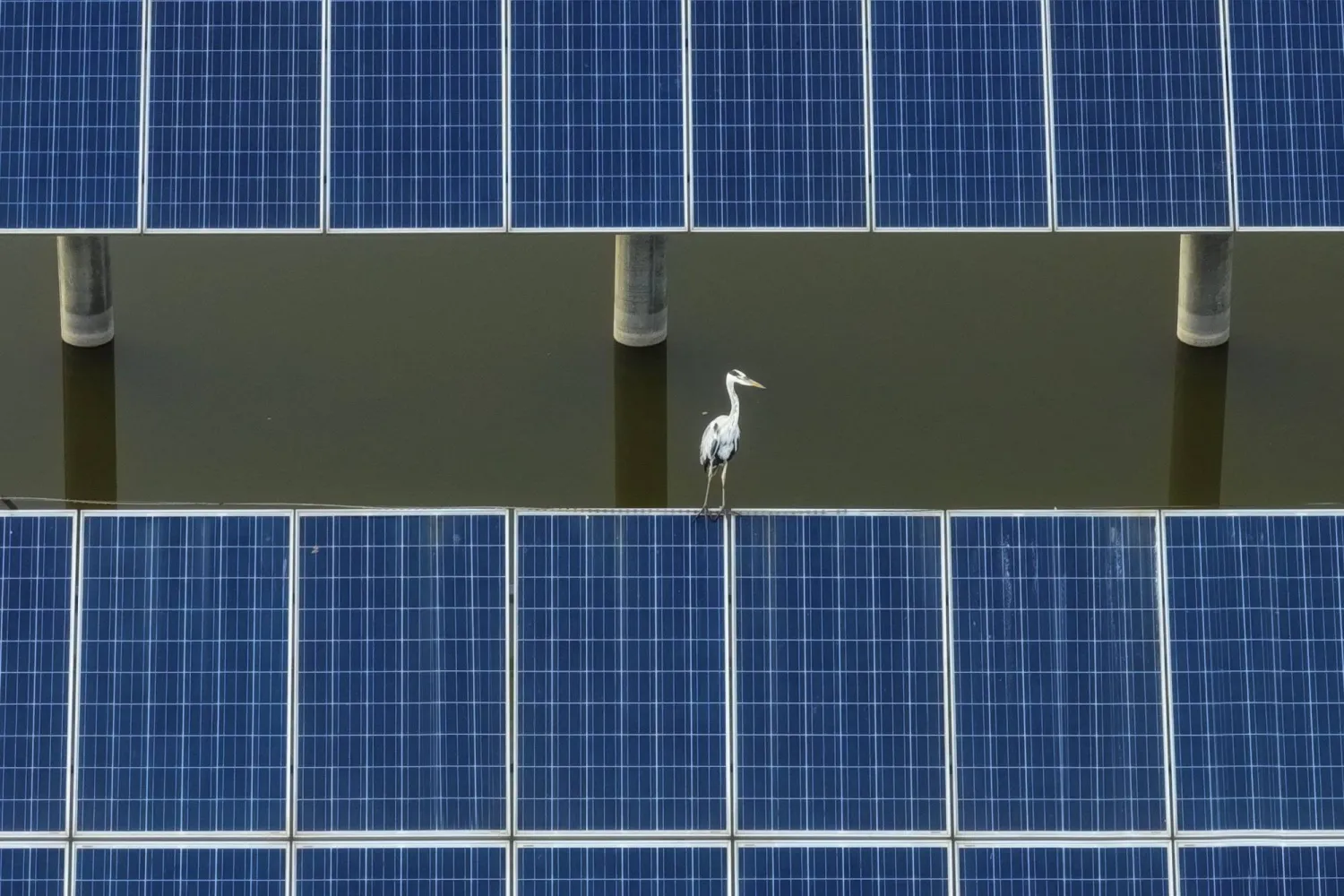
A bird perches on a solar panel at the Jingneng Helan 30-megawatt photovoltaic power station in Yinchuan, in northwestern China's Ningxia Hui Autonomous Region on August 20, 2026. (Photo by CN-STR / AFP) / China OUT
TT

Study: China's Rapid Solar Expansion Hurt Bird Diversity

A bird perches on a solar panel at the Jingneng Helan 30-megawatt photovoltaic power station in Yinchuan, in northwestern China's Ningxia Hui Autonomous Region on August 20, 2026. (Photo by CN-STR / AFP) / China OUT

The global push for solar energy expansion could carry hidden biodiversity costs, according to a study across China published in the journal Science on Thursday.

According to the research spanning more than 2,300 Chinese counties, pro-solar policies led to reductions in bird diversity in what the authors called an example of a "green dilemma" pitting carbon reduction against conservation.

"The main message is not to slow the renewable energy transition, but to make solar development more ecologically informed," first author Huiming Zhang, of the Nanjing University of Information Science & Technology, told AFP.

China's goal to achieve net zero before 2060 has seen it embark on a renewables revolution.

By 2024 its solar footprint reached an estimated 4,520 square kilometers (1,745 square miles) -- equivalent in size to the US state of Rhode Island -- and solar energy is projected to constitute 45 percent of its energy mix by 2060.

Choosing solar locations in China isn't just based on sunny locations and available land, but rather it is shaped by "Five-Year Plans" to promote economic development in certain regions.

Zhang and his colleagues exploited these variations in solar expansion policy across 2,344 counties across China from 2014 to 2023, while also accounting for national trends, weather, socioeconomic conditions, land cover, and birdwatching effort.

This data was paired with citizen science records to understand the impact on bird diversity.

Their findings revealed a negative trade off, with increased policy stringency consistently associated with decreased bird biodiversity, though the effect was moderate.

Using an index from 0 to 15.5 to measure the strength of solar policies, the study found that a four-point increase in policy strength was linked to a two percent decline in the Shannon index, a standard measure of species variety.

Rapid land conversion was the main culprit, particularly the transformation of cropland and grassland into developed areas, with the effects stronger in wealthier and non-desert regions.

Both resident and migratory birds suffered significant declines, but species that were native to mountain habitats poorly suited to solar farms were unaffected.

The push for solar farms was accompanied by greening efforts to satisfy environmental requirements, but here the authors identified what they called "inferior greening" -- where the total amount of leafiness may go up but because it was too homogenous, the ecological quality went down.

Writing in a related commentary, Yuanning Liang of Peking University said "birds serve as an effective indicator group for large-scale biodiversity assessment" because they are among the few animal groups for which abundance data over time and space is readily available.

Although the authors studied solar power, the siting problems they identified are relevant to renewable infrastructure more broadly, including wind power, she added.

According to AFP, the research team offered a number of recommendations, including directing large solar projects toward locations with lower ecological conflict, greater assessments of each site, and limiting land conversion in productive, habitat-rich regions.

"Clean energy development and biodiversity conservation do not have to come at each other's expense, but careful siting and biodiversity safeguards are essential," said Zhang.



82-year-old Dies after Beach Fight in Greece over Sun Lounger

Tourists from a nearby hotel watch military helicopters fly overhead during Medusa 15, a joint military exercise led by Greece and Egypt, at Maleme on the Greek island of Crete, Friday, Sept. 18, 2026. (AP Photo/Thanassis Stavrakis)
TT

82-year-old Dies after Beach Fight in Greece over Sun Lounger

Tourists from a nearby hotel watch military helicopters fly overhead during Medusa 15, a joint military exercise led by Greece and Egypt, at Maleme on the Greek island of Crete, Friday, Sept. 18, 2026. (AP Photo/Thanassis Stavrakis)

An 82-year-old man died Sunday after he got into a fight over a sun lounger on a beach in Greece near Athens, local media reported.

The octogenarian had a dispute with a 76-year-old man and a 21-year-old woman over the sun lounger, with the argument degenerating into a scuffle between the two men, according to police, the ANA news agency and ERT state television channel reported.

The 82-year-old, badly hurt, was transported to hospital from the Vouliagmeni beach resort area where the argument broke out. He was later declared dead at the hospital, AFP said.

Both the 76-year-old man and the 21-year-old woman were arrested, ANA said, with police investigating what happened.


10 Lions Die in Suspected Poisoning at Tanzania Wildlife Reserve

Lions are seen in their counpound at the Artis Amsterdam Royal Zoo in Amsterdam, Netherlands in this handout photo released to media on January 28, 2021. Artis Amsterdam Royal Zoo/Handout via REUTERS
TT

10 Lions Die in Suspected Poisoning at Tanzania Wildlife Reserve

Lions are seen in their counpound at the Artis Amsterdam Royal Zoo in Amsterdam, Netherlands in this handout photo released to media on January 28, 2021. Artis Amsterdam Royal Zoo/Handout via REUTERS

Ten lions were found dead in Tanzania's Ngorongoro wildlife reserve this week and preliminary findings suggest they may have been poisoned, the area's management authority said.

The deaths raise concerns over the conservation of lions in one of Africa's most renowned wildlife ecosystems. Poisoning has been a recurring threat to large ⁠carnivores across parts ⁠of East Africa, often linked to conflicts between predators and livestock owners.

The lions were discovered on September 18 in the Ndutu area of Endulen Ward in Arusha ⁠region, Reuters quoted the Ngorongoro Conservation Area Authority as saying in a statement released late on Saturday.

"Preliminary findings suggest the animals may have died after ingesting poison," the authority said, adding that it had launched an investigation to determine the cause and identify those responsible.

The Ngorongoro Conservation Area, a UNESCO ⁠World ⁠Heritage Site in northern Tanzania, is one of the country's leading tourism attractions. It is home to a wide range of wildlife, including lions, elephants, buffaloes and endangered black rhinos.

Last month, police arrested four suspects in an investigation into the deaths of 18 elephants across the border in Kenya.


Diana's Brother Compares Media Treatment of Harry, Meghan to Late Princess' Ordeal

FILED - 13 February 2018, United Kingdom, Edinburgh: FILE PHOTO - Prince Harry and Meghan, Duke and Duchess of Sussex, attend a reception for young people at Holyroodhouse Palace in Edinburgh. Photo: Andrew Milligan/PA Wire/dpa
TT

Diana's Brother Compares Media Treatment of Harry, Meghan to Late Princess' Ordeal

FILED - 13 February 2018, United Kingdom, Edinburgh: FILE PHOTO - Prince Harry and Meghan, Duke and Duchess of Sussex, attend a reception for young people at Holyroodhouse Palace in Edinburgh. Photo: Andrew Milligan/PA Wire/dpa

The media's treatment of Prince Harry and his wife Meghan is on a par with that faced by his mother Diana, the late princess' brother said in an interview published on Sunday, warning that lessons needed to be learned from that period.

Diana died aged 36 in a 1997 Paris car crash as photographers pursued her on motorbikes, sparking an outpouring of grief and a reckoning over whether the media bore some responsibility for her death after splashing details of her life across front pages for years.

"If you look at an article in a tabloid about Diana or the couple that you were ⁠mentioning, Harry and ⁠Meghan, you know, they can be really, really unpleasant," Diana's brother, Earl Charles Spencer, told the BBC.

"And I think it would be really beholden on people to learn from Diana's example.

"I'm not here to speak for Harry and Meghan, but for anyone who's being destroyed in this way daily, it must be such ⁠a cancerous influence in their life,” Reuters quoted him as saying.

Harry, Diana's youngest son, and Meghan, cited the impact of what they called a toxic media on their lives before they quit royal duties and moved to the United States in 2020.

They also sued much of the British tabloid press - with varying degrees of success - before they moved back to Britain in August.

Spencer has made headlines around the world in the last week after his book, "Swan Song: Diana, My Sister", was serialized in the Daily Mail, accusing her former husband, the now ⁠King Charles, of ⁠sounding "giddily elated" in the hours after her death.

The palace hit back by saying the king "is mindful that the pain of fraternal grief can cloud reason, affect judgment and color memory in ways others do not recognize, even many years after such a loss".

The publication of the book and the return of Harry and Meghan to Britain are another challenge for the king, who is still undergoing treatment for cancer.

Diana's family accused the royals of showing a lack of support or care towards the late princess before her death, a charge that was repeated by Harry, who is now largely estranged from the rest of the royal family.