Saudi Food and Drug Authority Launches Kingdom’s First Food Composition Databasehttps://english.aawsat.com/varieties/5312676-saudi-food-and-drug-authority-launches-kingdom%E2%80%99s-first-food-composition-database
Saudi Food and Drug Authority Launches Kingdom’s First Food Composition Database
This initiative falls under efforts to advance national food data systems. (SPA)
TT
TT
Saudi Food and Drug Authority Launches Kingdom’s First Food Composition Database
This initiative falls under efforts to advance national food data systems. (SPA)
The Saudi Food and Drug Authority (SFDA), represented by the National Nutrition Committee, has officially launched the Saudi Food Composition Database, the first national database of its kind in the Kingdom, reported the Saudi Press Agency on Sunday.
Developed under the Health Sector Transformation Program, a key initiative of Saudi Vision 2030, the platform provides accurate, reliable, and updated nutritional data on local foods and traditional dishes consumed across Saudi Arabia.
Built upon approved scientific methodologies and high-quality standards, the database contains comprehensive nutritional information including energy, carbohydrates, proteins, fats, vitamins, minerals, and dietary fiber.
It establishes a national reference for food composition data within health, research, and nutrition sectors.
The initiative strengthens evidence-based food and nutrition policy formulation, empowers scientific research and health studies, and raises community health and nutritional awareness. It also supports the food manufacturing sector in developing local products and elevating their nutritional value.
The database drives digital transformation across the health and food sectors by making data accessible, enabling developers to build digital tools to assess dietary patterns and nutritional status, thereby strengthening the integration of data, technology, and public health.
This initiative falls under efforts to advance national food data systems, support evidence-based decision-making, and improve nutritional health and quality of life, in alignment with the goals of Saudi Vision 2030.
Indonesia Haze Spikes Singapore Pollution, Shuts East Timor Schoolshttps://english.aawsat.com/varieties/5329467-indonesia-haze-spikes-singapore-pollution-shuts-east-timor-schools
Singapore cable cars travelling towards Mount Faber station are shrouded in haze as smoke from regional forest fires reduces visibility across the city-state, in Singapore, October 14, 2026. REUTERS/Suhaimi Abdullah
Indonesia Haze Spikes Singapore Pollution, Shuts East Timor Schools
Singapore cable cars travelling towards Mount Faber station are shrouded in haze as smoke from regional forest fires reduces visibility across the city-state, in Singapore, October 14, 2026. REUTERS/Suhaimi Abdullah
Air pollution in part of Singapore hit the country's "very high" band on Wednesday, while East Timor shut schools, as haze from forest fires raging in Indonesia causes a regional crisis.
The blazes in Indonesia have burned through hundreds of thousands of hectares of forest and plantations, sickened local residents and sent thick haze across the region.
Air pollution in western Singapore on Wednesday hit "very high" -- the country's top level -- the National Environment Agency said.
It recorded levels of tiny particulates capable of penetrating the blood and lungs -- known as PM2.5 -- at 288 micrograms per cubic meter, vastly exceeding the World Health Organization's recommended average annual exposure of five micrograms.
Indonesia regularly battles wildfires during the dry season, but has seen stronger-than-usual blazes this year as a powerful El Nino cycle brings drought.
Experts also point to slash-and-burn land-clearing practices that have changed the naturally fire-resistant landscape of Sumatra and Borneo islands.
The haze has drifted into neighboring Singapore and Malaysia, and as far afield as the Philippines and East Timor, which said it would shut schools nationwide for three days from Thursday.
The closures were necessary "as a preventive measure to protect the health of students, teachers, and other members of the educational community, given current air quality conditions", the government said.
Isle of Wight Fossil Sheds Light on Enigmatic Meat-eating Dinosaurshttps://english.aawsat.com/varieties/5329399-isle-wight-fossil-sheds-light-enigmatic-meat-eating-dinosaurs
The meat-eating dinosaur Invictibellatrix amberina feeds on a mammal while grasping another in its ecosystem alongside other dinosaurs and other kinds of animals on the Isle of Wight, United Kingdom, in the Cretaceous Period around 120 million years ago, in this illustration released on October 13, 2026. Sergey Krasovskiy and Pedro Salas/Handout via REUTERS
Isle of Wight Fossil Sheds Light on Enigmatic Meat-eating Dinosaurs
The meat-eating dinosaur Invictibellatrix amberina feeds on a mammal while grasping another in its ecosystem alongside other dinosaurs and other kinds of animals on the Isle of Wight, United Kingdom, in the Cretaceous Period around 120 million years ago, in this illustration released on October 13, 2026. Sergey Krasovskiy and Pedro Salas/Handout via REUTERS
The partial skull of a tiger-sized predator that prowled what is now the Isle of Wight off England's southern coast about 120 million years ago is giving scientists a better understanding of an enigmatic group of meat-eating dinosaurs known for running down prey and ripping them apart with massive hand claws.
Researchers said the fossil belongs to a species they have named Invictibellatrix amberina, an early member of the lineage of Cretaceous Period carnivorous dinosaurs called megaraptorans. Invictibellatrix adds to the knowledge of skull anatomy among early megaraptorans and, being the first one known from Europe, helps show how the group spread globally.
Invictibellatrix is one of the smallest megaraptorans. Based on fossils of closely related megaraptorans, the researchers estimated that Invictibellatrix was about 16 feet (5 meters) long, with the weight of a large tiger. Its body may have been covered in filament-like feathers, they said.
Megaraptorans were part of the group called theropods that spans all the meat-eating dinosaurs, Reuters reported.
"Megaraptorans are very unique among theropods because they have relatively small and slender heads but had long and strong arms with massive hand claws as well as very lightly built skeletons," said Cassius Morrison, a postdoctoral researcher at the University of Leeds in England and lead author of the study published in the journal Royal Society Open Science.
"These characteristics imply that megaraptorans were agile hunters capable of chasing down prey and using their large arms and claws to catch them and disembowel them using their hand claws," Morrison said.
The largest-known megaraptoran, named Maip, was about 33 feet (10 meters) long, inhabiting Patagonia during the twilight of the dinosaur age, about 50 million years after Invictibellatrix lived.
Littler megaraptorans like Invictibellatrix may have hunted smaller prey like mammals, smaller reptiles and baby dinosaurs. Larger megaraptorans may have targeted bigger plant-eating dinosaurs like duckbilled hadrosaurs and long-necked sauropods, though probably not the biggest ones.
Megaraptorans hunted in the opposite way from massive predators like Tyrannosaurus rex. Tyrannosaurus employed its large and stoutly built head, enormous teeth and incredible bite strength to kill prey, but had puny arms of little use in hunting.
Invictibellatrix was not the Isle of Wight's top predator, with larger theropods around, alongside various herbivorous dinosaurs, and may have filled a role similar to a hyena today.
There is a debate among dinosaur paleontologists as to where megaraptorans fit on the theropod family tree. Despite differences in how they were built and hunted, one hypothesis is that megaraptorans were closely related to tyrannosaurs, the group that included Tyrannosaurus and others that dominated the landscapes in North America and Asia later in the Cretaceous.
Invictibellatrix means "unconquered female warrior." Morrison noted that after humble beginnings megaraptorans developed into apex predators in South America, Australia and Antarctica, becoming "the ruling queens," while the tyrannosaurs became the "tyrant kings" in North America and Asia.
Scientists are trying to unravel the evolutionary history of megaraptorans. A leading hypothesis has megaraptorans originating in Asia before migrating through Europe into Africa and then on into South America, thriving until the dinosaurs were doomed by an asteroid strike 66 million years ago. This hypothesis was lacking fossil evidence because no megaraptorans had been known from Europe until now.
"These findings help to uncover the evolution of one of the most mysterious theropod groups," University College London doctoral student and study co-author Charlie Scherer said.
The Invictibellatrix fossil, a fragmented braincase, was discovered about a century ago and acquired by the Natural History Museum in London in 1924.
"It was left in one of the collection's drawers ever since, and no one noticed it until a couple of years ago," Scherer said.
While Tyrannosaurus may be more imposing than Invictibellatrix, the researchers noted that if a person were somehow transported back in time — like in the recent film "The End of Oak Street" — Invictibellatrix might present more of a danger.
"A smaller theropod like Invictibellatrix would likely have been a much bigger threat to a human than something like T. rex because we would likely be too small for T. rex to see as a worthwhile meal because of how massive it was and the amount of energy it would be required to catch us," Morrison said.
"But we would be the perfect size for something smaller like Invictibellatrix, as we are about a third to a quarter of its weight, making us a good hearty meal and more than just a snack.
Additionally, Invictibellatrix would have the agility and maneuverability to pursue and catch a human."
Study: Global Deforestation Slowed in 2025 but Surged in Congo Basinhttps://english.aawsat.com/varieties/5329389-study-global-deforestation-slowed-2025-surged-congo-basin
Deforestation from illegal mining borders the Malinowski River in the Tambopata National Reserve in Puerto Maldonado, Peru, Tuesday, Aug. 11, 2026. (AP Photo/Guadalupe Pardo)
Study: Global Deforestation Slowed in 2025 but Surged in Congo Basin
Deforestation from illegal mining borders the Malinowski River in the Tambopata National Reserve in Puerto Maldonado, Peru, Tuesday, Aug. 11, 2026. (AP Photo/Guadalupe Pardo)
Deforestation slowed worldwide last year, but the improvement is unlikely to last as the situation deteriorates in Central Africa and an exceptionally strong El Nino weather pattern intensifies, a new study said on Wednesday.
Seven million hectares of forest -- roughly the size of the Republic of Ireland -- were permanently destroyed in 2025, a 15-percent drop from the previous year, according to the annual Forest Declaration Assessment.
The slowdown, however, is not enough to keep the world from missing a pledge to end deforestation by 2030, according to the report, which was drafted by a coalition of research groups and non-governmental organizations.
The 2025 figure is "encouraging but so far it's the exception, not a new trajectory", Erin Matson, the study's co-author and lead consultant at advisory group Climate Focus, said in a media briefing.
To meet the target, agreed at the United Nations' COP26 climate talks in 2021, deforestation would have to fall by around one million hectares per year.
Clearing forests for agriculture or mining operations remains the leading drivers of deforestation.
Last year's improvement was due in part to progress in Latin America, with a 33-percent drop in what has historically been the world's deforestation "hot spot", according to the study.
The authors pointed particularly to Brazil's deforestation action plan and increased enforcement in the country's Amazon, AFP reported.
Progress in the region, however, "rests heavily on the choices of a small number of governments and remains highly vulnerable" to recent and upcoming elections across the Amazon basin.
Brazil's left-wing leader, Luiz Inacio Lula da Silva -- who has vowed to end illegal deforestation by 2030 -- faces populist right Senator Flavio Bolsonaro in a runoff presidential election on October 25.
Deforestation had surged under the administration of Bolsonaro's father, far-right former president Jair Bolsonaro.
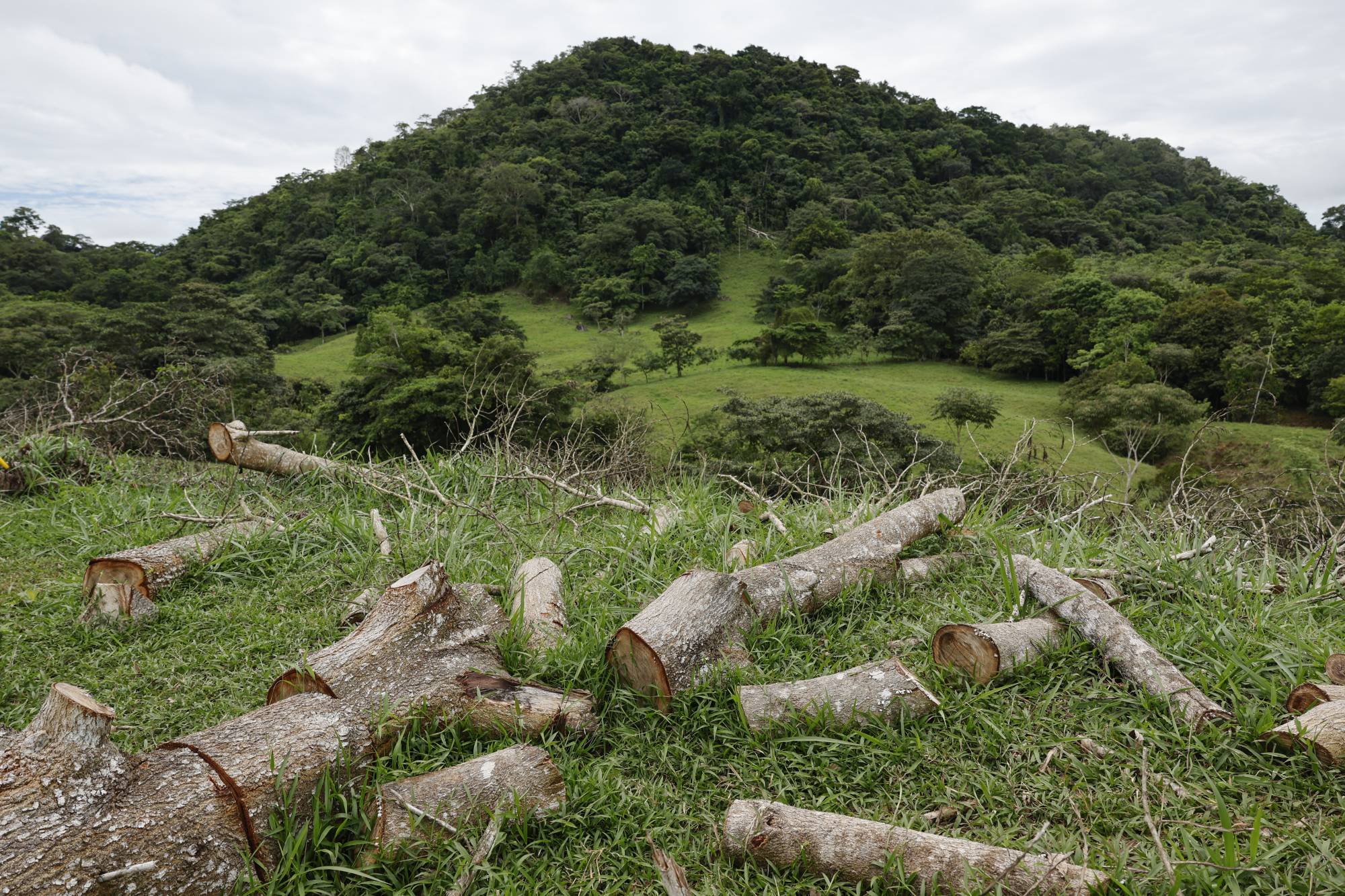
Trunks of a tree in Capira, Panama, 06 October 2026. EPA/Bienvenido Velasco
Progress could also be threatened in Colombia and Peru, where hard-right presidents were recently elected, according to the experts.
Across the Atlantic in Africa, the situation deteriorated in the Congo basin, where rainforest loss reached 2.4 million hectares -- near the same level of deforestation as the Amazon for the first time.
"Losing such a size of forest every year is a disaster," said Sam Nguiffo, a lawyer and founder of the Centre for Environment and Development in Cameroon.
"As humanity, we clearly cannot afford that because it will be totally irreversible," he said.
Logging for timber or felling trees for agriculture or mining appear to prevail in forest management in Central Africa, Nguiffo said.
Deforestation has a "massive impact on the cultural identity and on the livelihood of local and indigenous communities", he said.
"The erosion of the forest, both in size and in number of species, reduces the space available for communities and fuels conflicts," the lawyer added.
El Nino, the warming phase of a natural climate cycle, also threatens progress because its effects include droughts, creating conditions for wildfires.
The current El Nino event, which emerged in June, is expected to peak later this year but is already shaping up to be the strongest ever observed.
El Nino has been associated with strong drought in Indonesia, where tracts of forest and plantations have been burning in biodiverse Borneo and South Sumatra for months.
"If projections of the historically strong 2026-27 El Nino materialize, drought and fire risks will intensify further across tropical forest regions," the deforestation report said.
Matson, of Climate Focus, noted that there was a "huge spike" in tree cover loss during the last "super" El Nino event in 2015-2016.
"We can't fully predict the future but it's unlikely, I would say, that in 2026 we'll see the same kind of reductions (in deforestation) that we saw last year," she said.
لم تشترك بعد
انشئ حساباً خاصاً بك لتحصل على أخبار مخصصة لك ولتتمتع بخاصية حفظ المقالات وتتلقى نشراتنا البريدية المتنوعة