

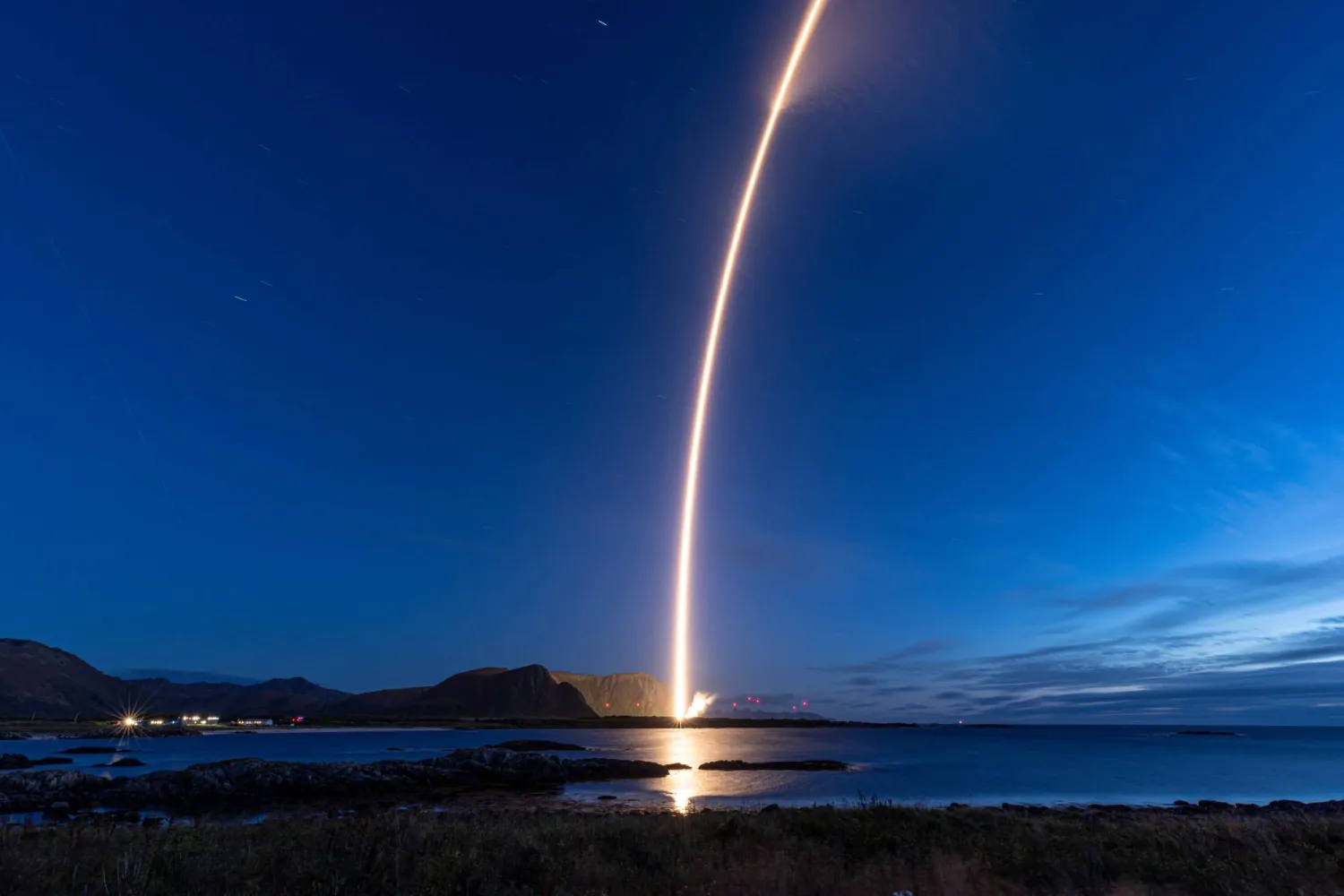

German Space Rocket Reaches Orbit in Europe's 1st Commercial Launch

Germany's Isar Aerospace rocket is launched into space from a base in Andoeya, Norway, September 5, 2026. Isar Aerospace/Franziska Kegel/Handout via REUTERS
TT

German Space Rocket Reaches Orbit in Europe's 1st Commercial Launch

Germany's Isar Aerospace rocket is launched into space from a base in Andoeya, Norway, September 5, 2026. Isar Aerospace/Franziska Kegel/Handout via REUTERS

German startup Isar Aerospace on Sunday said it would rapidly expand satellite deployments after the first orbital launch of its Spectrum rocket from Arctic Norway, a milestone for Europe's efforts to secure independent access to space.

The uncrewed Spectrum became the first commercial rocket to reach orbit from continental Europe, marking a breakthrough for a region where several countries are seeking a foothold in the fast-growing market for satellite launches.

"Launch capability is right now the biggest bottleneck in the entire industry," Isar co-founder and CEO Daniel Metzler told reporters.

He said privately owned Isar remains well-funded and that an initial public offering "is not on the table".

German ⁠Chancellor Friedrich Merz ⁠hailed Saturday's launch in a statement, calling it "the beginning of a new era".

Merz visited Isar's launch site in March, underscoring Europe's efforts to establish greater autonomy as the global order once championed by the United States is shifting under US President Donald Trump.

Blasting off from Norway's Arctic Andoeya Spaceport, Spectrum carried five small satellites along with an in-flight technology experiment, according to Isar. The rocket is designed to serve the growing market for small and medium-sized payloads.

"Europe's independent access ⁠to space just got a major boost," EU Defense and Space Commissioner Andrius Kubilius wrote on social media platform X.

It was Isar's second launch, coming 18 months after the company's first rocket plunged into the sea and exploded in a fiery spectacle shortly after takeoff from the same site. No one was injured.

Reuters quoted Isar as saying that it already has five more rockets in production and is now focused on scaling up operations to meet rising demand, with a long-term goal of conducting around 40 launches a year.

The German company is developing a second launch site in Nova Scotia in eastern Canada, and said on Sunday this could be ready for lift-offs in 2028.

Saturday's launch was intended as "both the vehicle's qualification mission and its first flight carrying payload," the Bavarian company ⁠said.

"The fact that ⁠we can now launch satellites from Andoeya strengthens Norwegian and European security in the turbulent times we live in," said Norway's minister of industry and commerce, Cecilie Myrseth.

Global players in the satellite launch market include Elon Musk's SpaceX, which launches from the United States, and French ArianeGroup, a joint venture between Airbus and Safran that uses a spaceport in South America's French Guiana.

SpaceX, a company spanning rockets, satellites and AI, in June listed on the Nasdaq exchange in a record initial public offering.

Sweden, with its Esrange launch site, and Britain with its SaxaVord Spaceport in the Scottish Shetland Islands, are the nearest rivals to the Norwegian site, all of which aim to give Europe greater autonomy in space flights.

Isar last week said it had secured about €200 million ($232 million) from the European Space Agency to help fund development of new rockets and expand its testing and launch infrastructure.



Military Shows to be Featured at Saudi International Falcons and Hunting Exhibition 2026

The exhibition will welcome visitors daily from 2 p.m. to 11 p.m. - SPA
TT

Military Shows to be Featured at Saudi International Falcons and Hunting Exhibition 2026

The exhibition will welcome visitors daily from 2 p.m. to 11 p.m. - SPA

The Saudi International Falcons and Hunting Exhibition 2026, scheduled for October 1 to 10 in Malham, north of Riyadh, will feature military shows presented by the Ministry of Interior among the accompanying events, adding a new element to the program.

The exhibition will allow visitors to watch the military shows at 4:30 p.m. and 7 p.m., while the band will perform at 6 p.m. and 8 p.m., SPA reported.

This year's exhibition will offer a wide range of experiences, including "Falconer of the Future," safari, mountain climbing, fishing, shooting, horseback and camel riding, auctions, and workshops, providing families, youth, and enthusiasts with a variety of options during their visit.

The exhibition will welcome visitors daily from 2 p.m. to 11 p.m.


Italy's Catania Airport Reopens as Etna Threat Downgraded

Visitors climb Mount Etna as smoke rises from its volcano in Catania, on the Mediterranean island of Sicily, on September 28, 2026. (Photo by Roman PILIPEY / AFP)
TT

Italy's Catania Airport Reopens as Etna Threat Downgraded

Visitors climb Mount Etna as smoke rises from its volcano in Catania, on the Mediterranean island of Sicily, on September 28, 2026. (Photo by Roman PILIPEY / AFP)

Italy's Catania airport resumed flights on Tuesday after briefly halting operations due to renewed volcanic activity from nearby Mount Etna and adverse weather conditions, in the latest stop-and-go disruption to air traffic.

According to Reuters, Operator SAC said ⁠flights to and ⁠from the airport had resumed with immediate effect after the volcanic alert level was lowered from red to ⁠orange.

The hub had previously suspended operations until 1300 GMT on Tuesday, only hours after ending a three-day shutdown on Monday evening.

The Sicilian airport, Italy's fifth-busiest by passenger traffic, is often disrupted by volcanic ⁠ash ⁠interference from Mount Etna, Europe's highest and most active volcano.

The latest shutdown affected thousands of passengers and placed significant pressure on other Sicilian airports, as airlines diverted flights away from Catania.


Scientists: Rising Seas Threaten Spread of Marine Invaders

An aerial view of fishermen returning from sea at the traditional fishing port in Banda Aceh, Indonesia, 29 September 2026. EPA/HOTLI SIMANJUNTAK
TT

Scientists: Rising Seas Threaten Spread of Marine Invaders

An aerial view of fishermen returning from sea at the traditional fishing port in Banda Aceh, Indonesia, 29 September 2026. EPA/HOTLI SIMANJUNTAK

Sea-level rise driven by climate change could help invasive marine species spread into newly flooded coastal areas, threatening biodiversity and some economic activities, researchers warned in a study published Monday.

The findings in Nature Ecology & Evolution highlight the links between the climate and biodiversity crises, with global warming altering ecosystems and creating new opportunities for non-native species to thrive.

That could "potentially expose ecosystems and human activities that have not previously been affected by these species," said study co-author Xuan Liu of Beijing Normal University.

The researchers modelled the potential future spread of 122 established non-native marine animals, including fish, crustaceans, molluscs and sea stars, under different climate and sea-level scenarios.

Climate change causes sea levels to rise through thermal expansion -- ocean water increases in volume as it warms -- and the melting of glaciers and ice sheets.

Global sea levels are projected to rise by about 20 centimeters (eight inches) by 2050 and 56 cm by 2100 under a scenario of moderate growth in greenhouse gas emissions.

That would see around 360,000 square kilometers (139,000 square miles) of coastal land flooded by mid-century, rising to 550,000 square kilometers by the end of the century.

More than two-thirds of the newly flooded coastal land -- roughly 290,000 to 470,000 square kilometers -- could become suitable for the marine non-native animals studied, particularly around estuaries at mid-latitudes, AFP quoted the authors as saying.

The risk is concentrated in regions including the eastern United States, Gulf of Mexico, North Sea, Gulf of Guinea, Arabian Gulf, northern Bay of Bengal, southeastern China and northern Australia.

Several species examined are already established in Europe, including the Pacific oyster, Atlantic blue crab and the veined rapa whelk, a predatory sea snail.

"Estuaries are particularly at risk because they are directly connected to the ocean and are also major hubs of human activity," Liu said.

Such areas could provide stepping stones for marine invaders moving further inland as the sea advances, the study said.

The findings come as governments prepare for two UN-backed international summits on the twin biodiversity and climate crises: COP17 in October and COP31 in November.

A global assessment by the UN's expert scientific panel on biodiversity, IPBES, estimated that economic costs from biological invasions exceeded $423 billion in 2019.