


‘Slumping’ South Korean Corals Worry Divers, Scientists Studying Climate Change

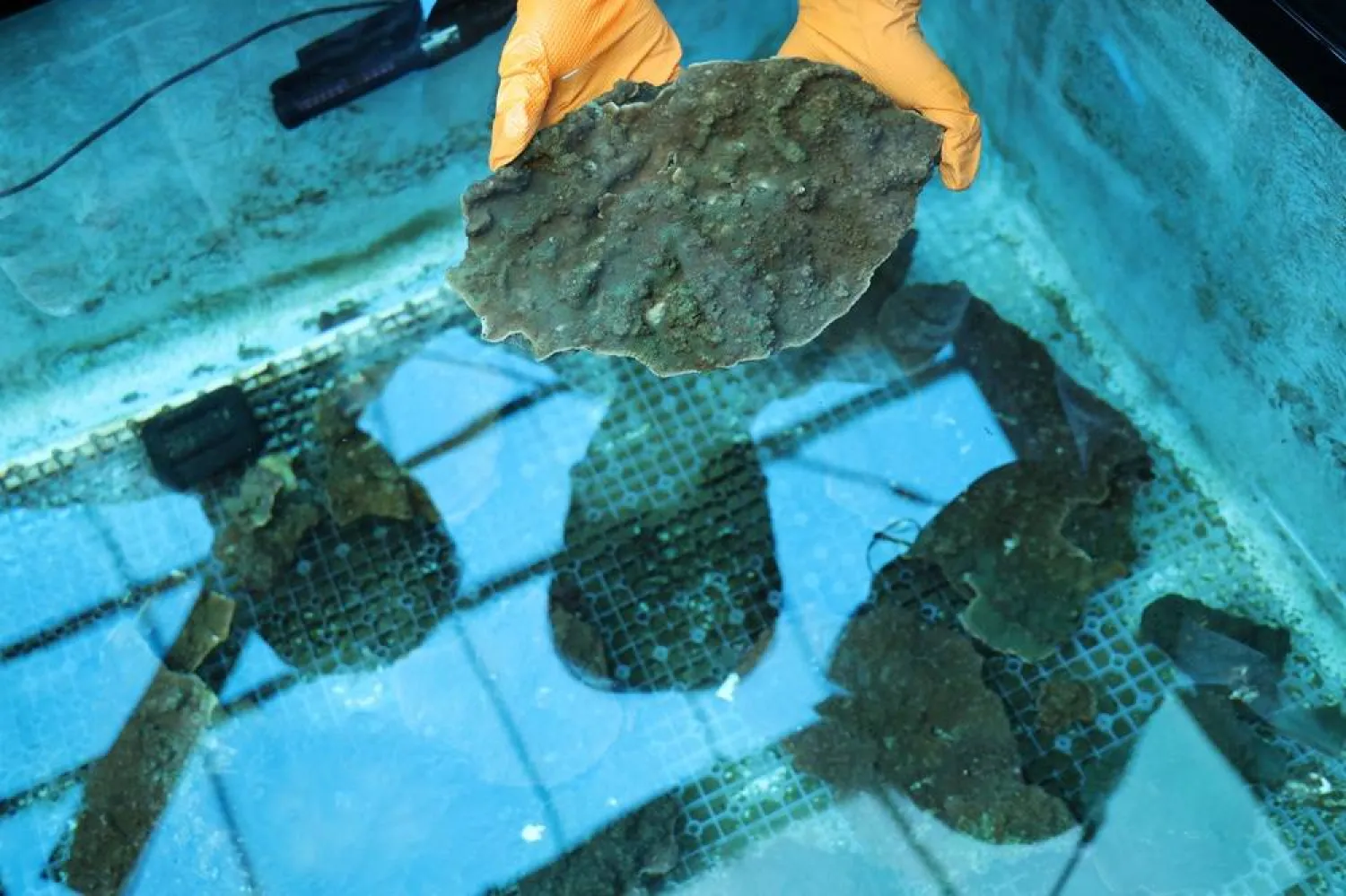
Kang Do-hyung, principal research scientist at Korea Institute of Ocean Science and Technology and former Oceans and Fisheries Minister, checks corals with researchers at a lab called Jeju Tropica, in Jeju, on Jeju Island, South Korea, August 20, 2026. (Reuters)
TT

‘Slumping’ South Korean Corals Worry Divers, Scientists Studying Climate Change

Kang Do-hyung, principal research scientist at Korea Institute of Ocean Science and Technology and former Oceans and Fisheries Minister, checks corals with researchers at a lab called Jeju Tropica, in Jeju, on Jeju Island, South Korea, August 20, 2026. (Reuters)

Ko Myeong-hyo loved the vibrant color and thriving life of South Korea's soft corals when she first began diving off the coast of Jeju island six years ago, looking to harvest seafood for sale.

"Watching the coral garden collapse and turn white, it was so disorienting," Ko says now, after two years of rising temperatures and harsher weather brought by climate change have led to many corals slumping over and dying.

"I was afraid the whole sea might be collapsing."

The "slumping" phenomenon is showing up again this year, says the Paran Ocean Citizen Science Center, a group of divers who monitor the island's UNESCO-listed soft corals, mostly around uninhabited islets south of Jeju.

Roughly half of one cluster off the islet of Beomseom has been struggling in past months, the group says.

Unlike hard corals supported by rigid calcium carbonate skeletons, soft corals rely on internal fluid pressure to keep upright. Environmental changes can disrupt that pressure, leading them to sag or collapse.

"If another large-scale 'slumping' happens, corals partially recover and ‌then a lot ‌break off and deteriorate again, and that keeps repeating, their capacity to recover just keeps declining," ‌said ⁠researcher Kim Taihun.

Kim ⁠and Anna Beate Jöst, a colleague at the Korea Institute of Ocean Science and Technology (KIOST), documented Jeju's 2024 soft coral slumping event for the first time in a May article in the journal Scientific Reports.

In an email, Korea Heritage Service, which manages the soft coral colonies designated a national monument, said it has monitored the situation this year and will keep up long-term research to identify the reasons for the changes.

The Oceans Ministry, which oversees marine protected species and areas such as soft corals, added that it plans detailed investigation to gauge the scale of damage.

EL NINO COULD WORSEN THIS YEAR'S EVENT

Kim said this year's event looked similar to that of 2024, but could worsen should high water temperatures persist ⁠through September, and the El Nino weather phenomenon may trigger typhoons and heavy rains.

But he called for ‌consistent and quantitative monitoring of the loss of soft corals through slumping, citing a ‌lack of research support.

Climate change has hit corals globally, with perhaps the world's most famous colonies on Australia's Great Barrier Reef getting the most attention.

A record ‌heatwave has parched the Korean peninsula this year while heavy rains have pelted the south.

Coral researchers say such weather conditions, as ‌well as water flowing down from China's Yangtze River to affect the area's salinity, are potential triggers for "slumping".

Jeju's waters have given safe harbor to soft coral communities, sensitive to environmental conditions and living on the edge of tolerable conditions in the northernmost limit of coral distribution in the East China Sea.

Soft coral functions as the nursery underpinning Jeju's marine ecosystem, and soft coral communities reside in the UNESCO-listed Jeju Island Biosphere Reserve.

"The seaweed sea, the coral ‌sea, is the foundational ecosystem underlying Jeju's marine ecology," said Yoon Sanghoon, an environmental expert at Paran.

"So if this base ecosystem collapses, there's a real possibility the entire marine ecosystem could collapse."

Over the ⁠past decade, marine heatwaves around ⁠Korea have extended almost four times longer, at 83.3 days, weather authorities say.

RIPPLING IMPACT

Paran, formed in 2023 by Jeju residents concerned by marine changes, brings together office workers, traditional divers and documentary filmmakers who flock there for monthly dives.

They plunge to the coral bed to take photograph and document changes they provide to scientists.

While Ko, a third-generation Jeju "haenyeo" or "sea woman", can dive to a depth of as much as 8 m (26 ft) relying on her own breath, she carries an oxygen tank on coral dives to greater depths.

The warming waters have affected the seabed in other ways, said her mother, 70-year-old Son Choon-sook, who began diving 45 years ago, when species such as turban shells, abalone and sea cucumber were abundant and thick seaweed festooned the rocks.

"I've worked at the sea for about 45 years, earned money, and sent my children to school on it," she said. "Now the catch has run dry, and it makes me very sad."

The thinning catch of the past few years follows summers that make the water too hot for species to spawn, she added, and her workday has shrunk to three hours from five formerly, as there is less to gather, but partly also for reasons of health.

Ko said her most recent dives in the summer have worried her again. "Rather than the beautiful coral shapes, I feel like I'm seeing more sick coral now," she added.



AlUla Skies 2026 Returns with Exceptional Celestial Experiences

The AlUla Skies Festival will take place from November 6-15. (SPA)
TT

AlUla Skies 2026 Returns with Exceptional Celestial Experiences

The AlUla Skies Festival will take place from November 6-15. (SPA)

Saudi Arabia’s AlUla Moments announced the return of AlUla Skies Festival, taking place from November 6-15, bringing 10 days of extraordinary experiences that celebrate the wonder of the skies. From hot-air balloons floating above the landscape at sunrise to immersive evenings beneath a canopy of stars, the festival offers visitors a spectacular new way to experience AlUla.

Designed as a celebration of nature, adventure, and astronomy, the event transforms AlUla’s dramatic desert landscapes into a destination for sky-inspired experiences, combining aerial adventures with cultural and entertainment programming, reported the Saudi Press Agency on Tuesday.

By day, guests can experience sunrise hot air balloon flights and aerial views over AlUla’s landscapes, while evenings will feature balloon glow shows, stargazing experiences, moonlight cinema, and wellness sessions, creating a unique blend of nature, culture, and immersive entertainment.

Timed to coincide with a period of moonless skies from November 7-12, with the New Moon on November 9, the 2026 edition offers ideal conditions for observing faint celestial objects. The festival will also coincide with the Leonid Meteor Shower on November 15, when visitors could see up to 20 meteors per hour with minimal moonlight interference.

As AlUla continues to grow as a leading destination for nature-based and experiential tourism, the festival offers visitors a chance to reconnect with the night sky and experience the landscapes from entirely new perspectives.

Among the headline moments of this year’s program is AlUla Skyrise, where guests can join a shared sunrise hot air balloon flight, rising above the landscapes of AlUla. The experience operates daily throughout the festival, with flights taking place from approximately 6:00-7:00 am, following early-morning transfers, briefing and boarding. Guests will also be served Saudi coffee and dates before take-off, with refreshments provided following the flight.

Visitors can also enjoy the Hot Air Balloon Glow Show, taking place at Hegra on November 6 and 7 and at Elephant Rock on November 13 and 14. The evening spectacle combines illuminated hot air balloons with music, lighting, projection, fire performers, and aerial trapeze artists, culminating in a choreographed grand finale.

Guests can join a shared sunrise hot air balloon flight, rising above the landscapes of AlUla. (SPA)

For those seeking a more accessible option, the Tethered Hot Air Balloon Experience offers gentle ascents with panoramic views of AlUla’s landscapes, making it ideal for families, first-time visitors, and photography enthusiasts. Payment is available on-site, with no advance booking required.

The festival will also feature VOX Moonlight Cinema at Our Habitas AlUla, across the 10-day program, with screenings scheduled throughout the festival.

For astronomy enthusiasts, the Stargazing at AlUla Fort experience will operate on November 6, 7, 10-12 and 13-15 from 19:00-23:00. The experience will feature five telescopes focused on planets and constellations, alongside guided observations led by a trained astronomer and a Rawi, who will provide cultural and storytelling context.

The 2026 program will also introduce Sunset Stillness wellness experiences at Our Habitas AlUla, featuring Guided Meditation, Sound Immersion and Conscious Connected Breathwork, taking place on November 13 and 14 from 17:00-18:00.

AlUla Skies Festival will bring stargazing experiences and hikes under the stars with Husaak, all set against AlUla’s sandstone mountains, canyons and heritage sites. With the festival taking place during a period of moonless skies, visitors can experience a range of daytime and night-time activities against AlUla’s dark desert skies.

The festival also highlights AlUla’s designation as the region’s First Dark Sky Park destination, with four areas officially designated as International Dark Sky Parks by DarkSky International, including AlGharameel Nature Reserve, Sharaan National Park and Wadi Nakhlah Nature Reserve. Together, these protected areas reinforce AlUla’s commitment to preserving its natural environments, reducing light pollution, while promoting sustainable tourism and offering visitors some of the region’s best stargazing conditions.

AlUla Skies Festival forms part of the AlUla Moments calendar, a year-round program celebrating art, culture, heritage, nature and adventure, and reinforces AlUla as a leading global destination for experiential travel.


Military Shows to be Featured at Saudi International Falcons and Hunting Exhibition 2026

The exhibition will welcome visitors daily from 2 p.m. to 11 p.m. - SPA
TT

Military Shows to be Featured at Saudi International Falcons and Hunting Exhibition 2026

The exhibition will welcome visitors daily from 2 p.m. to 11 p.m. - SPA

The Saudi International Falcons and Hunting Exhibition 2026, scheduled for October 1 to 10 in Malham, north of Riyadh, will feature military shows presented by the Ministry of Interior among the accompanying events, adding a new element to the program.

The exhibition will allow visitors to watch the military shows at 4:30 p.m. and 7 p.m., while the band will perform at 6 p.m. and 8 p.m., SPA reported.

This year's exhibition will offer a wide range of experiences, including "Falconer of the Future," safari, mountain climbing, fishing, shooting, horseback and camel riding, auctions, and workshops, providing families, youth, and enthusiasts with a variety of options during their visit.

The exhibition will welcome visitors daily from 2 p.m. to 11 p.m.


Italy's Catania Airport Reopens as Etna Threat Downgraded

Visitors climb Mount Etna as smoke rises from its volcano in Catania, on the Mediterranean island of Sicily, on September 28, 2026. (Photo by Roman PILIPEY / AFP)
TT

Italy's Catania Airport Reopens as Etna Threat Downgraded

Visitors climb Mount Etna as smoke rises from its volcano in Catania, on the Mediterranean island of Sicily, on September 28, 2026. (Photo by Roman PILIPEY / AFP)

Italy's Catania airport resumed flights on Tuesday after briefly halting operations due to renewed volcanic activity from nearby Mount Etna and adverse weather conditions, in the latest stop-and-go disruption to air traffic.

According to Reuters, Operator SAC said ⁠flights to and ⁠from the airport had resumed with immediate effect after the volcanic alert level was lowered from red to ⁠orange.

The hub had previously suspended operations until 1300 GMT on Tuesday, only hours after ending a three-day shutdown on Monday evening.

The Sicilian airport, Italy's fifth-busiest by passenger traffic, is often disrupted by volcanic ⁠ash ⁠interference from Mount Etna, Europe's highest and most active volcano.

The latest shutdown affected thousands of passengers and placed significant pressure on other Sicilian airports, as airlines diverted flights away from Catania.