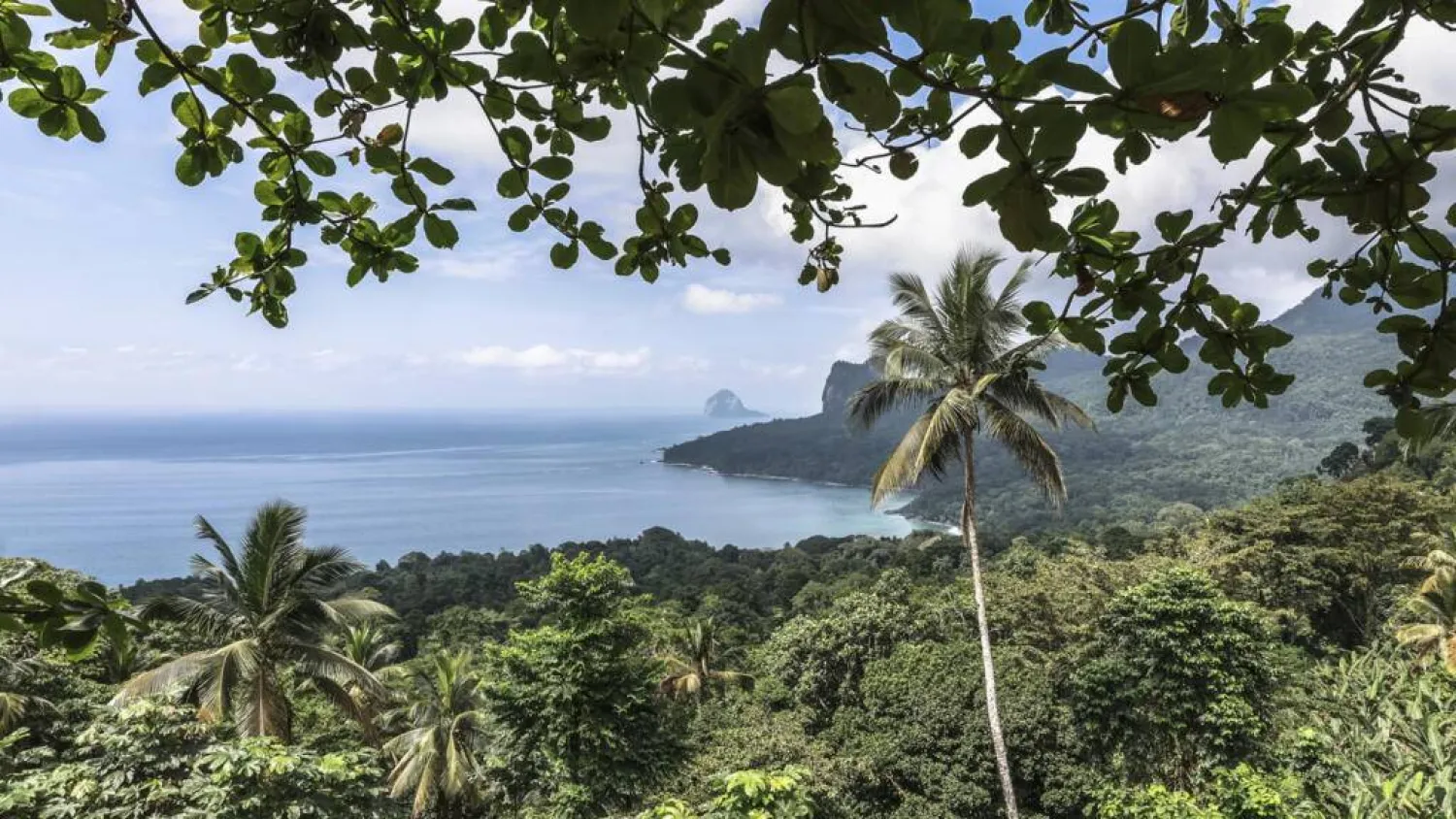
Cash for Nature Protection: Hotelier's Offer to Principe Islanders

Locals on the island of Principe are paid a financial dividend to preserve its natural beauty. Daniel BELOUMOU OLOMO / AFP
TT

Cash for Nature Protection: Hotelier's Offer to Principe Islanders

Locals on the island of Principe are paid a financial dividend to preserve its natural beauty. Daniel BELOUMOU OLOMO / AFP

On the paradise island of Principe, a lush jungle haven in the turquoise waters of the Gulf of Guinea, a South African multimillionaire is offering locals a financial dividend to preserve the natural beauty on which his luxury tourism business depends.
The initiative is the brainchild of tech entrepreneur Mark Shuttleworth, who for over a decade has been promoting a model of exclusive ecotourism aimed at an ultra-wealthy foreign clientele.
The dividend scheme, which Shuttleworth's charitable organization pays out individually to locals, aims to encourage them to preserve their natural environment -- a mountainous volcanic island, bordered by pristine beaches and whose tropical forest is home to a wealth of endemic species, AFP said.
In return for agreeing in writing not to engage in environmentally damaging activities like sand extraction or unregulated logging, adults can receive up to 6,250 dobras ($290) per quarter -- the equivalent of around $3.20 a day.
It represents a bonus in a tiny country where 45 percent of the population lives on less than $3.60 a day, according to the latest World Bank data from 2017.
But some critics say the initiative is a missed opportunity to work with the government to address the island's economic and social needs.
"I've just received the first quarterly payment. At 900 dobras it's definitely not a salary but it'll help," grinned 23-year-old technician Ermelindo Mendes, talking to AFP from his village of Monte Alegre in the lush hills.
The whole of Principe, part of the archipelago of Sao Tome and Principe, is an internationally recognized UNESCO biosphere reserve.
Staying in one of Shuttleworth's four hotels on the archipelago can cost up to $1,700 a night.
The hotelier promises his guests -- most of whom are European -- a luxury experience discovering a "hidden west African paradise".
- Nature's guardians -
His business model depends on preserving Principe's pristine natural environment.
So in February, to enlist the support of the island's 10,000 inhabitants, Shuttleworth began offering them a small nature dividend via his charitable organization, the Faya Foundation.
The locals are "nature's principal guardians. We need them on our side", said Vik Michau, a sociologist with the Foundation.
None have yet earned the maximum dividend of $290 per quarter.
"Data monitoring shows the natural environment isn't in an optimal state yet," Michau said.
To earn more, locals need to reforest the island and make what she described as "better choices regarding the natural environment".
Every year, 15,000 tourists visit the 140-square-kilometer (54-square-mile) island.
Many book the luxury package offered by Shuttleworth's HBD (Here Be Dragons) group.
"Most visitors are looking for nature, tranquility and peace -- everything the region has to offer," said Wander Dias de Sousa Pires, the head of the Principe tourist board.
- 'We see the suffering' -
But for the inhabitants of one of the world's poorest countries, the picture-postcard scenery masks a precarious daily struggle, beset by logistical difficulties and affected by distant geopolitical events over which they have no control.
"People who come here look at the scenery and say to themselves: 'This is paradise.' But those who live here see the suffering," said Conceicao Moreno, a 46-year-old member of parliament.
"We face utterly degrading social and economic conditions. The cost of living is very high, we have no access to quality healthcare or education and the roads and most of the infrastructure are in a state of disrepair," he said.
Moreno declined to take part in the dividend program, wary of the "relationship of domination" the grant might entail and unconvinced of its benefits to the recipients.
"The amounts paid out are too insignificant to have any impact on a family's survival," he said.
"They should have partnered with the government to offer social progress and infrastructure that would guarantee the island's development".
Michau said this view was to misunderstand the purpose of the foundation's "pioneering experiment".
The dividend is "not a salary" and charitable work cannot take the place of the state, she said.
"We are a private organization, not the government. We have drawn a very clear line between what falls within the government's remit, what we do here and where we can help."



Bacteria Suspected in Deaths of Hundreds of Baby Whales off Argentina

Scientists suspect a bacterial infection to be behind the mystery deaths of hundreds of southern right whale calves washed up on beaches in Argentina's Patagonia region. MAXI JONAS / AFP
TT

Bacteria Suspected in Deaths of Hundreds of Baby Whales off Argentina

Scientists suspect a bacterial infection to be behind the mystery deaths of hundreds of southern right whale calves washed up on beaches in Argentina's Patagonia region. MAXI JONAS / AFP

A bacterial infection is suspected of killing hundreds of baby whales in the southern Argentine region of Patagonia, a marine mammal expert told AFP on Thursday.

This week again, dozens of dead southern right whale calves washed up on beaches in southern Chubut province, continuing a disturbing trend that began in June.

"The death rate (among young whales) is quite high this season in particular," Mariano Coscarella, a researcher at the Marine Mammals Laboratory of the national research council Conicet, confirmed to AFP.

Coscarella, who is based in Puerto Madryn, a major whale-watching destination on the Atlantic coast, said veterinarians suspected an outbreak of erysipelas, a serious disease caused by bacteria commonly found on the mammals' skin.

"It seems to be a natural cause however we cannot completely rule out the influence of human activity," he said.

The Chubut provincial government said Wednesday it was working closely with the scientific community to solve the mystery of the dying whales.

It said that preliminary research suggested it was caused by a "common marine bacteria."

Puerto Madryn and the nearby Valdes Peninsula are a major breeding ground for southern right whales, which grow up to 17 meters (55 feet) in length and weigh on average 40 tons, roughly the equivalent of four elephants.

A record 2,110 whales were counted in the area in 2025, including 800 young.

This year, authorities have counted 1,375 specimens, including nearly 400 calves, Coscarella said.

He added that the recent deaths "do not constitute a medium-term danger" for the area's whale population given the average life span of the southern right whale, which local authorities put at 60 years.


Bats Originated and Took First Flight in Europe 65 Million Years Ago

FILE PHOTO: An Indian flying fox or fruit bat flies over trees at Kodiyathur village in Kozhikode district in the southern state of Kerala, India, February 2, 2022.REUTERS/Sivaram V/File Photo
TT

Bats Originated and Took First Flight in Europe 65 Million Years Ago

FILE PHOTO: An Indian flying fox or fruit bat flies over trees at Kodiyathur village in Kozhikode district in the southern state of Kerala, India, February 2, 2022.REUTERS/Sivaram V/File Photo

Scientists have long struggled to establish where bats first originated, with previous hypotheses proposing Africa, Asia and North America.

A new research has rewritten the evolutionary history of bats, providing evidence the winged mammals most likely originated in Europe during the late Palaeocene, some 65-60 million years ago.

By combining genomic data from all living bat families with ancient fossil records, an international team of 137 researchers from 64 countries working as part of the Bat1K consortium, a global initiative dedicated to sequencing the genomes of all living bat species have reconstructed the evolutionary history of the world's only mammals capable of true powered flight.

The landmark study published in Nature magazine analyzed 103 bat genomes, including 42 newly generated chromosome-level assemblies, representing all 21 recognized bat families.

This was combined with evidence from 44 fossil bats. The results provide a clearer picture of where and how this remarkable lineage emerged.

The researchers found that bats most likely first evolved in Europe during the late Palaeocene. And from there, their descendants spread into Africa.

As bats diversified, different groups then expanded independently into the Americas, Asia and Australia, eventually giving rise to the major bat groups found around the world today.

“The approach we used to model the evolution of fossil and living species together can do what other methods cannot - identify the oldest group of fossil bats while taking the genomic data into account, and uncover when and where bats originated,” said senior author Professor Liliana M Davalos from Stony Brook University.

Computationally reconstructing the genome of the ancient ancestor from which all living bats descended, researchers are able to offer a glimpse into the genetic make-up of one of the earliest flying mammals.

This new genomic resource will allow scientists to investigate the genetic changes behind bats' extraordinary diversity and adaptations, including flight, echolocation, longevity and resistance to disease, as well as their remarkable resistance to disease and exceptionally long lives, for their size.

Bats are among the most extraordinary mammals on Earth. They are the only mammals capable of true powered flight. Most bats orient and hunt in complete darkness using sound alone, and they account for one fifth of all living mammals, playing a vital role in maintaining healthy ecosystems across the globe.

Many bat species show remarkable resistance to disease and live exceptionally long lives for their size.

Yet despite their unique biology and ecological importance, scientists have struggled for decades to answer some of the most fundamental questions about their evolution.

“It is extraordinary, after decades of research and conflicting findings, we finally have a robust phylogenetic tree that we can now use to properly understand how and where bats’ unique traits evolved,” said leading senior author and co-founding Director of Bat1K Professor Emma Teeling, from the UCD School of Biology and Environmental Science.

“We also have the genomes to uncover the molecular basis of these spectacular mammalian adaptations and know where the fossil bats fall in this tree.”

This new study represents the largest combined bat genome and fossil study ever undertaken, drawing on samples collected over decades from bats around the world, including some of the rarest and unusual species found only in the most remote locations.


Mongolian Herders Enlist New Tech Against Harsher, Drier Climate

In this photo taken on August 25, 2026 sheep herder Ganchimeg stands with goats she rounded up in Bayantal, Mongolia's Govisumber province.  (Photo by Hector RETAMAL / AFP)
In this photo taken on August 25, 2026 sheep herder Ganchimeg stands with goats she rounded up in Bayantal, Mongolia's Govisumber province. (Photo by Hector RETAMAL / AFP)
TT

Mongolian Herders Enlist New Tech Against Harsher, Drier Climate

In this photo taken on August 25, 2026 sheep herder Ganchimeg stands with goats she rounded up in Bayantal, Mongolia's Govisumber province.  (Photo by Hector RETAMAL / AFP)
In this photo taken on August 25, 2026 sheep herder Ganchimeg stands with goats she rounded up in Bayantal, Mongolia's Govisumber province. (Photo by Hector RETAMAL / AFP)

When Mongolian herder Ganchimeg's sheep strayed dangerously near a salty lake this summer, driven by hunger as nearby vegetation was poor, she was in a "total panic".

"If they drank or stepped into it, the whole flock would be destroyed," she told AFP outside her traditional ger, the tent's shape silhouetted on the vast horizon of the Gobi Desert.

But thanks to an app helping herders navigate the risks that climate change is bringing to Mongolia, her husband was able to reach the sheep before they drank the brackish water.

"He immediately rushed over at top speed and intercepted them," said Ganchimeg, a mother of four who, like many Mongolians, goes by just one name.

"If we hadn't used that GPS tracker, we might have lost our entire flock."

Herders are on the frontline of both climate change and desertification impacts -- climate change is bringing extreme weather, including deadly cold snaps and droughts, which compound desertification caused by overgrazing.

Huge and sparsely populated, Mongolia is disproportionately affected by human-driven climate change, threatening the country's nomadic population and livestock.

Bilgudei Gankhulug, the 26-year-old founder of the Hunu app used by Ganchimeg, told AFP he was inspired to help herders after a 2024 "dzud" -- an extreme weather event that brought temperatures as low as minus 45C.

"Over eight million livestock died. I saw a lot of herders losing their income, losing their livelihoods in just the span of a few months," said Bilgudei.

Meaning "strong nomad", the name Hunu "embodies our mission of empowering nomadic herders with the help of technology," he said.

The app allows nomads to track their livestock with a solar-charging GPS device attached to one animal per group -- sufficient for herds that tend to stick together on the spacious steppe.

It has an artificial intelligence-powered weather feature with updates on the deadly dust storms and blizzards made more common in recent years by climate change, which scientists say is intensifying globally.

The app also compiles useful information on maps showing snow depth, wind direction, soil moisture and drought, assisting nomads in crucial decisions on where to move next.

Mongolia hosted talks on a global desertification treaty, known as COP17, last month.

Countries agreed financing for land restoration and tackling drought resilience, but concerns remain over a massive funding shortfall to the growing problem.

Bilgudei told AFP he hopes to expand Hunu to central Asian countries, and met with pastoralists from Tanzania and Uruguay at COP17 interested too.

"Our problems are pretty similar," he said.

About 80 percent of Mongolia is rangelands, large tracts of unfarmed land covered by native grasses and shrubs, according to Chimeddorj Buyanaa, Mongolia conservation director at the World Wildlife Fund.

"Rangelands are critically important for the local communities and also for the livelihoods of all of the Mongolian people," he told AFP.

Compounding the issue of climate change is rampant overgrazing that also endangers the region's wildlife, including snow leopards and saiga antelope, Chimeddorj said.

Around one in four Mongolians are nomadic herders.

Nearly 82 percent of the country's territory is affected by desertification and land degradation, authorities said in August.

Many herder families have simply decided to pack up and seek new lives in the city.

"Dundgovi Province's population has been declining continuously in recent years," the southern region's governor, Munkhchuluun Samdannyam, told AFP at COP17.

The worsening climate is a major problem for the province -- three-fifths of its economy depends on livestock husbandry, Munkhchuluun said -- but consequences are felt further afield.

"Dust storms can begin here and travel south to China, Korea, Japan and even as far as the United States," Munkhchuluun said.

"(It) is not only Mongolia's problem.

"It is also a global problem."

Speaking to AFP before heading to milk several camels tethered nearby, 49-year-old herder Bolormaa Erdenee said she was skeptical of forums like COP17.

"I often question whether the true voice of our herders is actually reaching decision-makers or not," she said.

Bolormaa and her husband raise about 400 livestock.

In their usual summer grazing area, she said roads for heavy mining trucks now criss-cross the steppe, kicking up dust and disrupting her animals.

Several nomadic households nearby have already relocated nearly 200 kilometers (125 miles) away in search of greener pastures.

Hunu app founder Bilgudei -- whose ancestors were nomadic herders -- said traditional migration itself is a form of environmental protection.

Bilgudei told AFP it's important to "learn from the traditions... and combine it with the science and technology".