


New York to Ban Central Park’s Horse-Drawn Carriages After Teen’s Death

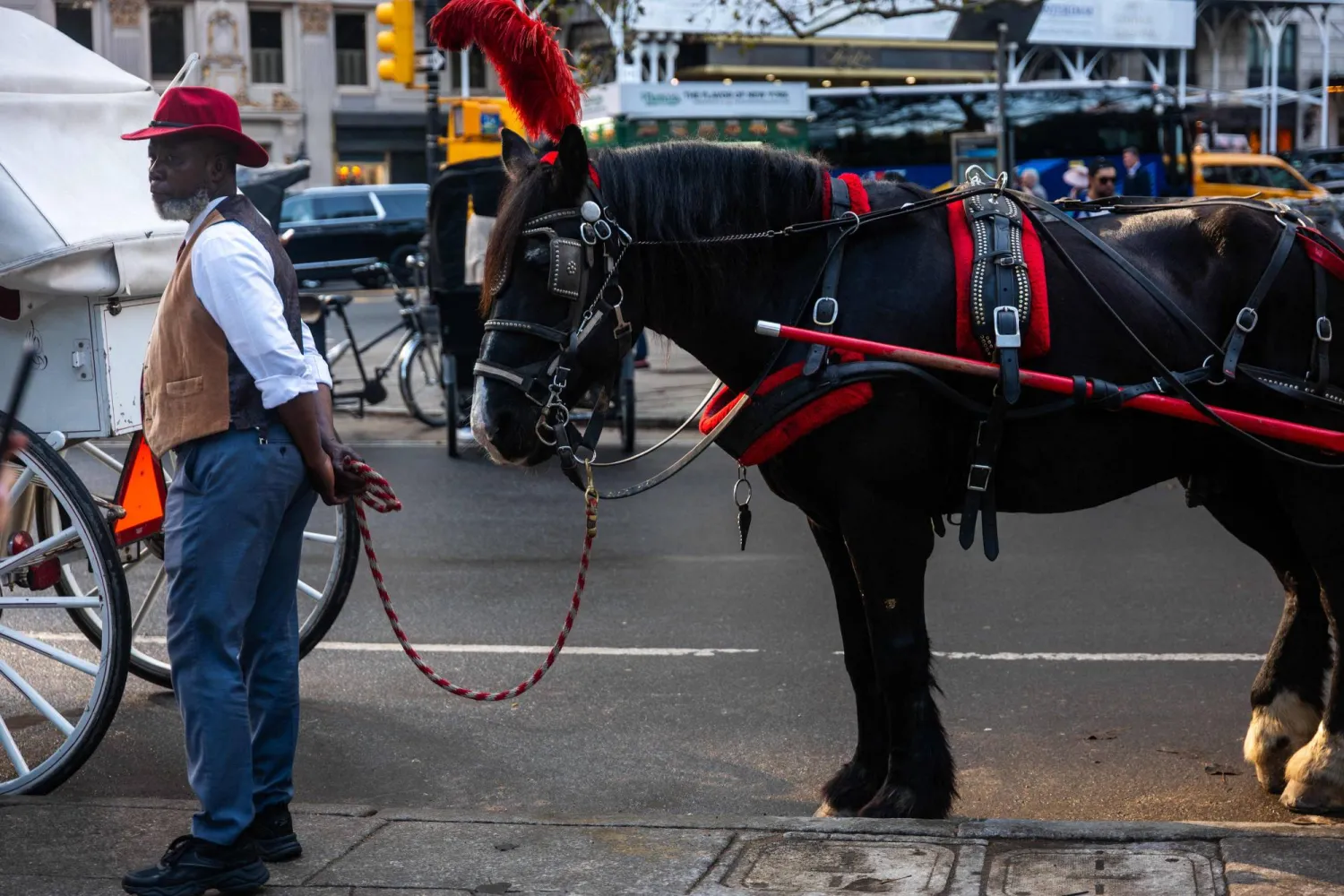
Carriage horses and their drivers relax in Central Park as they wait for customers on October 14, 2026 in New York City. (Getty Images/AFP)
TT

New York to Ban Central Park’s Horse-Drawn Carriages After Teen’s Death

Carriage horses and their drivers relax in Central Park as they wait for customers on October 14, 2026 in New York City. (Getty Images/AFP)

New York City lawmakers plan to ban horse-drawn carriages from Central Park, ending their more than 150-year run as an iconic, old-timey tourist attraction, following decades of opposition from animal welfare activists and the death of a teenage tourist last spring.

The City Council is expected to approve a bill next week that would end the rides by 2028. Three consecutive mayors had called for an end to the carriage rides because of safety concerns, only to have lawmakers yank back the reins.

A spokesperson for Julie Menin, the council speaker, confirmed the incoming vote and said the proposal had enough support to pass. Mayor Zohran Mamdani's office said he had reached a deal with the speaker on the legislation.

“The horse carriage industry is coming to an end in New York City,” Mamdani said in a social media post.

The latest push for a ban started in June, when 18-year-old Romanch Mahajan, visiting the city from India, died after jumping from a runaway horse carriage during a ride with family members.

His death, which appeared to be the first fatality in a horse carriage accident since they were introduced in Central Park, reignited the debate over whether carriages, a romantic throwback to the city's past, have a place in a modern metropolis.

Mahajan's family has appeared at City Hall, in person and through videoconference calls from India, begging the city to finally end the rides.

“We are shattered, our whole family shattered. The pain does not go away,” his father, Deepak Mahajan, told city council members via a videocall during a hearing for the bill last summer, saying his son leaped from the carriage to try and help his mother, who was flung from her seat, after the horse bolted. “Every morning we wake up and think of nothing but the loss of our son.”

For decades, animal welfare activists and other critics have decried the carriage industry, arguing horses shouldn't be hauling tourists around busy streets and Central Park while having to navigate bustling traffic and gawking passersby.

In the past, horses have collapsed, gotten startled and run off, hitting cars or other objects, with each accident resulting in fresh calls for a ban.

“The tragic and preventable death of 18-year-old Romanch Mahajan made clear that the status quo is no longer acceptable. Horse-drawn carriages have long been part of New York City’s history, but in an increasingly busy Central Park, this tradition has become a growing public safety liability,” Menin said in a statement.

The industry and its supporters have long cast the rides as a way for visitors to experience the New York they know from classic movies and television.

Fred Astaire and Cyd Charisse danced into one of the carriages in “The Band Wagon.” Robert Redford and Jane Fonda rode one in “Barefoot in the Park.” Macaulay Culkin escaped bandits in a carriage in “Home Alone 2: Lost in New York.”

“Taking a horse and carriage ride in New York City is one of the most iconic things to do in New York City and people from all over the world know about us and travel to New York to go to a carriage ride in New York,” Conor McHugh, a longtime carriage driver, told the Council earlier this year.

Mayors have faced pushback in efforts to ban rides

Efforts to close down the industry have been met with pushback from unions and influential supporters, often resulting in tiresome political fights that have seen mayors throw up their hands over nagging worries about putting carriage drivers out of work and what to do with the horses if they can no longer work.

Transport Workers Union International President John Samuelsen said the Council's bill has “no meaningful economic relief for workers” and that Menin “used the tragic death of a tourist to contrive a public safety crisis.”

“This is disgraceful political opportunism, and Zohran should not simply go along with it, particularly when immigrant families’ livelihoods are being destroyed. This entire situation is reprehensible,” he said in a statement.

The proposal as written would require the mayor's office to develop a workforce transition plan for drivers, and includes a measure that would allow the city to consider some kind of compensation for industry workers. Carriage owners could not sell their horses off for slaughter, according to the bill's language, which requires that horses be disposed of in a “humane manner.”

“I think we have a civic responsibility to ensure that we are not leaving anybody out to dry,” Mamdani told reporters Wednesday.

The mayor's predecessor, Eric Adams, called for ending the industry during the waning days of his administration, but the proposal went nowhere. The mayor before that, Bill de Blasio, had pledged to eliminate the rides on day one of his administration but abandoned the crusade after heavy opposition from unions and a media blitz involving actor Liam Neeson.

Over the years, the city has placed various safety regulations around the industry, including a requirement that the horses get at least five weeks of vacation a year outside of city limits with daily access to a pasture. The horses are inspected by a veterinarian twice a year, and the maximum age they can work at is 26, according to city regulations. And they don't work when it is hotter than 89 degrees.



Missing Teen Found Alive After 6 Days in Australian Woodlands

In this image made from video and provided by the Victoria State Police 17-year-old William, center right, is embraced by his mother Elizabeth, only first names were provided by police, while in a helicopter in Cowwarr, Australia, Thursday, Nov. 12, 2026, after William spent six days lost in eastern Australian woodlands. (Victoria Police via AP)
TT

Missing Teen Found Alive After 6 Days in Australian Woodlands

In this image made from video and provided by the Victoria State Police 17-year-old William, center right, is embraced by his mother Elizabeth, only first names were provided by police, while in a helicopter in Cowwarr, Australia, Thursday, Nov. 12, 2026, after William spent six days lost in eastern Australian woodlands. (Victoria Police via AP)

A 17-year-old boy with autism was found alive Thursday after six days lost in eastern Australian woodlands.

The boy, whom police identified only as William, had begun camping with a teenage friend when he disappeared last Friday near Walhalla, a former gold-mining town 185 kilometers (115 miles) east of Melbourne, police said.

A police helicopter crew found him surrounded by wilderness lying asleep on a flat rock beside a creek, and he was later reunited with his mother. William was in good spirits and mostly in good health, the police statement said.

Video shot from the rescue helicopter showed he was shirtless and sunburned. He was wearing shorts and boots and was using towels as blankets.

“I’m just over the moon that he’s alive,” his mother, Elizabeth, told reporters.

The AP has decided not to provide her family name to avoid identifying her son.

“And he’s never leaving the house again. He’s grounded for life. He’s not going anywhere ever again,” she joked.

William was later taken to a hospital for his health to be monitored, police said.

William's family have said he has Level 2 autism. That requires “substantial support,” according to the Australian advocacy group Autism360.

Such a person may have marked deficits in verbal and non-verbal social communication and rely heavily on routines and predictable activities.

Disruption can cause significant distress.

The Southern Hemisphere spring weather had been mild for the past week in the alpine region where William was lost and there had been little rain.

Elizabeth had dropped off her son and his friend last Friday for a weekend of camping. William walked a short distance from the campsite to the drop-off location to collect more camping equipment but never returned to his friend, police said.

After becoming lost, William trekked for days up and down “some very steep terrain,” Acting Police Inspector Jason Benbow said.

He spent the last two days where he was found at the creek, trapped by the steepness of his surrounds 2 kilometers (1.2 miles) from his camp site, Benbow said.

“He woke up to the sound of the helicopter, gave them a thumbs up and they winched him to safety,” Benbow told reporters.

The extensive police search for him involved more than 100 emergency services personnel and volunteers.


Europe’s Hera Spacecraft Begins Close Inspections of an Asteroid Rammed by NASA in a 2022 Test

This undated image provided by the European Space Agency on Nov. 5, 2026 and taken by the Hera spacecraft, shows asteroid Didymos. (European Space Agency via AP)
TT

Europe’s Hera Spacecraft Begins Close Inspections of an Asteroid Rammed by NASA in a 2022 Test

This undated image provided by the European Space Agency on Nov. 5, 2026 and taken by the Hera spacecraft, shows asteroid Didymos. (European Space Agency via AP)

A European spacecraft has begun close inspections of an asteroid rammed by NASA four years ago in a planetary defense test.

The European Space Agency announced Wednesday that the Hera spacecraft is now studying Didymos and its moonlet Dimorphos from just 15 miles to 18 miles (25 kilometers to 30 kilometers) away, The AP news reported.

NASA’s Dart spacecraft deliberately slammed into little Dimorphos in 2022 to see whether such a defensive move might help save Earth from a killer space rock one day.

The impact shortened the moonlet’s orbit around Didymos. More importantly, it nudged the moonlet into a slightly different path around the sun.

Next month, the small car-sized Hera, launched in 2024, will venture even closer — just 12 miles (20 kilometers) away.

ESA officials consider this a “crash site investigation” worthy of its finest robotic detective. Hera is carrying 25 science instruments as well as a pair of shoebox-sized Cubesats to survey Dimorphos even more closely and attempt to land on it.

The Dart spacecraft — short for Double Asteroid Redirection Test — sent rubble and even boulders flying off Dimorphos, providing an extra kick to the impact’s momentum. The debris trail extended thousands of miles (more than 10,000 kilometers) into space for months.

Some of that debris could still be in the vicinity, according to scientists.

Dimorphos is an estimated 500 feet (151 meters) in diameter. Didymos is roughly 2,560 feet (780 meters) in diameter.


Euclid Mission Data Release Spans More than 900 Million Galaxies

Looking across vast distances means peering into the past because of the time needed for light from distant objects to reach us (Reuters)
TT

Euclid Mission Data Release Spans More than 900 Million Galaxies

Looking across vast distances means peering into the past because of the time needed for light from distant objects to reach us (Reuters)

The European Space Agency has released its first big collection of data from the orbiting Euclid telescope's mission to map the universe's large-scale structure, including observations of more than 900 million galaxies, as scientists investigate the puzzling cosmic components dark matter and dark energy.

The data unveiled on Thursday covered a survey of the sky equal to about 9,500 times the size of the moon as viewed from Earth. The mission's goal is to complete the largest-ever three-dimensional atlas of the cosmos, spanning more than a third of the sky, in 2031.

Thursday's release encompassed around 13 months of Euclid observations, totaling an enormous 1.7 petabytes — 1.7 million gigabytes — of data, Reuters reported.

"It marks a major milestone for ESA's Euclid mission and for everyone involved," said astrophysicist Valeria Pettorino, ESA's Euclid project scientist.

Euclid, launched from Florida in 2023, is gathering data on how the universe has expanded and how its structure has formed over time while amassing information about the nature of dark energy and dark matter and the role of gravity on large scales.

"Euclid will not just take images of galaxies in the sky, in two dimensions, but will also measure their distance, the third dimension. This will tell us where galaxies are in space and time, across 10 billion years, and in all directions beyond our galactic plane," Pettorino said.

"Galaxies cluster along filaments, surrounded by empty space, and form a network that we call the cosmic web. Euclid will reconstruct the cosmic web and how it has grown over time. This is important because the exact configuration of the cosmic web, how many clusters or voids are there, how fast it changed, depend on the properties of dark energy and dark matter," Pettorino said.

The universe's contents include ordinary matter as well as dark matter and dark energy.

Ordinary matter — stars, planets, gas, dust and all the familiar stuff on Earth — represents about 5% of the contents. Dark matter, known from the gravitational effects it exerts on galactic scales, is invisible material that may make up about 27% of the cosmos. Dark energy, thought to be responsible for the accelerated expansion of the universe, may account for 68%.

Dark matter and dark energy do not emit or absorb light and cannot be directly observed.

Previous Euclid data releases covered only a few days of observations. The newly released dataset includes more than a year of data and still spans only 14% of the total sky area Euclid is due to survey in visible and near-infrared light over six years. This data release will be completed next year with the first results on dark energy and dark matter.

GRAVITATIONAL LENSING

Light traveling toward Earth from faraway galaxies can be bent and distorted by normal matter and dark matter in the foreground, an effect called gravitational lensing. Thus, the nearer galaxy's gravity warps the light coming from the one behind.

Gravitational lensing is one of the tools being used to study dark matter's distribution. The new Euclid data includes about 15,000 strong gravitational lens candidates, exceeding the total number discovered in the previous half century.

"Gravitational lenses are nature's own weighing scales," said Natalie Lines, a doctoral student in astrophysics at the University of Portsmouth in England and a member of the Euclid Consortium of scientists.

"How strongly the light is bent tells us how much matter a galaxy contains, including invisible components like dark matter. With thousands of lenses, we can study how dark matter is spread through galaxies and understand how galaxies form and evolve over cosmic time," Lines said.

Lines noted the sharpness of the Euclid images over a huge area of the cosmos.

"Telescopes on Earth can cover large areas of the night sky, but their view is blurred by the atmosphere. The Hubble and James Webb space telescopes take beautifully sharp images, but only of tiny patches of sky. Euclid does both at once, and that is crucial for finding things that are small and rare, like strong gravitational lenses," Lines said.

Looking across vast distances means peering into the past because of the time needed for light from distant objects to reach us. The most distant objects Euclid has viewed are quasars, the brilliant cores of galaxies powered by supermassive black holes. The telescope has pinpointed 60 million of them.

"Euclid has found some dating back to when the universe was just 5% of its current age, so their light set off around 13 billion years ago," Lines said.