


Rare Family of Barn Owls Move into Manhattan's Upper West Side

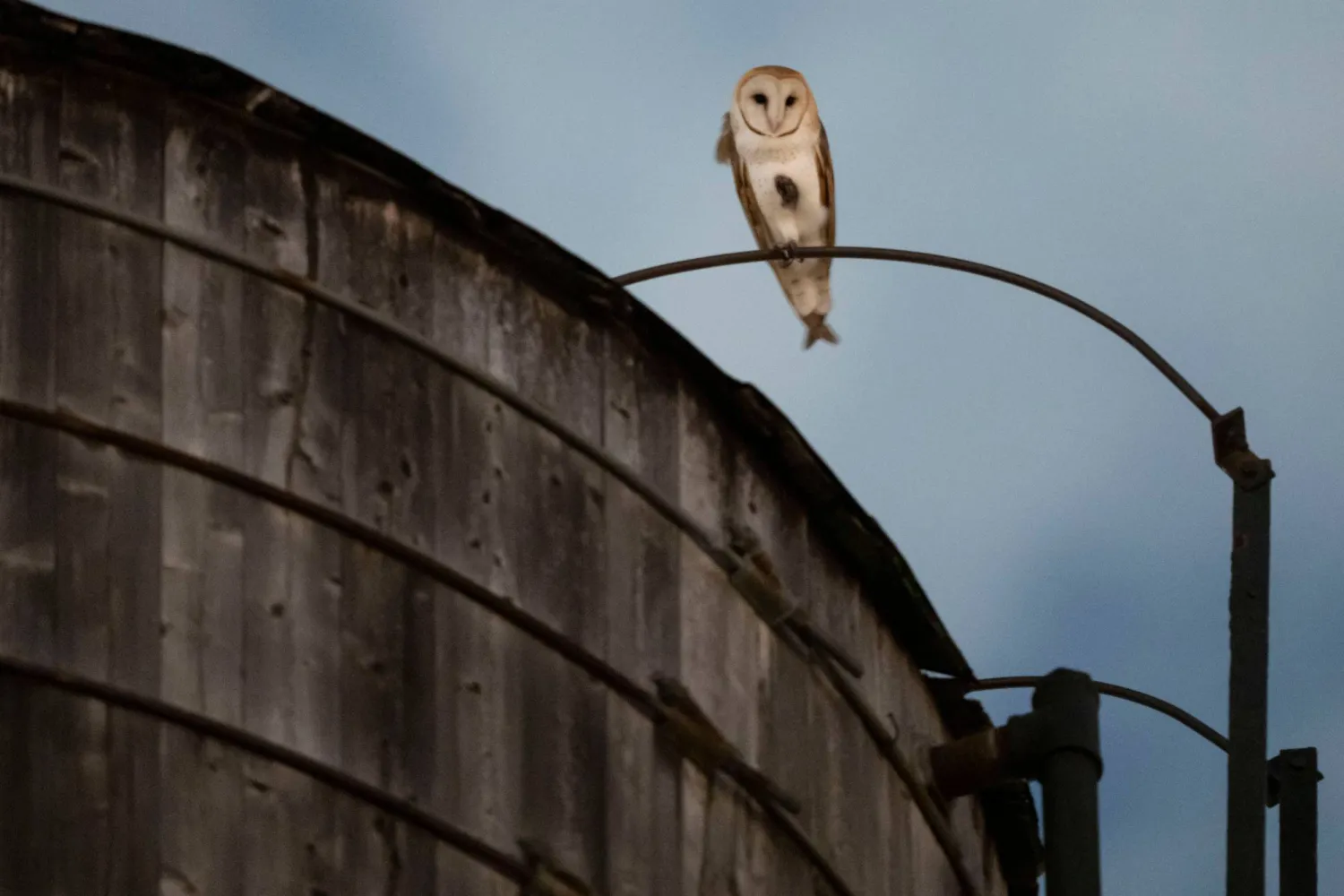
An American Barn Owl sits perched on a water tower on the Upper West Side neighborhood, Wednesday, Oct. 14, 2026, in New York. (AP Photo/Yuki Iwamura)
TT

Rare Family of Barn Owls Move into Manhattan's Upper West Side

An American Barn Owl sits perched on a water tower on the Upper West Side neighborhood, Wednesday, Oct. 14, 2026, in New York. (AP Photo/Yuki Iwamura)

Manhattan's Upper West Side has been reveling in the company of its latest celebrities: A family of barn owls nested in a water tower atop a building near Central Park.

This is the first documented instance of barn owls nesting in Manhattan in modern history, according to one expert, and the owls have attracted nightly crowds of people in the street eager to get a glimpse of the elusive birds.

“It was, like, totally shocking,” Andrew Farnsworth, a migration ecologist at the Cornell Lab of Ornithology, said of the barn owls. “To the best of our knowledge, like the collective birding knowledge, there hasn’t been a nest in, you know, in Manhattan, at least in recorded history.”
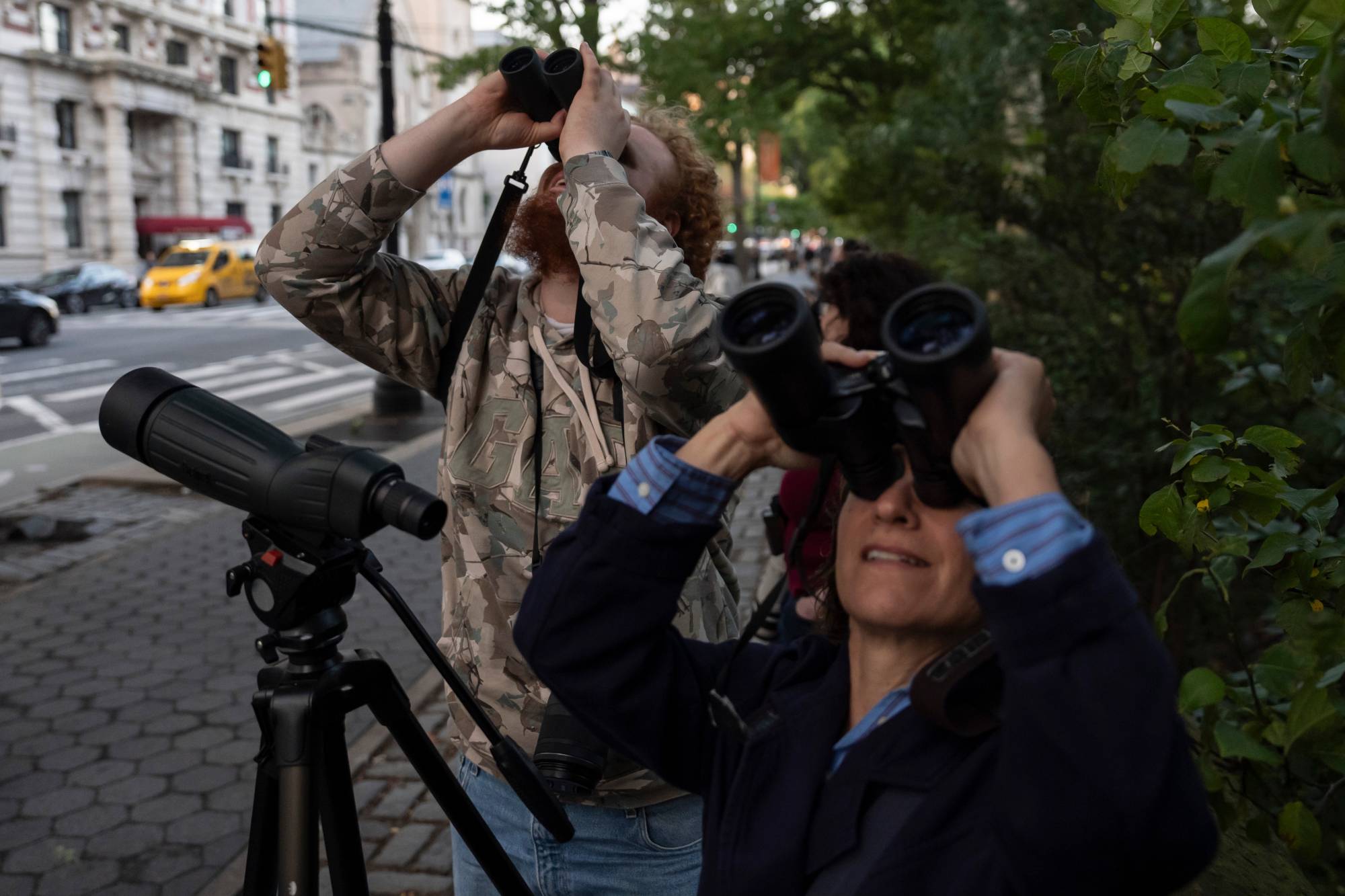
People look at American Barn Owls sit perched on a water tower on the Upper West Side neighborhood, Tuesday, Oct. 13, 2026, in New York. (AP Photo/Yuki Iwamura)

Word of the barn owl family didn't get around until last week, when Elisabeth Williams, an Upper West Side resident, notified a local news outlet on Oct. 6 that she and her husband saw multiple owls at the water tower atop a building on West 75th Street close to Central Park West.

The couple had previously seen a single owl on an apartment windowsill a few days earlier and were shocked even then, Williams recalled, according to The Associated Press.

“In a place like Manhattan, you normally really have to go out of your way to encounter nature,” she said. “And here it was, just sort of right outside our window.”

Barn owl sightings are rare in New York City It's not the first time that birds have captivated New Yorkers. Residents have fallen in love with American woodcocks, who are known to stop in Midtown Manhattan’s Bryant Park every year as they migrate north in early spring.

After Flaco the Eurasian eagle-owl died in 2024, dozens of mournful fans gathered to say goodbye to the beloved creature who flew around Manhattan and became a joy to many after someone let him out of his zoo enclosure the previous year. Then there was Pale Male, a red-tailed hawk who nested above Fifth Avenue for three decades before dying in 2023.

But barn owl sightings in New York City parks are very rare, according to the New York City Department of Parks & Recreation. New York is at the northern fringe of the barn owl's range and the barn owl population has declined “at an alarming rate” over time, according to the state Department of Environmental Conservation.

“There’s lots of excitement among New Yorkers, both birders and non-birders alike, about these owls because owls really capture the attention,” said Jessica Wilson, executive director of NYC Bird Alliance. “They’re magical, they’re nocturnal, they are secretive, they’re not commonly seen, especially on the Upper West Side of Manhattan. And to have this chance to see these birds is really thrilling.”

Photographers and casual onlookers have gathered on the street on a nightly basis to spot the owls.

“I’ve only seen one barn owl ever, and that was in California,” said Val Coleman, a retired New York City resident who was on the Upper West Side earlier this week trying to spot the owls.

“At dusk, we hope they will come out to hunt. We hope they don’t eat poisoned rats with rodenticide in ’em.”

David Barrett, a Manhattan-based birder who runs the popular social media account, Manhattan Bird Alert, said he’s observed at least one adult barn owl and five fledglings at the water tower. He’s also seen an adult owl carrying rodents back to the water tower. There are believed to be two adult owls, and some photographers have claimed to have seen six fledglings, Barrett added.

“Having one barn owl is a rarity, but it’s not national news. Having a family, for the first time ever, breeding in Manhattan in recorded history, that’s special news,” Barrett said.

Screeching was heard by residents Before the recent barn owl sightings, Williams and her husband heard periodic screeching noises outside going back to early September. They initially assumed it was a bird of some kind but were skeptical when a phone app indicated the noise was from a barn owl.

Thomas Obersteiner said that he first heard bizarre screeching and wailing noises from outside one evening in mid-September. It sounded like someone was “being murdered outside,” he said.

“That lasted for two or three weeks, every night, sometimes more, sometimes less, coming from different directions,” Obersteiner added. “But I had no idea what that was.”
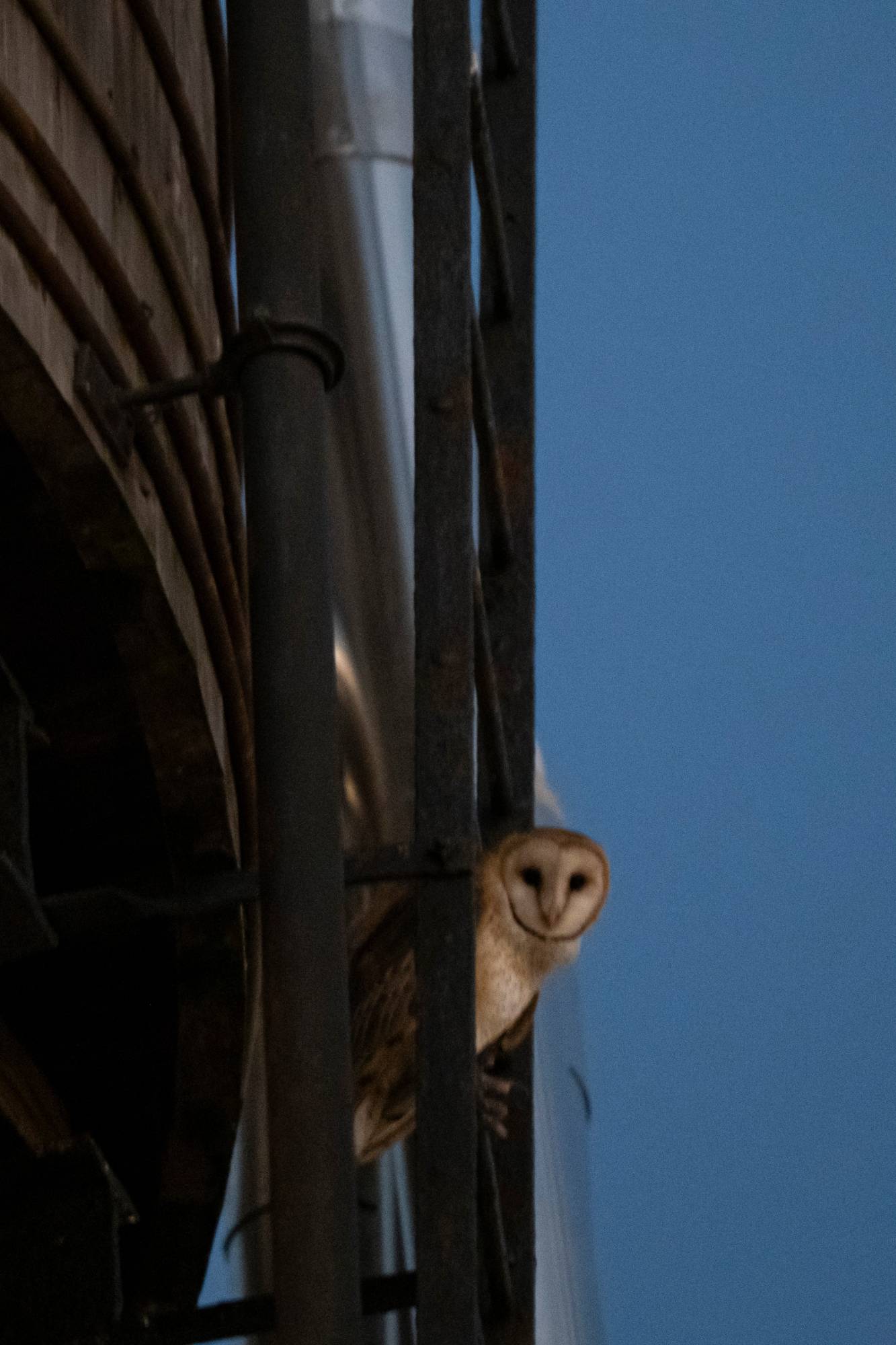
An American Barn Owl sits perched on a water tower on the Upper West Side neighborhood, Wednesday, Oct. 14, 2026, in New York. (AP Photo/Yuki Iwamura)

On multiple occasions, Obersteiner or his wife ran into their children's bedroom after mistaking the owls' screech for a child in pain, he said. It wasn't until he saw a news report that he realized that owls were making the sounds.

Farnsworth said the screech is typical of barn owls, who use it to communicate with one another. The screech is like a “horror movie kind of experience,” he said.

Obersteiner, who said his roof deck is “probably the best location in town right now” to watch the owls, has been letting nature photographers access that perch to observe the owls “almost every night” since news of the barn owls spread. On one night last week, 20 people had gathered.

“We can’t say no because it’s so much fun and these people are so serious,” Obersteiner added. “It's beautiful.”

Williams and her husband were not bird watchers before the barn owl family moved in to the water tower. But that may change soon after their “delightful” experience.

“I think we’re about to become birders,” Williams said.


Missing Teen Found Alive After 6 Days in Australian Woodlands

In this image made from video and provided by the Victoria State Police 17-year-old William, center right, is embraced by his mother Elizabeth, only first names were provided by police, while in a helicopter in Cowwarr, Australia, Thursday, Nov. 12, 2026, after William spent six days lost in eastern Australian woodlands. (Victoria Police via AP)
TT

Missing Teen Found Alive After 6 Days in Australian Woodlands

In this image made from video and provided by the Victoria State Police 17-year-old William, center right, is embraced by his mother Elizabeth, only first names were provided by police, while in a helicopter in Cowwarr, Australia, Thursday, Nov. 12, 2026, after William spent six days lost in eastern Australian woodlands. (Victoria Police via AP)

A 17-year-old boy with autism was found alive Thursday after six days lost in eastern Australian woodlands.

The boy, whom police identified only as William, had begun camping with a teenage friend when he disappeared last Friday near Walhalla, a former gold-mining town 185 kilometers (115 miles) east of Melbourne, police said.

A police helicopter crew found him surrounded by wilderness lying asleep on a flat rock beside a creek, and he was later reunited with his mother. William was in good spirits and mostly in good health, the police statement said.

Video shot from the rescue helicopter showed he was shirtless and sunburned. He was wearing shorts and boots and was using towels as blankets.

“I’m just over the moon that he’s alive,” his mother, Elizabeth, told reporters.

The AP has decided not to provide her family name to avoid identifying her son.

“And he’s never leaving the house again. He’s grounded for life. He’s not going anywhere ever again,” she joked.

William was later taken to a hospital for his health to be monitored, police said.

William's family have said he has Level 2 autism. That requires “substantial support,” according to the Australian advocacy group Autism360.

Such a person may have marked deficits in verbal and non-verbal social communication and rely heavily on routines and predictable activities.

Disruption can cause significant distress.

The Southern Hemisphere spring weather had been mild for the past week in the alpine region where William was lost and there had been little rain.

Elizabeth had dropped off her son and his friend last Friday for a weekend of camping. William walked a short distance from the campsite to the drop-off location to collect more camping equipment but never returned to his friend, police said.

After becoming lost, William trekked for days up and down “some very steep terrain,” Acting Police Inspector Jason Benbow said.

He spent the last two days where he was found at the creek, trapped by the steepness of his surrounds 2 kilometers (1.2 miles) from his camp site, Benbow said.

“He woke up to the sound of the helicopter, gave them a thumbs up and they winched him to safety,” Benbow told reporters.

The extensive police search for him involved more than 100 emergency services personnel and volunteers.


Europe’s Hera Spacecraft Begins Close Inspections of an Asteroid Rammed by NASA in a 2022 Test

This undated image provided by the European Space Agency on Nov. 5, 2026 and taken by the Hera spacecraft, shows asteroid Didymos. (European Space Agency via AP)
TT

Europe’s Hera Spacecraft Begins Close Inspections of an Asteroid Rammed by NASA in a 2022 Test

This undated image provided by the European Space Agency on Nov. 5, 2026 and taken by the Hera spacecraft, shows asteroid Didymos. (European Space Agency via AP)

A European spacecraft has begun close inspections of an asteroid rammed by NASA four years ago in a planetary defense test.

The European Space Agency announced Wednesday that the Hera spacecraft is now studying Didymos and its moonlet Dimorphos from just 15 miles to 18 miles (25 kilometers to 30 kilometers) away, The AP news reported.

NASA’s Dart spacecraft deliberately slammed into little Dimorphos in 2022 to see whether such a defensive move might help save Earth from a killer space rock one day.

The impact shortened the moonlet’s orbit around Didymos. More importantly, it nudged the moonlet into a slightly different path around the sun.

Next month, the small car-sized Hera, launched in 2024, will venture even closer — just 12 miles (20 kilometers) away.

ESA officials consider this a “crash site investigation” worthy of its finest robotic detective. Hera is carrying 25 science instruments as well as a pair of shoebox-sized Cubesats to survey Dimorphos even more closely and attempt to land on it.

The Dart spacecraft — short for Double Asteroid Redirection Test — sent rubble and even boulders flying off Dimorphos, providing an extra kick to the impact’s momentum. The debris trail extended thousands of miles (more than 10,000 kilometers) into space for months.

Some of that debris could still be in the vicinity, according to scientists.

Dimorphos is an estimated 500 feet (151 meters) in diameter. Didymos is roughly 2,560 feet (780 meters) in diameter.


Euclid Mission Data Release Spans More than 900 Million Galaxies

Looking across vast distances means peering into the past because of the time needed for light from distant objects to reach us (Reuters)
TT

Euclid Mission Data Release Spans More than 900 Million Galaxies

Looking across vast distances means peering into the past because of the time needed for light from distant objects to reach us (Reuters)

The European Space Agency has released its first big collection of data from the orbiting Euclid telescope's mission to map the universe's large-scale structure, including observations of more than 900 million galaxies, as scientists investigate the puzzling cosmic components dark matter and dark energy.

The data unveiled on Thursday covered a survey of the sky equal to about 9,500 times the size of the moon as viewed from Earth. The mission's goal is to complete the largest-ever three-dimensional atlas of the cosmos, spanning more than a third of the sky, in 2031.

Thursday's release encompassed around 13 months of Euclid observations, totaling an enormous 1.7 petabytes — 1.7 million gigabytes — of data, Reuters reported.

"It marks a major milestone for ESA's Euclid mission and for everyone involved," said astrophysicist Valeria Pettorino, ESA's Euclid project scientist.

Euclid, launched from Florida in 2023, is gathering data on how the universe has expanded and how its structure has formed over time while amassing information about the nature of dark energy and dark matter and the role of gravity on large scales.

"Euclid will not just take images of galaxies in the sky, in two dimensions, but will also measure their distance, the third dimension. This will tell us where galaxies are in space and time, across 10 billion years, and in all directions beyond our galactic plane," Pettorino said.

"Galaxies cluster along filaments, surrounded by empty space, and form a network that we call the cosmic web. Euclid will reconstruct the cosmic web and how it has grown over time. This is important because the exact configuration of the cosmic web, how many clusters or voids are there, how fast it changed, depend on the properties of dark energy and dark matter," Pettorino said.

The universe's contents include ordinary matter as well as dark matter and dark energy.

Ordinary matter — stars, planets, gas, dust and all the familiar stuff on Earth — represents about 5% of the contents. Dark matter, known from the gravitational effects it exerts on galactic scales, is invisible material that may make up about 27% of the cosmos. Dark energy, thought to be responsible for the accelerated expansion of the universe, may account for 68%.

Dark matter and dark energy do not emit or absorb light and cannot be directly observed.

Previous Euclid data releases covered only a few days of observations. The newly released dataset includes more than a year of data and still spans only 14% of the total sky area Euclid is due to survey in visible and near-infrared light over six years. This data release will be completed next year with the first results on dark energy and dark matter.

GRAVITATIONAL LENSING

Light traveling toward Earth from faraway galaxies can be bent and distorted by normal matter and dark matter in the foreground, an effect called gravitational lensing. Thus, the nearer galaxy's gravity warps the light coming from the one behind.

Gravitational lensing is one of the tools being used to study dark matter's distribution. The new Euclid data includes about 15,000 strong gravitational lens candidates, exceeding the total number discovered in the previous half century.

"Gravitational lenses are nature's own weighing scales," said Natalie Lines, a doctoral student in astrophysics at the University of Portsmouth in England and a member of the Euclid Consortium of scientists.

"How strongly the light is bent tells us how much matter a galaxy contains, including invisible components like dark matter. With thousands of lenses, we can study how dark matter is spread through galaxies and understand how galaxies form and evolve over cosmic time," Lines said.

Lines noted the sharpness of the Euclid images over a huge area of the cosmos.

"Telescopes on Earth can cover large areas of the night sky, but their view is blurred by the atmosphere. The Hubble and James Webb space telescopes take beautifully sharp images, but only of tiny patches of sky. Euclid does both at once, and that is crucial for finding things that are small and rare, like strong gravitational lenses," Lines said.

Looking across vast distances means peering into the past because of the time needed for light from distant objects to reach us. The most distant objects Euclid has viewed are quasars, the brilliant cores of galaxies powered by supermassive black holes. The telescope has pinpointed 60 million of them.

"Euclid has found some dating back to when the universe was just 5% of its current age, so their light set off around 13 billion years ago," Lines said.
