


Monarch Butterflies Get Tiny Trackers to Help Scientists Follow Their Mysterious Migration

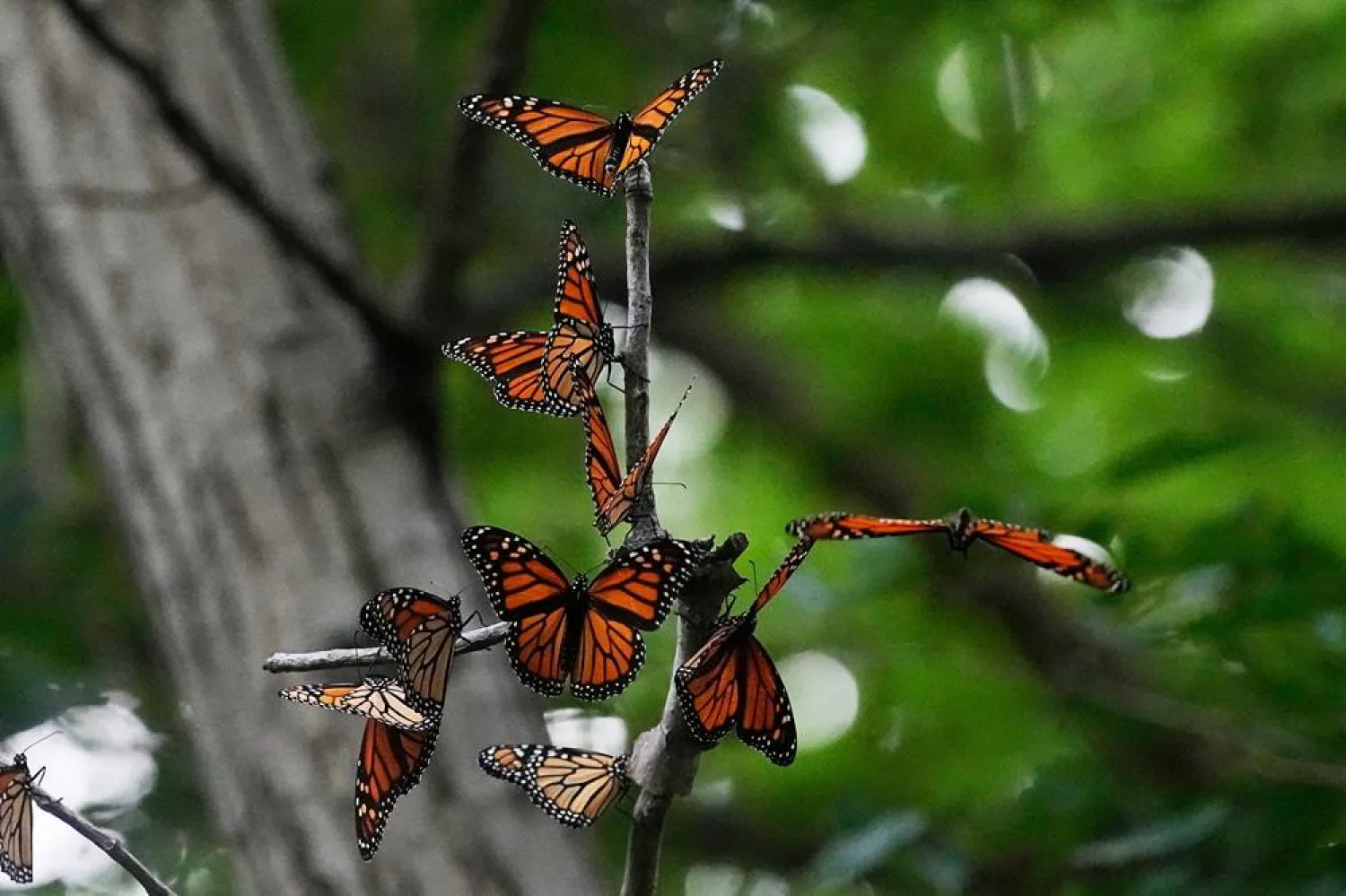
Monarch butterflies rest on their way to Mexico, Sept. 12, 2023, in Cleveland. (AP)
TT

Monarch Butterflies Get Tiny Trackers to Help Scientists Follow Their Mysterious Migration

Monarch butterflies rest on their way to Mexico, Sept. 12, 2023, in Cleveland. (AP)

As a child, Rebeca Quiñonez-Piñón wondered where monarch butterflies stop for a meal and a night's rest on their long migrations across North America. Now she and other scientists are attaching tiny tracking devices to hundreds of butterflies to find those critical stopover locations before they disappear.

Swarms of dazzling orange-and-black monarchs use environmental cues to travel some 3,000 miles (4,800 kilometers) from as far as southern Canada to spend the winter in forests of oyamel fir trees in central Mexico, a protected biosphere reserve that's also a World Heritage site.

For decades, however, scientists have struggled to build a clear picture of the butterflies' routes, how far they fly each day and where they settle at night. Solar-powered radio tags attached to nearly 1,750 monarchs this year are helping provide answers.

As habitat loss, pesticides and climate change pummel monarch populations, the research could help their numbers rebound. Quiñonez-Piñón said the uniquely famous monarch butterfly helps draw attention to the threats facing insects and their vital role in sustaining plant life across the continent.

“Pollinators are crucial to protect and ensure that our ecosystems remain healthy,” she said, “and also to have the sources of food that we require as humans.”

The public can follow the progress of individual butterflies on the free app called Project Monarch Science.

Tracking monarch butterflies in the ‘Texas funnel’ and beyond

Quiñonez-Piñón is the senior scientist at the National Wildlife Federation, a nonprofit that recently joined a tri-national science team to track monarchs. She’s leading a study that mixes real-time migratory tracking with community science to better understand where they stop in Texas.

Only some monarchs migrate. Of the ones that do, a big portion of the butterflies east of the Rocky Mountains fly through a narrow corridor known as the “Texas funnel” every fall and spring, when they head north again to lay their eggs before dying.

But depending on the year, they might favor different parts of the Lone Star State, based on where they can find water, nectar and overnight shelters like trees. It’s a detail that has fascinated scientists, including Quiñonez-Piñón.

Since the tracking started last year, scientists have found the first evidence of a butterfly in Utah, west of the Rockies, joining eastern monarchs in central Mexico. Others migrated down the Eastern Seaboard to Florida, jumped the Gulf of Mexico and are now tracking across Mexico, a connection scientists hadn’t seen before in such numbers.

“There’s just all these unique stories of their paths, connections between the population, that we didn’t know existed or we hypothesized but couldn’t prove,” said Emma Pelton, senior conservation biologist with the Xerces Society for Invertebrate Conservation.

“We’re a year into it, and I think we’re all just thrilled,” she said, especially since older tracking devices proved too big or heavy.

Since their migration started this year, about 175 tagged butterflies have been detected in Mexico.

Only some monarch butterflies get tracking devices

The new $200 tags weigh about as much as a drop of water and were developed by Cellular Tracking Technologies. If the person attaching the tag is properly trained and puts it on correctly, Quiñonez-Piñón said, “the monarch will be completely safe.”

Not all monarchs are good contenders for the tags. To ensure they’re not overburdened, most of the butterflies that get a tag weigh more than 400 milligrams (about as much as a standard pill), said David La Puma, vice president of global market development for Cellular Tracking Technologies and coordinator of the Project Monarch Collaboration, the team the National Wildlife Federation recently joined. Other researchers and community scientists look for longer-winged monarchs to tag.

Many monarchs are caught with nets and kept in cool temperatures to calm them before they're tagged, which requires delicacy and care. The insect is positioned in the middle of a special board, its legs and antennae protected, where adhesive is cotton-swabbed onto its abdomen and the tag. Then the transmitter is gently pressed to its body and the butterfly is eventually released.

Louie Yang, an insect ecologist at the University of California, Davis, said the technology is “pretty remarkable” because “we haven’t previously been able to see what path they take or how quickly they’re moving over different parts of that journey.”

But there are also limitations. The technology doesn't tell us a butterfly's exact location, he said, but rather where there was a receiver that detected it. And just because a butterfly was detected doesn't mean it's still alive.

Yang also said further studies will be needed to understand how and if the tags impact butterfly behavior.

Pesticides and climate change are pervasive threats

Monarchs typically live two to six weeks, but the butterflies that migrate to Mexico can live up to nine months and spend their lives moving south, waiting out the winter and migrating north again before breeding in the spring. The monarch’s feat has made it a symbol for the rights of international migrants.

Since the mid-1990s, the population of eastern monarchs has dropped more than 80%, and in the west by about 95%. Pesticides are a pervasive threat to milkweed, the plant where monarchs lay their eggs and the exclusive food source for its caterpillars.

Human-caused climate change — driven by burning coal, oil and gas — is also a primary threat year-round, said Tierra Curry, senior scientist and endangered species codirector with the Center for Biological Diversity.

“One of the problems now is that it stays too hot too long in the northern areas, and so they don’t get the cues to migrate. And then if the temperature freezes, they’re probably not going to make it to Mexico,” she said. “The later they start, the less the chances that they’re going to get all the way to the forest.”

Prolonged drought can dry up the water and nectar flower sources they need. They get hit by cars and trucks. And out in California, forests where western monarchs fly for the winter are being razed for development.

Late last year, the Trump administration delayed a decision on federal protections for monarchs. Several groups filed a lawsuit, and a court ordered the government to make a final decision by 2030.

However, conservationists are pushing ahead with new ways to protect the dwindling monarch population.

In Texas, nets on some highways are encouraging butterflies to fly higher so they don't get smashed, especially at night when they fly down to roost. Other efforts involve mass plantings of milkweed and pollinator plants in gardens, along roadsides and transportation corridors, Curry said. Several studies show they're boosting local populations.



Japan Space Probe Changes Target Over Engine Trouble

This undated image provided by the European Space Agency on Nov. 5, 2026 and taken by the Hera spacecraft, shows asteroid Didymos. (European Space Agency via AP)
TT

Japan Space Probe Changes Target Over Engine Trouble

This undated image provided by the European Space Agency on Nov. 5, 2026 and taken by the Hera spacecraft, shows asteroid Didymos. (European Space Agency via AP)

A Japanese probe that returned precious asteroid dust to Earth six years ago has changed course in its extended mission, officials said Tuesday, citing issues in its aging engines.

The unmanned Hayabusa-2 probe brought back pristine materials from the asteroid Ryugu in 2020, supporting discoveries linked to clues on the origin of life.

In July, the probe flew 400 meters (1,312 feet) from a near-Earth asteroid, making the closest approach ever recorded in such a mission, Japan Aerospace Exploration Agency (JAXA) has said.

It was then headed for its main target, an asteroid called 1998 KY26 that will be some 300 million kilometers away from Earth when the probe would have reached it in 2031.

However, 12 years since its launch, "the deterioration of the onboard equipment... is becoming increasingly evident", Yuya Mimasu, team leader of the extended mission, told reporters.

With the main engines suffering repeated malfunctions, "we decided to revise the plan to one that could be safely implemented", AFP quoted him as saying.

The probe will now head towards an asteroid called 2015 BM510, aiming for a flyby -- passing close to it at high speed -- in April 2028, according to the team leader.

"Because it is a dark, small asteroid... it will be one of the world's most difficult flyby missions," Mimasu said.

The new target is between 17 meters and 74 meters in diameter, completing a rotation every 49 minutes.

The revised operation can help "future planetary defense" missions aimed at deflecting asteroids that might otherwise collide with Earth, Mimasu said.


Wildlife Whereabouts Lost as Russian Researchers Cut Off from Satellite Tracking

Freshwater seal Kroshik carries a satellite-tracking transmitter on the shore of Lake Ladoga in the Leningrad region, in this still image from video released November 10, 2026. Fund of Friends of the Baltic Seal/Handout via REUTERS
TT

Wildlife Whereabouts Lost as Russian Researchers Cut Off from Satellite Tracking

Freshwater seal Kroshik carries a satellite-tracking transmitter on the shore of Lake Ladoga in the Leningrad region, in this still image from video released November 10, 2026. Fund of Friends of the Baltic Seal/Handout via REUTERS

You could follow Kroshik the rescue seal with little dots on a map. There he was: hunting for fish on the dangerous southern shore of Lake Ladoga, then swimming back to safer waters. Then suddenly, he was gone.

"We will know nothing more of Kroshik’s adventures," conservationist Vyacheslav Alexeyev wrote last week on the social media feed where he had been sharing the seal's whereabouts with thousands of fans. Hundreds of commenters responded with crying emojis and broken hearts.

This month, Russian researchers were cut off from the main satellite system they have used for years to track wildlife across some of the world's largest wildernesses, in the latest example of Moscow's scientific isolation due to sanctions and war.

The Argos system, run by French firm CLS, has been used to track rare migratory birds across Russia's Far East, wild reindeer in northern forests, bearded seals in the White Sea and Atlantic walruses around ⁠Franz Josef Land.

A ⁠CLS spokeswoman confirmed the suspension of services to Russian clients, due to "the evolving international context and the arising constraints".

Fans of Kroshik, or Little Crumb, had been following the playful freshwater ringed seal's movements across Lake Ladoga in northern Russia, thanks to updates pinged via satellite from a transmitter glued to his fur. He had gained fame for repeatedly returning to his carers after failed releases, before making it back to the wild in September.

"All of that will now have to be stopped, so our feelings about it are extremely negative," Alexeyev, who runs a shelter near St ⁠Petersburg that rescued Kroshik as a pup, cared for him for a decade and released him this year, told Reuters.

The satellite cut-off adds to an unravelling of decades of scientific cooperation between Russia and the West since Moscow's launch of its full-scale war in Ukraine in 2022.

Since then, partnerships with institutions such as the European Space Agency and the European Organization for Nuclear Research (CERN) have ended, while joint Arctic research has been curtailed.

Losing access to Argos for Russian researchers "is really going to lead to lacking information on priority species and conservation and management actions," said Philipp Maleko, a PhD candidate at the University of Wisconsin-Madison, who has used it to study endangered shorebirds that fly between Russia's Far East and Southeast Asia, such as the spotted greenshank.

"So many birds depend on Russia's Arctic boreal ecosystems for reproducing, for really sustaining viable populations," he told Reuters.

Russia's Lake Baikal ⁠Foundation, a conservation group dedicated ⁠to the huge Siberian lake that holds nearly a quarter of the world's unfrozen fresh surface water, warned in October that losing the data threatened wildlife research across Russia.

The suspension would disrupt programs monitoring Baikal’s endemic seal and a tiny population of endangered forest reindeer, its head was quoted as saying by news agency TASS.

Researchers say no other available system is quite as useful as Argos at tracking how animals move across Russia's far-flung regions, away from cellphone towers and human settlements.

CLS did not say how many users it had in Russia, but its website says it was nearly the only system used by Russian scientists to study marine and terrestrial wildlife migration in northern regions.

In October, Russia's state-run Agency for Strategic Initiatives said it was in talks to develop a Russian alternative.

At the St Petersburg shelter a plump, velvety seal glided past Alexeyev by the outdoor pool. Alexeyev said he did not think Argos could be replicated: "It is the only satellite constellation of its kind."

He was grateful the company had worked with Russia as long as it did, "despite all the difficulties and the generally hostile attitude towards us in Europe."


South Korea Tightens Exam Security After AI Cheating Scandal

AI glasses are placed at an optical shop in Seoul, South Korea, Monday, Nov. 16, 2026. (AP)
TT

South Korea Tightens Exam Security After AI Cheating Scandal

AI glasses are placed at an optical shop in Seoul, South Korea, Monday, Nov. 16, 2026. (AP)

South Korea will deploy thousands of extra personnel to prevent cheating on its college entrance exam sites this week and may introduce tougher penalties, Prime Minister Han Seong-sook said Tuesday.

The announcement comes after an individual confessed on Sunday to cheating on the national tax accountant exam using artificial intelligence tools, an admission that brought panic ahead of the college test.

Known as the Suneung, the intense once-a-year exam -- widely seen as a ticket to well-paid jobs and even better marriage prospects -- will bring much of South Korea to a standstill on Thursday to minimize distractions.

As a measure to detect phones that have not been handed over, an emergency alert will be sent before the exam begins, Han said at a press conference.

Students will also be ordered to place their glasses on their desks so supervisors can verify they are not smart devices.

"We also strongly urge students to avoid wearing clothing with buttons wherever possible," Han said.

Students "will be asked to roll up both sleeves, and collars, buttons and other areas will also be checked to determine whether electronic devices, including miniature cameras, are concealed", she added.

Those caught cheating could be banned from taking the Suneung for 10 years, up from the current one-year restriction, Han said.

The government will also file criminal complaints over serious cases of cheating, including those involving smart devices.

In addition to the 75,000 supervisors deployed to 1,312 test centers nationwide, an additional 8,400 personnel will be deployed this year.

"You may feel nervous and intimidated by the unfamiliar atmosphere inside and outside examination centers and the stricter inspection procedures," said Han, addressing the 550,000 students who will take the Suneung.

The extra staff "are minimum safeguards designed to protect the value of the hard work you have put in over the years and to guarantee a fair competition in which everyone can hold their head high", she added.

At a meeting held Sunday, officials decided to investigate all suspected cases of cheating involving AI across national qualification examinations.

The individual who confessed to cheating said he had photographed the exam questions with a miniature camera before using AI and checking the answers on his smartphone.

Han said the government "will define such cheating as a 'social evil'".