Roman Treasure Trove Found During Excavation in Britain

Roman peltate cavalry dangler (The Archaeological Practice Ltd via Newcastle University)
TT

Roman Treasure Trove Found During Excavation in Britain

Roman peltate cavalry dangler (The Archaeological Practice Ltd via Newcastle University)

Archaeology students doing their first excavation found a major Roman-era treasure trove in UK’s Northumberland, shedding more light on life at the northernmost edge of the ancient empire.

The quantity and quality of the treasure, unearthed earlier this year, was a surprise even to experienced researchers, archaeologists from Newcastle University said, according to The Independent.

One of the most remarkable items in the trove was a gold-chain section measuring about 7cm.

It was so well preserved that, if it were complete, it could still be worn today, researchers said.

The chain was likely made using the sophisticated loop-in-loop technique, a hallmark of high-quality Roman goldsmithing. Its individual rings were carefully pinched into figure-eight shapes, folded, and then interwoven to create the chain.

Such chains were typically made from pure gold and associated with elite jewelry, military amulets, or special fittings for high-ranking officers and their families.

“Finding the gold chain was really surreal, especially given that it was the first day of my first dig. I didn't expect to find anything like that in my whole career, so it was definitely a surprise,” archaeology student Elise Zallu said.

“Finding a gold artifact is something many archaeologists can go an entire career without experiencing,” said Eric Tourigny of Newcastle University. “For a first-year student to discover a beautifully preserved Roman gold chain on their first day in the trench is truly remarkable.”

Another student, Shannon Wood, unearthed a folded piece of lead bearing traces of a Latin inscription.

The object was most likely a seal associated with trade, taxation, ownership, or the movement of goods through the Roman military supply network, researchers said. It functioned as a personal message or a “curse tablet.”

In the Roman Empire, people scratched prayers, grievances, requests, and even curses onto thin sheets of lead and deposited them in sacred places.


Roman Treasure Trove Found During Excavation in Britain

Roman peltate cavalry dangler (The Archaeological Practice Ltd via Newcastle University)
TT

Roman Treasure Trove Found During Excavation in Britain

Roman peltate cavalry dangler (The Archaeological Practice Ltd via Newcastle University)

Archaeology students doing their first excavation found a major Roman-era treasure trove in UK’s Northumberland, shedding more light on life at the northernmost edge of the ancient empire.

The quantity and quality of the treasure, unearthed earlier this year, was a surprise even to experienced researchers, archaeologists from Newcastle University said, according to The Independent.

One of the most remarkable items in the trove was a gold-chain section measuring about 7cm.

It was so well preserved that, if it were complete, it could still be worn today, researchers said.

The chain was likely made using the sophisticated loop-in-loop technique, a hallmark of high-quality Roman goldsmithing. Its individual rings were carefully pinched into figure-eight shapes, folded, and then interwoven to create the chain.

Such chains were typically made from pure gold and associated with elite jewelry, military amulets, or special fittings for high-ranking officers and their families.

“Finding the gold chain was really surreal, especially given that it was the first day of my first dig. I didn't expect to find anything like that in my whole career, so it was definitely a surprise,” archaeology student Elise Zallu said.

“Finding a gold artifact is something many archaeologists can go an entire career without experiencing,” said Eric Tourigny of Newcastle University. “For a first-year student to discover a beautifully preserved Roman gold chain on their first day in the trench is truly remarkable.”

Another student, Shannon Wood, unearthed a folded piece of lead bearing traces of a Latin inscription.

The object was most likely a seal associated with trade, taxation, ownership, or the movement of goods through the Roman military supply network, researchers said. It functioned as a personal message or a “curse tablet.”

In the Roman Empire, people scratched prayers, grievances, requests, and even curses onto thin sheets of lead and deposited them in sacred places.


Wreck of Australia's 1st Warship Built at Home Found 128 Years after Sinking

This undated photo, courtesy of the Royal Australian Navy and provided by the Australian National Maritime Museum, shows HMCS Spitfire, whose wreck was found 128 years to the day after it sank off the north coast of Queensland, Australia. (Royal Australian Navy via AP)
TT

Wreck of Australia's 1st Warship Built at Home Found 128 Years after Sinking

This undated photo, courtesy of the Royal Australian Navy and provided by the Australian National Maritime Museum, shows HMCS Spitfire, whose wreck was found 128 years to the day after it sank off the north coast of Queensland, Australia. (Royal Australian Navy via AP)

The wreck of the first Australian warship built in the country, HMCS Spitfire, was found 128 years to the day after it sank off the north coast of what is now Queensland state, officials said Thursday.

The 19-meter (62-foot) schooner was launched in Sydney in 1855 to fight a potential Russian invasion. But Spitfire had been operating as a fishing boat four decades later when it sprung a leak and foundered on Aug. 21, 1898, off Piper Island, documents show.

A Royal Australian Navy mine hunter vessel found and exposed 16 meters (52 feet) of the wreck nearly three months ago, also on Aug. 21, after a monthlong search using a dive team and remotely operated vehicles, a joint statement from multiple agencies said.

“It is remarkable luck that Spitfire was discovered on the 128th anniversary of its sinking,” The Associated Press quoted Queensland heritage officer Celeste Jordan as saying in the statement.

The discovery was not announced sooner because of reporting processes between government agencies required under laws designed to protect shipwrecks, the Defense Department explained Thursday.

Bearing the designation of HMCS, meaning Her Majesty’s Colonial Schooner, Spitfire was commissioned in 1855 during the Crimean War when the British colonial government of New South Wales in Sydney feared the Russian Pacific Fleet would invade, Australian National Maritime Museum archaeologist James Hunter said.

Britain was at war with Russia in a conflict centered on Ukraine’s Crimean Peninsula. Gold had recently been discovered in New South Wales and the neighboring colony of Victoria, making them lucrative targets for conquest.

The Australian colonies then relied on Britain’s navy for defense and British warships were rare in the most distant reaches of the empire.

The Crimean War ended in 1856 without the Australian two-mast sailing vessel ever being used in battle. Spitfire became a pilot vessel in 1857 at Moreton Bay in what would soon become the Colony of Queensland, but was then still part of New South Wales, documents show.

The Queensland government sold Spitfire in 1885 into private ownership for use as a fishing boat.

Shipbuilder John Cuthbert delivered Spitfire two months after winning the contract. The speed suggested the warship’s construction already had been underway for a different purpose, Hunter said.

It was built from native timbers including an ironbark keel, blackbutt frames and kauri planking. The ship had copper sheathing below the waterline.

Russia’s Pacific Fleet at the time was mostly iron-hulled, steam-powered and “armed to the teeth warships,” Hunter told Australian Broadcasting Corp.

Spitfire was armed with a single cannon that fired 32-pound (14.5-kilogram) iron cannonballs.

“Would that have bounced off the side of one of those larger, Russian iron-hulled warships? Probably,” Hunter said.

There are no plans to salvage the wreck, which is largely buried in seabed sand. Authorities have not revealed Spitfire's exact location because it lies at a depth that can be reached by scuba divers. The ship is protected by federal and state law.

Vice Admiral Matthew Buckley, chief of the Australian navy, said Spitfire represents the beginning of the service's continuing story.

“Spitfire occupies a unique place in Australia’s naval history as the first warship built in Australia for Australian service,” Buckley said.


Cincinnati Zoo Trying to Shake Loose Fiona the Hippo after she Swallowed a Hat

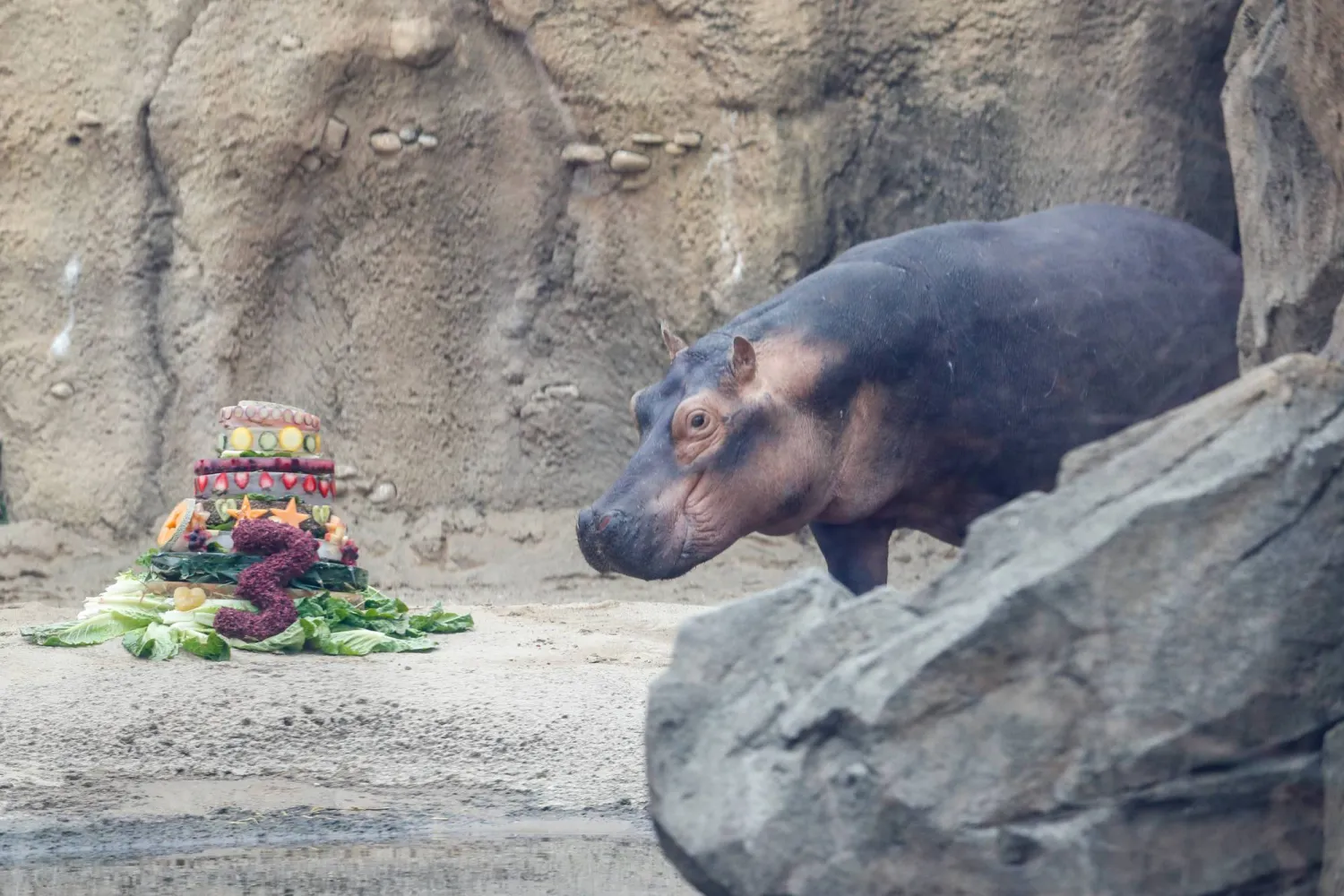
FILE - Fiona, a Nile Hippopotamus, prepares to eat her specialty birthday cake to celebrate turning three-years old this Friday, in her enclosure at the Cincinnati Zoo & Botanical Garden, Jan. 23, 2020, in Cincinnati. (AP Photo/John Minchillo, File)
TT

Cincinnati Zoo Trying to Shake Loose Fiona the Hippo after she Swallowed a Hat

FILE - Fiona, a Nile Hippopotamus, prepares to eat her specialty birthday cake to celebrate turning three-years old this Friday, in her enclosure at the Cincinnati Zoo & Botanical Garden, Jan. 23, 2020, in Cincinnati. (AP Photo/John Minchillo, File)

Fiona, the Cincinnati Zoo's famed hippo, underwent a colonoscopy this week, and now veterinarians are trying a new way to help her pass a knit cap that she swallowed after it slipped into her enclosure.

The zoo's animal care team borrowed a vibration plate from a horse farm, hoping the shaking will help move things along through her digestive tract, the zoo said Wednesday.

Video released by the zoo Wednesday shows Fiona snorting and moving about her indoor enclosure, The Associated Press reported.

Veterinarians sedated her Tuesday for a second time to evaluate her condition, said Mike Wenninger, the zoo’s director of animal health.

An ultrasound showed some bunching of her intestines, indicating she is still trying to pass the obstruction, Wenninger said. They also conducted a colonoscopy, using a 9-foot scope, he said.

Specialists have told the zoo that surgery isn’t an option for full-grown hippos, he said.

Fiona became a global sensation as a tiny newborn after her premature birth in 2017. During her first year, the zoo recorded her progress while fans worldwide followed her growth online.

She initially couldn’t stand on her own and weighed just 29 pounds (13.2 kilograms) at birth, 25 pounds (11.3 kilograms) less than the lowest recorded birth weight for her species.

The beloved hippo swallowed the hat just over a week ago. A visitor tossed it into the air, and a ceiling fan caught and catapulted it through a small opening above the area’s viewing windows, said zoo spokesperson Michelle Curley.

Zoo staff are now monitoring her around the clock, trying to keep her hydrated and giving Fiona her favorite foods to help her pass the knit cap, the zoo said.

“Her care team even offered her a sniff of coffee, a scent she has always liked,” Curley said Wednesday. “And they were happy to see her respond.”