


Villagers Flee Floods as Huge Kakhovka Dam Destroyed in Ukraine War Zone

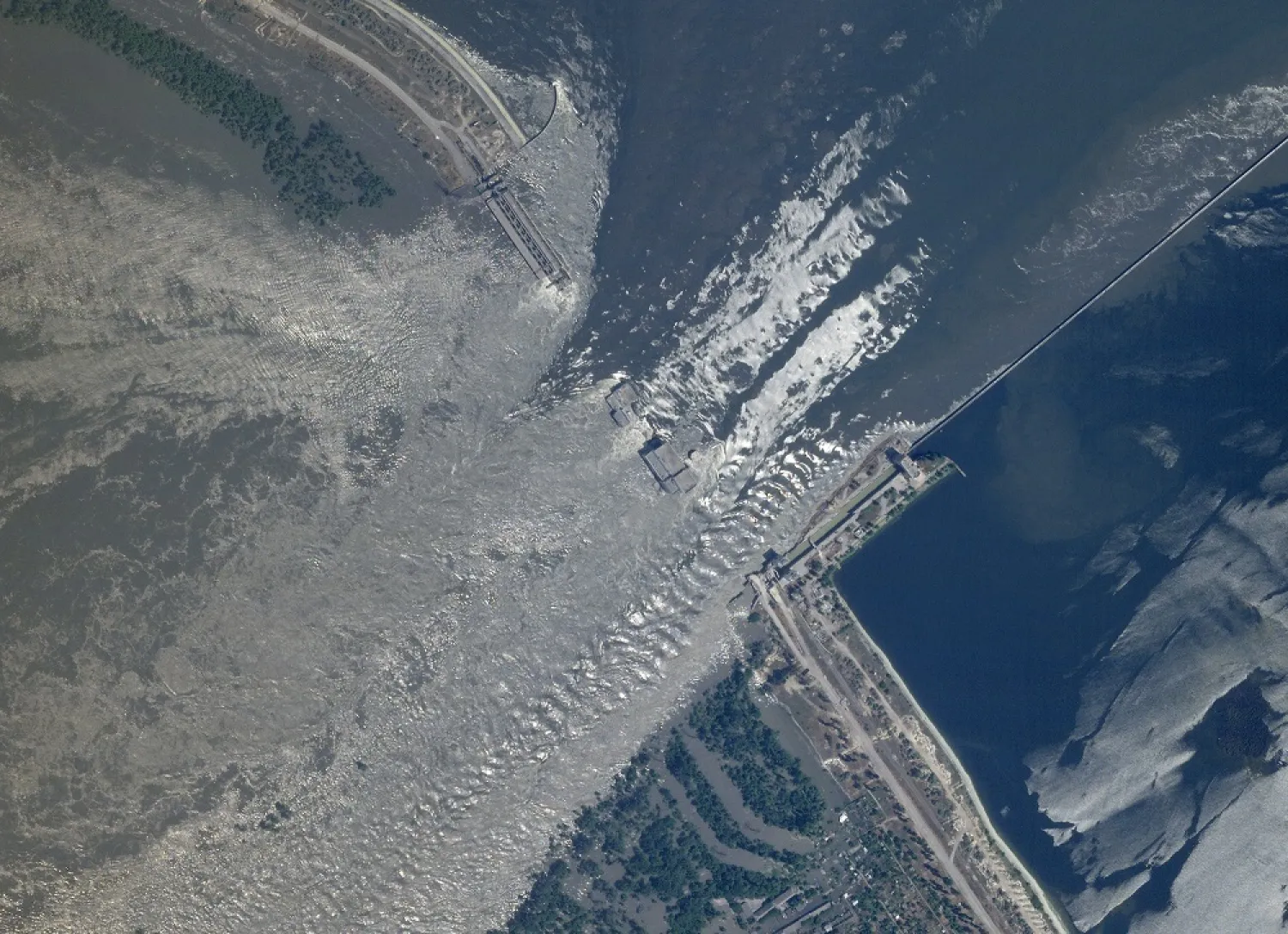
This satellite image provided by Planet Labs PBC shows an overview of the damage on the Kakhovka dam in southern Ukraine on Tuesday, June 6, 2023. (Planet Labs PBC via AP)
TT

Villagers Flee Floods as Huge Kakhovka Dam Destroyed in Ukraine War Zone

This satellite image provided by Planet Labs PBC shows an overview of the damage on the Kakhovka dam in southern Ukraine on Tuesday, June 6, 2023. (Planet Labs PBC via AP)

A torrent of water burst through a massive dam on the Dnipro River that separates Russian and Ukrainian forces in southern Ukraine on Tuesday, flooding a swathe of the war zone and forcing villagers to flee.

Ukraine accused Russia of blowing up the Nova Kakhovka dam in a deliberate war crime. The Kremlin said it was Ukraine that had sabotaged the dam, to distract attention from the launch of a major counteroffensive Moscow says is faltering. Some Russian-installed officials said the dam had burst on its own.

Neither side offered immediate public evidence of who was to blame. The Geneva Conventions explicitly ban targeting dams in war, because of the danger to civilians.

By mid-morning in the city of Kherson in Ukrainian government-controlled territory downstream from the dam, a pier on a tributary of the Dnipro had already been submerged.

Lidia Zubova, 67, waiting for a train out of the city after abandoning her inundated village of Antonivka, told Reuters: "Our local school and stadium downtown were flooded... The road was completely flooded, our bus got stuck."

Ukrainian police released video of an officer carrying an elderly woman to safety and others rescuing dogs in villages being evacuated as the waters rose. Interior Minister Ihor Klymenko accused Russia of shelling areas from where people were being evacuated and said two police officers were wounded.

On the Russian-controlled bank of the Dnipro, the Moscow-installed mayor of Nova Kakhovka said water levels had risen to 11 meters (36 feet). Residents reached by telephone there told Reuters that some had decided to stay despite being ordered out by occupying Russians.

"They say they are ready to shoot without warning," said one local man, Hlib, describing encounters with Russian troops. "If you come a meter closer than allowed, they immediately start yelling obscenities. We're still allowed to go to the store, but we don't know what orders will be given next."

Yevheniya, a female resident, said the water was up to the knees of the Russian soldiers walking the main street in high rubber boots. "If you try to go somewhere they don't allow, they immediately point their machine guns at you," she said. "More and more water is coming every hour. It's very dirty."

The Kazkova Dibrova zoo on the Russian-held riverbank was completely flooded and all 300 animals were dead, a representative said via the zoo's Facebook account.

The dam supplies water to a wide area of southern Ukrainian farmland, including the Russian-occupied Crimean peninsula, as well as cooling the Russian-held Zaporizhzhia nuclear plant.

The vast reservoir behind the dam is one of the main geographic features of southern Ukraine, 240 km (150 miles) long and up to 23 km (14 miles) wide.

An expanse of countryside lies in the flood plain below, with low-lying villages on the Russian-held southern bank particularly vulnerable.

'Terrorists'

The dam's destruction raised fears of a new humanitarian disaster in the center of the war zone and transformed front lines just as Ukraine prepared to launch a long-awaited counteroffensive to drive Russian troops from its territory.

Russia has controlled the dam since early in its 15-month-old invasion, although Ukrainian forces recaptured the Dnipro's northern bank last year. Both sides had long accused the other of plotting to destroy the dam.

"Russian terrorists. The destruction of the Kakhovka hydroelectric power plant dam only confirms for the whole world that they must be expelled from every corner of Ukrainian land," President Volodymyr Zelenskiy wrote on the Telegram messaging app.

Russians had "carried out an internal detonation of the structures" of the dam, Zelenskiy said. "About 80 settlements are in the zone of flooding."

NATO Secretary-General Jens Stoltenberg called it "an outrageous act, which demonstrates once again the brutality of Russia's war in Ukraine".

Kremlin spokesman Dmitry Peskov blamed "deliberate sabotage by the Ukrainian side".

"Apparently, this sabotage is also connected with the fact that having started large-scale offensive actions two days ago, now the Ukrainian armed forces are not achieving their goals."

Earlier, Russian-installed officials had given conflicting accounts, some saying the dam had been hit by Ukrainian missiles overnight, others saying it had burst on its own due to earlier damage.

Zaporizhzhia nuclear plant

The UN nuclear watchdog said the Zaporizhzhia power plant, upriver on the reservoir's Russian-held bank, should have enough water to cool its reactors for "some months" from a separate pond, even as the huge reservoir drains out.

Video showed water surging through the remains of the dam - which is 30 meters (yards) tall and 3.2 km (2 miles) long.

Some 22,000 people living across 14 settlements in the Kherson region are at risk of flooding, Russia's RIA news agency quoted the Moscow-installed head of the region as saying.

The Russian-installed governor of Crimea, Sergei Aksyonov, said there was a risk that water levels in the canal that carries fresh water to the Black Sea peninsula could fall. Crimea, which Russia has held since 2014, had sufficient water reserves for now and the risk would become clear in coming days.

Zelenskiy said in an interview published on Saturday that Ukraine was poised to unleash its much-heralded major counteroffensive, using newly supplied Western battle tanks and armored vehicles.

Moscow has said the Ukrainian offensive began on Sunday and claimed to have repulsed a third day of Ukrainian advances.

Kyiv has maintained deliberate ambiguity about it though Zelenskiy hinted at successes. In an evening address before the dam broke, he hailed "the news we have been waiting for" claiming forward moves around Bakhmut, a ruined city Russia captured earlier this month.

Russia also carried out a fresh wave of overnight air strikes on Kyiv. Ukraine said its air defense systems had downed more than 20 cruise missiles on their approach to the capital.

The Shebekino district of Russia's Belgorod region near the Ukrainian border came under renewed shelling, local authorities said. Anti-government Russian fighters based in Ukraine claim to have captured villages there.



NORAD Intercepts 5 Russian Aircraft near Alaska, Though Military Says There Was No Threat

An F-16 fighter jet takes off (file photo - Reuters)
TT

NORAD Intercepts 5 Russian Aircraft near Alaska, Though Military Says There Was No Threat

An F-16 fighter jet takes off (file photo - Reuters)

Military jets were launched to intercept five Russian aircraft that were flying in international airspace off Alaska’s western coast, but military officials said Friday the Russian aircraft were not seen as provocative.

The North American Aerospace Defense Command said it detected and tracked two Russian Tu-95s, two Su-35s and one A-50 operating near the Bering Strait on Thursday, The Associated Press said.

In response, NORAD launched two F-16s, two F-35s, one E-3 and four KC-135 refueling tankers to intercept, identify and escort the Russian aircraft until they departed the area, according to a release from the command.

“The Russian military aircraft remained in international airspace and did not enter American or Canadian sovereign airspace,” according to the NORAD statement. It also noted this kind of activity “occurs regularly and is not seen as a threat.”

The Russian aircraft were operating in an area near the Bering Strait, a narrow body of water about 50 miles (80 kilometers) wide separating the Pacific and Arctic oceans, called the Alaskan Air Defense Identification Zone.

Such zones begin where sovereign airspace ends. While it’s international airspace, all aircraft are required to identify themselves when entering zones in the interest of national security, NORAD said.

The command used satellites, ground and airborne radars and aircraft to detect and track aircraft

NORAD is headquartered at Peterson Space Force Base, Colorado, but has its Alaska operations based at Joint Base Elmendorf-Richardson in Anchorage.


Trump Unleashes Personal Assault on 'Disloyal' Supreme Court Justices

US President Donald Trump speaks during a press conference in the Brady Press Briefing Room of the White House in Washington, DC, on February 20, 2026. (Photo by Mandel NGAN / AFP)
TT

Trump Unleashes Personal Assault on 'Disloyal' Supreme Court Justices

US President Donald Trump speaks during a press conference in the Brady Press Briefing Room of the White House in Washington, DC, on February 20, 2026. (Photo by Mandel NGAN / AFP)

US President Donald Trump launched an extraordinary personal attack Friday on the Supreme Court justices who struck down his global tariffs, including two of his own appointees, and claimed they were being "swayed by foreign interests."

"I'm ashamed of certain members of the court, absolutely ashamed, for not having the courage to do what's right for our country," Trump told reporters at a White House press conference.

"They're very unpatriotic and disloyal to our Constitution," he said, deriding them at one point as "fools and lap dogs."

The Supreme Court has overwhelmingly sided with Trump since he took office in January of last year, and the tariffs ruling was the first major setback for the Republican president before the conservative-dominated court.

Asked if he regretted nominating justices Amy Coney Barrett and Neil Gorsuch -- who both voted against him -- to the top court, Trump said he did not "want to say whether or not I regret."

"I think their decision was terrible," he said. "I think it's an embarrassment to their families if you want to know the truth, the two of them."

Chief Justice John Roberts, Coney Barrett and Gorsuch, all conservatives, joined with the court's three liberals in the 6-3 ruling that Trump's sweeping global tariffs were illegal.

Trump heaped praise on the conservative justices who voted to uphold his authority to levy tariffs -- Clarence Thomas, Samuel Alito and Brett Kavanaugh, a Trump appointee.

He thanked the three "for their strength and wisdom, and love of our country."

Trump in particular singled out Kavanaugh, who wrote a 63-page dissent to the tariffs ruling, calling him a "genius" and saying he was "so proud of him."

- 'You're going to find out' -

The president also alleged there was foreign influence behind the ruling.

"It's my opinion that the court has been swayed by foreign interests," he said. "I think that foreign interests are represented by people that I believe have undue influence.

"They have a lot of influence over the Supreme Court, whether it's through fear or respect or friendships, I don't know," he said.

Asked by a reporter if he had evidence of foreign influence on the court, Trump replied: "You're going to find out."

Vice President JD Vance added his voice to the condemnation of the tariffs ruling, calling it "lawlessness from the court, plain and simple."

Tensions between the White House and the Supreme Court are not new -- a frustrated president Franklin D Roosevelt once proposed expanding the court to pack it with Democratic loyalists.

But Steven Schwinn, a constitutional law professor at the University of Illinois Chicago, said Trump's "gratuitous and ad homineum attacks" on individual justices reveal "his fundamental misunderstanding of the separation of powers."

"He seems to believe that any good-faith disagreement with his own interpretation of the law is, by definition, illegitimate," Schwinn told AFP.

"At the same time, he lacks any serious interpretation of the law of his own, except to say that the law is what he wants it to be. This is not how a democracy works."

Trump was also asked whether the six justices who voted against him would be welcome at next week's State of the Union speech before Congress.

"Three are happily invited," the president said.

The others are "invited, barely," he said, before adding "I couldn't care less if they come."


Trump to Travel to China Next Month, with US Trade Policy in Focus

US President Donald Trump arrives at Joint Base Andrews in Maryland, US, February 19, 2026. (Reuters)
TT

Trump to Travel to China Next Month, with US Trade Policy in Focus

US President Donald Trump arrives at Joint Base Andrews in Maryland, US, February 19, 2026. (Reuters)

US President Donald Trump will travel to China from March 31 to April 2 for a highly anticipated meeting between the world's two biggest economies, following the Supreme Court's decision to overturn Trump's sweeping tariffs against imported goods.

A White House official confirmed the trip on Friday, just before the highest US court struck down many of the tariffs Trump has used to manage sometimes-tense relations with China.

Trump is expected to visit Beijing and meet Chinese President Xi Jinping as part of a lavish, extended visit. Trump was last in China in 2017, ‌the most ‌recent trip by a US president.

A key topic had been whether ‌to ⁠extend a trade ⁠truce that kept both countries from further hiking tariffs. After Friday's ruling, however, it was not immediately clear whether - and under what legal authority - Trump would restore tariffs on imports from China.

TRUMP SEES TRADE IMBALANCE AS NATIONAL EMERGENCY

The administration has said the tariffs were necessary because of national emergencies related to trade imbalances and China's role in producing illicit fentanyl-related chemicals.

"That's going to be a wild one," Trump told foreign leaders visiting Washington on Thursday ⁠about the trip. "We have to put on the biggest display you've ‌ever had in the history of China."

The Chinese ‌embassy in Washington did not immediately respond to a request for comment. Beijing has not ‌confirmed the trip.

The visit would be the leaders' first talks since February and their first ‌in-person visit since an October meeting in South Korea. At that October meeting, Trump agreed to trim tariffs on China in exchange for Beijing cracking down on the fentanyl trade, resuming US soybean purchases and keeping rare earth minerals flowing.

While the October meeting largely sidestepped the sensitive issue of ‌Taiwan, Xi raised US arms sales to the island in February.

Washington announced its largest-ever arms sales deal with Taiwan in December, ⁠including $11.1 billion in ⁠weapons that could ostensibly be used to defend against a Chinese attack. Taiwan expects more such sales.

China views Taiwan as its own territory, a position Taipei rejects. The United States has formal diplomatic ties with China, but it maintains unofficial ties with Taiwan and is the island's most important arms supplier. The United States is bound by law to provide Taiwan with the means to defend itself.

Xi also said during the February call that he would consider further increasing soybean purchases, according to Trump.

Struggling US farmers are a major political constituency for Trump, and China is the top soybean consumer.

Although Trump has justified several hawkish policy steps from Canada to Greenland and Venezuela as necessary to thwart China, he has eased policy toward Beijing in the past several months in key areas, from tariffs to advanced computer chips and drones.