


Ukraine’s President Tells Other Countries to Act before Russia Attacks Nuclear Plant

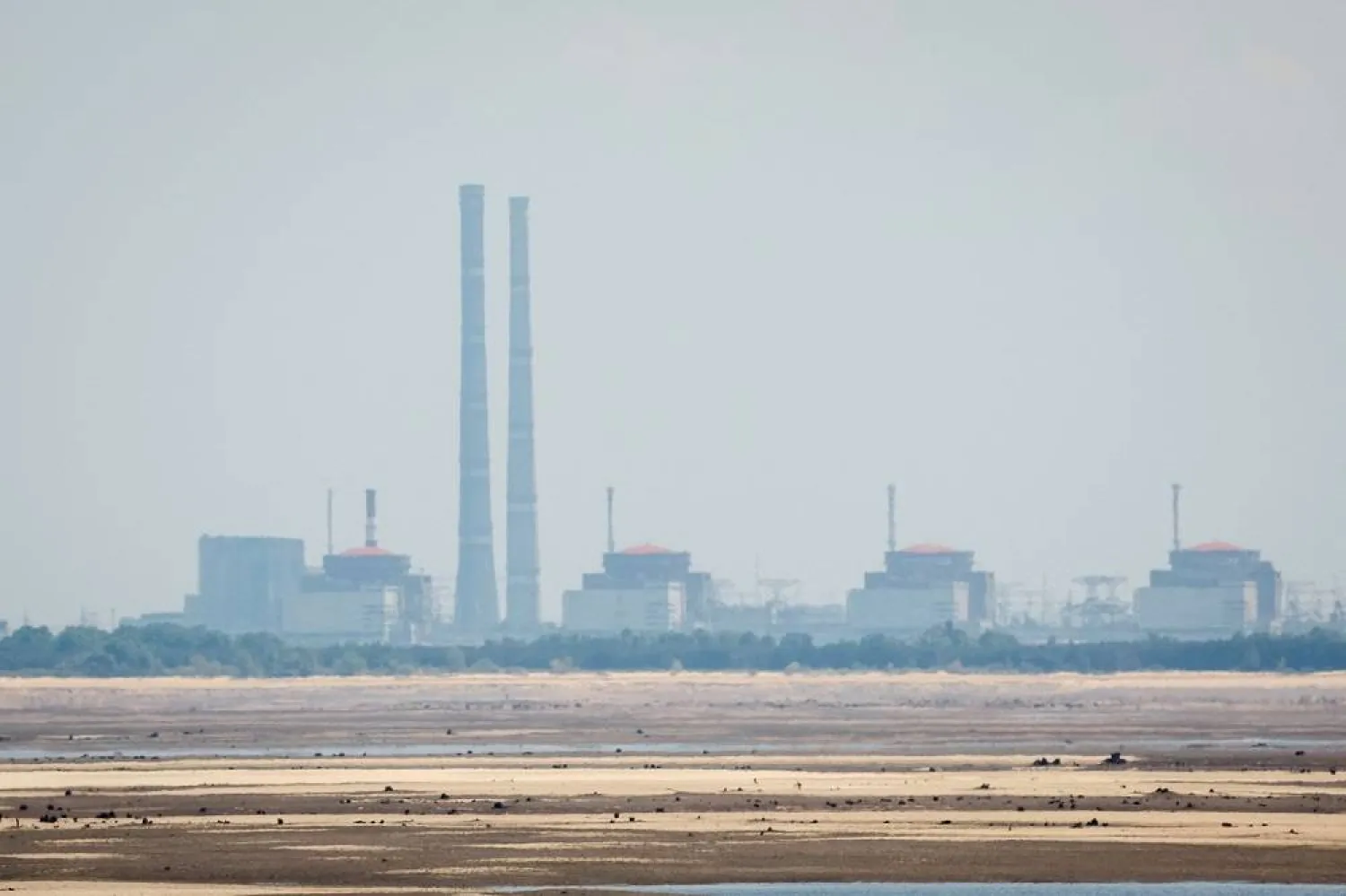
A view shows Zaporizhzhia Nuclear Power Plant from the bank of Kakhovka Reservoir near the town of Nikopol after the Nova Kakhovka dam breached, amid Russia's attack on Ukraine, in Dnipropetrovsk region, Ukraine June 16, 2023. (Reuters)
TT

Ukraine’s President Tells Other Countries to Act before Russia Attacks Nuclear Plant

A view shows Zaporizhzhia Nuclear Power Plant from the bank of Kakhovka Reservoir near the town of Nikopol after the Nova Kakhovka dam breached, amid Russia's attack on Ukraine, in Dnipropetrovsk region, Ukraine June 16, 2023. (Reuters)

Ukraine wants other countries to heed its warning that Russia may be planning to attack an occupied nuclear power plant to cause a radiation disaster, President Volodymyr Zelenskyy said.

Members of his government briefed international representatives on the possible threat to the Zaporizhzhia Nuclear Power Plant. Zelenskyy said he expected other nations to “give appropriate signals and exert pressure” on Moscow.

“Our principle is simple: The world must know what the occupier is preparing. Everyone who knows must act,” Zelenskyy said late Thursday. “The world has enough power to prevent any radiation incidents, let alone a radiation catastrophe.”

The potential for a life-threatening release of radiation has been a concern since Russian troops invaded Ukraine last year and seized the plant, which is Europe’s largest nuclear power station. The head of the UN's atomic energy agency spent months unsuccessfully trying to negotiate for a safety perimeter to protect the facility as nearby areas came under repeated shelling.

The International Atomic Energy Agency noted Thursday that “the military situation has become increasingly tense” while a Ukrainian counteroffensive that got underway this month unfolds in Zaporizhzhia province, where the namesake plant is located, and in an adjacent part of Donetsk province.

Although the last of the plant's six reactors was shut down last fall to reduce the risk of a meltdown, experts have warned that one could still happen if the cooling system that keeps the reactor core and spent nuclear fuel from overheating loses power.

During months of fighting, Russia and Ukraine have traded blame over which side was increasing the possibility of that happening. On Friday, IAEA Director General Rafael Grossi met with the head of Russian state nuclear corporation Rosatom in the Kaliningrad exclave of Russia to discuss the conditions at the plant.

Rosatom director Alexey Likachev and other officials “emphasized that they now expect specific steps” from the UN agency to prevent Ukrainian attacks on the plant and its adjacent territory, said a statement from the Russian corporation, whose divisions build and operate nuclear power plants.

The governor of Zaporizhzhia, Yuriy Malashko, reported Friday that Russian shelling in the southern province killed two people in the past day. An attack that hit a transportation company in Kherson, the capital of Kherson province, killed three others on Friday, governor Oleksandr Prokudin said.

Russia also fired 13 cruise missiles overnight at a military airfield in the western Khmelnytskyi province but Ukrainian air defenses intercepted them all, according to the air force. The attack came after Russian-appointed officials said that Ukrainian-fired missiles damaged a bridge that serves as key supply link to occupied areas of southern Ukraine.

Russia's air-launched Kh-101 and Kh-555 missiles were sent from the Caspian Sea, the air force said. It did not identify the targeted airfield, but Ukraine has an air base near the Khmelnytskyi region's town of Starokostiantyniv.

The base houses fighter jets and bombers, and five years ago it hosted a training exercise with air force personnel from the United States, Ukraine and seven European countries. It has come under Russian attack previously, including within the last month.

Ukrainian Deputy Defense Minister Hanna Maliar said on Friday that Russia has beefed up its defense forces in southern Ukraine in response to the early counteroffensive but also intensified its efforts to take more ground in the east. Asked if the Ukrainian military's initial attacks set the stage for a larger assault, Maliar confirmed that was the plan.

“We are yet to see the main events, and the main blow," she said on Ukrainian television. “And indeed, a part of reserves will be used later.”

Ukrainian forces so far have made only incremental gains in Zaporizhzhia province, one of four regions of the country that Russian President Vladimir Putin illegally annexed last year. Putin has pledged to defend the regions as Russian territory.

Zelenskyy has said that Ukraine is fighting to force Russian troops out of those regions and Crimea, which Moscow is using as a staging and supply route in the 16-month-old war. If the counteroffensive now in its early stages breaks the Russian defenses in the south, Ukrainian forces could attempt to reach a pair of occupied port cities on the Sea of Azoz and break Russia’s land bridge to Crimea.

The Ukrainian leader's nighttime remarks Thursday on a possible attack on the nuclear power plant carried a tone of frustration with “countries that are pretending to be neutral even now” in the war. He accused “anyone who turns a blind eye to Russia’s occupation of such a facility” of enabling Moscow to commit an act of evil and terror.

“Obviously, radiation does not ask who is neutral and can reach anyone in the world. Accordingly, anyone in the world can help now, and it is quite clear what to do,” Zelenskyy said.

On Friday, Russia claimed it was the target of “an information and propaganda campaign to discredit the country in the international arena.” Russia’s Federal Security Service, the FSB, said five people were arrested for trying to smuggle a kilogram of the radioactive isotope Cesium-137 out of the country under the direction of a Ukrainian citizen.

The FSB said the material was to be used for “organizing staged scenes of the use of weapons of mass destruction.” Cesium-137 is often mentioned as of potential use in making a ”dirty bomb" that could contaminate a wide area.


Andrew Mountbatten-Windsor Arrested on Suspicion of Misconduct in Public Office

FILE - Britain’s Andrew Mountbatten-Windsor, formerly known as Prince Andrew, looks round as he leaves after attending the Easter Matins Service at St. George's Chapel, Windsor Castle, England, April 20, 2025. (AP Photo/Kirsty Wigglesworth, File)
TT

Andrew Mountbatten-Windsor Arrested on Suspicion of Misconduct in Public Office

FILE - Britain’s Andrew Mountbatten-Windsor, formerly known as Prince Andrew, looks round as he leaves after attending the Easter Matins Service at St. George's Chapel, Windsor Castle, England, April 20, 2025. (AP Photo/Kirsty Wigglesworth, File)

UK police arrested Andrew Mountbatten-Windsor on Thursday on suspicion of misconduct in public office.

The Thames Valley Police, an agency that covers areas west of London, including Mountbatten-Windsor’s former home, said it was “assessing” reports that the former Prince Andrew sent trade reports to convicted sex offender Jeffrey Epstein in 2010. The assessment followed the release of millions of pages of documents connected to a US investigation of Epstein.

The police force did not name Mountbatten-Windsor, as is normal under UK law. But when asked if he had been arrested, the force pointed to a statement saying that they had arrested a man in his 60s. Mountbatten-Windsor is 66.

“Following a thorough assessment, we have now opened an investigation into this allegation of misconduct in public office,’’ the statement said. “It is important that we protect the integrity and objectivity of our investigation as we work with our partners to investigate this alleged offence."

“We understand the significant public interest in this case, and we will provide updates at the appropriate time,” the statement added.

Pictures circulated online appearing to show unmarked police cars at Wood Farm on the Sandringham Estate in Norfolk, with plainclothes officers appearing to gather outside the home of Mountbatten-Windsor.


Georgia Arrests Two Foreigners Trying to Purchase Uranium

FILE PHOTO: A block with the symbol, atomic number and mass number of Uranium (U) element, in this illustration taken January 21, 2026. REUTERS/Dado Ruvic/Illustration/File Photo
TT

Georgia Arrests Two Foreigners Trying to Purchase Uranium

FILE PHOTO: A block with the symbol, atomic number and mass number of Uranium (U) element, in this illustration taken January 21, 2026. REUTERS/Dado Ruvic/Illustration/File Photo

Georgia has ‌detained two people who attempted to purchase $3 million worth of uranium and a cache of a radioactive isotope found in nuclear weapons testing programs, the national security service said on Thursday.

Two foreign nationals from unspecified countries were arrested in the city of Kutaisi, the State Security Service said in a statement.

"They were planning to ‌illegally purchase ‌nuclear material uranium and radioactive ‌substance ⁠Cesium 137 for $3 ⁠million and illegally transport it to the territory of another country," Reuters quoted it as saying.

It said other foreigners had been arriving in Georgia in recent weeks with the aim of purchasing and transporting the nuclear and ⁠radioactive materials, without elaborating further.

The ‌statement did ‌not specify the quantity of materials the individuals were ‌attempting to procure. There were ‌no details on the substances' origin or potential destination.

Cesium 137 is a radioactive isotope present primarily in the aftermath of nuclear weapons testing ‌and nuclear power plant accidents such as the Chernobyl disaster in ⁠then-Soviet ⁠Ukraine in 1986.

The security of nuclear materials was one of the biggest concerns after the 1991 fall of the Soviet Union, of which Georgia was part. There have been several serious incidents involving the illicit trade in nuclear materials in Georgia over recent decades.

Most recently, three Chinese citizens were arrested in the capital Tbilisi for attempting to purchase two kilograms of "nuclear material" uranium.


Former South Korean President Yoon Receives Life Sentence for Imposing Martial Law

FILE PHOTO: South Korea’s impeached President Yoon Suk Yeol attends the fourth hearing of his impeachment trial over his short-lived imposition of martial law at the Constitutional Court in Seoul, South Korea, 23 January 2025. JEON HEON-KYUN/Pool via REUTERS/File Photo
TT

Former South Korean President Yoon Receives Life Sentence for Imposing Martial Law

FILE PHOTO: South Korea’s impeached President Yoon Suk Yeol attends the fourth hearing of his impeachment trial over his short-lived imposition of martial law at the Constitutional Court in Seoul, South Korea, 23 January 2025. JEON HEON-KYUN/Pool via REUTERS/File Photo

Former South Korean President Yoon Suk Yeol was sentenced to life in prison for his brief imposition of martial law in a dramatic culmination to the country’s biggest political crisis in decades.

Yoon was ousted from office after a baffling attempt to overcome an opposition-controlled legislature by declaring martial law and sending troops to surround the National Assembly on Dec. 3, 2024, The Associated Press said.

Judge Jee Kui-youn of the Seoul Central District Court said he found Yoon guilty of rebellion for mobilizing military and police forces in an illegal attempt to seize the liberal-led Assembly, arrest politicians and establish unchecked power for a “considerable” time.

Martial law crisis recalled dictatorial past Yoon’s martial law imposition, the first of its kind in more than four decades, harkened back to South Korea’s past military-backed governments when authorities occasionally proclaimed emergency decrees that allowed them to station soldiers, tanks and armored vehicles on streets or at public places such as schools to prevent anti-government demonstrations.

As lawmakers rushed to the National Assembly, Yoon’s martial law command issued a proclamation declaring sweeping powers, including suspending political activities, controlling the media and publications, and allowing arrests without warrants.

The decree lasted about six hours before being lifted after a quorum of lawmakers managed to break through a military blockade and unanimously voted to lift the measure.

Yoon was suspended from office on Dec. 14, 2024, after being impeached by lawmakers and was formally removed by the Constitutional Court in April 2025. He has been under arrest since last July while facing multiple criminal trials, with the rebellion charge carrying the most severe punishment.

Yoon's lawyers reject conviction Yoon Kap-keun, one of the former president’s lawyers, accused Jee of issuing a “predetermined verdict” based solely on prosecutors’ arguments and said the “rule of law” had collapsed. He said he would discuss whether to appeal with his client and the rest of the legal team.

Yoon Suk Yeol told the court the martial law decree was only meant to raise public awareness of how the liberals were paralyzing state affairs, and that he was prepared to respect lawmakers if they voted against the measure.

Prosecutors said it was clear Yoon was attempting to disable the legislature and prevent lawmakers from lifting the measure through voting, actions that exceeded his constitutional authority even under martial law.

In announcing Yoon and Kim’s verdicts, Jee said the decision to send troops to the National Assembly was key to his determination that the imposition of martial law amounted to rebellion.

“This court finds that the purpose of (Yoon’s) actions was to send troops to the National Assembly, block the Assembly building and arrest key figures, including the National Assembly speaker and the leaders of both the ruling and opposition parties, in order to prevent lawmakers from gathering to deliberate or vote,” Jee said. “It’s sufficiently established that he intended to obstruct or paralyze the Assembly’s activities so that it would be unable to properly perform its functions for a considerable period of time.”

Protesters rally outside court

As Yoon arrived in court, hundreds of police officers watched closely as Yoon supporters rallied outside a judicial complex, their cries rising as the prison bus transporting him drove past. Yoon’s critics gathered nearby, demanding the death penalty.

There were no immediate reports of major clashes following the verdict.

A special prosecutor had demanded the death penalty for Yoon Suk Yeol, saying his actions posed a threat to the country’s democracy and deserved the most serious punishment available, but most analysts expected a life sentence since the poorly-planned power grab did not result in casualties.

South Korea has not executed a death row inmate since 1997, in what is widely seen as a de facto moratorium on capital punishment amid calls for its abolition.

Other officials sentenced for enforcing martial law

The court also convicted and sentenced several former military and police officials involved in enforcing Yoon’s martial law decree, including ex-Defense Minister Kim Yong Hyun, who received a 30-year jail term for his central role in planning the measure and mobilizing the military.

Last month, Yoon was sentenced to five years in prison for resisting arrest, fabricating the martial law proclamation and sidestepping a legally mandated full Cabinet meeting before declaring the measure.

The Seoul Central Court has also convicted two members of Yoon’s Cabinet in other cases. That includes Prime Minister Han Duck-soo, who received a 23-year prison sentence for attempting to legitimize the decree by forcing it through a Cabinet Council meeting, falsifying records and lying under oath. Han has appealed the verdict.

Yoon is the first former South Korean president to receive a life sentence since former military dictator Chun Doo-hwan, who was sentenced to death in 1996 for his 1979 coup, a bloody 1980 crackdown on pro-democracy protesters in Gwangju that left more than 200 people dead or missing, and corruption.

The Supreme Court later reduced his sentence to life imprisonment, and he was released in late 1997 under a special presidential pardon. He died in 2021.
