

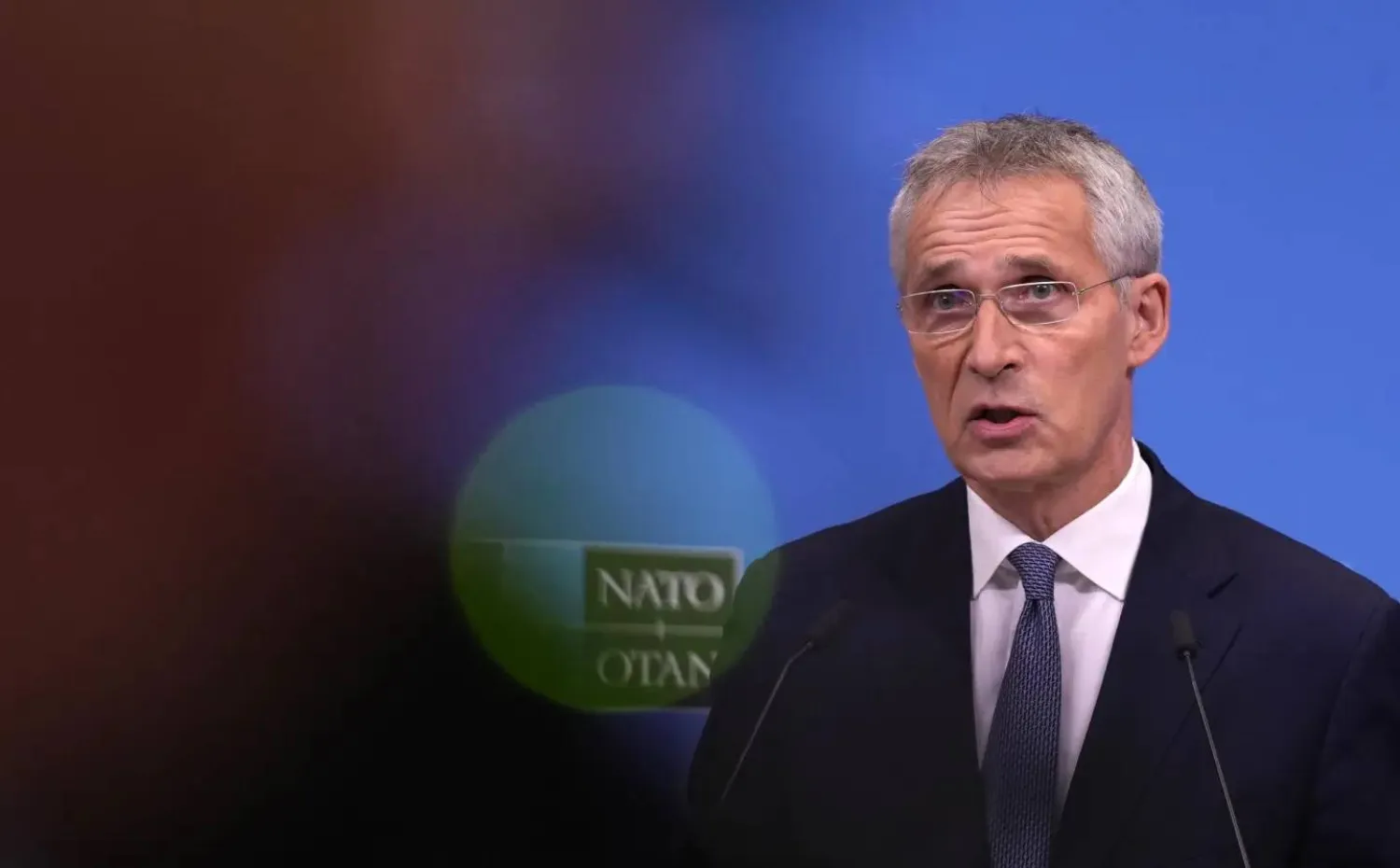

NATO Chief Convenes Talks in a Bid to Persuade Türkiye to Let Sweden Join the Military Alliance

NATO Secretary General Jens Stoltenberg speaks during a media conference at NATO headquarters in Brussels, Wednesday, Oct. 20, 2021. (AP Photo/Virginia Mayo, File)
TT

NATO Chief Convenes Talks in a Bid to Persuade Türkiye to Let Sweden Join the Military Alliance

NATO Secretary General Jens Stoltenberg speaks during a media conference at NATO headquarters in Brussels, Wednesday, Oct. 20, 2021. (AP Photo/Virginia Mayo, File)

NATO Secretary-General Jens Stoltenberg said Wednesday he has called a meeting of senior officials from Türkiye, Sweden and Finland for July 6 to try to overcome Turkish objections to Sweden joining the military alliance.

The meeting is a last-ditch effort by Stoltenberg to deal with one of the final obstacles to Sweden's membership before a major summit the following week. Sweden's membership would be a highly symbolic moment and another indication of how Russia’s war in Ukraine is driving countries to join the Western alliance, The Associated Press said.

However, Hungary also has not yet ratified Sweden’s bid, and Hungarian lawmakers said a long-delayed parliamentary vote on ratifying Sweden’s NATO membership would not would not happen until the autumn legislative session. NATO requires the unanimous approval of all members to expand, so that almost certainly means the country will not get the green light in time for the July 11-12 summit in the Lithuanian capital, Vilnius.

“The time is now to welcome Sweden as a full member of NATO,” Stoltenberg told reporters. Foreign ministers, intelligence chiefs and security advisers from Türkiye, Sweden and Finland will be taking part in the talks in Brussels.

Sweden applied to join NATO last year after Russia invaded Ukraine amid widespread concern in Europe that President Vladimir Putin might broaden the war. It applied alongside Finland and they had hoped to join together, but Turkish objections to Sweden's membership meant that Finland eventually joined on its own in April.

Stockholm has changed its anti-terror laws and lifted an arms embargo on Türkiye to satisfy Ankara's demands. But Turkish President Recep Tayyip Erdogan said in a statement posted on his social media account that he spoke with German Chancellor Olaf Scholz earlier Wednesday by phone and again raised his concerns over Sweden’s NATO membership.

“President Erdogan stated that while taking steps in the right direction, especially the change in Sweden’s anti-terror legislation, supporters of the PKK/PYD/YPG in Sweden continue to freely organize demonstrations praising terrorism, recruiting people and providing financial resources to terrorist organizations, and that this situation is unacceptable for Türkiye.”

The Kurdistan Workers’ Party, or PKK, has waged a 38-year insurgency against Türkiye that has left tens of thousands dead. It is designated a terrorist organization by the U.S and the European Union.

Türkiye’s government accuses Sweden of being too lenient toward groups that Ankara says pose a security threat, including Kurdish groups and people associated with a 2016 coup attempt.

Sweden has a Kurdish diaspora of around 100,000 people.

Demonstrations by pro-Kurdish and anti-NATO groups in Sweden have frustrated Stockholm's efforts to show it is taking Türkiye’s security concerns seriously. Other protests by individual anti-Islam activists have complicated things further.

On Wednesday a man who identified himself in Swedish media as a refugee from Iraq burned a Quran outside a mosque in central Stockholm. Police authorized the protest, citing freedom of speech, after a previous decision to ban a similar protest was overturned by a Swedish court.

Turkish officials condemned the Quran-burning on the first day of the Eid al-Adha holiday.

"Defending hate crimes under the guise of freedom of expression is a violation of the rights of those who are the victims of these crimes and a real blow to freedom of expression," Vice President Cevdet Yilmaz said in a social media post.

Turkish Foreign Minister Hakan Fidan said it was "unacceptable to allow these anti-Islamic actions under the pretext of freedom of expression. To turn a blind eye to such atrocious acts is to be complicit.”

Hungary has never clearly stated publicly what its concerns are about Sweden's possible membership.

In a Facebook post, Agnes Vadai, a lawmaker with Hungary’s opposition Democratic Coalition party, wrote that Prime Minister Viktor Orban and his governing Fidesz party would not schedule a vote on Sweden’s accession during its final spring session next week.

The postponement is the latest in a long succession of delays that have gone on for a year, with high-ranking Hungarian officials saying they support Sweden’s membership while also making vague demands from Stockholm as a condition for approval.

NATO officials expect that Hungary will approve Sweden's membership once Türkiye lifts its objections.

French President Emmanuel Macron called on Türkiye and Hungary to quickly approve the accession.

“It’s now time ... to allow Sweden to attend the Vilnius summit as an ally,” Macron said in a joint declaration with Stoltenberg ahead of a working meeting Wednesday in Paris. “Now, more than ever, is the time to make decisions that will ensure the unity and stability of the continent.”



India’s Modi Visits Israel as US-Iran Tensions Mount

Israeli Prime Minister Benjamin Netanyahu (L) and Indian Prime Minister Narendra Modi (C) greet children at the Knesset, the Israeli Parliament, in Jerusalem, 25 February 2026. (EPA)
TT

India’s Modi Visits Israel as US-Iran Tensions Mount

Israeli Prime Minister Benjamin Netanyahu (L) and Indian Prime Minister Narendra Modi (C) greet children at the Knesset, the Israeli Parliament, in Jerusalem, 25 February 2026. (EPA)

India's Prime Minister Narendra Modi arrived in Israel on Wednesday for a two-day visit that both countries have cast as a chance to deepen relations, as regional concerns mount over the risk of military conflict between the United States and Iran.

In an address to the Israeli parliament, Modi told lawmakers that India stood with Israel "with full conviction" as he shared his nation's condolences over the October 2023 Hamas attack.

"Like you, we have a consistent and uncompromising policy of zero tolerance for terrorism, with no double standards," he said.

Both Modi and Israeli ‌Prime Minister Benjamin ‌Netanyahu, who also addressed the parliament, spoke of terrorist attacks ‌that their ⁠nations had faced.

Some opposition lawmakers briefly walked out of the special session, protesting at the speaker's decision not to invite the head of the Supreme Court, but returned for Modi's remarks.

Netanyahu's right-wing government, which the speaker belongs to, has had a confrontational relationship with the court.

Modi, a Hindu nationalist, became the first prime minister in India's history to visit Israel in 2017, during which he and Netanyahu ⁠took a barefoot stroll on a beach in the northern ‌port city of Haifa.

Both still in power nearly ‌nine years later, the two leaders, who describe one another as friends, are expected to hold talks ‌on artificial intelligence as well as defense at a time when Israel is seeking ‌to increase its military exports.

An Israeli government official said Modi's visit would "pave the way for new partnerships and collaborations across many fields." Bilateral ties were on the cusp of a significant upgrade, an Israeli foreign ministry official said.

US MILITARY BUILDUP NEAR IRAN

Modi is visiting as the United States deploys ‌a vast naval force near Iran's coast ahead of possible strikes on the countries, with the two sides at an ⁠impasse in talks ⁠over Tehran's nuclear program. The Pentagon has also deployed an aircraft carrier to the Mediterranean, bound for Israel's coast.

A US. attack on Iran could draw Iranian retaliation against Israel as well as US military facilities in the region where millions of Indians live and work and send home billions of dollars of remittances each year.

In his speech to lawmakers, Modi vaguely spoke about the challenges facing stability in the region, acknowledging that the landscape had become more challenging in recent years, but made no mention of the US military build-up, or of Iran.

He backed the US plan to end the war in Gaza, telling the parliament that it could lead to peace "for all people of the region, including by addressing the Palestinian issue."

"The road to peace is not always easy. But India joins you and the world for dialogue, peace and stability in this region," Modi said.


US Unveils New Iran Sanctions in ‘Maximum Pressure’ Effort

A woman walks past a wall painting in the colors of the Iranian flag in Tehran on February 25, 2026. (AFP)
TT

US Unveils New Iran Sanctions in ‘Maximum Pressure’ Effort

A woman walks past a wall painting in the colors of the Iranian flag in Tehran on February 25, 2026. (AFP)

The United States on Wednesday announced fresh sanctions targeting Iran, pressing on with what Washington calls its "maximum pressure" campaign ahead of talks between both sides in Geneva.

President Donald Trump has repeatedly threatened strikes if Iran does not cut a deal on its nuclear program.

The US Treasury Department's latest sanctions take aim at more than 30 individuals, entities and vessels said to be enabling "illicit Iranian petroleum sales," as well as its weapons production.

In particular, vessels operating "as part of Iran's shadow fleet, which transport Iranian petroleum and petroleum products to foreign markets" were targeted as a means to strike at authorities' revenue sources, the Treasury said.

"Iran exploits financial systems to sell illicit oil, launder the proceeds, procure components for its nuclear and conventional weapons programs, and support its terrorist proxies," charged US Treasury Secretary Scott Bessent in a statement.

He vowed that the Trump administration will continue to push for "maximum pressure on Iran to target the regime's weapons capabilities and support for terrorism."

In his State of the Union address on Tuesday night, Trump accused Tehran of "sinister nuclear ambitions" after he ordered a massive military deployment around the region.

But for now, Iranian President Masoud Pezeshkian has said that he had a favorable outlook for talks between both sides.


US and South Korean Militaries will Have Joint Drills in March as Tensions with North Korea Escalate

Col. Jang Do-young, left, public affairs director of South Korea's Joint Chiefs of Staff, and U.S. Army Col. Ryan Donald, public affairs director of the United Nations Command, Combined Forces Command, and United States Forces Korea, pose for a photo during a media briefing on the 2026 ROK-US Freedom Shield Military Exercise at the Defense Ministry in Seoul, South Korea, Wednesday, Feb. 25, 2026. (Jung Yeon-je/Pool Photo via AP)
TT

US and South Korean Militaries will Have Joint Drills in March as Tensions with North Korea Escalate

Col. Jang Do-young, left, public affairs director of South Korea's Joint Chiefs of Staff, and U.S. Army Col. Ryan Donald, public affairs director of the United Nations Command, Combined Forces Command, and United States Forces Korea, pose for a photo during a media briefing on the 2026 ROK-US Freedom Shield Military Exercise at the Defense Ministry in Seoul, South Korea, Wednesday, Feb. 25, 2026. (Jung Yeon-je/Pool Photo via AP)

The US and South Korean militaries said on Wednesday they will conduct their annual springtime exercises next month to bolster their countries’ combined defense capabilities against a backdrop of a deepening diplomatic freeze with nuclear-armed North Korea.

The Freedom Shield drills is set for March 9-19, according to the announcement.

North Korea has long described the allies ’ joint exercises as invasion rehearsals and used them as a pretext to dial up its own military demonstrations and weapons testing activity. The allies say the drills are defensive in nature, The AP News reported.

The announcement came as North Korea is holding a major political conference where authoritarian leader Kim Jong Un is expected to outline his key domestic, foreign policy and military goals for the next five years. North Korean state media have not so far reported any direct comments by Kim on relations with Washington and Seoul at the ruling Workers’ Party congress, which began last week.

Based on recent public comments, experts say Kim could use the congress to further entrench his hard-line stance toward South Korea, reiterate calls for Washington to drop its demand for denuclearization as a precondition for renewed talks, and announce steps to simultaneously strengthen and integrate his nuclear and conventional forces.

Freedom Shield is one of two “command post” exercises that the allies conduct each year; the other is Ulchi Freedom Shield, held in August. The drills are largely computer-simulated and designed to test the allies’ joint operational capabilities while incorporating evolving war scenarios and security challenges.

As usual, the March drill will be accompanied by a field training program called Warrior Shield to enhance “training realism and combat readiness,” Col. Ryan Donald, public affairs director of US Forces Korea, told a news conference.

South Korea’s Joint Chiefs of Staff said about 18,000 South Korean troops will participate in Freedom Shield while the US military did not disclose how many American troops will be involved.

There has been speculation that the allies are seeking to tone down the drills to create conditions for dialogue with North Korea.

Liberal South Korean President Lee Jae Myung has expressed a desire for inter-Korean engagement, and some of his top officials have voiced hope that President Donald Trump’s expected visit to China in late March or April could open the door to renewed talks between Washington and Pyongyang.

Col. Jang Do-young, public affairs director of South Korea’s Joint Chiefs of Staff, said the March exercises will not involve scenarios of a possible response to a North Korean nuclear attack but will include training aimed at “deterring nuclear threats.” He said the allies were still discussing the specifics of the field training program.

The rapid expansion in recent years of Kim’s nuclear weapons program — now featuring systems capable of threatening US allies in Asia, as well as long-range missiles that could potentially reach the American homeland — has heightened South Korea’s security concerns while its diplomacy with Pyongyang remains stalled.

South Korea is also grappling with intensifying US-China competition in the region, which has prompted Washington to press its ally to assume a greater share of the defense burden against North Korea as it focuses more on China.

North Korea has repeatedly rejected Washington and Seoul’s calls to resume diplomacy aimed at winding down its nuclear program, which derailed in 2019 following the collapse of Kim’s second summit with Trump during the American president’s first term.

Kim has now made Russia the priority of his foreign policy, sending thousands of troops and large amounts of military equipment to support Moscow’s war in Ukraine, possibly in exchange for aid and military technology.

In a separate development, South Korea’s Defense Ministry said a pilot safely evacuated from a South Korean F-16 fighter jet that crashed on Wednesday evening into a mountain in the southeastern city of Yeongju during training.

The ministry said there were no immediate reports of casualties or civilian property damages and that the air force was investigating the crash.