

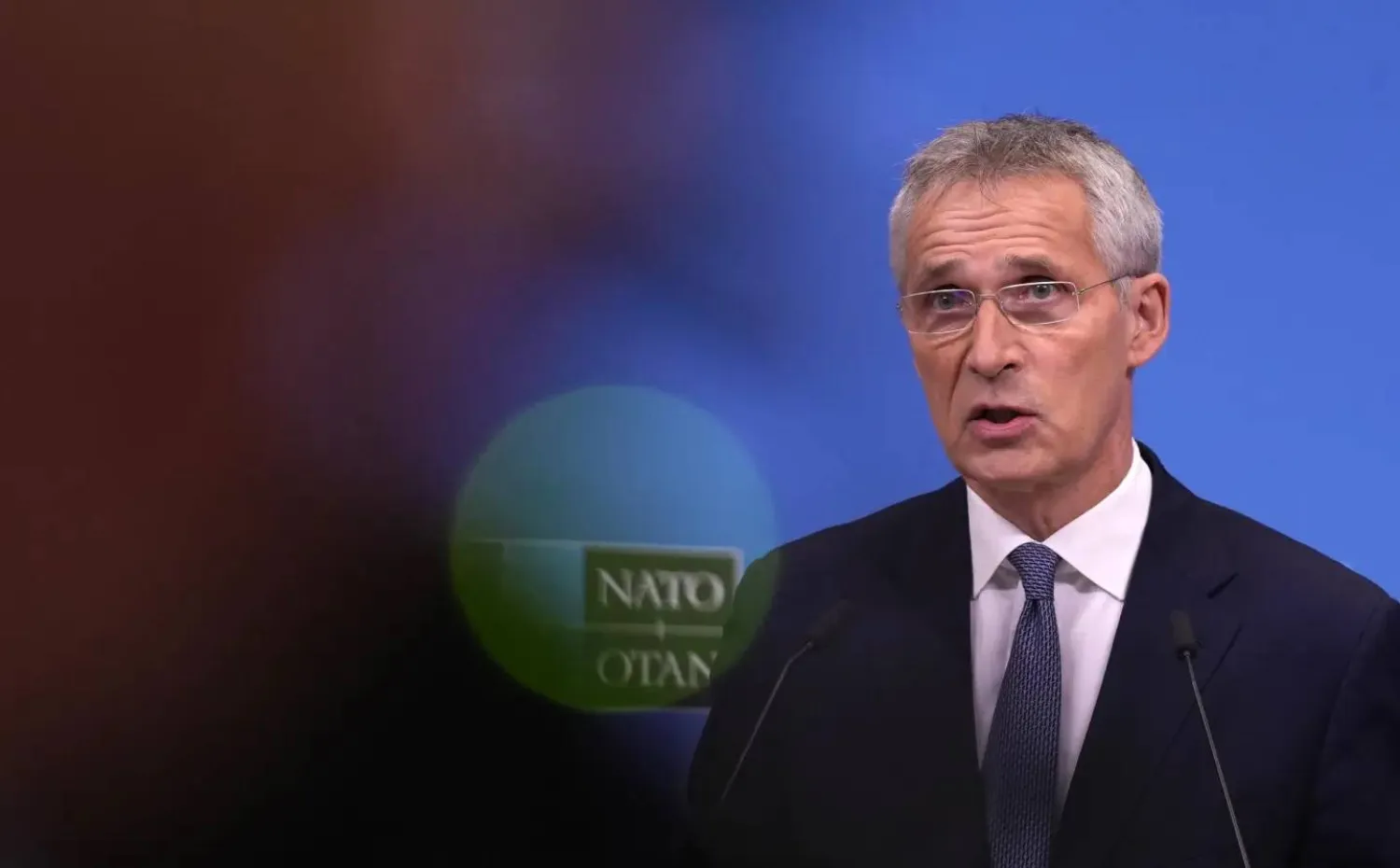

NATO Chief Convenes Talks in a Bid to Persuade Türkiye to Let Sweden Join the Military Alliance

NATO Secretary General Jens Stoltenberg speaks during a media conference at NATO headquarters in Brussels, Wednesday, Oct. 20, 2021. (AP Photo/Virginia Mayo, File)
TT

NATO Chief Convenes Talks in a Bid to Persuade Türkiye to Let Sweden Join the Military Alliance

NATO Secretary General Jens Stoltenberg speaks during a media conference at NATO headquarters in Brussels, Wednesday, Oct. 20, 2021. (AP Photo/Virginia Mayo, File)

NATO Secretary-General Jens Stoltenberg said Wednesday he has called a meeting of senior officials from Türkiye, Sweden and Finland for July 6 to try to overcome Turkish objections to Sweden joining the military alliance.

The meeting is a last-ditch effort by Stoltenberg to deal with one of the final obstacles to Sweden's membership before a major summit the following week. Sweden's membership would be a highly symbolic moment and another indication of how Russia’s war in Ukraine is driving countries to join the Western alliance, The Associated Press said.

However, Hungary also has not yet ratified Sweden’s bid, and Hungarian lawmakers said a long-delayed parliamentary vote on ratifying Sweden’s NATO membership would not would not happen until the autumn legislative session. NATO requires the unanimous approval of all members to expand, so that almost certainly means the country will not get the green light in time for the July 11-12 summit in the Lithuanian capital, Vilnius.

“The time is now to welcome Sweden as a full member of NATO,” Stoltenberg told reporters. Foreign ministers, intelligence chiefs and security advisers from Türkiye, Sweden and Finland will be taking part in the talks in Brussels.

Sweden applied to join NATO last year after Russia invaded Ukraine amid widespread concern in Europe that President Vladimir Putin might broaden the war. It applied alongside Finland and they had hoped to join together, but Turkish objections to Sweden's membership meant that Finland eventually joined on its own in April.

Stockholm has changed its anti-terror laws and lifted an arms embargo on Türkiye to satisfy Ankara's demands. But Turkish President Recep Tayyip Erdogan said in a statement posted on his social media account that he spoke with German Chancellor Olaf Scholz earlier Wednesday by phone and again raised his concerns over Sweden’s NATO membership.

“President Erdogan stated that while taking steps in the right direction, especially the change in Sweden’s anti-terror legislation, supporters of the PKK/PYD/YPG in Sweden continue to freely organize demonstrations praising terrorism, recruiting people and providing financial resources to terrorist organizations, and that this situation is unacceptable for Türkiye.”

The Kurdistan Workers’ Party, or PKK, has waged a 38-year insurgency against Türkiye that has left tens of thousands dead. It is designated a terrorist organization by the U.S and the European Union.

Türkiye’s government accuses Sweden of being too lenient toward groups that Ankara says pose a security threat, including Kurdish groups and people associated with a 2016 coup attempt.

Sweden has a Kurdish diaspora of around 100,000 people.

Demonstrations by pro-Kurdish and anti-NATO groups in Sweden have frustrated Stockholm's efforts to show it is taking Türkiye’s security concerns seriously. Other protests by individual anti-Islam activists have complicated things further.

On Wednesday a man who identified himself in Swedish media as a refugee from Iraq burned a Quran outside a mosque in central Stockholm. Police authorized the protest, citing freedom of speech, after a previous decision to ban a similar protest was overturned by a Swedish court.

Turkish officials condemned the Quran-burning on the first day of the Eid al-Adha holiday.

"Defending hate crimes under the guise of freedom of expression is a violation of the rights of those who are the victims of these crimes and a real blow to freedom of expression," Vice President Cevdet Yilmaz said in a social media post.

Turkish Foreign Minister Hakan Fidan said it was "unacceptable to allow these anti-Islamic actions under the pretext of freedom of expression. To turn a blind eye to such atrocious acts is to be complicit.”

Hungary has never clearly stated publicly what its concerns are about Sweden's possible membership.

In a Facebook post, Agnes Vadai, a lawmaker with Hungary’s opposition Democratic Coalition party, wrote that Prime Minister Viktor Orban and his governing Fidesz party would not schedule a vote on Sweden’s accession during its final spring session next week.

The postponement is the latest in a long succession of delays that have gone on for a year, with high-ranking Hungarian officials saying they support Sweden’s membership while also making vague demands from Stockholm as a condition for approval.

NATO officials expect that Hungary will approve Sweden's membership once Türkiye lifts its objections.

French President Emmanuel Macron called on Türkiye and Hungary to quickly approve the accession.

“It’s now time ... to allow Sweden to attend the Vilnius summit as an ally,” Macron said in a joint declaration with Stoltenberg ahead of a working meeting Wednesday in Paris. “Now, more than ever, is the time to make decisions that will ensure the unity and stability of the continent.”



Russia Condemns US-Israel Strikes on Iran as ‘Unprovoked Act of Armed Aggression’

Aftermath of an Israeli and the US strike on a police station, amid the US-Israel conflict with Iran, in Tehran, Iran, March 2, 2026. Majid Asgaripour/WANA (West Asia News Agency) via Reuters
TT

Russia Condemns US-Israel Strikes on Iran as ‘Unprovoked Act of Armed Aggression’

Aftermath of an Israeli and the US strike on a police station, amid the US-Israel conflict with Iran, in Tehran, Iran, March 2, 2026. Majid Asgaripour/WANA (West Asia News Agency) via Reuters

Russia on Saturday condemned the US-Israeli strikes on Iran as “a pre-planned and unprovoked act of armed aggression against a sovereign and independent UN member state,” demanding an immediate halt to the military campaign and a return to diplomacy.

In a statement posted to Telegram, the Foreign Ministry accused “Washington and Tel Aviv” of “hiding behind” concerns about Iran’s nuclear program while actually pursuing regime change.

It warned the attacks risked triggering a “humanitarian, economic and possibly radiological catastrophe” in the region and accused the US and Israel of “plunging the Middle East into an abyss of uncontrolled escalation.”

Russia has emerged as a key trade partner and supplier of weapons and technologies for Iran, which has faced bruising international sanctions. Though Russia’s Foreign Ministry was quick to condemn the US-Israeli attacks, the Kremlin will likely carefully assess its response following a recent warming of ties between Moscow and Washington.

Russian President Vladimir Putin has praised US President Donald Trump’s efforts to mediate an end to the conflict in Ukraine, and Moscow and Washington have discussed ways to revive their economic ties.

Russian Foreign Minister Sergei Lavrov spoke by phone with Iranian Foreign Minister Abbas Araghchi, Russia's Foreign Ministry said. Araghchi briefed Lavrov on Iran’s attempts to repel the attacks and said Iran would seek to convene an urgent UN Security Council session, it said. Lavrov reiterated Russia’s condemnation of the US-Israeli strikes and Moscow’s readiness to help broker peace.

Kremlin spokesman Dmitry Peskov said Putin discussed the situation in Iran with Russia's Security Council via videoconference, but did not give details.

In the Foreign Ministry statement, Moscow called the bombing of nuclear facilities under International Atomic Energy Agency safeguards “unacceptable” and said it stood ready to help broker a peaceful resolution, while placing full responsibility for the escalation on the United States and Israel.

"Responsibility for the negative consequences of this manmade crisis, including an unpredictable chain reaction and spiraling violence, lies entirely with them," the statement said.

Russia's Foreign Ministry also condemned what it called “the serial nature of destabilizing attacks carried out by the US administration," accusing the US of attacking "the international legal pillars of the world order."

Russia has maintained a delicate balancing act in the Middle East for decades, trying to navigate its warm relations with Israel even as it has developed strong economic and military ties with Iran.

Iranian forces and Russian sailors conducted annual drills in the Gulf of Oman and the Indian Ocean last week aimed at “upgrading operational coordination as well as exchange of military experiences,” Iran’s state-run IRNA news agency reported.

Putin and his Iranian counterpart, Masoud Pezeshkian, signed a broad cooperation pact in January last year as their countries deepened their partnership in the face of stinging Western sanctions.

The West alleges that in 2022, Russia and Iran signed a $1.7 billion deal for Shahed drones after Putin sent troops into Ukraine, and the US also believes Iran has transferred short-range ballistic missiles, but neither Moscow nor Tehran ever acknowledged the actions.

Ukrainian President Volodymyr Zelenskyy voiced support for the strikes on Iran, calling it "an accomplice of Putin” for supplying Moscow with Shahed drones and the technology to produce them and other weapons during its four-year war against Ukraine.

Russia and Iran also pooled their efforts to shore up Bashar al-Assad’s government during Syria’s civil war, but failed to prevent his downfall after a lightning offensive by the opposition. Assad and his family fled to Russia.

Some observers in Moscow argue that the focus on the confrontation between Israel and Iran could distract global attention from the war in Ukraine and play into Russia’s hands by potentially weakening Western support for Kyiv.


Ukraine Could Help Down Iran’s Drones, if Partners Broker Ceasefire, FM Says

Ukrainian Foreign Minister Andrii Sybiha speaks during the joint press conference with Dutch Foreign Minister Tom Berendsen (not pictured) in Kyiv, Ukraine, 28 February 2026. (EPA)
TT

Ukraine Could Help Down Iran’s Drones, if Partners Broker Ceasefire, FM Says

Ukrainian Foreign Minister Andrii Sybiha speaks during the joint press conference with Dutch Foreign Minister Tom Berendsen (not pictured) in Kyiv, Ukraine, 28 February 2026. (EPA)

Ukraine could send drone specialists to the Middle East and share capabilities and expertise to help down Iranian drones if its partners ‌help to broker ‌a ceasefire ‌in ⁠its four-year war ⁠with Russia, Foreign Minister Andrii Sybiha told Reuters on Monday.

Sybiha said that Ukraine's ⁠effectiveness in intercepting Iranian-made "Shahed" ‌drones ‌had reached up ‌to 90%, thanks ‌in part to using domestically produced interceptor drones.

"We won't be able ‌to send all of our operators, ⁠but ⁠we can certainly send some of them if the absence of Russian strikes against our country is guaranteed," Sybiha said.


Trump Says He Ordered Iran Strikes to Thwart Tehran’s Nuclear, Missile Programs

US President Donald Trump delivers remarks during a ceremony to award the medal of honor to Master Sgt. Roderick "Roddie" W. Edmonds, Staff Sgt. Michael H. Ollis, and retired Command Sgt. Maj. Terry P. Richardson in the East Room of the White House in Washington, DC, USA, 02 March 2026. (EPA)
TT

Trump Says He Ordered Iran Strikes to Thwart Tehran’s Nuclear, Missile Programs

US President Donald Trump delivers remarks during a ceremony to award the medal of honor to Master Sgt. Roderick "Roddie" W. Edmonds, Staff Sgt. Michael H. Ollis, and retired Command Sgt. Maj. Terry P. Richardson in the East Room of the White House in Washington, DC, USA, 02 March 2026. (EPA)

US President Donald Trump said on Monday he had ordered the attack on Iran to thwart Tehran's nuclear development and a ballistic missile program that he said was growing rapidly. 

Trump offered his most extensive comments about the war beyond two video messages and a series of brief phone interviews with reporters over the weekend that offered sometimes conflicting objectives in the conflict. 

He said, without providing evidence, that the threat from Iran had been imminent. 

"This was our last best ‌chance to strike ... ‌and eliminate the intolerable threats posed by ‌this ⁠sick and sinister ⁠regime," he said at an event in the White House East Room. 

Trump said military operations were ahead of schedule, without providing details. He said he had projected the US campaign would last four to five weeks but that it could go longer. 

A central premise of the fight was to ⁠prevent Iran from developing a nuclear weapon, which ‌Tehran has denied doing, and thwart ‌its long-range ballistic missile program, Trump said. 

"An Iranian regime armed ‌with long-range missiles and nuclear weapons would be an intolerable ‌threat to the Middle East, but also to the American people," Trump said. 

Trump said US forces had knocked out 10 Iranian ships - "they're at the bottom of the sea" - and expressed ‌confidence about how the campaign was going. 

"Today, the United States military continues to carry out large-scale, ⁠combat operations ⁠in Iran to eliminate the grave threats posed to America by this terrible, terrorist regime," Trump said. 

He said the objectives of the war included destroying Iran's missile capabilities, annihilating their navy and stopping from them from having a nuclear weapon. 

Trump said a third objective was a long-standing US goal, to prevent Iran from supporting militant groups elsewhere in the region. 

Trump noted the loss of four American service personnel in the fight so far, adding: "In their memory, we continue this mission with ferocious, unyielding resolve to crush the threat this terrorist regime poses to the American people." 

- Ground troops -  

Earlier, Trump said he is not ruling out sending US troops into Iran, while threatening a new, "big wave" of attacks.  

The 79-year-old Republican has long campaigned against decades of US military entanglements in the Middle East, but ordered a large-scale war against Iran starting Saturday.  

While so far the assault has focused entirely on aerial attacks by missiles and bombs, Trump refused to rule out sending ground troops -- something generally considered to be far riskier in terms of possible casualties.  

"I don't have the yips with respect to boots on the ground -- like every president says, 'There will be no boots on the ground.' I don't say it," Trump told the New York Post in one of numerous brief interviews he has given since launching the Iran operation.  

"I say 'probably don't need them,' [or] 'if they were necessary,'" he said.  

Trump also spoke to CNN on Monday, flagging what he said would be an escalation in the assault on Iran.  

"We haven't even started hitting them hard. The big wave hasn't even happened," he told CNN, without elaborating. "The big one is coming soon."  

US and Israeli forces have so far struck hundreds of targets across Iran, including the country’s missiles, navy and command-and-control sites.  

Four US military members have been announced killed and three fighter jets have been shot down -- officially in friendly fire.  

Iran has fired missiles at Israel, at US bases around the region and also at targets in regional Arab countries -- Bahrain, Jordan, Kuwait, Qatar and the United Arab Emirates -- something that Trump called "the biggest surprise." 

Trump's comments came shortly after Defense Secretary Pete Hegseth also signaled that deploying troops inside Iran had not been ruled out.  

Asked if there were already boots on the ground, Hegseth told a news conference: "No, but we're not going to go into the exercise of what we will or will not do."  

"We'll go as far as we need to go," he said.  

As for how long the war will last, Hegseth said: "Four weeks, two weeks, six weeks, it could move up. It could move back."  

He sought to differentiate the Iran operation from past long-running US wars in Iraq and Afghanistan, saying the war is not an effort to build democracy in Iran.  

"No stupid rules of engagement, no nation building quagmire, no democracy-building exercise. No politically correct wars. We fight to win and we don't waste time or lives," the Pentagon chief said.  

"This is not Iraq. This is not endless," Hegseth said. "Our generation knows better and so does this president. He called the last 20 years of nation building wars 'dumb' and he's right."  

General Dan Caine, the top US military officer, spoke alongside Hegseth, saying that air superiority had been achieved over Iran.  

Strikes by American forces "resulted in the establishment of local air superiority. This air superiority will not only enhance the protection of our forces, but also allow them to continue the work over Iran," Caine said.