


Ukraine Aims to Wear Down and Outsmart a Russian Army Distracted by Infighting

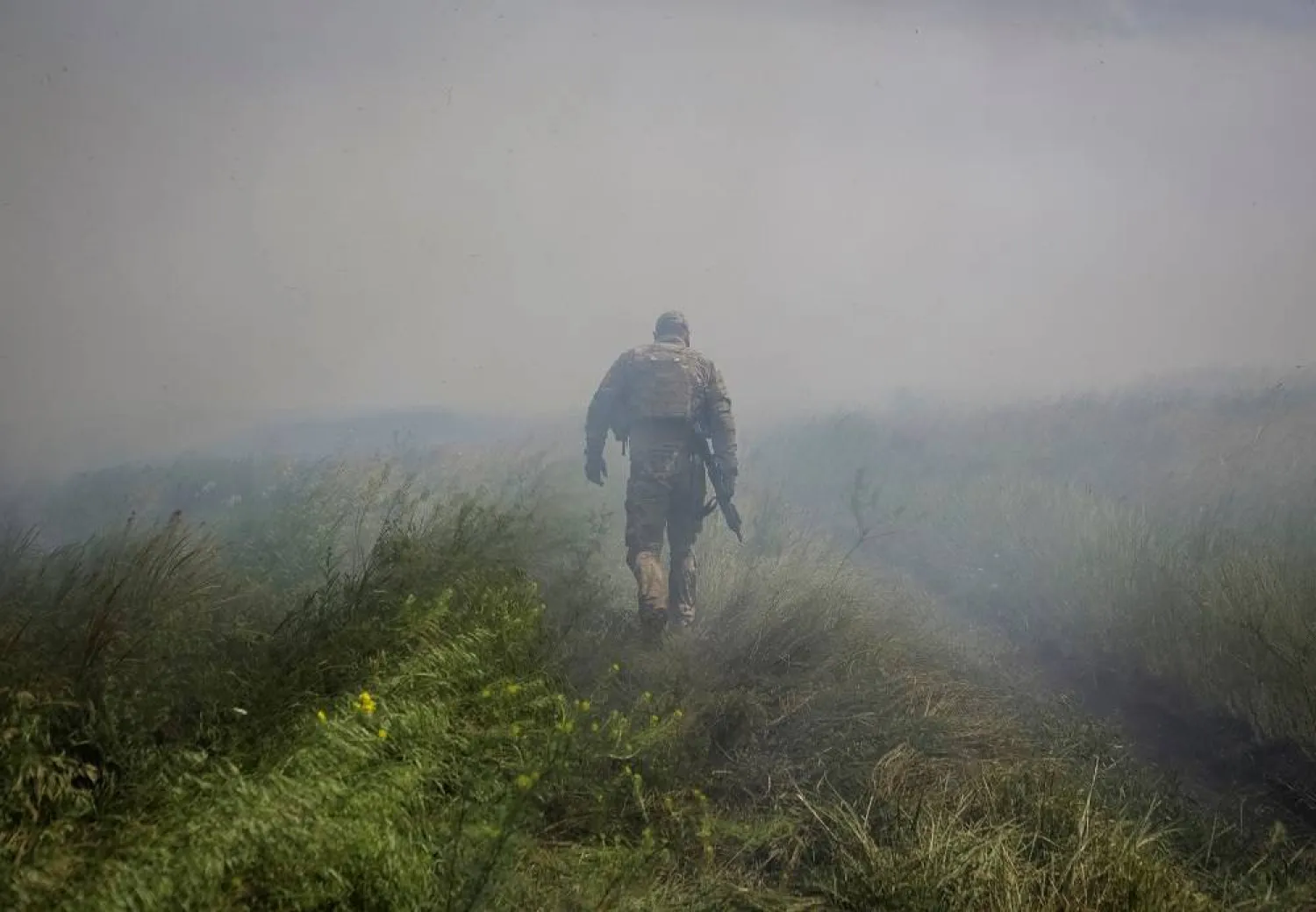
A Ukrainian service member is seen, amid Russia's attack on Ukraine, near the front line near the newly liberated village Neskuchne in Donetsk region, Ukraine June 13, 2023. (Reuters)
TT

Ukraine Aims to Wear Down and Outsmart a Russian Army Distracted by Infighting

A Ukrainian service member is seen, amid Russia's attack on Ukraine, near the front line near the newly liberated village Neskuchne in Donetsk region, Ukraine June 13, 2023. (Reuters)

The ambush had been postponed three times before Ukrainian commanders decided one recent night that conditions were finally right. Cloaked in darkness, a battalion of Kyiv’s 129th brigade pressed ahead, advancing stealthily on unsuspecting Russian soldiers.

By the time the Russians situated along the front line realized they were under attack, it was too late.

Ukraine's recapture of the small village of Neskuchne in the eastern Donetsk region on June 10 encapsulates the opening strategy of a major counteroffensive launched earlier this month. Small platoons bank on the element of surprise and, when successful, make incremental gains in territory and battlefield intelligence.

"We had a few scenarios. In the end, I think we chose the best one. To come quietly, unexpectedly," said Serhii Zherebylo, the 41-year-old deputy commander of the battalion that retook Neskuchne.

Across the 1,500-kilometer (930-mile) front line, Ukrainian forces are attempting to wear down the enemy and reshape battle lines to create more favorable conditions for a decisive, eastward advance. One strategy could be to try to split Russia's forces in two so that the Crimean Peninsula, which Moscow illegally annexed in 2014, is isolated from the rest of the territory it controls.

Ukraine's troops were given a boost of morale last week by an armed rebellion in Russia that posed the most significant threat to President Vladimir Putin's power in more than two decades. Yet how the revolt by Wagner Group mercenaries under the command of Russian warlord Yevgeny Prigozhin affects the trajectory of the war remains to be seen.

The infighting is a major distraction for Russia's military and political leaders, but experts say the impact on the battlefield so far appears minimal.

For the past four days, Ukraine has stepped up operations around the eastern city of Bakhmut, which Wagner forces seized after months of intense fighting and then handed over to Russian soldiers, who continue to lose some ground on their southern flank.

Along the front line, however, the strength of the Russian military remains unchanged since the revolt.

It is not clear where Ukraine will attempt to decisively punch through, but any success will rely on newly formed, Western-equipped brigades that are not yet deployed. For now, Russia's deeply fortified positions and relative air superiority are slowing Ukraine's advance.

Military experts say it is hard to say who has the advantage: Russia is dug-in with manpower and ammunition, while Ukraine is versatile, equipped with modern weaponry and clever on the battlefield.

But with the autumn muddy season only four months away, some Ukrainian commanders say they are racing against time.

"Although Ukrainian forces are making small and steady gains, they do not yet have the operational initiative, meaning they are not dictating the tempo and terms of action," said Dylan Lee Lehrke, an analyst with the British security intelligence firm Janes.

"This has led some observers to claim the counteroffensive is not meeting expectations," Lehrke said. But it was never going to resemble Ukraine’s blitzkrieg liberation of the eastern Kharkiv region last year, he said, because "Russian forces have had too long to prepare fortifications."

Russian authorities say Ukraine has suffered substantial losses since the start of the counteroffensive — 259 tanks and 790 armored vehicles, according to Putin, whose claims could not be independently verified.

Grinding battles are being waged in multiple combat zones.

A catastrophic dam collapse last month in the southern Kherson region has altered the geography along the Dnieper River, giving Ukrainians more freedom of movement there. Russian military bloggers claim a small group of Ukrainian fighters are making gains in the area, although Ukrainian officials have not confirmed these reports.

Across the agricultural plains of the southeastern Zaporizhzhia region, Ukrainian troops backed by tanks, artillery and drones appear to be chipping away more decisively against Russian positions.

Ukrainian troops would deal a severe blow to Russian forces if they managed to regain access to the Sea of Azov from this direction, effectively cutting off Moscow’s land bridge to Crimea. It’s too early to determine whether this is a realistic goal.

They are still a long way off.

In an underground command center on the front, a Ukrainian Special Forces commander with the call sign "Hunter" stares intently at an aerial view of the lush green battlefield.

His servicemen have just stormed an enemy position, but the return fire is constant. Russians blast rockets into the air, while his fighters hide and wait for orders.

Hunter directs the drone operator to shoot.

On the screen, a huge plume of black smoke swells in the air. A hit, he says.

The battle here will only get harder, analysts say.

Ukrainian troops are still several kilometers from Russia’s main defensive lines. As they penetrate deeper into occupied territory, the fighters will have to contend with Russian defenses organized in a diagonal pattern, 10 kilometers deep in some areas, including minefields, anti-tank ditches and pyramid-shaped obstacles known as "dragon's teeth."

And with each advance, they become more vulnerable to Russian air attacks.

At least 130 square kilometers (50 square miles) of land has been regained in the south since the start of the counteroffensive, Deputy Defense Minister Hanna Malyar said this week.

It’s not the pace many hoped for.

A US official familiar with the Biden administration thinking said the counteroffensive is a "long slog" that is testing Ukrainian forces in ways that few other episodes of the 16-month old war have. The official, who was not authorized to comment and spoke on the condition of anonymity, said that there never was expected to be a "D-Day moment," but that the early going suggests the pace of the counteroffensive will be "tough and challenging" for the Ukrainians.

Unlike some of the earlier battles in the war, in which Russian forces showed little resistance or even fled the battlefield, Ukrainian forces are currently facing stiff resistance, the official said.

In the northeast, Russian forces have stepped up offensive operations in the direction of the Kreminna forest near Lyman with the aim of securing a buffer to prevent incursions close to Moscow’s supply lines, said Lehrke. But it may well have a secondary aim — of forcing more Ukrainian deployments, he said.

The dense forested area has proven to be notoriously difficult terrain.

"The Russians have sabotage groups going into the woods and there have been cases where they enter behind the first line of Ukrainian defenses," said Pavlo Yusov, a press officer with the National Guard’s Thunderstorm brigade, currently in Lyman.

Col. Volodymyr Silenko, a commander of the 30th Mechanized Brigade operating near Bakhmut, pays no mind to criticism over the pace of attacks. It’s much more important to focus on how the adversary is thinking and responding, he said.

"A war is not a competition of raw force and strength of weapons and people, it’s more about who’s more cunning," he said.

Silenko knows the Russians watch his men, the same way he watches theirs; Moscow sees their movements, how they change, how they evolve.

"Our job is to outsmart them," he said.

Deception was a key part of Ukraine's most significant battlefield success to date, last fall's "Kherson ruse." By making it appear that the city of Kherson was the main target of that counteroffensive, Ukrainian forces were able to swiftly retake the northern Kharkiv region.

"That was a master class in deception," said Lehrke. "Whether they can do the same this time remains to be seen."




Türkiye Says Greece-Chevron Activity off Crete Unlawful 

A Chevron gas station sign is pictured at one of their retain gas stations in Cardiff, California October 9, 2013. REUTERS/Mike Blake/File Photo
TT

Türkiye Says Greece-Chevron Activity off Crete Unlawful 

A Chevron gas station sign is pictured at one of their retain gas stations in Cardiff, California October 9, 2013. REUTERS/Mike Blake/File Photo

Türkiye said on Thursday it opposed Greece's "unilateral activities" in energy fields south of Crete with a consortium led by US major Chevron as a violation of international law and good neighbourly relations.

Athens responded that its policies abide international law.

The Chevron-led consortium signed exclusive lease agreements on Monday to look for natural gas off southern Greece, expanding US presence in the eastern Mediterranean.

"We oppose this unlawful activity, which is being attempted in violation of the 2019 Memorandum of Understanding on Maritime Jurisdiction between Libya and our country," the Turkish Defense Ministry said at a press briefing.

It said the activity, while not directly impacting Türkiye's continental shelf, also violated Libya's maritime jurisdiction that was declared to the United Nations in May last year.

"We continue to provide the necessary support to the Libyan authorities to take action against these unilateral and unlawful activities by Greece," the ministry said.

A 2019 agreement signed by Türkiye and Libya set out maritime boundaries in the Mediterranean Sea. It was rejected by Greece as it ignored the presence of the Greek island of Crete between the coasts of Türkiye and Libya. The Chevron deal doubles the amount of Greek maritime acreage available for exploration and is the second in months involving a US energy major, as the European Union seeks to phase out supplies from Russia and the US seeks to replace them.

Asked about the Turkish objections later on Thursday, Greek government spokesman Pavlos Marinakis told a press briefing that Athens followed an "active policy" and "exercises its rights in accordance with international law and respects international law steadfastly - and I think no one questions that, period."

There was no immediate comment from Chevron.

Neighbors and NATO members Türkiye and Greece have been at odds over a range of issues for decades, primarily maritime boundaries and rights in the Aegean, an area widely believed to hold energy resources and with key implications for airspace and military activity.

A 2023 declaration on friendly relations prompted a thaw between the sides and leaders have voiced a desire to address remaining issues.


Andrew Mountbatten-Windsor Arrested on Suspicion of Misconduct in Public Office

FILE - Britain’s Andrew Mountbatten-Windsor, formerly known as Prince Andrew, looks round as he leaves after attending the Easter Matins Service at St. George's Chapel, Windsor Castle, England, April 20, 2025. (AP Photo/Kirsty Wigglesworth, File)
TT

Andrew Mountbatten-Windsor Arrested on Suspicion of Misconduct in Public Office

FILE - Britain’s Andrew Mountbatten-Windsor, formerly known as Prince Andrew, looks round as he leaves after attending the Easter Matins Service at St. George's Chapel, Windsor Castle, England, April 20, 2025. (AP Photo/Kirsty Wigglesworth, File)

UK police arrested Andrew Mountbatten-Windsor on Thursday on suspicion of misconduct in public office.

The Thames Valley Police, an agency that covers areas west of London, including Mountbatten-Windsor’s former home, said it was “assessing” reports that the former Prince Andrew sent trade reports to convicted sex offender Jeffrey Epstein in 2010. The assessment followed the release of millions of pages of documents connected to a US investigation of Epstein.

The police force did not name Mountbatten-Windsor, as is normal under UK law. But when asked if he had been arrested, the force pointed to a statement saying that they had arrested a man in his 60s. Mountbatten-Windsor is 66.

“Following a thorough assessment, we have now opened an investigation into this allegation of misconduct in public office,’’ the statement said. “It is important that we protect the integrity and objectivity of our investigation as we work with our partners to investigate this alleged offence."

“We understand the significant public interest in this case, and we will provide updates at the appropriate time,” the statement added.

Pictures circulated online appearing to show unmarked police cars at Wood Farm on the Sandringham Estate in Norfolk, with plainclothes officers appearing to gather outside the home of Mountbatten-Windsor.


Georgia Arrests Two Foreigners Trying to Purchase Uranium

FILE PHOTO: A block with the symbol, atomic number and mass number of Uranium (U) element, in this illustration taken January 21, 2026. REUTERS/Dado Ruvic/Illustration/File Photo
TT

Georgia Arrests Two Foreigners Trying to Purchase Uranium

FILE PHOTO: A block with the symbol, atomic number and mass number of Uranium (U) element, in this illustration taken January 21, 2026. REUTERS/Dado Ruvic/Illustration/File Photo

Georgia has ‌detained two people who attempted to purchase $3 million worth of uranium and a cache of a radioactive isotope found in nuclear weapons testing programs, the national security service said on Thursday.

Two foreign nationals from unspecified countries were arrested in the city of Kutaisi, the State Security Service said in a statement.

"They were planning to ‌illegally purchase ‌nuclear material uranium and radioactive ‌substance ⁠Cesium 137 for $3 ⁠million and illegally transport it to the territory of another country," Reuters quoted it as saying.

It said other foreigners had been arriving in Georgia in recent weeks with the aim of purchasing and transporting the nuclear and ⁠radioactive materials, without elaborating further.

The ‌statement did ‌not specify the quantity of materials the individuals were ‌attempting to procure. There were ‌no details on the substances' origin or potential destination.

Cesium 137 is a radioactive isotope present primarily in the aftermath of nuclear weapons testing ‌and nuclear power plant accidents such as the Chernobyl disaster in ⁠then-Soviet ⁠Ukraine in 1986.

The security of nuclear materials was one of the biggest concerns after the 1991 fall of the Soviet Union, of which Georgia was part. There have been several serious incidents involving the illicit trade in nuclear materials in Georgia over recent decades.

Most recently, three Chinese citizens were arrested in the capital Tbilisi for attempting to purchase two kilograms of "nuclear material" uranium.