


Netanyahu Leaves Hospital as Israel Faces a Key Vote — And a Crisis — Over Divisive Legal Changes 

An aerial view shows right-wing demonstrators backing the Israeli government and its reform plans rallying in Tel Aviv, the epicenter of 29 straight weeks of anti-government protests, on July 23, 2023. (AFP)
TT

Netanyahu Leaves Hospital as Israel Faces a Key Vote — And a Crisis — Over Divisive Legal Changes 

An aerial view shows right-wing demonstrators backing the Israeli government and its reform plans rallying in Tel Aviv, the epicenter of 29 straight weeks of anti-government protests, on July 23, 2023. (AFP)

Israeli Prime Minister Benjamin Netanyahu was released from the hospital Monday after an emergency heart procedure, facing an unprecedented national crisis ahead of parliament’s vote on the first major piece of legislation to remake the country’s justice system.

Demonstrators, many of whom feel the very foundations of their country are being eroded by the government's plan, stepped up their opposition, blocking a road leading up to parliament. Businesses shuttered their doors in protest of the vote.

Driven by a governing coalition made up of ultranationalist and ultra-religious parties, the judicial overhaul has divided Israel, testing the delicate social ties that bind the country, rattling the cohesion of its powerful military and repeatedly drawing concern from even its closest ally, the United States.

Efforts to find a last-ditch compromise were underway, with Israel's President Isaac Herzog shuttling between the sides, including a meeting at the hospital where Netanyahu was treated, to find an agreement over the way forward. But it was unclear whether those would result in a compromise ahead of the vote, expected Monday afternoon.

Early Monday, protesters banging on drums and blowing horns blocked a road leading to the Knesset, and police used water cannons to push them back. The protest movement said one of its leaders was arrested.

“The state of Israel stands before destruction and ruin that is being brought upon it by a gang of extremists and kooks. We must go up to Jerusalem today!” one branch of the protest movement called out to demonstrators on social media.

Israeli media reported that a consortium of businesses announced late Sunday that some of their members wouldn't open on Monday in protest at the government's plans, leading to big mall chains and some gas stations sealing their doors.

The dramatic events were being watched closely in Washington, from where the Biden administration has frequently spoken out against Netanyahu's government and its overhaul plan. In a statement to the news site Axios late Sunday, Biden warned against pushing ahead with the legal changes that were sparking so much division.

“Given the range of threats and challenges confronting Israel right now, it doesn’t make sense for Israeli leaders to rush this — the focus should be on pulling people together and finding consensus,” he told the site.

Netanyahu’s sudden hospitalization for the implant of a pacemaker added another dizzying twist to an already dramatic series of events that have bitterly divided his country and are certain to shape Israel's future.

Netanyahu's doctors said Sunday the procedure had gone smoothly. In a short video statement from the hospital late Sunday, Netanyahu, 73, said he felt fine and thanked his doctors for his treatment and the public for wishing him well.

Wearing a white dress shirt and dark blazer, Netanyahu said he was pursuing a compromise with his opponents while also preparing for a vote on Monday that would enshrine a key piece of the legislation into law.

“I want you to know that tomorrow morning I’m joining my colleagues at the Knesset,” he said.

The overhaul calls for sweeping changes aimed at curbing the powers of the judiciary, from limiting the Supreme Court’s ability to challenge parliamentary decisions to changing the way judges are selected.

Netanyahu and his far-right allies, a collection of ultranationalist and ultra-Orthodox parties, say the changes are needed to curb the powers of unelected judges. Their opponents, coming largely from Israel's professional middle class, say the plan will destroy the country’s fragile system of checks and balances and push Israel toward authoritarian rule.

The plan has triggered seven months of mass protests, drawn harsh criticism from business and medical leaders, and a fast-rising number of military reservists in key units have said they will stop reporting for duty if the plan passes, raising concern that Israel’s security could be threatened.

President Herzog, who returned Sunday from a trip to the White House, immediately rushed to Netanyahu's hospital room.

“This is a time of emergency,” Herzog said. “We have to reach an agreement.”

Herzog held meetings later Sunday with Israel's opposition leader, Yair Lapid, and Benny Gantz, head of National Unity, another opposition party.

As they spoke, tens of thousands of people gathered for mass rallies for and against the plan. Netanyahu's supporters thronged central Tel Aviv — normally the setting for anti-government protests — while his opponents marched on Israel's Knesset, or parliament.

Many of the protesters in Jerusalem had camped out in a nearby park, after completing a four-day march into the city from Tel Aviv on Saturday.

Further ratcheting up the pressure on the Israeli leader, thousands of military reservists have been declaring their refusal to serve under a government taking steps that they see as setting the country on a path to dictatorship. Those moves have prompted fears that the military’s preparedness could be compromised.

“These are dangerous cracks,” military chief Lt. Gen. Herzi Halevi wrote in a letter to soldiers Sunday meant to address the tensions. “If we will not be a strong and cohesive military, if the best do not serve in the IDF, we will no longer be able to exist as a country in the region.”

Despite the attempts to project business as usual, Netanyahu's schedule was disrupted by his hospitalization. His weekly Cabinet meeting scheduled for Sunday morning was postponed. Two upcoming overseas trips, to Cyprus and Türkiye, were being rescheduled, his office said.

In Monday's vote, legislators are to decide on an overhaul measure that would prevent judges from striking down government decisions on the basis that they are “unreasonable.”

Proponents say the current “reasonability” standard gives judges excessive powers over decision-making by elected officials. Critics say removing it would allow the government to pass arbitrary decisions, make improper appointments or firings and open the door to corruption.

Protesters, who come from a wide swath of Israeli society, see the overhaul as a power grab fueled by personal and political grievances of Netanyahu — who is on trial for corruption charges — and his partners who want to deepen Israel’s control of the occupied West Bank and perpetuate controversial draft exemptions for ultra-Orthodox men.

Netanyahu was rushed to the hospital in the middle of the night a week after being hospitalized for what doctors said was dehydration.

The sudden hospitalization for the pacemaker procedure indicated that Netanyahu's health issues were more serious than what he initially said.

Netanyahu and his far-right allies announced the overhaul plan in January, days after taking office.

Netanyahu paused the overhaul in March after intense pressure by protesters and labor strikes that halted outgoing flights and shut down parts of the economy. After talks to find a compromise failed last month, he said his government was pressing on with the overhaul.



Iran Rejects US Claims on Missile Program as ‘Big Lies’ 

Iranians walk through Tehran's Grand Bazaar on February 24, 2026. (AFP)
TT

Iran Rejects US Claims on Missile Program as ‘Big Lies’ 

Iranians walk through Tehran's Grand Bazaar on February 24, 2026. (AFP)

Iran's foreign ministry on Wednesday dismissed US claims about its missile program as "big lies", after President Donald Trump claimed Tehran was developing missiles that can strike the United States.

"Whatever they're alleging in regards to Iran's nuclear program, Iran's ballistic missiles, and the number of casualties during January's unrest, is simply the repetition of 'big lies'," ministry spokesman Esmaeil Baqaei said on X.

Baqaei did not specify exactly which claims he was responding to, but hours earlier Trump had said Iran was seeking missiles that could reach American soil.

In an interview with Al Jazeera in February, Iran's Foreign Minister Abbas Araghchi said Tehran lacked the capability to target the US but would attack American bases in the Middle East if Washington launched a strike.

During his State of the Union speech, Trump also reiterated that Iran would never be allowed to build a nuclear weapon, saying that Tehran's leaders were "at this moment again pursuing their sinister nuclear ambitions".

Iran has repeatedly denied it is seeking a nuclear weapon, but insists it has the right to use nuclear technology for peaceful purposes.

The US president also claimed that Iranian authorities killed 32,000 people during a wave of protests that started in December and peaked on January 8 and 9.

Iranian officials acknowledge more than 3,000 deaths, but say the violence was caused by "terrorist acts" fueled by the United States and Israel.

The US-based Human Rights Activists News Agency (HRANA) has recorded more than 7,000 deaths, while warning the full toll is likely far higher.


Reports: Japanese Journalist Arrested in Iran 

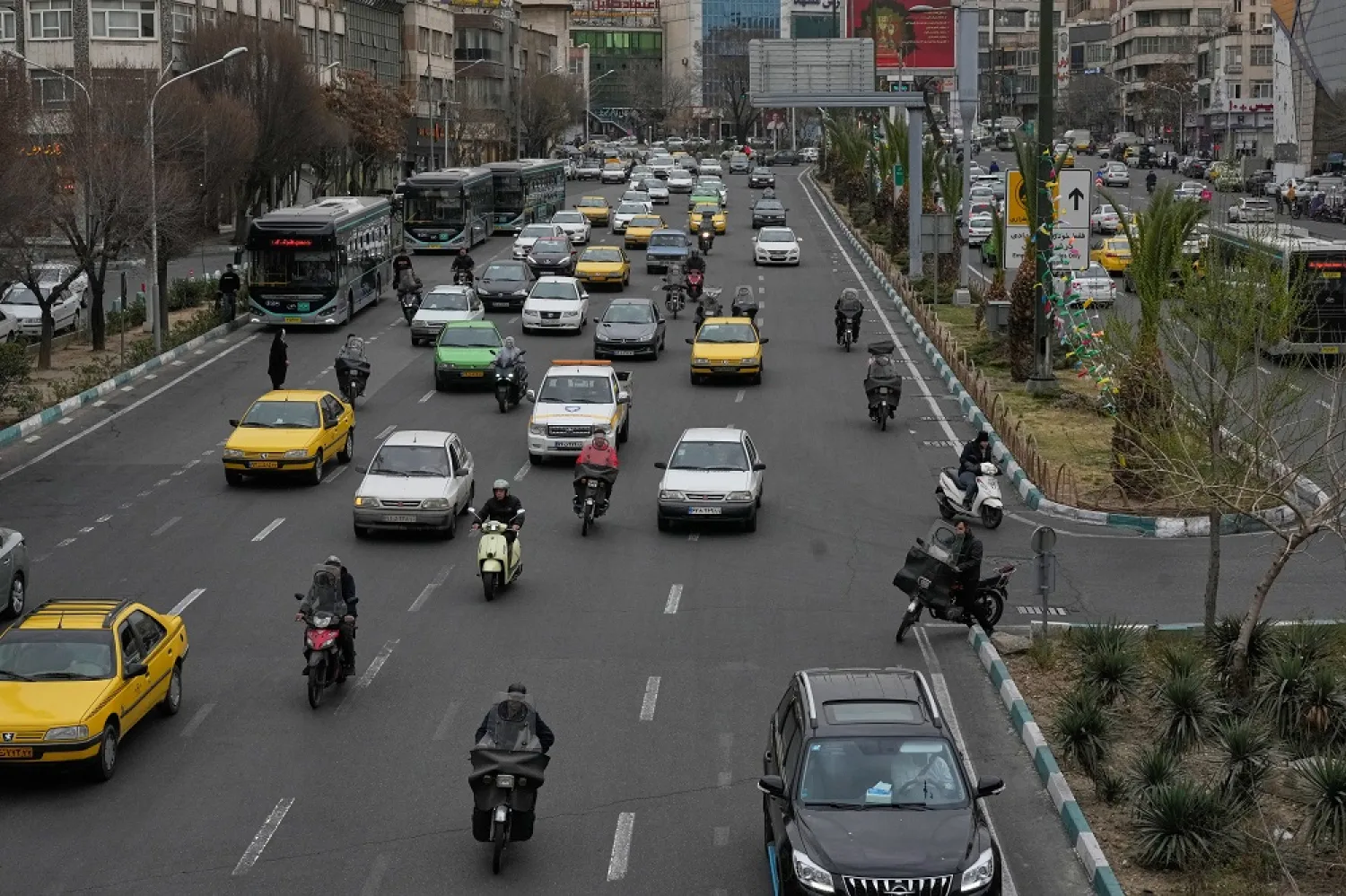
 Vehicles drive in downtown Tehran, Iran, Tuesday, Feb. 24, 2026. (AP)
Vehicles drive in downtown Tehran, Iran, Tuesday, Feb. 24, 2026. (AP)
TT

Reports: Japanese Journalist Arrested in Iran 

 Vehicles drive in downtown Tehran, Iran, Tuesday, Feb. 24, 2026. (AP)
Vehicles drive in downtown Tehran, Iran, Tuesday, Feb. 24, 2026. (AP)

Iran has arrested the Tehran bureau chief of Japanese public broadcaster NHK, according to media reports. 

The reports named him as Shinnosuke Kawashima and said he had been transferred to the notorious Evin Prison. 

"We at NHK always act with the safety of our staff as our top priority. At this time, we are unable to comment further," an NHK spokesman told AFP on Wednesday. 

Government spokesman Masanao Ozaki told reporters that a Japanese citizen had been detained on January 20 but declined to give more details. 

"The Japanese government has confirmed that one Japanese national was detained by the local authorities in Tehran, Iran, on January 20," deputy chief cabinet secretary Osaki said. 

"Since this detention case came to light, the government has been strongly urging the Iranian side to secure the early release of the individual concerned," Ozaki said. 

"We are also in contact with the person and their family and other related parties, and are providing whatever assistance is necessary." 


Bill Gates ‘Took Responsibility for His Actions’ Over Epstein Links, Foundation Says 

This undated and unlocated handout image released by Democrats on the House Oversight Committee on December 18, 2025 shows US businessman and philanthropist Bill Gates (L) posing with a woman whose face has been redacted. Democratic lawmakers released a new cache of photos and documents on December 18 from the estate of convicted sex offender Jeffrey Epstein. (House Oversight Democrats / AFP / Handout)
TT

Bill Gates ‘Took Responsibility for His Actions’ Over Epstein Links, Foundation Says 

This undated and unlocated handout image released by Democrats on the House Oversight Committee on December 18, 2025 shows US businessman and philanthropist Bill Gates (L) posing with a woman whose face has been redacted. Democratic lawmakers released a new cache of photos and documents on December 18 from the estate of convicted sex offender Jeffrey Epstein. (House Oversight Democrats / AFP / Handout)

Bill Gates "took responsibility for his actions" over ties ‌to late financier and sex offender Jeffrey Epstein in a town hall meeting with employees of the Gates Foundation, a spokesperson for the philanthropic group told Reuters in a written statement on Tuesday.

The spokesperson's comments came in response to a Wall Street Journal report, which said that Gates had apologized to staff during the town hall over his ties with Epstein.

Documents released by the US Department of Justice (DOJ) have indicated that Gates and Epstein met repeatedly after Epstein's prison term to discuss expanding the Microsoft founder's philanthropic efforts.

According to the Journal report, Gates told staff that it was a huge mistake to spend time with Epstein and ‌bring Gates Foundation ‌executives into meetings with the sex offender. The report cited ‌a ⁠recording of the ⁠comments Gates made in the town hall.

"I apologize to other people who are drawn into this because of the mistake that I made," he said, according to the newspaper.

The Journal added that Gates also acknowledged that he had two affairs with Russian women that Epstein later discovered, but that they did not involve Epstein's victims.

"I did nothing illicit. I saw nothing illicit," Gates told the staff, according ⁠to the report.

Documents released by the DOJ also included ‌pictures of the Microsoft founder posing with women ‌whose faces are redacted. Gates has previously said the relationship with Epstein was confined to ‌philanthropy-related discussions and has said it was a mistake to meet with ‌him.

According to the Journal, Gates told the foundation's staff that the images were pictures that Epstein asked him to take with Epstein's assistants after their meetings.

"To be clear I never spent any time with victims, the women around him," Gates added, according to ‌the report.

A spokesperson for the Gates Foundation told Reuters that Gates held a scheduled town hall with the employees ⁠and answered questions on ⁠a range of issues, including the release of the Epstein files.

"In the town hall, Bill spoke candidly, addressing several questions in detail, and took responsibility for his actions."

The spokesperson also said the Gates Foundation statement acknowledged what was shared by the billionaire during the town hall, and the statement is all that the foundation would say about the report.

Earlier this month, the Gates Foundation said it did not make any financial payments to Epstein or employ him at any time.

The billionaire also pulled out of India's AI Impact Summit hours before his scheduled keynote last week.

The Gates Foundation, chaired by Bill Gates and started by him and his then-wife in 2000, is one of the world's biggest funders of global health initiatives.