



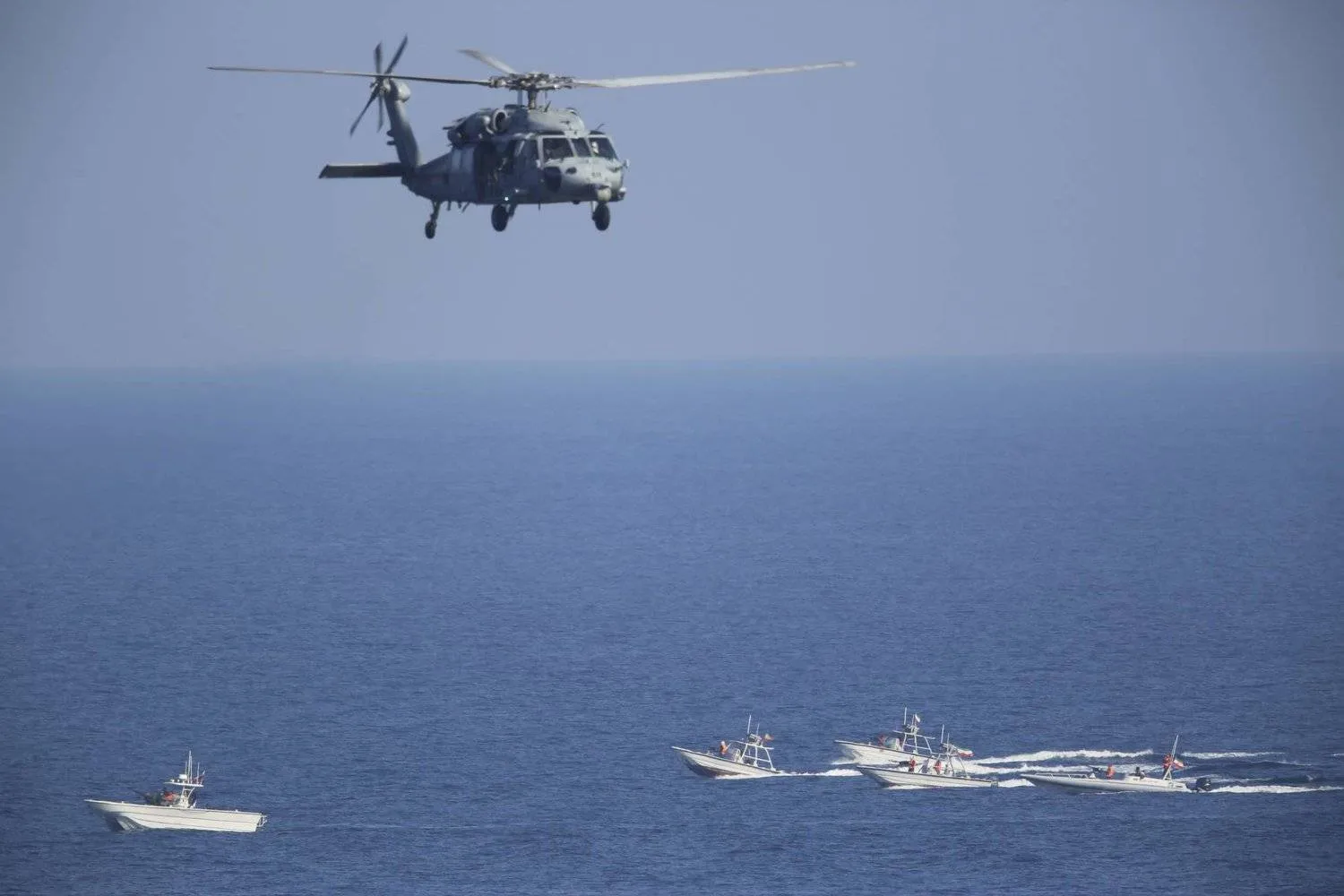

The United States could soon offer to put armed sailors and Marines on commercial ships traveling through the Gulf's Strait of Hormuz amid alleged attempts by Iran to hijack ships in international waters.
Washington didn't even take the step during the so-called "Tanker War," which culminated with the US Navy and Iran fighting a one-day naval battle in 1988 that was the Navy's most significant since World War II.
A US official, speaking on condition of anonymity, said that the plans had yet to receive final approval. Still, it has buy-in from senior Biden administration officials and could commence as soon as this month.
Marines from Camp Lejeune, North Carolina, have been flown to Bahrain and received related training, with additional personnel due to arrive soon aboard American warships.
"We have a cohort on the ground," the official said, adding that the "policy decision has pretty much been made."
The Marines training for the mission in Bahrain is with the 26th Expeditionary Unit, a naval force that typically deploys aboard Navy warships.
Other personnel with the unit are aboard the USS Bataan, USS Carter Hall, and USS Mesa Verde and could arrive in the Middle East soon.
The Bataan and Carter Hall left Norfolk, Virginia, on July 10 on a mission the Pentagon described as being "in response to recent attempts by Iran to threaten the free flow of commerce in the Strait of Hormuz and its surrounding waters."
A second US official acknowledged the proposal is under discussion at the Pentagon but emphasized that it has yet to be approved.
Asked about the plan, a Pentagon spokesman, Brig-Gen. Patrick Ryder said Thursday he had no announcements to make.
White House spokesman John Kirby directed questions to the Defense Department while noting that the Strait of Hormuz, where some of the incidents have occurred, is a "vital seaway."
He said the US has seen threats by Iran to close off this "choke point."
The strait connects the Persian Gulf to the Gulf of Oman and the open ocean. At least 20 percent of the world's crude oil is moved through the strategic waterway.
The effort is among a set of muscular actions pursued by the Biden administration following a purported rise in attempts by Iran to seize commercial tanker ships.
US officials said the US sailors would only provide security at the request of the ships involved.
They cited an incident on July 5 as an inflection point in US discussions. Iranian forces tried to commandeer two civilian tanker ships that day, firing on and striking one of them, the Richmond Voyager, in its hull, Navy officials said.
Iranian forces fled after the arrival of the USS McFaul, a naval destroyer.
In another recent incident, warships from the United States and Britain answered a June 4 distress call from a merchant vessel transiting the Strait of Hormuz, where three Iranian fast-attack boats had harassed the civilian ship, Navy officials said.
In that case, the McFaul and the Royal Navy frigate HMS Lancaster responded, with the Lancaster launching a helicopter to drive off the Iranian ships.
The Navy said in May that the oil tanker Niovi was seized by Iran's Islamic Revolutionary Guard Corps while in the strait.
The civilian vessel had departed Dubai and was traveling to the port of Fujairah in the United Arab Emirates when a dozen fast-attack craft surrounded it. In April, Iran made a similar seizure of the oil tanker Advantage Sweet.
Other recent steps to deter Iran include deploying advanced F-35 jets, along with other fighter aircraft and A-10 attack jets, to the Persian Gulf region.
The Pentagon also dispatched an additional Navy destroyer to bolster the presence of US military vessels already in the region.
However, Iranian officials have criticized the deployments, calling them destabilizing and provocative.
The renewed hostilities occurred as Iran close to enriching weapon-grade uranium following the collapse of the 2015 nuclear deal.


