


North Korean Leader Calls for His Military to Sharpen War Plans as His Rivals Prepare Drills 

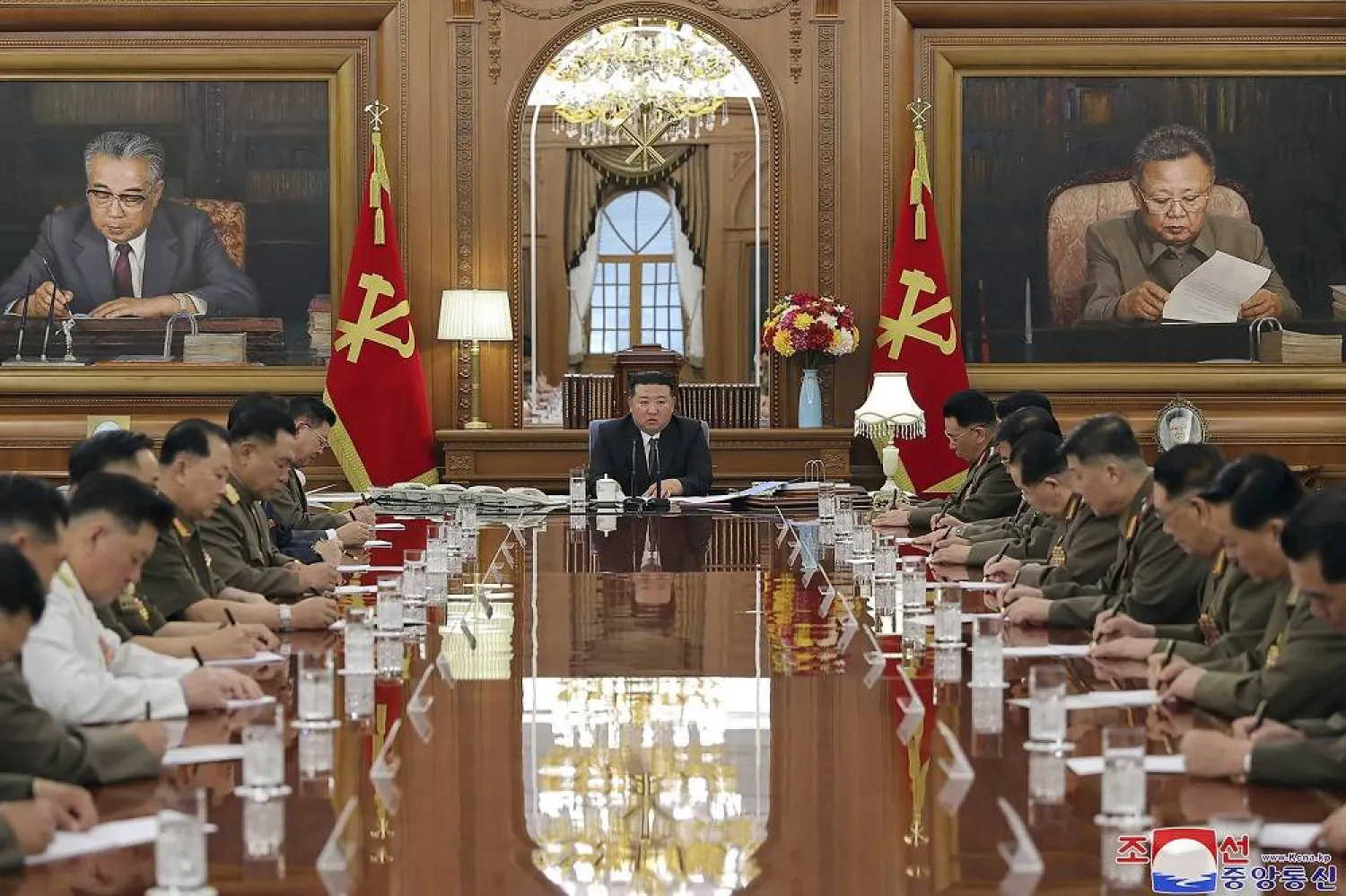
In this undated photo provided by the North Korean government, North Korean leader Kim Jong Un, center, attends a meeting of the North Korean ruling Workers’ Party’s central military commission in Pyongyang, North Korea Wednesday, Aug. 9, 2023. (Korean Central News Agency/Korea News Service via AP)
TT

North Korean Leader Calls for His Military to Sharpen War Plans as His Rivals Prepare Drills 

In this undated photo provided by the North Korean government, North Korean leader Kim Jong Un, center, attends a meeting of the North Korean ruling Workers’ Party’s central military commission in Pyongyang, North Korea Wednesday, Aug. 9, 2023. (Korean Central News Agency/Korea News Service via AP)

North Korean leader Kim Jong Un ordered his military to sharpen its war plans and signed off on expanding combat operations of frontline units, state media said Thursday, as the United States and South Korea prepare for a large-scale combined military exercise.

Condemning the allies’ expanding drills as invasion rehearsals, Kim has used them as a pretext to further accelerate his weapons demonstrations, which have included the testing-firings of more than 100 missiles since the start of 2022, driving tensions on the Korean Peninsula to their highest point in years.

Experts say Kim’s nuclear push is aimed at forcing the United States to accept the idea of the North as a nuclear power so he can eventually negotiate economic and security concessions from a position of strength.

Thursday’s meeting of the North Korean ruling Workers’ Party’s central military commission, which Kim controls as chairman, was to discuss advancing his military’s war readiness and establishing offensive countermeasure plans to deter his adversaries, which state media said were getting more blatant in their “reckless military confrontation” with the North.

After talks of boosting North Korean frontline units and stepping up war drills to incorporate new strategies and weapons, Kim signed an order to implement unspecified “important military measures," Pyongyang’s official Korean Central News Agency said.

During the meeting, Kim stressed that the military must acquire “more powerful strike means” to bolster his nuclear deterrent and make speedier deployments of those weapons to combat units. He called for the country’s munitions industry to step up mass production of various weapons and systems, and for the military to actively conduct “actual war drills” to digest those systems and enhance its war-fighting capabilities, KCNA said.

Photos of the meeting published by state media showed Kim pointing to spots in a blurred map of the Korean Peninsula. The spots appeared to be the metropolitan region surrounding the South Korean capital of Seoul, where half of the country’s 51 million people live, and an area around the central city of Daejeon, the location of South Korea’s army headquarters.

Kim also made personnel changes during the meeting, appointing Vice Marshal Ri Yong Gil as his new chief of general staff to replace Gen. Pak Su Il, KCNA said.

Since he began his rule in late 2011, Kim has shown a tendency to swiftly replace senior government and military officials if he was unhappy with their performances or needed to hold them responsible for broader policy failures, which the North never pins on its supreme leader.

The decision to sack Pak eight months into the job possibly indicates that Kim was dissatisfied about his ability to craft military strategies and went back to a more trusted hand in Ri, who had a lengthy previous stint as chief of general staff, said Cheong Seong-Chang, a senior analyst at South Korea's Sejong Institute.

When asked about Kim’s comments, Ahn Eun-ju, a spokesperson at South Korea's Foreign Ministry, said it was “deplorable” that North Korea was talking about boosting war readiness while ignoring the plight of its desperately poor population.

Some experts say the North's economy is likely at its worst since Kim took power. COVID-19 restrictions further shocked an economy crippled by decades of mismanagement and US-led sanctions imposed over his nuclear ambitions. That hasn't stopped Kim from channeling the country's limited resources into expanding a nuclear arsenal he sees as his strongest guarantee of survival.

“North Korea should instead pay attention to the safety of its citizens with a typhoon approaching,” Ahn said, referring to Tropical Storm Khaunun, which pounded South Korea with intense rains and winds on Thursday and was expected to blow into North Korea early Friday.

“We are maintaining a firm readiness posture, and North Korea's empty threats of force will not work with us," she said.

Lee Sung Joon, spokesperson for South Korea’s Joint Chiefs of Staff, said during a briefing that the US and South Korean intelligence authorities were closely monitoring North Korean weapons development activities and possibilities of provocations.

Kim’s comments during the meeting echoed what he said last week during a three-day tour of the country’s key weapons factories, including a facility that produces launcher trucks for his intercontinental ballistic missiles designed to target the US mainland, and called for significant improvements to the country’s arms and war readiness.

Kim’s visits also included an artillery factory that deepened outside concerns that North Korea was preparing to export artillery and other arms supplies to Russia as President Vladimir Putin reaches out to other countries for support in the war in Ukraine.

In the face of deepening confrontations with Washington and Seoul, Kim has been trying boost the visibility of his partnerships with Moscow and Beijing to break out of diplomatic isolation and insert himself into a united front against the US.

Kim invited Russian Defense Minister Sergei Shoigu and a Chinese ruling party officials to share center stage at a giant military parade in Pyongyang where he rolled out his most powerful missiles designed to target South Korea and the United States.

Shoigu’s presence at the July 27 parade came after Kim took him on a tour of a domestic arms exhibition, which demonstrated North Korea’s support for Russia’s invasion of Ukraine and added to suspicions the North was willing to supply arms to Russia.

During Thursday’s meeting, North Korean officials also agreed to hold another military parade to mark the 75th anniversary of its government’s founding. The Sept. 9 parade would be the country’s third event in 2023 alone. Analysts say the North has never staged military parades more than twice in the same year.



Trump to Travel to China Next Month, with US Trade Policy in Focus

US President Donald Trump arrives at Joint Base Andrews in Maryland, US, February 19, 2026. (Reuters)
TT

Trump to Travel to China Next Month, with US Trade Policy in Focus

US President Donald Trump arrives at Joint Base Andrews in Maryland, US, February 19, 2026. (Reuters)

US President Donald Trump will travel to China from March 31 to April 2 for a highly anticipated meeting between the world's two biggest economies, following the Supreme Court's decision to overturn Trump's sweeping tariffs against imported goods.

A White House official confirmed the trip on Friday, just before the highest US court struck down many of the tariffs Trump has used to manage sometimes-tense relations with China.

Trump is expected to visit Beijing and meet Chinese President Xi Jinping as part of a lavish, extended visit. Trump was last in China in 2017, ‌the most ‌recent trip by a US president.

A key topic had been whether ‌to ⁠extend a trade ⁠truce that kept both countries from further hiking tariffs. After Friday's ruling, however, it was not immediately clear whether - and under what legal authority - Trump would restore tariffs on imports from China.

TRUMP SEES TRADE IMBALANCE AS NATIONAL EMERGENCY

The administration has said the tariffs were necessary because of national emergencies related to trade imbalances and China's role in producing illicit fentanyl-related chemicals.

"That's going to be a wild one," Trump told foreign leaders visiting Washington on Thursday ⁠about the trip. "We have to put on the biggest display you've ‌ever had in the history of China."

The Chinese ‌embassy in Washington did not immediately respond to a request for comment. Beijing has not ‌confirmed the trip.

The visit would be the leaders' first talks since February and their first ‌in-person visit since an October meeting in South Korea. At that October meeting, Trump agreed to trim tariffs on China in exchange for Beijing cracking down on the fentanyl trade, resuming US soybean purchases and keeping rare earth minerals flowing.

While the October meeting largely sidestepped the sensitive issue of ‌Taiwan, Xi raised US arms sales to the island in February.

Washington announced its largest-ever arms sales deal with Taiwan in December, ⁠including $11.1 billion in ⁠weapons that could ostensibly be used to defend against a Chinese attack. Taiwan expects more such sales.

China views Taiwan as its own territory, a position Taipei rejects. The United States has formal diplomatic ties with China, but it maintains unofficial ties with Taiwan and is the island's most important arms supplier. The United States is bound by law to provide Taiwan with the means to defend itself.

Xi also said during the February call that he would consider further increasing soybean purchases, according to Trump.

Struggling US farmers are a major political constituency for Trump, and China is the top soybean consumer.

Although Trump has justified several hawkish policy steps from Canada to Greenland and Venezuela as necessary to thwart China, he has eased policy toward Beijing in the past several months in key areas, from tariffs to advanced computer chips and drones.


Diplomacy Is Still the Only Viable Path to Peace in Ukraine, UN Refugee Chief Barham Salih Says

UNCHR High Commissioner Barham Salih talks during an interview with The Associated Press in Kyiv, Ukraine, Friday, Feb. 20, 2026. (AP)
TT

Diplomacy Is Still the Only Viable Path to Peace in Ukraine, UN Refugee Chief Barham Salih Says

UNCHR High Commissioner Barham Salih talks during an interview with The Associated Press in Kyiv, Ukraine, Friday, Feb. 20, 2026. (AP)

There are many obstacles to a peace deal in Ukraine, but a diplomatic solution remains the only viable option, the newly appointed head of the UN refugee agency said Friday, warning that humanitarian operations are increasingly overstretched because of multiple global crises.

Barham Salih, Iraq’s former president who was elected UNHCR high commissioner in December, made his first visit to Ukraine since taking office.

After traveling to Ukraine’s front-line cities, including Kharkiv and Zaporizhzhia, he met with President Volodymyr Zelenskyy and discussed the latest in efforts to secure a peace deal. He also discussed the future of UNHCR operations as Ukraine endures Russian attacks on its energy grid during a harsh winter.

“You have to be hopeful, but I do understand the difficulties in the situation, and it’s clear, of course, there are many, many impediments along the way, but at the end of the day, there is no military solution. There needs to be peace, a durable and just peace so that people can go back to their lives,” he said, speaking to The Associated Press in an interview in Kyiv.

“Things are not necessarily easy, definitely not easy, but let’s redouble the effort to make sure that diplomacy has a chance and really bring about a durable and just peace to this war that has been going on for far too long,” he added.

Of the agency’s $470 million appeal for Ukraine, only $150 million has been pledged. The shortfall reflects deep cuts across the humanitarian sector, making it increasingly difficult to deliver aid across multiple crises.

There are 3.7 million Ukrainians displaced within the country and nearly 6 million Ukrainians outside the country who have become refugees in Europe and elsewhere, he said.

“This tells you the gap between what is needed and what is available,” he said. “My appeal to the international community is, really, this is not the moment to walk away, this is not a moment to look the other way round. These vulnerable populations need support. We should deliver this help to them.”

The UN agency in Ukraine predicts 10.8 million Ukrainians will require humanitarian assistance in 2026, according to a report from the agency. The most critical needs are concentrated along the war’s front lines in the eastern and southern parts of Ukraine, as well as in the northern border region. Intensified hostilities produce fresh waves of displacement.

The agency’s Ukraine appeal competes with large-scale conflicts in Sudan and Gaza. Since his appointment, Salih has spent only one week in his Geneva office, traveling to Kenya, Chad, Türkiye and Jordan before visiting Ukraine.

Drastic cuts to US humanitarian funding under President Donald Trump has accelerated the erosion of global humanitarian infrastructure and severely undermined the ability of organizations to deliver aid.

There are 117 million displaced people worldwide, including at least 42 million refugees, Salih said. Two-thirds face protracted displacement and remain dependent on humanitarian assistance.

Deciding where to prioritize given shrinking resources is “difficult” he said.

“It’s really very difficult to prioritize given the scale of the problem. I was in Kenya and I was in Chad recently and I was in Türkiye and in Jordan talking to refugees from Syria. And of course, now in Ukraine, these are all pressing issues, pressing requirements,” he said.

“We need to be there to help people, but also I have to say we really need to look at durable solutions too as well. It’s not a matter of sustaining dependency or humanitarian assistance,” he added.

In his meeting with Zelenskyy, Salih said they discussed the need to focus on the “recovery phase and sustainable solutions and self reliance as we go forward,” he said.


Israel Army Says on ‘Defensive Alert’ Regarding Iran but No Change to Public Guidelines

Israeli air defense system fires to intercept missiles during an Iranian attack over Tel Aviv, Israel, Thursday, June 19, 2025. (AP)
TT

Israel Army Says on ‘Defensive Alert’ Regarding Iran but No Change to Public Guidelines

Israeli air defense system fires to intercept missiles during an Iranian attack over Tel Aviv, Israel, Thursday, June 19, 2025. (AP)

The Israeli army said it was on "defensive alert" as the United States threatens potential military action against Iran, but insisted there were no changes in its guidelines for the public.

"We are closely monitoring regional developments and are aware of the public discourse concerning Iran. The (Israeli military) is on defensive alert," army spokesman Brigadier General Effie Defrin said in a video statement published Friday.

"Our eyes are wide open in all directions, and our finger is more than ever on the trigger in response to any change in the operational reality," he added, but emphasized "there is no change in the instructions".