A Tanker Believed to Hold Sanctioned Iran Oil Starts Offloading near Texas despite Tehran's Threats

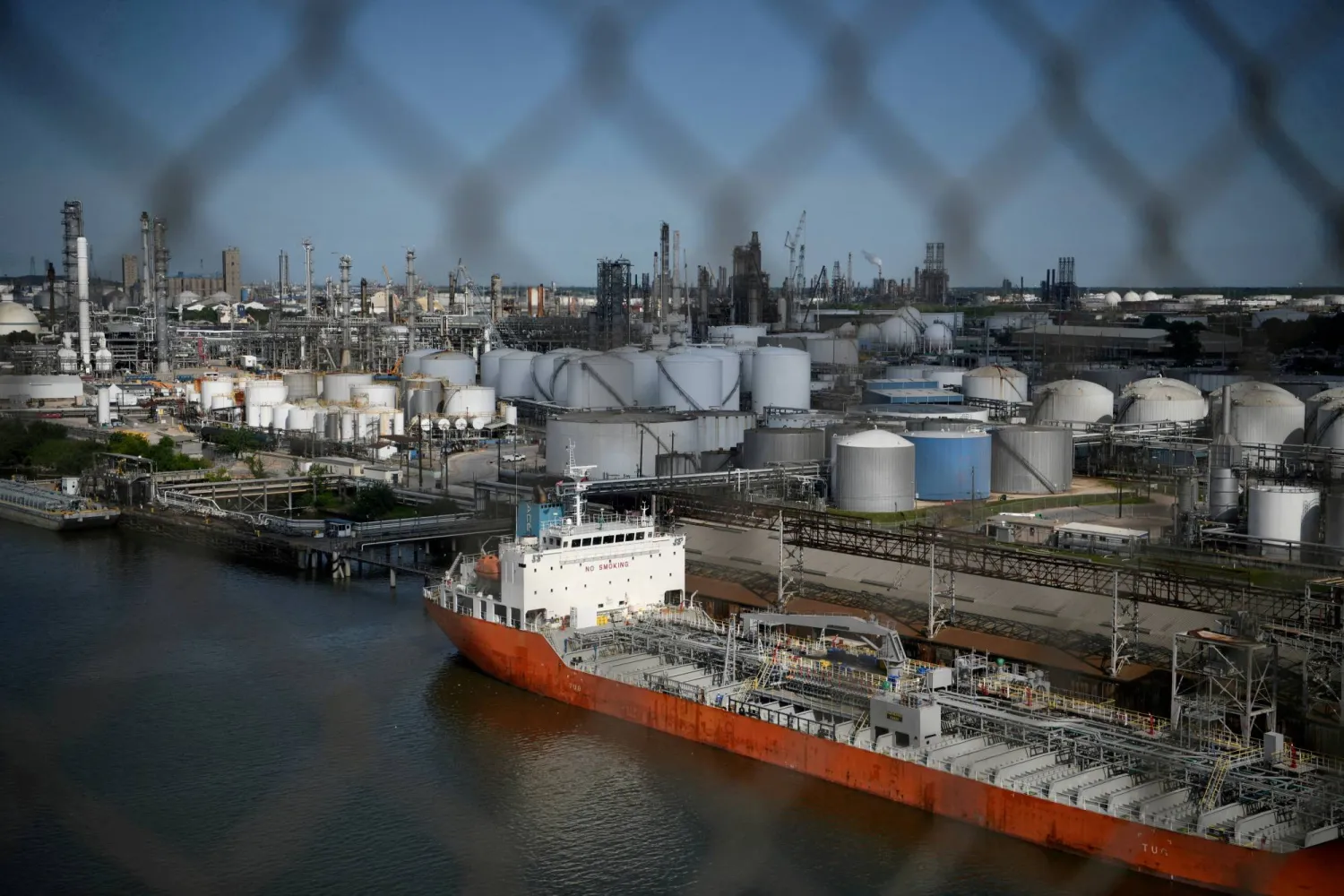
FILE PHOTO: The Houston Ship Channel and adjacent refineries, part of the Port of Houston, are seen in Houston, Texas, US, May 5, 2019.  REUTERS/Loren Elliott//File Photo
FILE PHOTO: The Houston Ship Channel and adjacent refineries, part of the Port of Houston, are seen in Houston, Texas, US, May 5, 2019. REUTERS/Loren Elliott//File Photo
TT

A Tanker Believed to Hold Sanctioned Iran Oil Starts Offloading near Texas despite Tehran's Threats

FILE PHOTO: The Houston Ship Channel and adjacent refineries, part of the Port of Houston, are seen in Houston, Texas, US, May 5, 2019.  REUTERS/Loren Elliott//File Photo
FILE PHOTO: The Houston Ship Channel and adjacent refineries, part of the Port of Houston, are seen in Houston, Texas, US, May 5, 2019. REUTERS/Loren Elliott//File Photo

An American-owned oil tanker long suspected of carrying sanctioned Iranian crude oil began offloading its cargo near Texas late Saturday, tracking data showed, even as Tehran has threatened to target shipping in the Arabian Gulf over it.
Ship-tracking data analyzed by The Associated Press showed the Marshall Islands-flagged Suez Rajan was undergoing a ship-to-ship transfer of its oil to another tanker, the MR Euphrates, near Galveston, some 70 kilometers (45 miles) southeast of Houston.
The fate of the cargo aboard the Suez Rajan has become mired in the wider tensions between the US and Iran, even as Tehran and Washington work toward a trade of billions of dollars in frozen Iranian assets in South Korea for the release of five Iranian-Americans held in Tehran.
Already, Iran's paramilitary Revolutionary Guard has warned that those involved in offloading the cargo “should expect to be struck back.” The US Navy has increased its presence steadily in recent weeks in the Mideast, sending the troop-and-aircraft-carrying USS Bataan through the Strait of Hormuz in recent days and considering putting armed personnel on commercial ships traveling through the strait to stop Iran from seizing additional ships.
US officials and the owners of the Suez Rajan, the Los Angeles-based private equity firm Oaktree Capital Management, did not immediately respond to requests for comment.
The saga over the Suez Rajan began in February 2022, when the group United Against Nuclear Iran said it suspected the tanker carried oil from Iran’s Khargh Island, its main oil distribution terminal in the Arabian Gulf.
For months, the ship sat in the South China Sea off the northeast coast of Singapore before suddenly sailing for the Gulf of Mexico without explanation. Analysts believe the vessel's cargo likely has been seized by American officials, though there still were no public court documents early Sunday involving the Suez Rajan.
In the meantime, Iran has seized two tankers near the Strait of Hormuz, including one with cargo for US oil major Chevron Corp. In July, the top commander of the Revolutionary Guard's naval arm threatened further action against anyone offloading the Suez Rajan, with state media linking the recent seizures to the cargo's fate.
“We hereby declare that we would hold any oil company that sought to unload our crude from the vessel responsible and we also hold America responsible,” Rear Adm. Alireza Tangsiri said at the time. “The era of hit and run is over, and if they hit, they should expect to be struck back."
Iran's mission to the United Nations did not immediately respond to a request for comment over the offloading of the Suez Rajan. The state-run IRNA news agency acknowledged this AP story, but did not elaborate. Western-backed naval organizations in the Arabian Gulf in recent days also warned of an increased risk of ship seizures from Iran around the Strait of Hormuz.
Iran’s 2015 nuclear deal with world powers saw it regain the ability to sell oil openly on the international market. But in 2018, then-President Donald Trump unilaterally withdrew from the accord and re-imposed American sanctions. That slammed the door on much of Iran’s lucrative crude oil trade, a major engine for its economy and its government. It also began a cat-and-mouse hunt for Iranian oil cargo — as well as a series of escalating attacks attributed to Iran since 2019.
The delay in offloading the Suez Rajan's cargo had become a political issue as well for the Biden administration as the ship had sat for months in the Gulf of Mexico, possibly due to companies being worried about the threat from Iran.
In a letter dated Wednesday, a group of Democratic and Republican US senators asked the White House for an update on what was happening with the ship's cargo, estimated to be worth some $56 million. They said the money could go toward the US Victims of State Sponsored Terrorism Fund, which compensates those affected by the Sept. 11 attacks, the 1979 Iran hostage crisis and other militant assaults.
“We owe it to these American families to enforce our sanctions,” the letter read.
The US Treasury has said Iran's oil smuggling revenue supports the Quds Force, the expeditionary unit of the Revolutionary Guard that operates across the Mideast.
Claire Jungman, the chief of staff at United Against Nuclear Iran, praised the transfer finally happening.
"By depriving the (Guard) of crucial resources, we strike a blow against terrorism that targets not only American citizens but also our global allies and partners,” Jungman told the AP.
On Sunday, Iranian state media released still images from video that showed the USS Bataan with small Guard fast boats trailing it as it traveled through the Strait of Hormuz, the narrow mouth of the Arabian Gulf through which 20% of the world's oil passes. One image appeared to have been taken from a drone above the Bataan.
Cmdr. Rick Chernitzer, a spokesman for the US Navy’s Bahrain-based 5th Fleet, acknowledged to the AP that the Bataan had transited through the strait in recent days. He declined to elaborate.



UK Condemns 10-year Sentence for British Couple in Iran

(FILES) A handout photograph released in London on August 4, 2025 by the family of Craig and Lindsay Foreman, shows Craig and Lindsay at Naqsh-e Jahan Square, or Shah Square, with the Shah Mosque in the background, in Isfahan, Iran, at an undated time. (Photo by FAMILY HANDOUT / AFP)
TT

UK Condemns 10-year Sentence for British Couple in Iran

(FILES) A handout photograph released in London on August 4, 2025 by the family of Craig and Lindsay Foreman, shows Craig and Lindsay at Naqsh-e Jahan Square, or Shah Square, with the Shah Mosque in the background, in Isfahan, Iran, at an undated time. (Photo by FAMILY HANDOUT / AFP)

British foreign minister Yvette Cooper on Thursday condemned as "totally unjustifiable" the 10-year sentence given to a British couple in Iran for spying, saying the government would continue to press for their release.

Craig and Lindsay Foreman had been charged with espionage after Iran accused them of gathering information in several parts of the country.

"We will pursue this case relentlessly with the Iranian government until we see ‌Craig and Lindsay ‌Foreman safely returned to the UK and reunited with ‌their ⁠family," Reuters quoted Cooper as saying in ⁠a statement.

The Foremans were arrested on January 3 of last year while travelling through Iran on a global motorcycle journey. Iranian state media announced their detention the following month over espionage charges and they have now been held for more than 13 months.

Joe Bennett, Lindsay's son, said in a separate statement the couple had appeared at a three-hour trial ⁠on October 27, in which they were not allowed to ‌present a defense.

"We have seen no ‌evidence to support the charge of espionage," he said, adding that the family ‌was deeply concerned about the couple's welfare and the lack of transparency ‌in the judicial process.

Bennett called on the British government to "act decisively and use every available avenue" to secure their release.

The Iranian embassy in London did not immediately respond to a request for comment on the sentencing.

According to a family ‌statement, the couple have been held for extended periods without being able to communicate. They have had limited or ⁠delayed access ⁠to legal representation, periods of solitary confinement and delays in receiving funds for basic necessities. They also reported disrupted or cancelled consular visits.

Cooper, whose office did not comment on the disruption, said they would continue to provide consular assistance.

Lindsay Foreman has been held in the women's section of Tehran's Evin Prison, while her husband Craig has been held in its political wing.

Iran's Revolutionary Guards have in recent years detained foreign and dual nationals, typically on espionage or national security charges.

Human rights organizations say the authorities use such arrests as leverage in disputes with other countries, a practice they describe as part of a broader pattern of politically motivated detentions. Tehran has rejected those accusations and said the cases involved legitimate security concerns.


N. Korea Flexes Nuclear-capable Rocket Launcher Ahead of Key Congress

A photo released by the official Korean Central News Agency (KCNA) shows North Korean leader Kim Jong Un (C), accompanied by his daughter Kim Ju Ae (R), overseeing a test-fire of a large-caliber multiple-rocket launcher system at an unknown location in North Korea, 27 January 2026 (issued 28 January 2026). EPA/KCNA  EDITORIAL USE ONLY
A photo released by the official Korean Central News Agency (KCNA) shows North Korean leader Kim Jong Un (C), accompanied by his daughter Kim Ju Ae (R), overseeing a test-fire of a large-caliber multiple-rocket launcher system at an unknown location in North Korea, 27 January 2026 (issued 28 January 2026). EPA/KCNA EDITORIAL USE ONLY
TT

N. Korea Flexes Nuclear-capable Rocket Launcher Ahead of Key Congress

A photo released by the official Korean Central News Agency (KCNA) shows North Korean leader Kim Jong Un (C), accompanied by his daughter Kim Ju Ae (R), overseeing a test-fire of a large-caliber multiple-rocket launcher system at an unknown location in North Korea, 27 January 2026 (issued 28 January 2026). EPA/KCNA  EDITORIAL USE ONLY
A photo released by the official Korean Central News Agency (KCNA) shows North Korean leader Kim Jong Un (C), accompanied by his daughter Kim Ju Ae (R), overseeing a test-fire of a large-caliber multiple-rocket launcher system at an unknown location in North Korea, 27 January 2026 (issued 28 January 2026). EPA/KCNA EDITORIAL USE ONLY

North Korean leader Kim Jong Un has unveiled a battery of huge nuclear-capable rocket launchers ahead of a key congress of the nation's ruling party, state media said Thursday.

Kim is expected to detail the next phase in North Korea's nuclear weapons program when he opens a rare congress of the ruling Workers' Party in coming days.

The 600-mm multiple launch rocket system was front and center as preparations ramped up for the once-in-five-years gathering, widely viewed as North Korea's most important political event.

"When this weapon is used actually, no force would be able to expect God's protection," Kim said, according to the Korean Central News Agency.

"It is really a wonderful and attractive weapon."

Photos released by state media showed dozens of launch vehicles parked in neat rows on the plaza of Pyongyang's House of Culture, which will host the congress.

The weapon was "appropriate for a special attack, that is, for accomplishing a strategic mission", Kim told a ceremony on Wednesday, using a common euphemism for nuclear weapons.

He said the weapons system -- which was presented to the congress as a gift from munitions workers -- would deter unnamed enemies.

"There is no need to further explain about its destructive power and military value," AFP quoted Kim as saying.

"This is because it can reduce the aimed target to ashes through surprise and simultaneous attack by focusing its destructive energy."

The launch system could fire rockets with an estimated range of 400 kilometers (250 miles), covering all of South Korea, said analyst Hong Min from the Korea Institute for National Unification.

"Its primary purpose is to neutralize the combined air power of South Korea and the United States," he told AFP.

"If equipped with tactical nuclear warheads, a single battery firing four to five rounds could devastate an entire airbase."

South Korea's capital Seoul is less than 50 kilometers (30 miles) from the border at its nearest point.

Analysts believe North Korea would use its vast artillery arsenal to launch saturation strikes on the South should fighting break out.

Kim ordered the expansion and modernization of missile production in the months leading up to the Workers' Party congress.

Pyongyang has also significantly stepped up missile testing.


Iran Says No Country Can Deprive it of Enrichment Rights

A handout photo made available by Iran's Revolutionary Guard Corps (IRGC)'s official website Sepahnews on 17 February 2026 shows IRGC conducting a military drill in the Strait of Hormuz, in the Arabian gulf, southern Iran. EPA/SEPAHNEWS HANDOUT
TT

Iran Says No Country Can Deprive it of Enrichment Rights

A handout photo made available by Iran's Revolutionary Guard Corps (IRGC)'s official website Sepahnews on 17 February 2026 shows IRGC conducting a military drill in the Strait of Hormuz, in the Arabian gulf, southern Iran. EPA/SEPAHNEWS HANDOUT

Iran's atomic energy chief Mohammad Eslami said no country can deprive the Iranian republic of its right to nuclear enrichment, after US President Donald Trump again hinted at military action following talks in Geneva.

"The basis of the nuclear industry is enrichment. Whatever you want to do in the nuclear process, you need nuclear fuel," said Eslami, according to a video published by Etemad daily on Thursday.

"Iran's nuclear program is proceeding according to the rules of the International Atomic Energy Agency, and no country can deprive Iran of the right to peacefully benefit from this technology."

The comments follow the second round of Oman-mediated talks between Tehran and Washington in Geneva on Tuesday.

The two foes had held an initial round of discussions on February 6 in Oman, the first since previous talks collapsed during the 12-day Iran-Israel war in June.

The United States briefly joined the war alongside Israel, striking Iranian nuclear facilities.

On Wednesday, Trump again suggested the United States might strike Iran in a post on his Truth Social site.

He warned Britain against giving up sovereignty over the Chagos Islands in the Indian Ocean, saying that the archipelago's Diego Garcia airbase might be needed were Iran not to agree a deal, "in order to eradicate a potential attack by a highly unstable and dangerous regime".

Washington has repeatedly called for zero enrichment, but has also sought to address Iran's ballistic missile program and its support for militant groups in the region -- issues which Israel has pushed to include in the talks.

Western countries accuse the Iranian republic of seeking to acquire nuclear weapons.

Tehran denies having such military ambitions but insists on its right to this technology for civilian purposes.

Trump, who has ratcheted up pressure on Iran to reach an agreement, has deployed a significant naval force to the region, which he has described as an "armada".

After sending the aircraft carrier USS Abraham Lincoln and escort battleships to the Gulf in January, he recently indicated that a second aircraft carrier, the Gerald Ford, would depart "very soon" for the Middle East.

Separately, the Iranian and Russian navies were conducting joint drills in the Sea of Oman and the northern Indian Ocean on Thursday.