


Türkiye’s Erdogan Says Black Sea Grain Deal Can Be Restored Soon

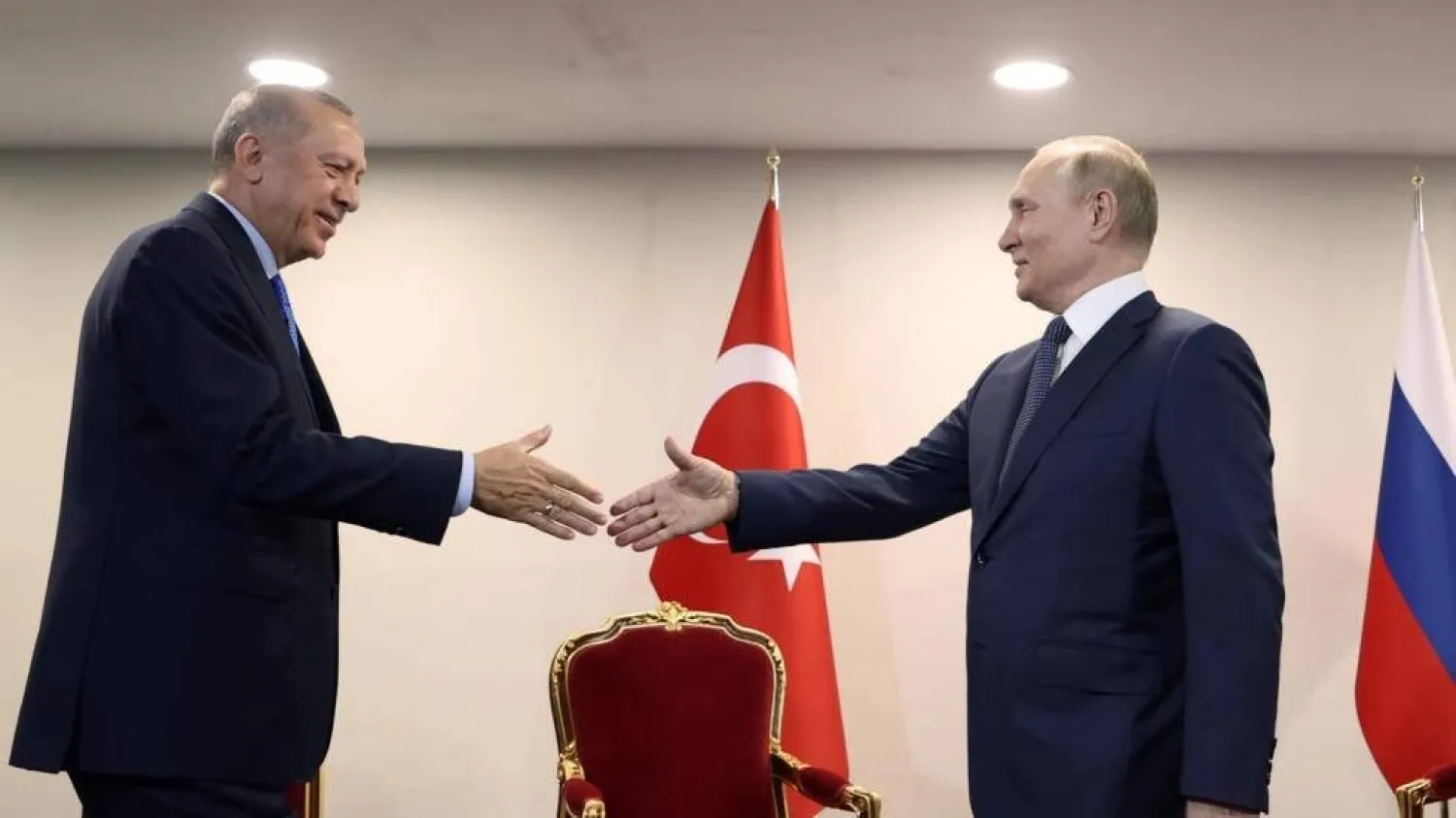
Turkish President Recep Tayyip Erdogan has good relations with Russia's Vladimir Putin. Mustafa Kamaci / TURKISH PRESIDENTIAL PRESS SERVICE/AFP
TT

Türkiye’s Erdogan Says Black Sea Grain Deal Can Be Restored Soon

Turkish President Recep Tayyip Erdogan has good relations with Russia's Vladimir Putin. Mustafa Kamaci / TURKISH PRESIDENTIAL PRESS SERVICE/AFP

Turkish President Recep Tayyip Erdogan said after talks with Russia's Vladimir Putin on Monday that it would soon be possible to revive the grain deal that the United Nations says helped to ease a food crisis by getting Ukrainian grain to market.

Russia quit the deal in July - a year after it was brokered by the United Nations and Türkiye - complaining that its own food and fertilizer exports faced serious obstacles.

Erdogan, who previously played a significant role in convincing Putin to stick with the deal, and the United Nations are both trying to get Putin to return to the deal.

"As Türkiye, we believe that we will reach a solution that will meet the expectations in a short time," Erdogan said in the Black Sea resort of Sochi after his first face to face meeting with Putin since 2022.

Erdogan said that Russia's expectations were well-known to all and that the shortcomings should be eliminated, adding that Türkiye and the United Nations had worked on a new package of suggestions to ease Russian concerns.

Putin has said Russia could return to the grain deal if the West fulfils a separate memorandum agreed with the United Nations at the same time to facilitate Russian food and fertilizer exports.

Standing beside Erdogan, Putin said Russia could return to the deal but only if the West stopped restricting Russian agricultural exports from reaching global markets.

"We will be ready to consider the possibility of reviving the grain deal and I told Mr. President about this again today - we will do this as soon as all the agreements on lifting restrictions on the export of Russian agricultural products are fully implemented," Putin said.

He said Western claims that Russia had stoked a food crisis by suspending participation in the grain deal were incorrect as prices did not rise on its exit from the deal.

"There is no physical shortage of food," Putin said.

Grain deal?

While Russian exports of food and fertilizer are not subject to Western sanctions imposed after Russia's invasion of Ukraine and Russia exported record amounts of wheat last year, Moscow and agricultural exporters say restrictions on payments, logistics and insurance have hindered shipments.

"The West continues to block the supply of grain and fertilizers from the Russian Federation to world markets," Putin said, adding that the West had "cheated" Russia over the deal because rich countries got more than 70% of the grain exported under the deal.

Russia and Ukraine are two of the world's key agricultural producers, and major players in the wheat, barley, maize, rapeseed, rapeseed oil, sunflower seed and sunflower oil markets.

Putin said Russia expected a grain harvest of 130 million tons this year of which 60 million tons could be exported.

UN Secretary-General António Guterres said on Thursday that he had sent Russian Foreign Minister Sergei Lavrov "a set of concrete proposals" aimed at reviving the deal.

One of Moscow's main demands is for the Russian Agricultural Bank to be reconnected to the SWIFT international payments system. The EU cut it off in June 2022 as part of sweeping sanctions imposed in response to the invasion.

Putin said that a plan to supply up to 1 million tons of Russian grain to Türkiye at reduced prices for subsequent processing at Turkish plants and shipping to countries most in need was not an alternative to the grain deal.

He also said Russia was close to a deal with six African countries over a plan to supply Burkina Faso, Zimbabwe, Mali, Somalia, the Central African Republic and Eritrea with up to 50,000 tons of grain each free of charge.  


NORAD Intercepts 5 Russian Aircraft near Alaska, Though Military Says There Was No Threat

An F-16 fighter jet takes off (file photo - Reuters)
TT

NORAD Intercepts 5 Russian Aircraft near Alaska, Though Military Says There Was No Threat

An F-16 fighter jet takes off (file photo - Reuters)

Military jets were launched to intercept five Russian aircraft that were flying in international airspace off Alaska’s western coast, but military officials said Friday the Russian aircraft were not seen as provocative.

The North American Aerospace Defense Command said it detected and tracked two Russian Tu-95s, two Su-35s and one A-50 operating near the Bering Strait on Thursday, The Associated Press said.

In response, NORAD launched two F-16s, two F-35s, one E-3 and four KC-135 refueling tankers to intercept, identify and escort the Russian aircraft until they departed the area, according to a release from the command.

“The Russian military aircraft remained in international airspace and did not enter American or Canadian sovereign airspace,” according to the NORAD statement. It also noted this kind of activity “occurs regularly and is not seen as a threat.”

The Russian aircraft were operating in an area near the Bering Strait, a narrow body of water about 50 miles (80 kilometers) wide separating the Pacific and Arctic oceans, called the Alaskan Air Defense Identification Zone.

Such zones begin where sovereign airspace ends. While it’s international airspace, all aircraft are required to identify themselves when entering zones in the interest of national security, NORAD said.

The command used satellites, ground and airborne radars and aircraft to detect and track aircraft

NORAD is headquartered at Peterson Space Force Base, Colorado, but has its Alaska operations based at Joint Base Elmendorf-Richardson in Anchorage.


Trump Unleashes Personal Assault on 'Disloyal' Supreme Court Justices

US President Donald Trump speaks during a press conference in the Brady Press Briefing Room of the White House in Washington, DC, on February 20, 2026. (Photo by Mandel NGAN / AFP)
TT

Trump Unleashes Personal Assault on 'Disloyal' Supreme Court Justices

US President Donald Trump speaks during a press conference in the Brady Press Briefing Room of the White House in Washington, DC, on February 20, 2026. (Photo by Mandel NGAN / AFP)

US President Donald Trump launched an extraordinary personal attack Friday on the Supreme Court justices who struck down his global tariffs, including two of his own appointees, and claimed they were being "swayed by foreign interests."

"I'm ashamed of certain members of the court, absolutely ashamed, for not having the courage to do what's right for our country," Trump told reporters at a White House press conference.

"They're very unpatriotic and disloyal to our Constitution," he said, deriding them at one point as "fools and lap dogs."

The Supreme Court has overwhelmingly sided with Trump since he took office in January of last year, and the tariffs ruling was the first major setback for the Republican president before the conservative-dominated court.

Asked if he regretted nominating justices Amy Coney Barrett and Neil Gorsuch -- who both voted against him -- to the top court, Trump said he did not "want to say whether or not I regret."

"I think their decision was terrible," he said. "I think it's an embarrassment to their families if you want to know the truth, the two of them."

Chief Justice John Roberts, Coney Barrett and Gorsuch, all conservatives, joined with the court's three liberals in the 6-3 ruling that Trump's sweeping global tariffs were illegal.

Trump heaped praise on the conservative justices who voted to uphold his authority to levy tariffs -- Clarence Thomas, Samuel Alito and Brett Kavanaugh, a Trump appointee.

He thanked the three "for their strength and wisdom, and love of our country."

Trump in particular singled out Kavanaugh, who wrote a 63-page dissent to the tariffs ruling, calling him a "genius" and saying he was "so proud of him."

- 'You're going to find out' -

The president also alleged there was foreign influence behind the ruling.

"It's my opinion that the court has been swayed by foreign interests," he said. "I think that foreign interests are represented by people that I believe have undue influence.

"They have a lot of influence over the Supreme Court, whether it's through fear or respect or friendships, I don't know," he said.

Asked by a reporter if he had evidence of foreign influence on the court, Trump replied: "You're going to find out."

Vice President JD Vance added his voice to the condemnation of the tariffs ruling, calling it "lawlessness from the court, plain and simple."

Tensions between the White House and the Supreme Court are not new -- a frustrated president Franklin D Roosevelt once proposed expanding the court to pack it with Democratic loyalists.

But Steven Schwinn, a constitutional law professor at the University of Illinois Chicago, said Trump's "gratuitous and ad homineum attacks" on individual justices reveal "his fundamental misunderstanding of the separation of powers."

"He seems to believe that any good-faith disagreement with his own interpretation of the law is, by definition, illegitimate," Schwinn told AFP.

"At the same time, he lacks any serious interpretation of the law of his own, except to say that the law is what he wants it to be. This is not how a democracy works."

Trump was also asked whether the six justices who voted against him would be welcome at next week's State of the Union speech before Congress.

"Three are happily invited," the president said.

The others are "invited, barely," he said, before adding "I couldn't care less if they come."


Trump to Travel to China Next Month, with US Trade Policy in Focus

US President Donald Trump arrives at Joint Base Andrews in Maryland, US, February 19, 2026. (Reuters)
TT

Trump to Travel to China Next Month, with US Trade Policy in Focus

US President Donald Trump arrives at Joint Base Andrews in Maryland, US, February 19, 2026. (Reuters)

US President Donald Trump will travel to China from March 31 to April 2 for a highly anticipated meeting between the world's two biggest economies, following the Supreme Court's decision to overturn Trump's sweeping tariffs against imported goods.

A White House official confirmed the trip on Friday, just before the highest US court struck down many of the tariffs Trump has used to manage sometimes-tense relations with China.

Trump is expected to visit Beijing and meet Chinese President Xi Jinping as part of a lavish, extended visit. Trump was last in China in 2017, ‌the most ‌recent trip by a US president.

A key topic had been whether ‌to ⁠extend a trade ⁠truce that kept both countries from further hiking tariffs. After Friday's ruling, however, it was not immediately clear whether - and under what legal authority - Trump would restore tariffs on imports from China.

TRUMP SEES TRADE IMBALANCE AS NATIONAL EMERGENCY

The administration has said the tariffs were necessary because of national emergencies related to trade imbalances and China's role in producing illicit fentanyl-related chemicals.

"That's going to be a wild one," Trump told foreign leaders visiting Washington on Thursday ⁠about the trip. "We have to put on the biggest display you've ‌ever had in the history of China."

The Chinese ‌embassy in Washington did not immediately respond to a request for comment. Beijing has not ‌confirmed the trip.

The visit would be the leaders' first talks since February and their first ‌in-person visit since an October meeting in South Korea. At that October meeting, Trump agreed to trim tariffs on China in exchange for Beijing cracking down on the fentanyl trade, resuming US soybean purchases and keeping rare earth minerals flowing.

While the October meeting largely sidestepped the sensitive issue of ‌Taiwan, Xi raised US arms sales to the island in February.

Washington announced its largest-ever arms sales deal with Taiwan in December, ⁠including $11.1 billion in ⁠weapons that could ostensibly be used to defend against a Chinese attack. Taiwan expects more such sales.

China views Taiwan as its own territory, a position Taipei rejects. The United States has formal diplomatic ties with China, but it maintains unofficial ties with Taiwan and is the island's most important arms supplier. The United States is bound by law to provide Taiwan with the means to defend itself.

Xi also said during the February call that he would consider further increasing soybean purchases, according to Trump.

Struggling US farmers are a major political constituency for Trump, and China is the top soybean consumer.

Although Trump has justified several hawkish policy steps from Canada to Greenland and Venezuela as necessary to thwart China, he has eased policy toward Beijing in the past several months in key areas, from tariffs to advanced computer chips and drones.
