


Ukrainians Flee 'Ghost Town' as Russians Seek Recapture

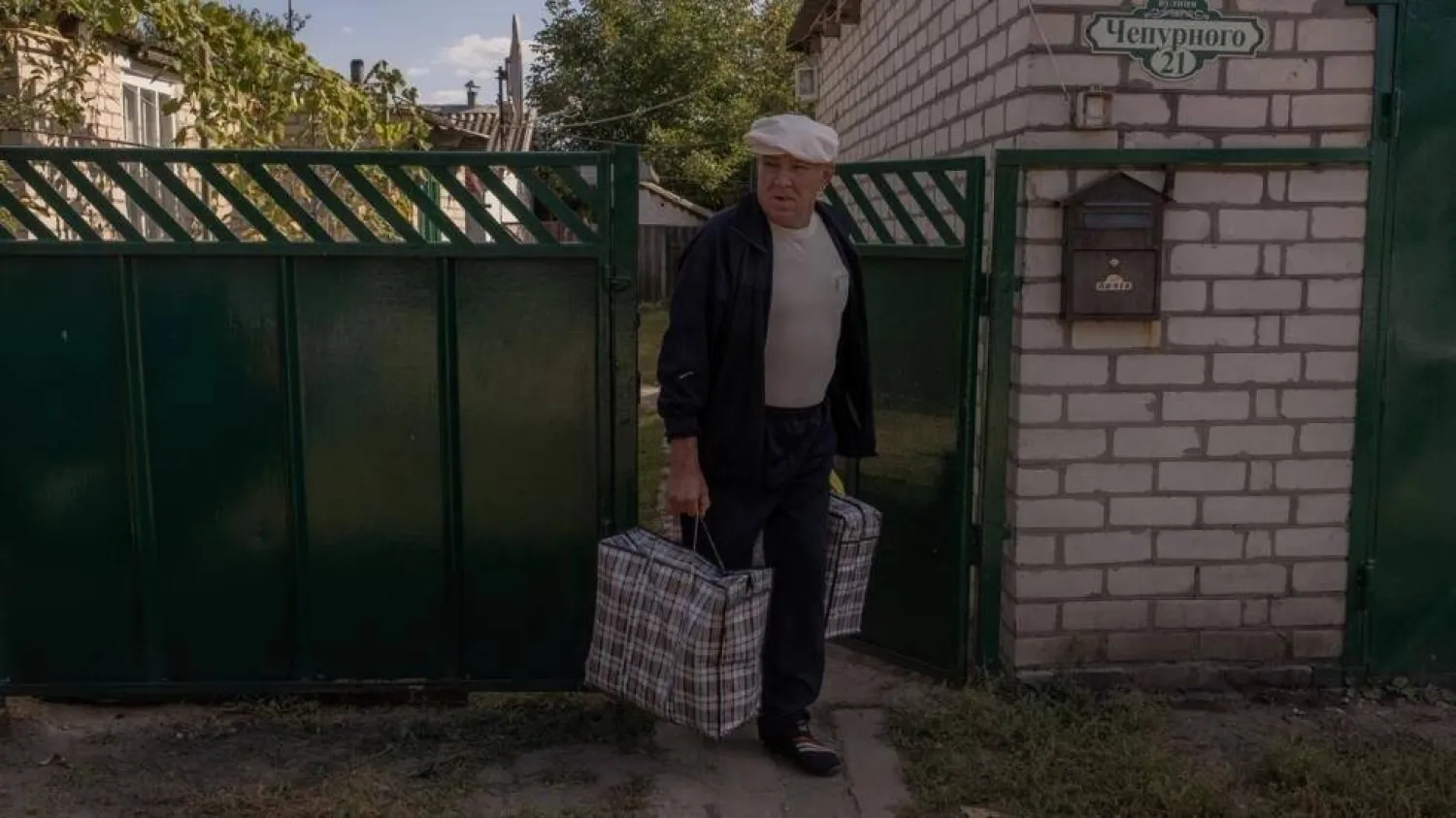
Boguslavka looks idyllic but Sergiy has finally decided to leave after heavy strikes. Roman PILIPEY / AFP
TT

Ukrainians Flee 'Ghost Town' as Russians Seek Recapture

Boguslavka looks idyllic but Sergiy has finally decided to leave after heavy strikes. Roman PILIPEY / AFP

Sergiy walked out of his grey-brick house carrying two plastic holdalls and closed the front door as his dog barked. Then the 71-year-old got into a car for evacuation.

His village of Boguslavka in eastern Ukraine looks idyllic, with geese in ponds and cows grazing, but Sergiy had finally decided to leave after heavy strikes, AFP said.

This area close to the Russian border has become too dangerous for civilians as Russians attempt to retake the formerly occupied town of Kupiansk, less than 10 kilometers (six miles) from the front line.

The small, historic town in the Kharkiv region has a strategic hilltop, which Russians are battling to recapture. While they have made some advances, Ukraine says the situation is under control.

Recapturing the village would be a coup for Moscow. The villagers however, who lived under Russian occupation for over half of last year, are still surrounded by ruins.

Responding to attacks from guided aerial bombs, the Ukraine's authorities ordered the mandatory evacuation of parts of Kupiansk and nearby villages.

Although labeled mandatory, the orders are not actually enforced. But for those ready to leave however, the Red Cross is evacuating locals to the nearby larger city of Kharkiv, which itself is being shelled regularly by Russia.

'I want to go home'
Sergiy, a heating-stove specialist, declined to give his last name but he made it clear he had long resisted leaving home.

He was worried about his animals and poultry, which a neighbor will feed.

Now, at least, he will get to stay with his wife in Kharkiv and see his 18-year-old grandson, who has just started university.

But he became tearful as he talked about his smallholding.

"I want to go home so much," he said. "I don't want to live any more."

In Kupiansk, two women from the town were waiting for Sergiy in the Red Cross evacuation bus.

Tatiana, 72, a chatty woman with platinum-blond hair and bright pink lipstick, said she could not stand the artillery or the fear any longer.

"I get so scared. I'm shaking all over," she said, denouncing the Russians.

The second woman, Lyudmila, 60, smiled brightly, saying she was heading off to stay with a friend outside Kyiv.

She first fled Kupiansk during the Russian occupation, staying in several cities before returning.

Now it is "pretty scary", she said, counting herself lucky that most of her flat's windows were intact.

'Don't just sit there'
"I always say people should leave," said Klim, commander of the Ukrainian Red Cross's rapid response unit for the Kharkiv region, who is leading the voluntary evacuation.

Russia's Grad rockets "do not differentiate. Don't just sit there, because tomorrow may be too late," said the commander, who uses a military-style call sign.

He and his partner donned bullet-proof vests to drive to Kupiansk, crossing a pontoon bridge guarded by soldiers.
In the town center, the missiles had destroyed shops and blown out the windows in the blocks of flats.

On the open door of one ruined shop, someone had left a handwritten note.

"It's empty: everything's already been stolen."

The silence was broken by regular thuds of artillery from the other side of the river, where the Russians were positioned.

Earlier that day, the bridge had been struck and soldiers had put up a barrier to stop vehicles.

From high points in Kupiansk, smoke could clearly be seen rising from lower-lying ground on the opposite bank.

'A ghost town'
Soldiers were among the few customers in the surviving shops and a small market, where traders were packing well before the town's 6 o'clock evening curfew.

"The town is empty, a ghost town," said Marina, 54, leaning on the counter of her daughter's grocery store, where she helps out.

She got "goosebumps" even talking about the Russian occupation, she said, and was dead-set against its return.

"Here we feel free, but there we walked around like we were under some kind of whip."

But not everyone felt the same way.

Sitting watching the scene in a jumper and leggings, retired doctor Lidiya smiled as she recalled Russian occupation.

"When our Russians were here, life was wonderful," she said.

"There wasn't this looting and there was some order."

Such open expressions of support for Russia are rare, however.

Chatting with friends outside a shop, 55-year-old Volodymyr said he could not leave as his job was to keep the town's water running.

This involves pumping water from outside the town and mending holes in pipes from shelling -– a job that never quite got done, he said.

"Those left are the most steadfast," he said of Kupiansk's remaining residents.

"The ones they cannot overcome."


Iran Says Redirects US-sanctioned Oil Tanker to Its Shores

FILE PHOTO: An aerial view of the Iranian shores and the island of Qeshm in the strait of Hormuz, December 10, 2023. REUTERS/Stringer/File Photo
TT

Iran Says Redirects US-sanctioned Oil Tanker to Its Shores

FILE PHOTO: An aerial view of the Iranian shores and the island of Qeshm in the strait of Hormuz, December 10, 2023. REUTERS/Stringer/File Photo

Iran said on Friday it redirected a US-sanctioned oil tanker carrying Iranian oil back to its shores, though it was unclear from its statement why it would have returned it, reported AFP.

"The Islamic Republic of Iran's navy, through a specially planned operation in the Sea of Oman, seized the offending tanker Ocean Koi," the army said in a statement carried by state television, adding that the oil belonged to Iran.

It said the ship was redirected to Iran's southern shores after it sought "to damage and disrupt Iran's oil exports," without elaborating.


Meloni Meets Rubio as Iran War Strains Italy-US Ties

US Secretary of State Marco Rubio leaves the San Damaso courtyard after meeting Pope Leo XIV at the Vatican, May 7, 2026. REUTERS/Yara Nardi
TT

Meloni Meets Rubio as Iran War Strains Italy-US Ties

US Secretary of State Marco Rubio leaves the San Damaso courtyard after meeting Pope Leo XIV at the Vatican, May 7, 2026. REUTERS/Yara Nardi

Italian Prime Minister Giorgia Meloni met US Secretary of State Marco Rubio on Friday at a moment of unusual strain between her government and President Donald Trump's administration, driven largely by the war with Iran.

Rubio is in Italy for a two-day trip aimed at easing ties with Pope Leo after unprecedented attacks on the pontiff by Trump, while also addressing Washington's frustration over Italy's refusal to support the US-Israeli war on Iran.

Meloni had been one of Trump's firmest supporters in Europe, cultivating close ties with him and presenting herself as a natural ‌bridge between Washington ‌and other EU states that had no natural political ‌affinity ⁠with the Republican ⁠US leader.

But that alignment has come under increasing strain in recent months, as the Iran war has forced her to balance loyalty to the United States against Italian public animosity to the war and the growing economic cost of the conflict.

Before heading to the prime minister's office, Rubio met Italy's Foreign Minister Antonio Tajani, who said the talks had been positive.

"I am convinced ⁠that Europe needs America, Italy needs America, but the United ‌States also needs Europe and Italy," Tajani ‌told reporters.

Meloni and Rubio were expected to discuss the situation in the Gulf, as ‌well as Russia's war on Ukraine, US tariffs on European goods and ‌the outlook for Cuba, which Washington is seeking to isolate both diplomatically and economically.

TRUMP'S ATTACKS ON POPE

The Italians will also be keen for a readout on Rubio's meetings at the Vatican. Trump's recent attacks on Pope Leo crossed a sensitive ‌line in overwhelmingly Catholic Italy and prompted Meloni to call them "unacceptable."

Her criticism in turn drew a sharp rebuke ⁠from Trump, who said ⁠she lacked courage and had let Washington down. He subsequently threatened to withdraw US troops from Italy.

Meloni said on Monday she would not support such a move, but acknowledged that the decision "doesn't depend on me".

Italy last month refused to allow US aircraft to use the Sigonella air base in Sicily for combat operations linked to the Iran conflict. Italian officials have said Washington had not sought prior authorization from Rome for the use of the site.

Defense Minister Guido Crosetto, a close Meloni ally, later warned that the Iran war was putting US global leadership at risk and said he feared the "madness" of nuclear escalation.

Pollsters say Meloni's ties to Trump could prove a potential liability with voters ahead of national elections due next year.


Trump Says Ceasefire Still Holds after Fighting Between the US and Iran Flares

US President Donald Trump looks on as he speaks to reporters near the Lincoln Memorial Reflecting Pool as it undergoes renovations, in Washington, D.C., US, May 7, 2026. REUTERS/Kylie Cooper
TT

Trump Says Ceasefire Still Holds after Fighting Between the US and Iran Flares

US President Donald Trump looks on as he speaks to reporters near the Lincoln Memorial Reflecting Pool as it undergoes renovations, in Washington, D.C., US, May 7, 2026. REUTERS/Kylie Cooper

US and Iranian forces clashed in the Gulf, but President Donald Trump said a ceasefire was still holding despite the flare-up, which dented hopes for a swift diplomatic resolution to the crisis.

The escalation came as Washington awaited Tehran's response to a US proposal to end the war, which began on February 28 when the US and Israel launched airstrikes on Iran.

Trump said on Thursday three US Navy destroyers were attacked as they moved through the Strait of Hormuz, a conduit for around a fifth of the world's oil and liquefied natural gas flows that Iran has all but closed since the conflict began.

"Three World Class American Destroyers just transited, very successfully, out of the Strait of Hormuz, under fire. There was no damage done to the three Destroyers, but great damage done to the Iranian attackers," Trump wrote on Truth Social.

He later told reporters the ceasefire remained in effect and played down the exchange.

"They trifled with us today. We blew them away," Trump said in Washington.

Iran, however, accused the United ⁠States of breaching ⁠the ceasefire, an agreement that has been punctuated by intermittent clashes since it was announced on April 7.

Iran's top joint military command said US forces had targeted an Iranian oil tanker and another ship, and carried out air attacks on civilian areas on Qeshm Island in the Strait of Hormuz and nearby coastal areas. It said Iranian forces responded by attacking US military vessels east of the strait and south of the port of Chabahar.

A spokesperson for Iran's Khatam al-Anbiya Central Headquarters said the Iranian strikes inflicted "significant damage," but US Central Command said none of its assets were hit.

Iranian state media later signaled a de-escalation, with Press TV reporting that, after several hours of exchanges, "the situation on Iranian islands and coastal cities by the Strait of Hormuz is back to normal now."
