


Israel Suspends Military Exports to Colombia Over Its President’s Criticism of Gaza Siege 

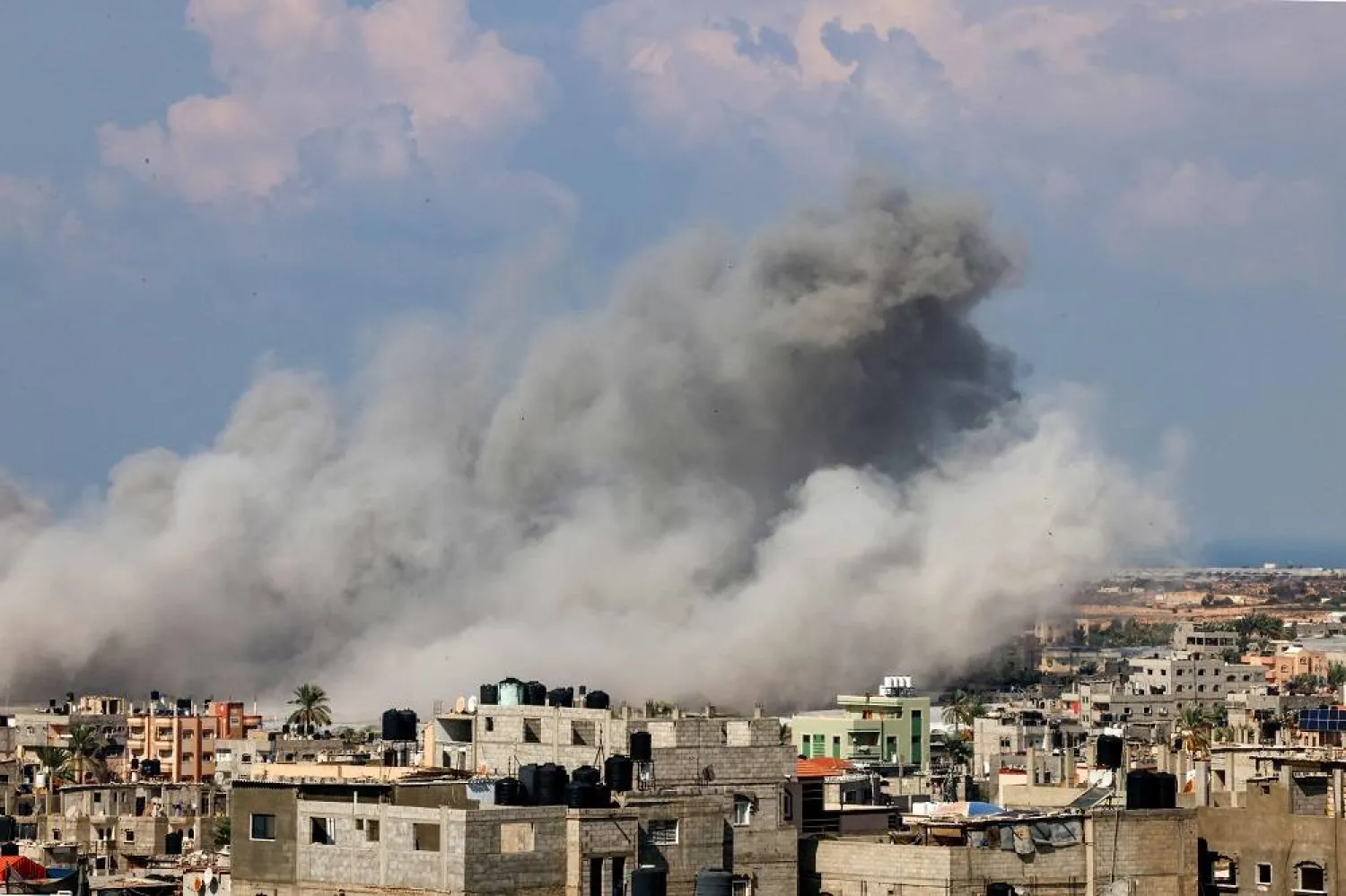
Smoke billows after an Israeli air strike in Rafah in the southern Gaza Strip on October 16, 2023. (AFP)
TT

Israel Suspends Military Exports to Colombia Over Its President’s Criticism of Gaza Siege 

Smoke billows after an Israeli air strike in Rafah in the southern Gaza Strip on October 16, 2023. (AFP)

Israel has suspended security exports to Colombia in an escalating diplomatic spat over online messages by Colombia's president comparing Israel's siege of Gaza to the actions of Nazi Germany.

Colombian President Gustavo Petro has doubled down on his criticism of Israel and suggested that his country may need to suspend diplomatic relations with Israel, while his foreign minister has suggested Israel's ambassador should leave the country.

In a statement published Sunday, Israel's foreign ministry said that Petro's recent statements on X, previously known as Twitter, “inflame antisemitism" and “threaten the safety of the Jewish community in Colombia.”

The Israeli government said it called Colombia's ambassador to a meeting in which she was informed that defense cooperation between the countries would be suspended.

Colombia currently has diplomatic relations with both Israel and the Palestinian Authority, and over the past two decades it has been one of Israel’s closes partners in Latin America.

The South American nation uses Israeli-built war planes and machine guns to fight drug cartels and rebel groups and both countries also signed a free trade agreement in 2020.

But the two nations have been less aligned since Petro took office last year as Colombia’s first leftist president.

The war of words between Petro and Israel's Ambassador Gali Dagan started a week ago when Petro refused to condemn the Hamas raid on Israel, in which militants killed hundreds of civilians in their homes.

When Dagan urged Petro to speak about the “terrorist” attack, Colombia’s president replied with a message that “terrorism is killing innocent children in Palestine” and followed up with messages in which he accused Israel of turning Gaza into a “concentration camp.”

The comments comparing Israel’s military to the Nazis sparked criticism from Colombia’s Jewish community and also triggered a response from the US State Department, which said last Thursday through its Special Envoy to Combat and Monitor Antisemitism that it was “shocked” to see Colombia’s president comparing “the Israeli government to Hitler’s genocidal regime.”

Over the weekend Petro wrote on X that Hamas had been “invented” by Israel’s intelligence services in order to divide Palestinians and “have an excuse” to “punish” them. He provided no proof to back his claims.

Dagan mocked Petro’s message with a sarcastic reply in which he wrote that his nation’s intelligence services had also “created” Colombia’s largest paramilitary group and that “Jews with big noses" still rule over the group.

On Monday, Colombian Foreign Minister Alvaro Leyva wrote on his X account that Dagan should “leave” the country and apologize for his messages. Later however he wrote that Israel’s ambassador had not been expelled and that relations between both countries would be maintained if Israel so desired. “Respectful relations between states are always welcome” Leyva wrote.

Petro doubled down on his critiques of Israel over the weekend, describing its military campaign in Gaza as “genocide” and threatening to break off relations with the Jewish state.

“If we must suspend diplomatic relations with Israel, then that is what we will do” he wrote on X on Sunday. “You cannot insult the president of Colombia.”



Türkiye Says Israel Using Security as Pretext to Acquire 'More Land'

Turkish Foreign Minister Hakan Fidan speaks during the opening ceremony of Antalya Diplomacy Forum in Antalya, Türkiye, April 17, 2026. REUTERS/Umit Bektas
TT

Türkiye Says Israel Using Security as Pretext to Acquire 'More Land'

Turkish Foreign Minister Hakan Fidan speaks during the opening ceremony of Antalya Diplomacy Forum in Antalya, Türkiye, April 17, 2026. REUTERS/Umit Bektas

Türkiye's top diplomat on Saturday accused Israel of creating an international "illusion" and using security concerns as a pretext to seize "more land," in the latest flare-up in escalating tensions between the two regional powers.

Israel and Türkiye have been trading near-daily diplomatic barbs over a range of regional conflicts, from Israel's war in Gaza to rising tensions linked to Iran.

"Israel is not after its own security. Israel is after more land," Turkish Foreign Minister Hakan Fidan said at the Antalya Diplomacy Forum in the Mediterranean resort city.

"Security is being used by the Netanyahu government as an excuse to occupy more land," he added, referring to Israeli Prime Minister Benjamin Netanyahu.

Speaking in English at a panel discussion, Fidan said Israel had created an "illusion" internationally by portraying itself as acting purely in its own defense.

"It has become very clear, especially in recent years, that it is more than that," he said.

From Palestinian lands including Gaza, the West Bank and East Jerusalem, and now extending towards Lebanon and Syria, Israel was pursuing "an onward occupation and expansionism in the region," Fidan said, according to AFP.

"I think this has to stop."

"Israel has to know that the only way to live peacefully in the region is to let other countries enjoy their own security, territorial integrity and freedom, and not to use power against them," he added.

Türkiye and Israel have frequently been at odds, including over Israel's military campaign in Gaza and differences over Syria's future.


Iran Command Says Has Closed Hormuz Again over US Blockade

A satellite image shows the ship movement at the Strait of Hormuz on April 2, 2026, in Space. EUROPEAN UNION/COPERNICUS SENTINEL-2/Handout via REUTERS
TT

Iran Command Says Has Closed Hormuz Again over US Blockade

A satellite image shows the ship movement at the Strait of Hormuz on April 2, 2026, in Space. EUROPEAN UNION/COPERNICUS SENTINEL-2/Handout via REUTERS

Iran's central military command announced on Saturday it would resume "strict management" of the Strait of Hormuz, reversing a decision to unblock the strategic channel as part of negotiations with Washington.

In a statement shared on state television, the headquarters said Washington had broken a promise by continuing its naval blockade of ships sailing to and from Iran's ports.

Until the United States restores freedom of movement for all vessels visiting Iran, "the situation in the Strait of Hormuz will remain strictly controlled," the statement said.

The announcement came after US President Donald Trump said the blockade of the Strait will remain and attacks will resume if no agreement is reached with Iran.


Australia, Japan Sign Contracts to Start $7 Billion Warship Deal

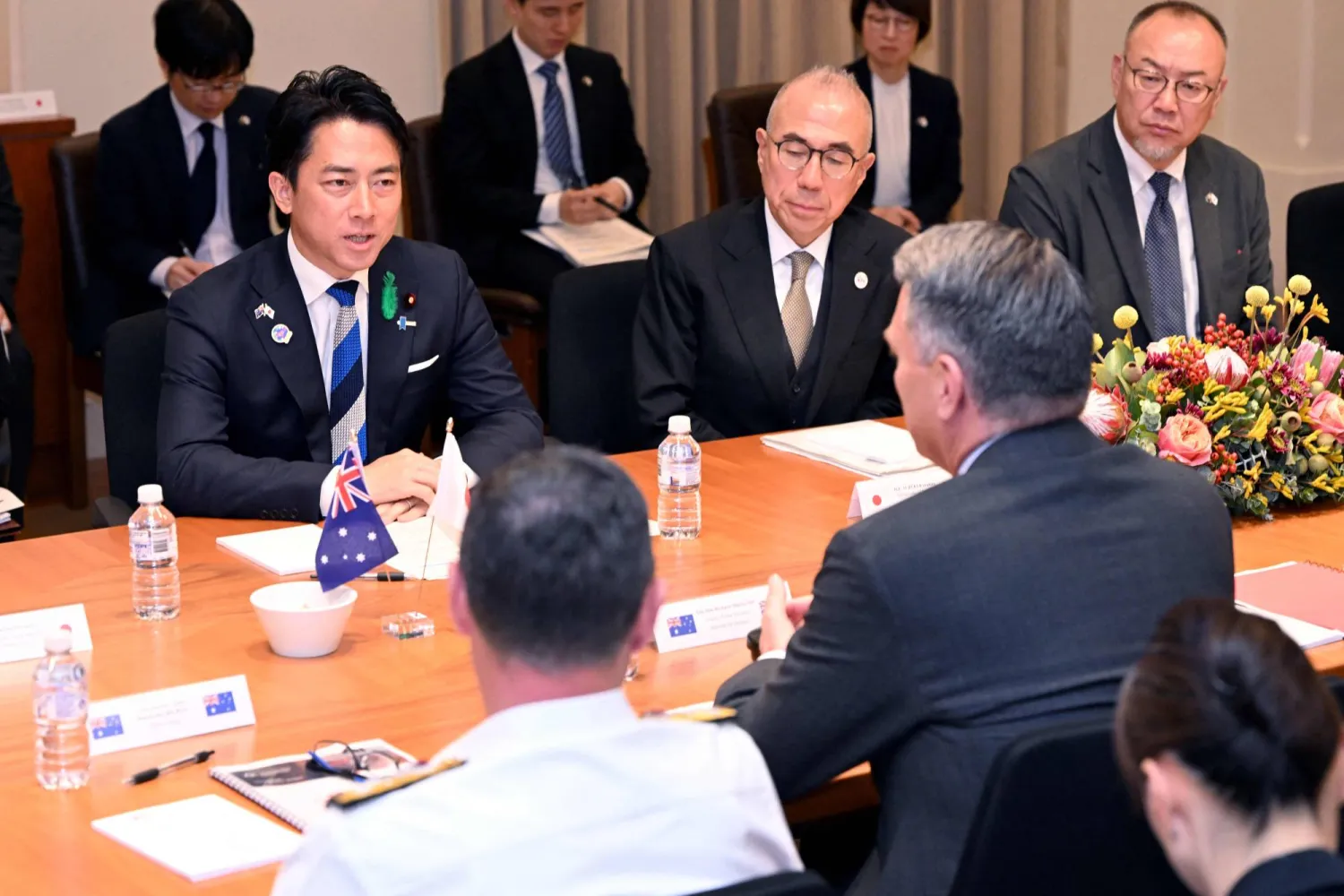
Australia's Deputy Prime Minister and Minister for Defense Richard Marles (R) listens to Japan's Minister of Defense Koizumi Shinjiro (L) during a Defense Ministers' Meeting at the Commonwealth Parliament Offices in Melbourne on April 18, 2026. (Photo by William WEST / AFP)
TT

Australia, Japan Sign Contracts to Start $7 Billion Warship Deal

Australia's Deputy Prime Minister and Minister for Defense Richard Marles (R) listens to Japan's Minister of Defense Koizumi Shinjiro (L) during a Defense Ministers' Meeting at the Commonwealth Parliament Offices in Melbourne on April 18, 2026. (Photo by William WEST / AFP)

Australia and Japan signed contracts on Saturday launching their landmark A$10 billion ($7 billion) deal to supply Australia with warships, Tokyo's most consequential military sale since ending a military export ban in 2014.

Defense Ministers Richard Marles and Shinjiro Koizumi signed a memorandum "reaffirming the Australian and Japanese governments' shared commitment to the successful delivery" of the warships, Marles said in a statement.

The deal struck in ⁠August anchors Japan's ⁠push away from its postwar pacifism to forge security ties beyond its alliance with the US to counter China.

Mitsubishi Heavy Industries is to supply the Royal Australian Navy with three upgraded Mogami-class ⁠multi-role frigates built in Japan from 2029. Eight more frigates will be built in Australia.

Japan's Defense Ministry posted on X that Koizumi and Marles welcomed the "conclusion of contracts for General Purpose Frigates, and confirmed to further strengthen bilateral defense ties" in the signing in Melbourne.

Contracts were signed for the first three frigates, to be built ⁠in ⁠Japan, before there is a "transition to an onshore build" at the Henderson shipyard near Perth in Western Australia, Reuters quoted Marles as saying.

Australia plans to deploy the ships - designed to hunt submarines, strike surface ships and provide air defense - to defend critical maritime trade routes and its northern approaches in the Indian and Pacific Oceans, where China's military footprint is expanding.