Türkiye Says Israel Using Security as Pretext to Acquire 'More Land'

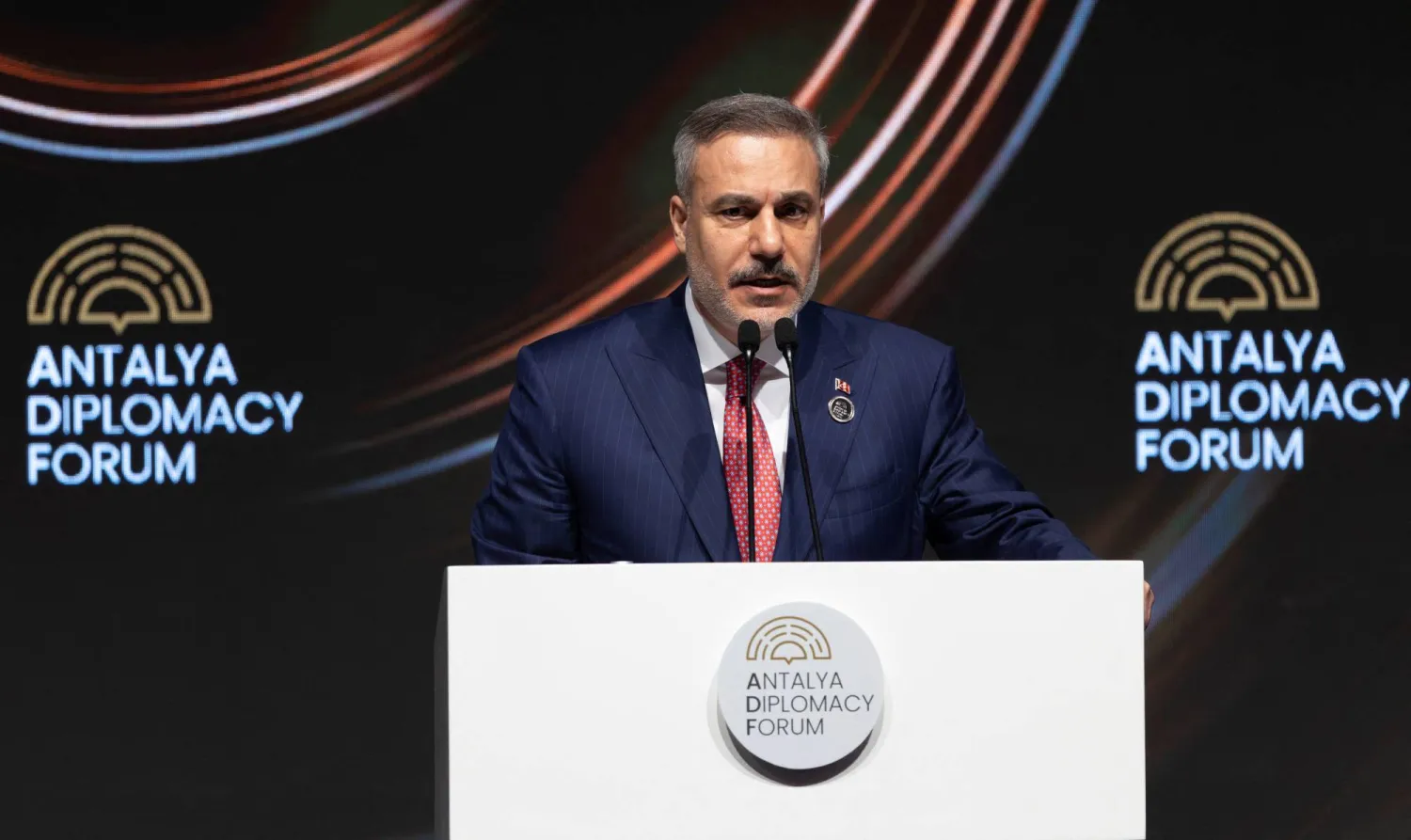
Turkish Foreign Minister Hakan Fidan speaks during the opening ceremony of Antalya Diplomacy Forum in Antalya, Türkiye, April 17, 2026. REUTERS/Umit Bektas
TT

Türkiye Says Israel Using Security as Pretext to Acquire 'More Land'

Turkish Foreign Minister Hakan Fidan speaks during the opening ceremony of Antalya Diplomacy Forum in Antalya, Türkiye, April 17, 2026. REUTERS/Umit Bektas

Türkiye's top diplomat on Saturday accused Israel of creating an international "illusion" and using security concerns as a pretext to seize "more land," in the latest flare-up in escalating tensions between the two regional powers.

Israel and Türkiye have been trading near-daily diplomatic barbs over a range of regional conflicts, from Israel's war in Gaza to rising tensions linked to Iran.

"Israel is not after its own security. Israel is after more land," Turkish Foreign Minister Hakan Fidan said at the Antalya Diplomacy Forum in the Mediterranean resort city.

"Security is being used by the Netanyahu government as an excuse to occupy more land," he added, referring to Israeli Prime Minister Benjamin Netanyahu.

Speaking in English at a panel discussion, Fidan said Israel had created an "illusion" internationally by portraying itself as acting purely in its own defense.

"It has become very clear, especially in recent years, that it is more than that," he said.

From Palestinian lands including Gaza, the West Bank and East Jerusalem, and now extending towards Lebanon and Syria, Israel was pursuing "an onward occupation and expansionism in the region," Fidan said, according to AFP.

"I think this has to stop."

"Israel has to know that the only way to live peacefully in the region is to let other countries enjoy their own security, territorial integrity and freedom, and not to use power against them," he added.

Türkiye and Israel have frequently been at odds, including over Israel's military campaign in Gaza and differences over Syria's future.


Iran Chief Negotiator Ghalibaf Says US ‘Seeks to Start New War’

In this handout picture provided by the Islamic Consultative Assembly News Agency (ICANA), Iran’s Parliament Speaker Mohammad Bagher Ghalibaf, dressed in an IRGC uniform, chairs a session in Tehran on February 1, 2026. (ICANA / AFP)
TT

Iran Chief Negotiator Ghalibaf Says US ‘Seeks to Start New War’

In this handout picture provided by the Islamic Consultative Assembly News Agency (ICANA), Iran’s Parliament Speaker Mohammad Bagher Ghalibaf, dressed in an IRGC uniform, chairs a session in Tehran on February 1, 2026. (ICANA / AFP)

Iran's chief negotiator Mohammad Bagher Ghalibaf on Wednesday said the United States was seeking to restart the war and hoping Tehran would surrender.

"The enemy's movements, both overt and clandestine, show that despite economic and political pressure, it has not abandoned its military objectives and is seeking to start a new war," Ghalibaf said in an audio message on his official website.

Ghalibaf's remarks came as Tehran and Washington escalated threats while swapping proposals to end the war, which broke out on February 28. A ceasefire has been in place since April 8.

On Wednesday, Iran's Revolutionary Guards warned that the war would expand beyond the region if the US and Israel resume attacks after President Donald Trump said he would strike again unless Tehran agreed a peace deal.

Ghalibaf said the US was still hoping Iran would surrender and respond favorably to Washington's "excessive demands", by maintaining economic pressure and a naval blockade in place since April 13.

"We must strengthen our preparations for an effective and forceful response to any potential attacks," he said, adding that "Iran will never give in to intimidation, under any circumstances".

Ghalibaf acknowledged the economic pressure on Iranians, while appealing for "national unity".

"Today it is clearer than ever that we are engaged in a war of wills. Whoever wins this war will write Iran's history and determine its future," he said.


Israel Army Chief Says Military on ‘Highest Alert’ as Threats Over Iran War Escalate

Israel's Iron Dome defense system intercepts rockets over its airspace, Nov. 5, 2023. (Getty Images)
TT

Israel Army Chief Says Military on ‘Highest Alert’ as Threats Over Iran War Escalate

Israel's Iron Dome defense system intercepts rockets over its airspace, Nov. 5, 2023. (Getty Images)

Israel's army chief Lieutenant Colonel Eyal Zamir on Wednesday said the military was at its highest alert level, as Tehran and Washington traded threats of war.

"At this moment, the military is on the highest level of alert and prepared for any development," Zamir said at a meeting of all division commanders, according to a statement issued by the military.

Iran's Revolutionary Guards had earlier warned that the war would expand beyond the region if the US and Israel resumed attacks, after President Donald Trump said he would strike again unless Tehran agreed a peace deal.


Rubio Offers Cubans ‘New Path’ in Special Video Address

US Secretary of State Marco Rubio speaks during a press briefing in the Brady Briefing Room of the White House in Washington, DC, on May 5, 2026. (AFP)
TT

Rubio Offers Cubans ‘New Path’ in Special Video Address

US Secretary of State Marco Rubio speaks during a press briefing in the Brady Briefing Room of the White House in Washington, DC, on May 5, 2026. (AFP)

US Secretary of State Marco Rubio offered Cubans a "new path" in a special video address Wednesday hours before Washington was expected to criminally indict the island's influential former leader Raul Castro.

Addressing the Cuban people directly in Spanish, Rubio accused the country's communist leadership of theft, corruption and oppression.

"President (Donald) Trump is offering a new path between the US and a new Cuba," said Rubio, the son of Cuban immigrants.

"A new Cuba where you have a real opportunity to choose who governs your country and vote to replace them if they are not doing a good job."

Tensions between Washington and Havana have spiked in recent months since US forces ousted Cuba's regional ally Venezuelan president Nicolas Maduro in a military raid and then imposed a painful energy blockade on the already economically struggling island nation.

Trump has repeatedly signaled that the Cuban government could be next to fall, and earlier this month even said Washington would be "taking over" the Caribbean island, about 90 miles (145 km) from Florida, "almost immediately."

"In the US, we are ready to open a new chapter in the relationship between our people and our countries," Rubio said, according to an official English translation of his speech released by the State Department. "And, currently, the only thing standing in the way of a better future are those who control your country."

In his speech on the day when the Cuban community in the United States marks the island's independence, Rubio accused Gaesa, the military-backed conglomerate estimated to control 70 percent of the Cuban economy, of enriching the elites at the expense of ordinary citizens.

"A 'state within the state' that is accountable to no one and hoards the profits from its businesses for the benefit of a small elite," Rubio charged. "And the only role played by the so-called 'government' is to demand that you continue making 'sacrifices' and repressing anyone who dares to complain."

The US Justice Department was expected on Wednesday to announce criminal charges against 94-year-old Raul Castro, who succeeded his brother Fidel as president of Cuba and oversaw a historic 2015 rapprochement with the United States under Barack Obama that Trump later reversed.

According to US media reports, the indictment would focus on the 1996 downing of two civilian planes manned by anti-Castro pilots, that killed four people, and sent bilateral relations plummeting.

Four US Congress members expressed hope that the indictments will see justice served.

"We have a different President now, a president who is not willing to look the other way," Mario Diaz-Balart of Florida told reporters during a press conference. "We expect that today justice has finally arrived."

Representative Nicole Malliotakis of New York added: "This a Communist regime that has brutally killed, tortured its people, and much of it was work of Raul Castro himself."

"We hope this will be a turning point for the Cuban people," she said.

While Cuban Americans on Wednesday marked Cuba's independence, the Cuban government emphasizes different dates in its historical narrative, particularly the victory of Fidel Castro's revolution on January 1, 1959.

"Intervention, interference, dispossession, frustration: that is what May 20th signifies in Cuba's history," Cuban President Miguel Diaz-Canel said in a post on X, referring to the Platt Amendment, an addendum to Cuba's pre-communist constitution that allowed Washington to intervene militarily in Cuba.