


'Black Lives 4 Palestine': US Activists Find Common Cause

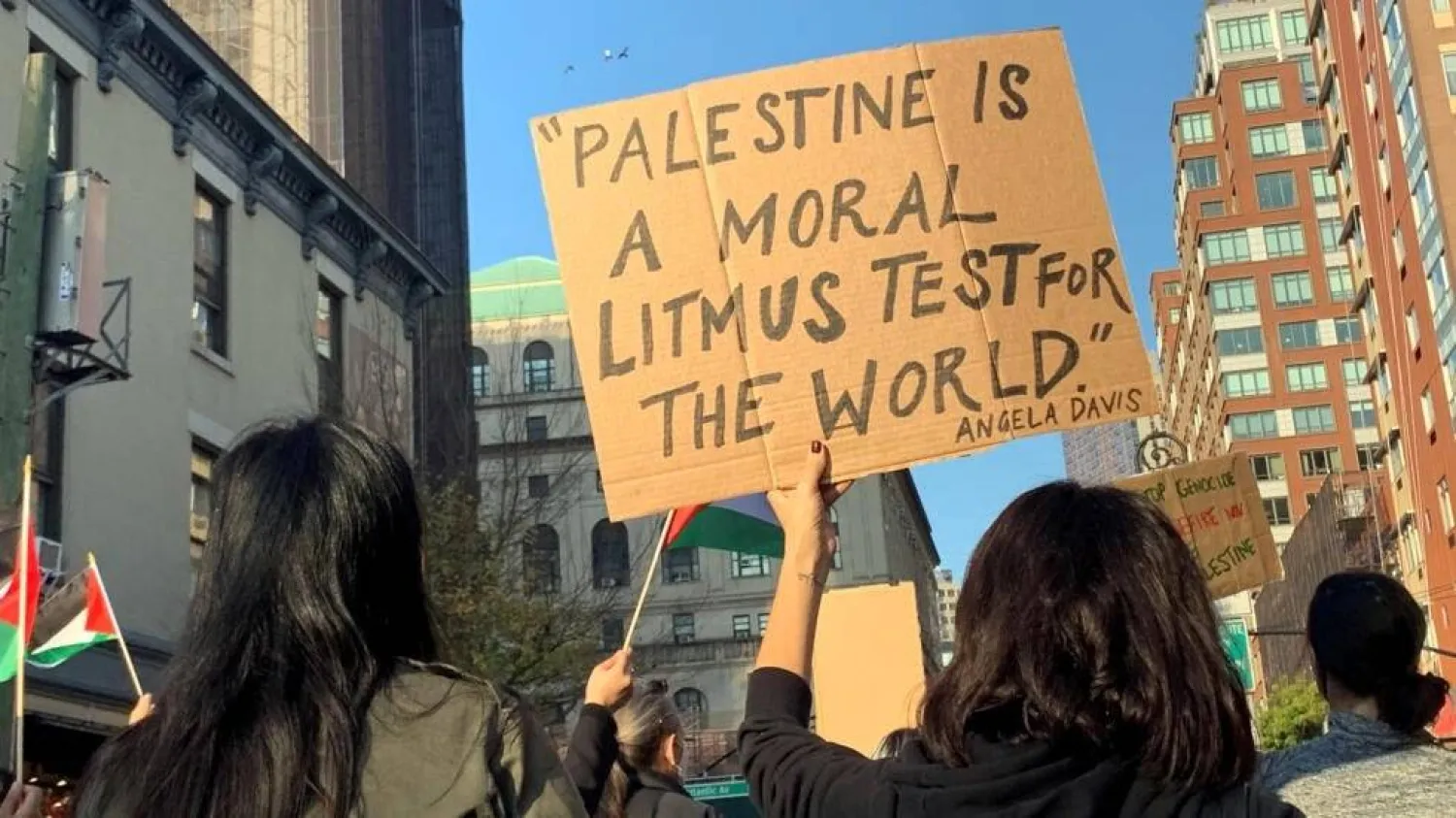
Demonstrators march during the "Palestine to Africa - Palestinian Liberation is Black Liberation" protest in New York on November 5, 2023. Maggy Donaldson / AFP
TT

'Black Lives 4 Palestine': US Activists Find Common Cause

Demonstrators march during the "Palestine to Africa - Palestinian Liberation is Black Liberation" protest in New York on November 5, 2023. Maggy Donaldson / AFP

Marching in Black Lives Matter protests in 2020 was the first time AnnEliza Canning-Skinner "experienced what solidarity is," she says.

Fast-forward three years and the 28-year-old has been a regular on the streets of New York, marching in support of Palestinians as Israel's bombing campaign of the Gaza Strip hits the one month-mark, said AFP.

Israel launched the offensive, which the UN warns is creating a humanitarian "catastrophe," after brutal Hamas attacks in Israel on October 7.

Canning-Skinner is one of thousands of demonstrators across the United States who've turned out for protests, with appeals including a ceasefire of deadly violence in Gaza and an end to US funding of the Israeli military.

And increasingly demonstrators stateside are drawing clear connections between the Palestinian and Black liberation movements.

At a recent protest in Brooklyn, Canning-Skinner, a Black woman, marched alongside fellow protestors who hoisted signs with messages including "Black Lives 4 Palestine" and "White Silence Is Violence."

"It all correlates," Canning-Skinner told AFP.

The historic roots of solidarity between Black organizers and Palestinians run deep, but both activists and scholars say events in recent years have crystallized the parallels for protestors.

"In terms of doing the kind of ideological work to convince people that Palestine is an issue that they ought to take up, I think Black Lives Matter has been tremendously important," Derek Ide, a historian at the University of Michigan focused on the topic, told AFP.

"There are more people out in the streets and that is definitely a result of the kind of organizing that Black activists have been doing alongside Palestinian groups and organizations."

'Shared condition'

Dating back to the 19th century, some Black nationalist thinkers found inspiration in the Zionist cause for a Jewish state, seeing an analog of their own vision for a Black homeland.

But with the mid-20th century emergence of the Black Power and anti-war movements, "it became much more common in African American activist circles to understand the Palestinians as an oppressed people," explained Sam Klug, an African American studies historian focused on decolonization.

The 1967 Six-Day War marked an important turning point, he said, noting the Student Nonviolent Coordinating Committee (SNICC) -- a major organizing force during the US Civil Rights Movement -- published a primer that "took a really strong pro-Palestinian stance."

It "described a kind of shared condition of oppression and occupation among African Americans, Palestinians and a kind of global colonial community."

Decades later, the 2014 police killing of Michael Brown in Ferguson, Missouri triggered mass protests over racism and state violence, as the Black Lives Matter (BLM) movement started gaining national attention.

That same summer Israel launched a seven-week military campaign against Gaza: "Seeing these two things happen simultaneously... solidified that these were united struggles" for many activists, historian Ide said.

"We saw a kind of flurry of action and dialogue between protesters in Ferguson as well as Palestinians in Gaza... sharing tactics and strategies and stories of repression and resistance to oppression."

The 2020 police murder of George Floyd even further galvanized anti-racism efforts in the United States, sparking an enormous protest movement.

Once more, Palestinians posted advice online on how to deal with tactics deployed by riot police, including rubber-coated bullets and tear gas.

For Klug, "it's hard to imagine" the current protests in the United States reaching their current scope without BLM.

"It's certainly not the only factor," he said. "But I do think it's an important one."

'Global solidarity'

Several recent demonstrators interviewed by AFP drew connections between Israeli law enforcement and US police, in particular pointing to programs that see US officers train alongside Israeli counterparts.

Prior to the current war, Israel already had been carrying out stepped-up military raids, some including deadly force against civilians.

Klug pointed to "a clear shared visual language that people can see when Israeli security services are brutalizing Palestinian civilians, that Americans have become very familiar with from the scenes of white police officers committing acts of violence against African American civilians."

Such factors can help explain in part why American public opinion on the Palestinian cause, particularly among young people, has warmed in recent years, in a country whose governmental support for Israel is unwavering.

Klug said the uprising over George Floyd and the BLM activism that preceded it has shifted the Palestinian conversation for many Black activists -- but also more broadly "among younger Americans of all races."

He pointed to growing activism on the left among anti-Zionist Jewish groups, including Jewish Voice for Peace and If Not Now, both of which have taken a strong organizing role in recent weeks.

For Jo Behanzin, who cited BLM organizing as inspiration for marching in a recent Manhattan demonstration for Gaza, it's a question of "global solidarity."

The 25-year-old noted the international support for BLM in 2020: "I want to reciprocate that, as part of the continued global movement against white supremacy and colonialism."



Trump to Travel to China Next Month, with US Trade Policy in Focus

US President Donald Trump arrives at Joint Base Andrews in Maryland, US, February 19, 2026. (Reuters)
TT

Trump to Travel to China Next Month, with US Trade Policy in Focus

US President Donald Trump arrives at Joint Base Andrews in Maryland, US, February 19, 2026. (Reuters)

US President Donald Trump will travel to China from March 31 to April 2 for a highly anticipated meeting between the world's two biggest economies, following the Supreme Court's decision to overturn Trump's sweeping tariffs against imported goods.

A White House official confirmed the trip on Friday, just before the highest US court struck down many of the tariffs Trump has used to manage sometimes-tense relations with China.

Trump is expected to visit Beijing and meet Chinese President Xi Jinping as part of a lavish, extended visit. Trump was last in China in 2017, ‌the most ‌recent trip by a US president.

A key topic had been whether ‌to ⁠extend a trade ⁠truce that kept both countries from further hiking tariffs. After Friday's ruling, however, it was not immediately clear whether - and under what legal authority - Trump would restore tariffs on imports from China.

TRUMP SEES TRADE IMBALANCE AS NATIONAL EMERGENCY

The administration has said the tariffs were necessary because of national emergencies related to trade imbalances and China's role in producing illicit fentanyl-related chemicals.

"That's going to be a wild one," Trump told foreign leaders visiting Washington on Thursday ⁠about the trip. "We have to put on the biggest display you've ‌ever had in the history of China."

The Chinese ‌embassy in Washington did not immediately respond to a request for comment. Beijing has not ‌confirmed the trip.

The visit would be the leaders' first talks since February and their first ‌in-person visit since an October meeting in South Korea. At that October meeting, Trump agreed to trim tariffs on China in exchange for Beijing cracking down on the fentanyl trade, resuming US soybean purchases and keeping rare earth minerals flowing.

While the October meeting largely sidestepped the sensitive issue of ‌Taiwan, Xi raised US arms sales to the island in February.

Washington announced its largest-ever arms sales deal with Taiwan in December, ⁠including $11.1 billion in ⁠weapons that could ostensibly be used to defend against a Chinese attack. Taiwan expects more such sales.

China views Taiwan as its own territory, a position Taipei rejects. The United States has formal diplomatic ties with China, but it maintains unofficial ties with Taiwan and is the island's most important arms supplier. The United States is bound by law to provide Taiwan with the means to defend itself.

Xi also said during the February call that he would consider further increasing soybean purchases, according to Trump.

Struggling US farmers are a major political constituency for Trump, and China is the top soybean consumer.

Although Trump has justified several hawkish policy steps from Canada to Greenland and Venezuela as necessary to thwart China, he has eased policy toward Beijing in the past several months in key areas, from tariffs to advanced computer chips and drones.


Diplomacy Is Still the Only Viable Path to Peace in Ukraine, UN Refugee Chief Barham Salih Says

UNCHR High Commissioner Barham Salih talks during an interview with The Associated Press in Kyiv, Ukraine, Friday, Feb. 20, 2026. (AP)
TT

Diplomacy Is Still the Only Viable Path to Peace in Ukraine, UN Refugee Chief Barham Salih Says

UNCHR High Commissioner Barham Salih talks during an interview with The Associated Press in Kyiv, Ukraine, Friday, Feb. 20, 2026. (AP)

There are many obstacles to a peace deal in Ukraine, but a diplomatic solution remains the only viable option, the newly appointed head of the UN refugee agency said Friday, warning that humanitarian operations are increasingly overstretched because of multiple global crises.

Barham Salih, Iraq’s former president who was elected UNHCR high commissioner in December, made his first visit to Ukraine since taking office.

After traveling to Ukraine’s front-line cities, including Kharkiv and Zaporizhzhia, he met with President Volodymyr Zelenskyy and discussed the latest in efforts to secure a peace deal. He also discussed the future of UNHCR operations as Ukraine endures Russian attacks on its energy grid during a harsh winter.

“You have to be hopeful, but I do understand the difficulties in the situation, and it’s clear, of course, there are many, many impediments along the way, but at the end of the day, there is no military solution. There needs to be peace, a durable and just peace so that people can go back to their lives,” he said, speaking to The Associated Press in an interview in Kyiv.

“Things are not necessarily easy, definitely not easy, but let’s redouble the effort to make sure that diplomacy has a chance and really bring about a durable and just peace to this war that has been going on for far too long,” he added.

Of the agency’s $470 million appeal for Ukraine, only $150 million has been pledged. The shortfall reflects deep cuts across the humanitarian sector, making it increasingly difficult to deliver aid across multiple crises.

There are 3.7 million Ukrainians displaced within the country and nearly 6 million Ukrainians outside the country who have become refugees in Europe and elsewhere, he said.

“This tells you the gap between what is needed and what is available,” he said. “My appeal to the international community is, really, this is not the moment to walk away, this is not a moment to look the other way round. These vulnerable populations need support. We should deliver this help to them.”

The UN agency in Ukraine predicts 10.8 million Ukrainians will require humanitarian assistance in 2026, according to a report from the agency. The most critical needs are concentrated along the war’s front lines in the eastern and southern parts of Ukraine, as well as in the northern border region. Intensified hostilities produce fresh waves of displacement.

The agency’s Ukraine appeal competes with large-scale conflicts in Sudan and Gaza. Since his appointment, Salih has spent only one week in his Geneva office, traveling to Kenya, Chad, Türkiye and Jordan before visiting Ukraine.

Drastic cuts to US humanitarian funding under President Donald Trump has accelerated the erosion of global humanitarian infrastructure and severely undermined the ability of organizations to deliver aid.

There are 117 million displaced people worldwide, including at least 42 million refugees, Salih said. Two-thirds face protracted displacement and remain dependent on humanitarian assistance.

Deciding where to prioritize given shrinking resources is “difficult” he said.

“It’s really very difficult to prioritize given the scale of the problem. I was in Kenya and I was in Chad recently and I was in Türkiye and in Jordan talking to refugees from Syria. And of course, now in Ukraine, these are all pressing issues, pressing requirements,” he said.

“We need to be there to help people, but also I have to say we really need to look at durable solutions too as well. It’s not a matter of sustaining dependency or humanitarian assistance,” he added.

In his meeting with Zelenskyy, Salih said they discussed the need to focus on the “recovery phase and sustainable solutions and self reliance as we go forward,” he said.


Israel Army Says on ‘Defensive Alert’ Regarding Iran but No Change to Public Guidelines

Israeli air defense system fires to intercept missiles during an Iranian attack over Tel Aviv, Israel, Thursday, June 19, 2025. (AP)
TT

Israel Army Says on ‘Defensive Alert’ Regarding Iran but No Change to Public Guidelines

Israeli air defense system fires to intercept missiles during an Iranian attack over Tel Aviv, Israel, Thursday, June 19, 2025. (AP)

The Israeli army said it was on "defensive alert" as the United States threatens potential military action against Iran, but insisted there were no changes in its guidelines for the public.

"We are closely monitoring regional developments and are aware of the public discourse concerning Iran. The (Israeli military) is on defensive alert," army spokesman Brigadier General Effie Defrin said in a video statement published Friday.

"Our eyes are wide open in all directions, and our finger is more than ever on the trigger in response to any change in the operational reality," he added, but emphasized "there is no change in the instructions".