

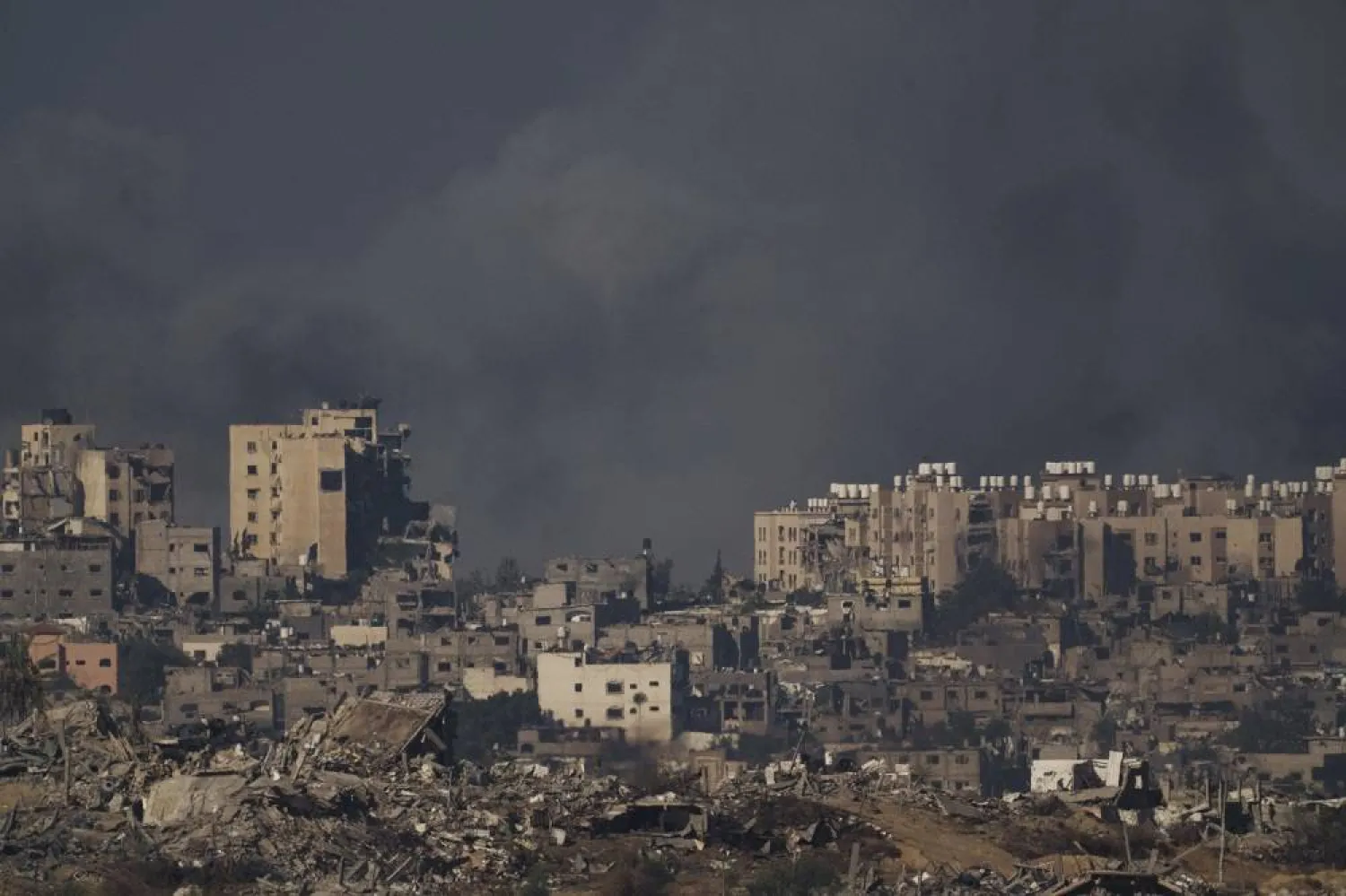

South African Leader Accuses Israel of War Crimes as He Heads BRICS Summit on Gaza

Smoke rises following an Israeli airstrike in the Gaza Strip, as seen from southern Israel, Tuesday, Nov. 21, 2023. (AP)
TT

South African Leader Accuses Israel of War Crimes as He Heads BRICS Summit on Gaza

Smoke rises following an Israeli airstrike in the Gaza Strip, as seen from southern Israel, Tuesday, Nov. 21, 2023. (AP)

South African President Cyril Ramaphosa accused Israel of war crimes and acts "tantamount to genocide" in Gaza during a virtual meeting of leaders of developing countries including Russia's Vladimir Putin and China's Xi Jinping on Tuesday. Ramaphosa also condemned Hamas for its attack on Israeli civilians that sparked the conflict and said both sides were guilty of violating international law.

"The collective punishment of Palestinian civilians through the unlawful use of force by Israel is a war crime," Ramaphosa said at the start of the meeting of leaders and top diplomats from the BRICS bloc of countries. "The deliberate denial of medicine, fuel, food and water to the residents of Gaza is tantamount to genocide."

"In its attacks on civilians and by taking hostages, Hamas has also violated international law and must be held accountable for these actions," Ramaphosa said.

Putin and Xi struck more cautious notes, calling for a ceasefire and the release of civilian hostages but not launching the same level of criticism of either side as Ramaphosa.

Also joining the meeting were leaders and officials from fellow BRICS members Brazil and India, and from Saudi Arabia, Argentina, Egypt, Ethiopia, Iran and the United Arab Emirates, which are set to join the bloc in January.

Ramaphosa chaired the "extraordinary meeting" and made the opening remarks because of South Africa's position as current chair of BRICS.

Putin said there was a "humanitarian catastrophe" unfolding in Gaza and it was "shocking to watch how surgeries are performed on children without anesthesia." He again blamed the crisis on what he called failed diplomacy by the United States.

"All these events, in fact, are a direct consequence of the US desire to monopolize mediation functions in the Palestinian-Israeli settlement," Putin said while appearing on teleconference from the Kremlin. He called for a ceasefire in Gaza, the freeing of hostages and the evacuation of civilians from the Gaza Strip.

Putin's comments were in line with Russia's careful approach to the Israel-Hamas war, which may present an opportunity for it to advance its role as a global power broker. Putin proposed last month that Moscow could mediate in the conflict due to its relationships with both Israel and the Palestinians. He said Tuesday that the BRICS bloc could play "a key role" in finding a political settlement.

Putin has condemned the Oct. 7 attack by Hamas militants on towns in southern Israel that led to Israel’s offensive in Gaza, now in its seventh week, while warning Israel over its response and against blockading the Gaza Strip.

More than 12,700 Palestinians have been killed in Gaza, according to the Palestinian Health Ministry in the West Bank. Officials there say another 4,000 are missing. Around 1,200 people have been killed on the Israeli side, mainly civilians during the Hamas attack.

The meeting came a day after China’s top diplomat hosted the foreign ministers of Saudi Arabia, Egypt, Jordan, the Palestinian Authority and Indonesia in Beijing, their first stop on a tour of UN Security Council permanent members. That underlined China’s longstanding support for the Palestinians and its growing geopolitical influence.

India, which also wants to be seen as a leader of the developing world, has long walked a tightrope between Israel and the Palestinians and historically has close ties to both.

South Africa has been fiercely critical of Israel over the war in Gaza and had already filed a request with the International Criminal Court to investigate it over alleged war crimes. South Africa has for years compared Israel's policies in Gaza and the West Bank with its own past apartheid regime of racial segregation.

South Africa's Parliament was to vote on a motion on Tuesday to shut down the Israeli Embassy and sever diplomatic ties over the war, leading Israel to recall its ambassador to South Africa for discussions.

Ramaphosa called for the International Criminal Court to "urgently" initiate prosecutions against those responsible for what he termed war crimes on both sides. He said South Africa also wants to see a ceasefire and the deployment of a UN force to monitor the ceasefire.



Trump to Travel to China Next Month, with US Trade Policy in Focus

US President Donald Trump arrives at Joint Base Andrews in Maryland, US, February 19, 2026. (Reuters)
TT

Trump to Travel to China Next Month, with US Trade Policy in Focus

US President Donald Trump arrives at Joint Base Andrews in Maryland, US, February 19, 2026. (Reuters)

US President Donald Trump will travel to China from March 31 to April 2 for a highly anticipated meeting between the world's two biggest economies, following the Supreme Court's decision to overturn Trump's sweeping tariffs against imported goods.

A White House official confirmed the trip on Friday, just before the highest US court struck down many of the tariffs Trump has used to manage sometimes-tense relations with China.

Trump is expected to visit Beijing and meet Chinese President Xi Jinping as part of a lavish, extended visit. Trump was last in China in 2017, ‌the most ‌recent trip by a US president.

A key topic had been whether ‌to ⁠extend a trade ⁠truce that kept both countries from further hiking tariffs. After Friday's ruling, however, it was not immediately clear whether - and under what legal authority - Trump would restore tariffs on imports from China.

TRUMP SEES TRADE IMBALANCE AS NATIONAL EMERGENCY

The administration has said the tariffs were necessary because of national emergencies related to trade imbalances and China's role in producing illicit fentanyl-related chemicals.

"That's going to be a wild one," Trump told foreign leaders visiting Washington on Thursday ⁠about the trip. "We have to put on the biggest display you've ‌ever had in the history of China."

The Chinese ‌embassy in Washington did not immediately respond to a request for comment. Beijing has not ‌confirmed the trip.

The visit would be the leaders' first talks since February and their first ‌in-person visit since an October meeting in South Korea. At that October meeting, Trump agreed to trim tariffs on China in exchange for Beijing cracking down on the fentanyl trade, resuming US soybean purchases and keeping rare earth minerals flowing.

While the October meeting largely sidestepped the sensitive issue of ‌Taiwan, Xi raised US arms sales to the island in February.

Washington announced its largest-ever arms sales deal with Taiwan in December, ⁠including $11.1 billion in ⁠weapons that could ostensibly be used to defend against a Chinese attack. Taiwan expects more such sales.

China views Taiwan as its own territory, a position Taipei rejects. The United States has formal diplomatic ties with China, but it maintains unofficial ties with Taiwan and is the island's most important arms supplier. The United States is bound by law to provide Taiwan with the means to defend itself.

Xi also said during the February call that he would consider further increasing soybean purchases, according to Trump.

Struggling US farmers are a major political constituency for Trump, and China is the top soybean consumer.

Although Trump has justified several hawkish policy steps from Canada to Greenland and Venezuela as necessary to thwart China, he has eased policy toward Beijing in the past several months in key areas, from tariffs to advanced computer chips and drones.


Diplomacy Is Still the Only Viable Path to Peace in Ukraine, UN Refugee Chief Barham Salih Says

UNCHR High Commissioner Barham Salih talks during an interview with The Associated Press in Kyiv, Ukraine, Friday, Feb. 20, 2026. (AP)
TT

Diplomacy Is Still the Only Viable Path to Peace in Ukraine, UN Refugee Chief Barham Salih Says

UNCHR High Commissioner Barham Salih talks during an interview with The Associated Press in Kyiv, Ukraine, Friday, Feb. 20, 2026. (AP)

There are many obstacles to a peace deal in Ukraine, but a diplomatic solution remains the only viable option, the newly appointed head of the UN refugee agency said Friday, warning that humanitarian operations are increasingly overstretched because of multiple global crises.

Barham Salih, Iraq’s former president who was elected UNHCR high commissioner in December, made his first visit to Ukraine since taking office.

After traveling to Ukraine’s front-line cities, including Kharkiv and Zaporizhzhia, he met with President Volodymyr Zelenskyy and discussed the latest in efforts to secure a peace deal. He also discussed the future of UNHCR operations as Ukraine endures Russian attacks on its energy grid during a harsh winter.

“You have to be hopeful, but I do understand the difficulties in the situation, and it’s clear, of course, there are many, many impediments along the way, but at the end of the day, there is no military solution. There needs to be peace, a durable and just peace so that people can go back to their lives,” he said, speaking to The Associated Press in an interview in Kyiv.

“Things are not necessarily easy, definitely not easy, but let’s redouble the effort to make sure that diplomacy has a chance and really bring about a durable and just peace to this war that has been going on for far too long,” he added.

Of the agency’s $470 million appeal for Ukraine, only $150 million has been pledged. The shortfall reflects deep cuts across the humanitarian sector, making it increasingly difficult to deliver aid across multiple crises.

There are 3.7 million Ukrainians displaced within the country and nearly 6 million Ukrainians outside the country who have become refugees in Europe and elsewhere, he said.

“This tells you the gap between what is needed and what is available,” he said. “My appeal to the international community is, really, this is not the moment to walk away, this is not a moment to look the other way round. These vulnerable populations need support. We should deliver this help to them.”

The UN agency in Ukraine predicts 10.8 million Ukrainians will require humanitarian assistance in 2026, according to a report from the agency. The most critical needs are concentrated along the war’s front lines in the eastern and southern parts of Ukraine, as well as in the northern border region. Intensified hostilities produce fresh waves of displacement.

The agency’s Ukraine appeal competes with large-scale conflicts in Sudan and Gaza. Since his appointment, Salih has spent only one week in his Geneva office, traveling to Kenya, Chad, Türkiye and Jordan before visiting Ukraine.

Drastic cuts to US humanitarian funding under President Donald Trump has accelerated the erosion of global humanitarian infrastructure and severely undermined the ability of organizations to deliver aid.

There are 117 million displaced people worldwide, including at least 42 million refugees, Salih said. Two-thirds face protracted displacement and remain dependent on humanitarian assistance.

Deciding where to prioritize given shrinking resources is “difficult” he said.

“It’s really very difficult to prioritize given the scale of the problem. I was in Kenya and I was in Chad recently and I was in Türkiye and in Jordan talking to refugees from Syria. And of course, now in Ukraine, these are all pressing issues, pressing requirements,” he said.

“We need to be there to help people, but also I have to say we really need to look at durable solutions too as well. It’s not a matter of sustaining dependency or humanitarian assistance,” he added.

In his meeting with Zelenskyy, Salih said they discussed the need to focus on the “recovery phase and sustainable solutions and self reliance as we go forward,” he said.


Israel Army Says on ‘Defensive Alert’ Regarding Iran but No Change to Public Guidelines

Israeli air defense system fires to intercept missiles during an Iranian attack over Tel Aviv, Israel, Thursday, June 19, 2025. (AP)
TT

Israel Army Says on ‘Defensive Alert’ Regarding Iran but No Change to Public Guidelines

Israeli air defense system fires to intercept missiles during an Iranian attack over Tel Aviv, Israel, Thursday, June 19, 2025. (AP)

The Israeli army said it was on "defensive alert" as the United States threatens potential military action against Iran, but insisted there were no changes in its guidelines for the public.

"We are closely monitoring regional developments and are aware of the public discourse concerning Iran. The (Israeli military) is on defensive alert," army spokesman Brigadier General Effie Defrin said in a video statement published Friday.

"Our eyes are wide open in all directions, and our finger is more than ever on the trigger in response to any change in the operational reality," he added, but emphasized "there is no change in the instructions".