Putin Says 617,000 Russian Troops are Currently Fighting in Ukraine, Offering Rare Detail

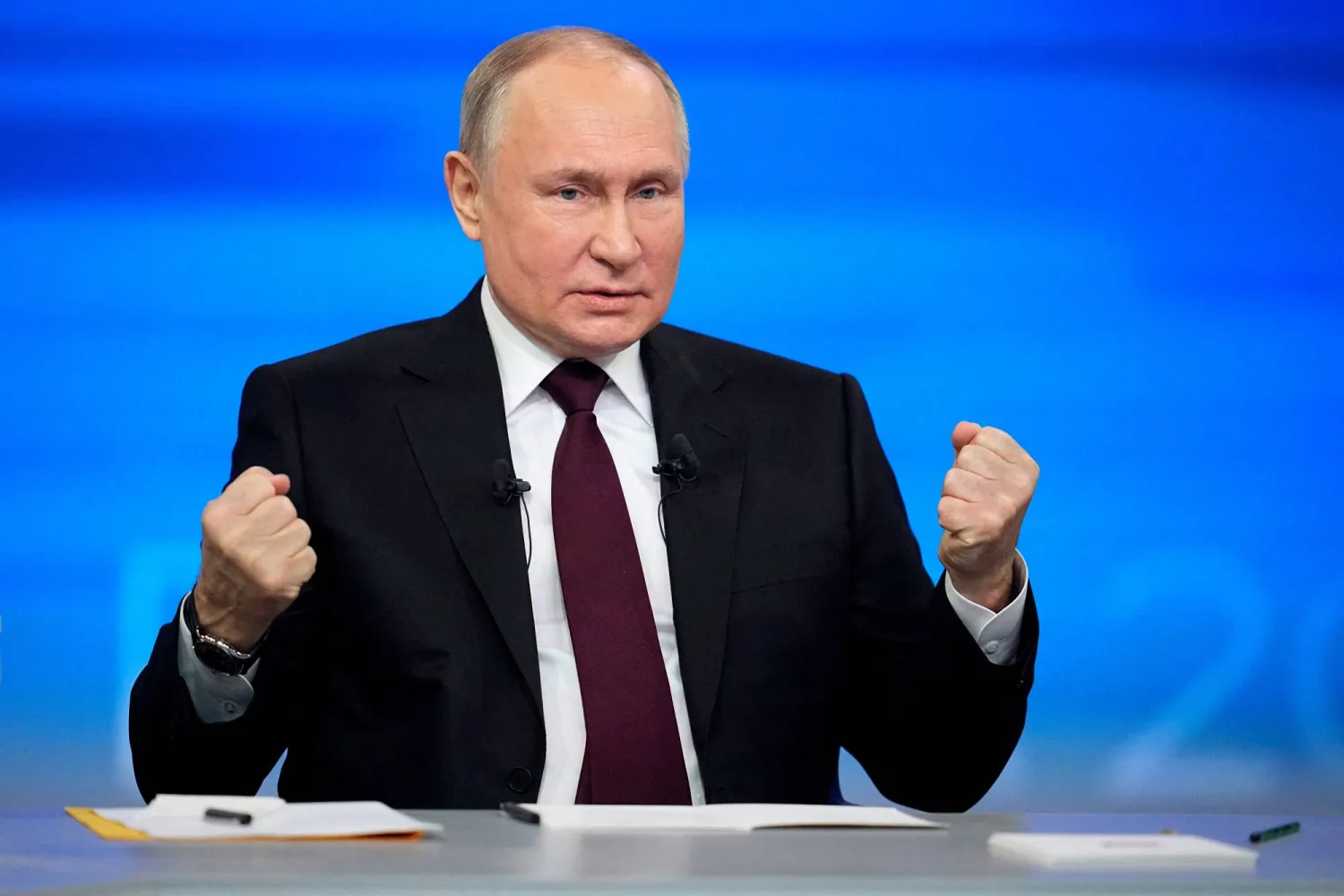
Russian President Vladimir Putin speaks during his annual press conference in Moscow, Russia December 14, 2023. Alexander Zemlianichenko/Pool via REUTERS
TT

Putin Says 617,000 Russian Troops are Currently Fighting in Ukraine, Offering Rare Detail

Russian President Vladimir Putin speaks during his annual press conference in Moscow, Russia December 14, 2023. Alexander Zemlianichenko/Pool via REUTERS

President Vladimir Putin said Thursday that a total of 617,000 Russian troops are currently fighting in Ukraine.
Some 244,000 of them are soldiers who were called up to fight alongside professional Russian military troops, according to the president.
Putin revealed those rare details about the military operation during his year-end press conference. He dismissed the need for another wave of mobilization after drafting some 300,000 men last year in a move that proved widely unpopular, The Associated Press said.
Russian President Vladimir Putin began his end-of-year news conference Thursday vowing that his goals in Ukraine remain the same and that there would be no peace until they're achieved.
The Russian president, who has held power for nearly 24 years and announced recently he is running for reelection, was greeted with applause as he arrived in the hall in central Moscow.
This year, ordinary citizens have the chance to phone in questions along with those asked by journalists, and Russians have been submitting questions for Putin for two weeks. It is the first time Putin, who has heavily limited his interaction with foreign media, will potentially face multiple questions from Western journalists since before the fighting in Ukraine began.
Putin said Thursday that Moscow’s goals — “de-Nazification, demilitarization and a neutral status” of Ukraine — remain unchanged.
He spelled out those objectives the day he sent troops to Ukraine in February 2022.
“De-Nazification” refers from Russia’s allegations that the Ukrainian government is heavily influenced by radical nationalist and neo-Nazi groups. The claim is derided by Ukraine and the West.
Putin has also demanded that Ukraine remain neutral — and not join the NATO alliance.
“There will be peace when we achieve our goals,” Putin said.
The Kremlin has since repeatedly said that the “special military operation” in Ukraine will continue until those loosely defined goals are achieved.
Offering rare detail on Moscow's operation, Putin said some 244,000 troops who were called up to fight in Ukraine are currently on the battlefield and dismissed the need for a second wave of mobilization of reservists. He did not give a total for the number of troops in Ukraine, where professional Russian military forces also fight.
In September 2022, Putin ordered a partial military call-up as he tried to boost his forces in Ukraine, sparking protests.
“There is no need,” for mobilization now, Putin said, because 1,500 men are being recruited into the Russian army every day across the country. He said, as of Wednesday evening, a total of 486,000 soldiers have signed a contract with the Russian military.
In addition to the fighting in Ukraine, the economy and social services are expected to be discussed at the news conference, Russian state journalists said.
Last year, Putin did not hold his usual call-in show with ordinary Russians or his traditional session with reporters.
In addition, his annual state-of-the-nation address was delayed until February of this year. His last news conference was in 2021 amid U.S warnings that Russia was on the brink of sending troops into Ukraine.
With the future of Western aid to Ukraine in doubt and another winter of fighting looming, neither side has managed to make significant battlefield gains recently. Ukrainian President Volodymyr Zelenskyy traveled to Washington on Tuesday and made an impassioned plea for more U.S. aid and weaponry.
Putin's appearance is primarily aimed at a domestic audience and will be a chance for him to personally resolve the problems of ordinary Russian citizens and reinforce his grip on power ahead of the March 17 election.
“For the majority of people, this is their only hope and possibility of solving the most important problems,” according to a state television news report on the Russia 1 channel.
State media said that as of Wednesday, about 2 million questions for Putin had been submitted ahead of the broadcast, which is heavily choreographed and more about spectacle than scrutiny.
In 2021, Putin called a citizen who asked about water quality in the city of Pskov in western Russia and personally assured him he would order the government and local officials to fix the problem.
Some Russian journalists, who lined up for hours in freezing temperatures to get into the venue, have donned traditional dress, including elaborate hats in order to catch Putin's attention. Many journalists also hold placards, prompting the Kremlin to limit the size of signs they can carry during the news conference, which often lasts about four hours.
Attendees must test for COVID-19 and flu before entering the news conference site. Putin enforced strict quarantine for visitors during the COVID-19 pandemic.



Swedish Voters Go to Polls to Choose a New Parliament as Hard Right Bids for Role in Government

 Opposition leader and Sweden's Social Democratic Party leader, Magdalena Andersson, and her husband, Richard Friberg, vote during the general election in Nacka, near Stockholm, Sweden, September 13, 2026. (Reuters)
Opposition leader and Sweden's Social Democratic Party leader, Magdalena Andersson, and her husband, Richard Friberg, vote during the general election in Nacka, near Stockholm, Sweden, September 13, 2026. (Reuters)
TT

Swedish Voters Go to Polls to Choose a New Parliament as Hard Right Bids for Role in Government

 Opposition leader and Sweden's Social Democratic Party leader, Magdalena Andersson, and her husband, Richard Friberg, vote during the general election in Nacka, near Stockholm, Sweden, September 13, 2026. (Reuters)
Opposition leader and Sweden's Social Democratic Party leader, Magdalena Andersson, and her husband, Richard Friberg, vote during the general election in Nacka, near Stockholm, Sweden, September 13, 2026. (Reuters)

Voters in Sweden will head to the polls on Sunday for an election that will determine whether a conservative leader remains in charge and a hard-right party wins ministerial jobs for the first time, or whether the center-left returns to power.

Prime Minister Ulf Kristersson is seeking a second four-year term at the helm of the European Union nation that is also NATO’s newest member. Meanwhile, his predecessor hopes to win the job back.

Experts say the campaign has been fragmented and incoherent, with policy questions such as how healthcare should be organized drowned out by questions about which parties will be able to put together a government.

“Crime has come down, inflation has come down. So these topics are not really what people discuss,” said Zeth Isaksson, a sociologist in electoral behavior at Stockholm University and a political scientist at the European University Institute in Florence, Italy. “People discuss who is going to be in government, and that’s what the election is about.”

Kristersson has led Sweden since 2022 with a three-party center-right coalition. It relies on outside support from the Sweden Democrats, an anti-immigration party that has far-right roots but has moved toward the political mainstream, for a parliamentary majority. If the right is reelected, it can expect Cabinet posts this time.

He’s up against Magdalena Andersson of the center-left Social Democrats, a party that more often than not has led Swedish governments since World War II. Andersson served as prime minister from 2021 until she lost power at the last election.

There are two major political blocs: one with four parties on the right and another with four parties on the left. So the big question is less about which party wins and more about which side can form a majority. Individual parties need a minimum of 4% of the vote to win parliamentary seats.

The Sweden Democrats, who in 2022 took 20.5% of the vote to become the biggest party on the right, can expect Cabinet seats if power doesn’t change hands.

Kristersson announced in April that his conservative Moderates would allow them into government if the right has a majority — though he would remain prime minister even if the Sweden Democrats are the stronger party.

The Sweden Democrats were founded in the 1980s by people who had been active in right-wing extremist groups, including neo-Nazis. They toned down their rhetoric and expelled openly racist members under Jimmie Åkesson, who has led them since 2005 and overseen their growth from what was once a marginal party.

The Sweden Democrats' role is in focus against a background of gains for the populist right in Europe, including the first-place finish by the far-right Alternative for Germany party in a regional election there Sept. 6.

More than 8 million people in the nation of about 10.6 million are eligible to vote in the election for the 349-seat parliament, the Riksdag, which will elect the next prime minister. The Swedish Election Authority says the first preliminary results will be available around 9 p.m. local time (1900 GMT).


DR Congo’s Worst Ebola Epidemic Ever Passes 7,000 Cases

A Congolese medical worker dressed in personal protective equipment (PPE) walks within the emergency unit at the Muthiri Adventist Hospital, as aid agencies intensify efforts to contain a new Ebola outbreak involving the Bundibugyo strain in the Mutiri quarter of Butembo, North Kivu province, Democratic Republic of Congo, September 10, 2026. (Reuters)
TT

DR Congo’s Worst Ebola Epidemic Ever Passes 7,000 Cases

A Congolese medical worker dressed in personal protective equipment (PPE) walks within the emergency unit at the Muthiri Adventist Hospital, as aid agencies intensify efforts to contain a new Ebola outbreak involving the Bundibugyo strain in the Mutiri quarter of Butembo, North Kivu province, Democratic Republic of Congo, September 10, 2026. (Reuters)

More than 7,000 Ebola cases have been recorded in the Democratic Republic of Congo's worst outbreak of the deadly disease ever, according to figures released Saturday by Congolese authorities.

But the government also suggested that the spread of the disease may already have peaked, despite the virus having been confirmed in a seventh province earlier this week.

The DRC officially detected the latest outbreak in mid-May, with nearly 3,400 people killed in its 17th epidemic of the highly infectious virus.

It began in the northeastern Ituri province before spreading to conflict-plagued, remote eastern and northern regions where armed groups have roamed for decades, the presence of the state is weak and health infrastructure is lacking.

The disease was confirmed in South-Ubangi, which borders the Central African Republic and Congo-Brazzaville, earlier this week.

According to the latest figures from the Congolese authorities, 7,022 cases have been recorded since the beginning of the epidemic. Of that number, 3,398 people have died and 1,671 have recovered.

"The peak was reached at the beginning of the third week of August," Congolese government spokesman Patrick Muyaya wrote on X on Saturday.

"All the indicators show a decrease in the number of cases," he added, specifying that "10 of the 61 health zones" affected by the epidemic have not recorded any new cases "for at least 21 days".

Most of the recorded cases are in Ituri, where Ebola has been detected in schools in the days after the post-summer holiday return to classes, causing alarm among parents and health workers.

"We are very worried because we don't know which child comes from which family or what the health status of the members of that family is," Angele Magani, the mother of a student in Bunia, Ituri's provincial capital, told AFP.

"We are so scared, even though the school authorities reassure us about the health measures that have been put in place," she added.

Bunia school official Roger Mungimbo said "there is a mandatory hand-washing system with soap, and we have also done everything possible to have a maximum of 30 pupils per classroom."

"We regularly make the children aware that they must not touch each other" and wash their hands regularly, he added.

Ebola, which has killed more than 15,000 people in Africa over the last 50 years, is transmitted through contact with bodily fluids and can cause severe internal and external bleeding and organ failure.

The current epidemic is caused by the Bundibugyo strain, for which there is no approved vaccine or treatment. Several treatments and vaccines are being tested.


India’s Modi and China’s Xi Seek to Reset Ties on BRICS Sidelines

This handout photograph taken on September 12, 2026 and released by the Indian Press Information Bureau (PIB) shows India's Prime Minister Narendra Modi (R) and China's President Xi Jinping shaking hands during a bilateral meeting on the sidelines of the 18th BRICS Summit at the Bharat Mandapam in New Delhi on September 12, 2026. (Handout / Indian Press Information Bureau (PIB) / AFP)
TT

India’s Modi and China’s Xi Seek to Reset Ties on BRICS Sidelines

This handout photograph taken on September 12, 2026 and released by the Indian Press Information Bureau (PIB) shows India's Prime Minister Narendra Modi (R) and China's President Xi Jinping shaking hands during a bilateral meeting on the sidelines of the 18th BRICS Summit at the Bharat Mandapam in New Delhi on September 12, 2026. (Handout / Indian Press Information Bureau (PIB) / AFP)

Indian Prime Minister Narendra Modi and Chinese President Xi Jinping met Saturday on the sidelines of the BRICS summit in New Delhi, the latest effort by the rival neighbors to repair ties strained by a deadly border clash six years ago.

Xi said China has approached relations with India from a “strategic and long-term perspective” and called for the two countries to draw on each other’s strengths, support one another and pursue common development.

He also urged “high-quality cooperation” between the two countries, saying China and India, as major members of the Global South, should promote a more multipolar world and contribute to global peace and stability.

Xi said institutional exchanges between the two countries have gradually resumed and bilateral trade has expanded, according to China’s official Xinhua News Agency. China and India are partners, not rivals, Xi said, and the two countries present opportunities for each other’s development rather than threats, according to Xinhua.

Modi thanked Xi for China’s cooperation in hosting the summit. China will host the summit next year. BRICS stands for Brazil, Russia, India, China, the group's founding countries, plus South Africa.

Modi said peace along the disputed border was essential for broader ties and urged both sides to honor existing agreements, a statement by India’s foreign ministry later Saturday said. Both leaders reaffirmed their commitment to a fair and mutually acceptable settlement of the boundary dispute, it said.

“Differences should not become disputes,” Modi said, adding: “Both sides must be guided by three mutuals: mutual respect, mutual sensitivity and mutual interest.”

The leaders discussed expanding people-to-people and business ties while addressing trade imbalances, supply chain issues and market access concerns, the statement said.

The two leaders held talks in China last year during Modi's visit to attend the Shanghai Cooperation Organization, a regional political, economic and security group founded by China.

The summit marks Xi’s first visit to India since 2019 and yet another effort toward a cautious thaw between the rival neighbors, six years after a deadly border clash badly damaged ties.

A military clash in 2020 killed at least 20 Indian soldiers and four Chinese service members along a grueling frontier in the cold desert region of Ladakh. It turned into a long-running standoff in the rugged mountainous area, where each side has stationed tens of thousands of military personnel backed by artillery, tanks and fighter jets.

India and China have since taken steps to ease tensions, but deep mistrust remains.

The two nuclear-armed powers still dispute some parts of their border, while India’s large trade deficit with China, restrictions on Chinese investment and technology and their competing strategic interests in Asia continue to weigh on relations. India has also significantly expanded military infrastructure along its disputed frontier with China, while Beijing has built roads and defensive positions on its side of the contested border.

Xi’s visit is expected to test whether the recent thaw can translate into a broader stabilization of ties.

Since their 1962 war, the economies of both countries have grown substantially, but China has far outpaced India and runs a large trade surplus with its neighbor. Their growing economic rivalry has added to longstanding territorial and strategic differences.

India has sought to capitalize on China’s rising labor costs and strained ties with the United States and Europe to position itself as an alternative base for foreign manufacturers. New Delhi has also viewed China’s multibillion-dollar Belt and Road Initiative with concern and has strongly opposed it.

At the same time, India’s growing strategic partnership with the US has raised concerns in Beijing, which views the relationship as part of efforts to counter China’s rise.