


Attack by Opposition Group Kills Policeman in Southeast Iran

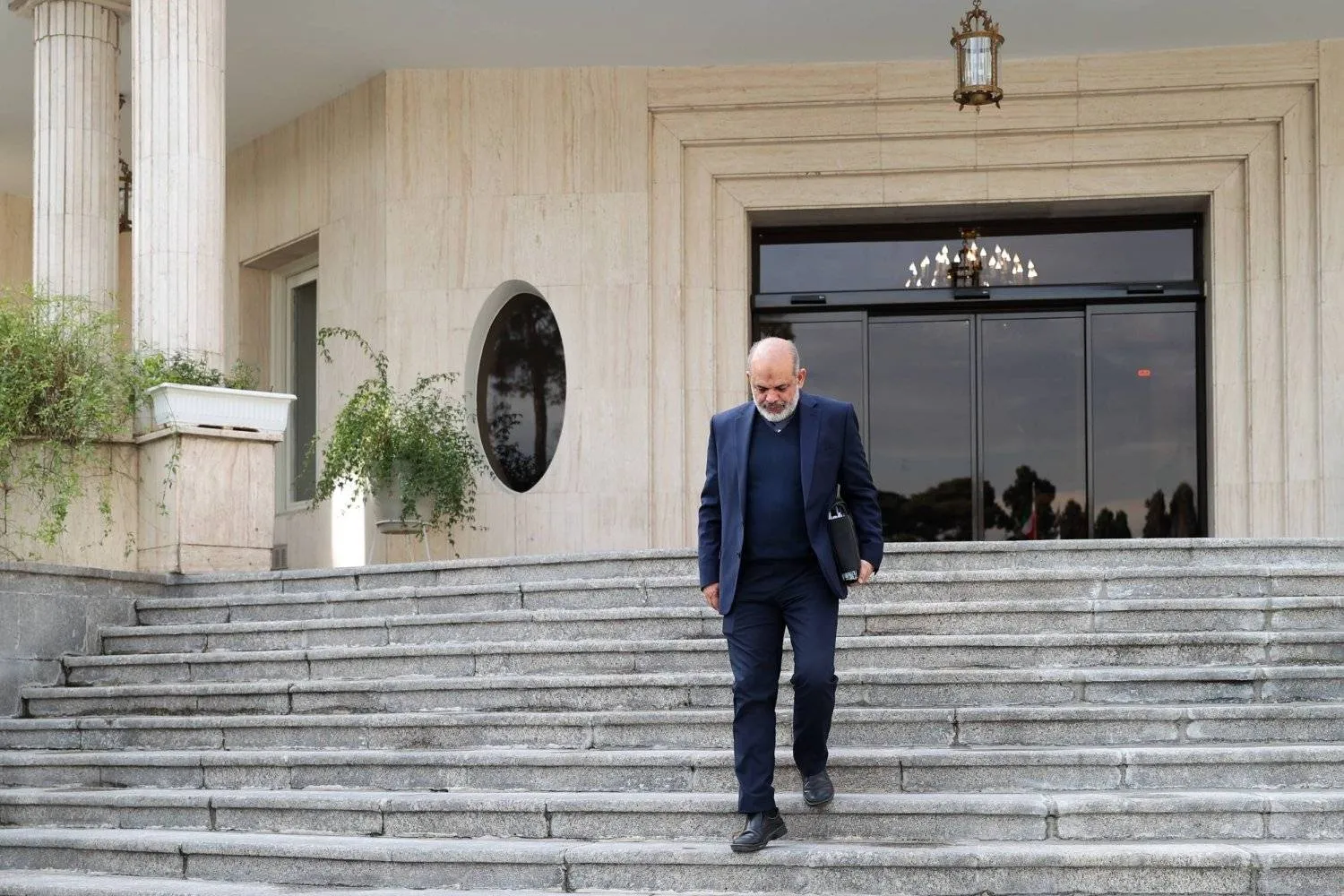
Iran’s Minister of Interior Ahmad Vahidi leaves the government headquarters. (Iranian presidency) 
TT

Attack by Opposition Group Kills Policeman in Southeast Iran

Iran’s Minister of Interior Ahmad Vahidi leaves the government headquarters. (Iranian presidency) 

A police officer was killed during a three-hour clash with militants in the south-eastern region of Iran on Wednesday, according to Iranian state media.

The attack targeted a checkpoint in Rask County, Baluchestan province, and was claimed by an opposition Baluchi faction.

The incident unfolded in an exchange of gunfire between forces from a police station in Rask and members of an armed group, resulting in the death of one policeman, as reported by the IRNA news agency.

Ahmad Vahidi, Iran's Minister of Interior, confirmed that an investigation has been initiated to probe the incident.

The opposition group, Jaish Al Adl (Army of Justice), claimed responsibility for the attack through a brief statement on its Telegram channel, asserting it caused "significant damage and human casualties."

The clash reportedly lasted for three hours, with the assailants retreating upon the arrival of security reinforcements, as per IRNA.

Salim Kadkhoda, the governor of Rask, informed IRNA that the group failed to infiltrate the police station during the confrontation.

Earlier reports from the Halvash local website mentioned explosions around the Rask base, with attackers blocking routes leading to the confrontation site.

The incident follows a recent attack in the city of Kerman that killed nearly 100 people and wounded scores, some still in critical condition.

In mid-December, 11 Iranian police officers were killed in an attack on a police station in Rask, with Jaish Al Adl claiming responsibility.

The group is active in the border province with Pakistan and Afghanistan and has conducted multiple assaults on Iranian security forces in recent years.

In February 2019, the group claimed responsibility for an attack targeting Iran's Revolutionary Guard Corps (IRGC) personnel traveling on a bus. At least 27 IRGC personnel were killed.

Baluchi opposition groups in the province are labeled as "terrorists" or "anti-revolution" by Iran, while Iranian state media refer to them as "extremist groups." These groups claim to defend Baluchi national rights.

The Pakistani Iranian borders are a scene for clashes between the security forces and the Baluchi opposition, with accusations against Islamabad for supporting the latter.

Tensions in Baluchestan escalated last year after protests following the death of Mahsa Amini in Tehran and Kurdish provinces. It also witnessed protests over the alleged rape of a teenage girl by a police officer.

The unrest has resulted in over 500 deaths in Iran since the start of the demonstrations, with at least 130 from Baluchestan, the country's poorest province with a Sunni majority.

The residents of Baluchestan complain about perceived ethnic and religious discrimination in the region.

Iran Human Rights (IHR), headquartered in Oslo, revealed that Baluchestan witnesses the highest number of executions among Iran's 31 provinces.



South Korea's Lee Urges North Korea to Restore Dialogue, Pledges Military Buildup

South Korean President Lee Jae Myung delivers a speech during the Armed Forces Day at a military base in Gyeyong, South Korea, Thursday, Oct.  1, 2026. (Jeon Heon-kyun/Pool Photo via AP)
South Korean President Lee Jae Myung delivers a speech during the Armed Forces Day at a military base in Gyeyong, South Korea, Thursday, Oct. 1, 2026. (Jeon Heon-kyun/Pool Photo via AP)
TT

South Korea's Lee Urges North Korea to Restore Dialogue, Pledges Military Buildup

South Korean President Lee Jae Myung delivers a speech during the Armed Forces Day at a military base in Gyeyong, South Korea, Thursday, Oct.  1, 2026. (Jeon Heon-kyun/Pool Photo via AP)
South Korean President Lee Jae Myung delivers a speech during the Armed Forces Day at a military base in Gyeyong, South Korea, Thursday, Oct. 1, 2026. (Jeon Heon-kyun/Pool Photo via AP)

South Korean President Lee Jae Myung on Thursday called on North Korea to help restore trust and resume dialogue, a day after Seoul and Pyongyang traded barbs over a landmine incident that South Korea's military and the UN Command said amounted to an armistice violation.

"I hope that the North joins us now on the path of restoring trust and resuming dialogue, ‌following a ‌long interruption," Lee said in an address ‌marking ⁠the country's Armed ⁠Forces Day, adding that his administration would "consistently pursue practical measures to reduce military tensions between the two Koreas."

The comments came after Seoul's military and the UN Command said North Korea violated the Korean War armistice following a landmine blast last week that wounded ⁠three South Korean soldiers in the Demilitarized ‌Zone (DMZ).

Kim Yo Jong, the ‌influential sister of North Korean leader Kim Jong Un, rejected ‌the findings in a statement on Wednesday, accused ‌Seoul of fabricating the results and warned of retaliation.

Lee reaffirmed his goal of securing the transfer of wartime operational control from the United States to South Korea, calling it ‌part of a long-standing push for self-reliant national defense.

In a wide-ranging defense reform ⁠agenda, Lee ⁠also said in his speech that South Korea would build nuclear-powered submarines by the mid-2030s and upgrade missile defense capabilities, including AI-based command-and-control systems and high-energy laser interceptors.

He said the modernization drive would also involve expanding AI capabilities, restructuring the military for future warfare and strengthening the country's three-axis defense system for detecting and intercepting missile threats.

Lee's government has sought to reopen dialogue with North Korea, but Pyongyang has largely rejected Seoul's overtures while pressing ahead with border fortification work along the DMZ.


Pakistani Airstrikes in Afghanistan Kill 9 People, Kabul Says

People stand on the rubble of a house that was damaged in what the Taliban said was a Pakistani airstrike in Garmsir district in Helmand province, Afghanistan, October 1, 2026. Picture taken with a mobile phone. REUTERS/Stringer
TT

Pakistani Airstrikes in Afghanistan Kill 9 People, Kabul Says

People stand on the rubble of a house that was damaged in what the Taliban said was a Pakistani airstrike in Garmsir district in Helmand province, Afghanistan, October 1, 2026. Picture taken with a mobile phone. REUTERS/Stringer

Pakistan carried out airstrikes in two Afghan provinces overnight, both countries said Thursday, with Afghanistan saying 9 women and children were killed and another 11 civilians were wounded in the bombings.

Pakistan’s Ministry of Information said its strikes were against militant hideouts in two locations and that “initial reports suggest” that 22 militants had been killed. The casualty claims from either side could not be independently verified.

The strikes come amid repeated cross-border clashes between the two countries, while Pakistan has repeatedly carried out airstrikes inside Afghanistan since tensions between the two countries spiraled dramatically earlier this year. The two neighbors have longstanding disputes over militant activity along their border.

The United Nations Mission in Afghanistan said last week that it had documented over 1,100 civilian deaths and injuries in Afghanistan from cross-border violence so far this year. Pakistan denies striking civilians, and says it targets militants who carry out attacks inside Pakistan. Afghanistan denies harboring militants.

The spokesman for Afghanistan's Taliban government, Zabihullah Mujahid, said the airstrikes hit civilian homes in southern Helmand province and the eastern province of Kunar, destroying three houses, killing nine women and children and wounding 11 other civilians.

“We condemn this act, and consider this an act of aggression and a crime that violates all universally accepted principles,” The Associated Press quoted him as saying.

Pakistan's Ministry of Information said the airstrikes were “well planned and calibrated” against militant hideouts and camps, and had “been carried out in Afghanistan with precision and accuracy.”

It added that large quantities of weapons and ammunition were located in the hideouts and were destroyed.

Pakistan accuses Afghanistan’s Taliban government of allowing militants, particularly the Pakistani Taliban — formally known as Tehrik-e-Taliban Pakistan, or TTP — to operate from Afghan territory and carry out attacks inside Pakistan. The TTP is separate from but allied with the Afghan Taliban, who have ruled Afghanistan since seizing power in 2021.

Kabul denies providing the group a safe haven and has rejected Pakistan’s accusations.

“The threat to Pakistan emanates from Afghanistan," Pakistan's ministry said. "Our action precisely targeted the terrorist hubs.”

“Maximum precautions were taken and it was ensured that no collateral damage occurs,” the statement said and added that its campaign “will continue at full pace to wipe out" the threat of militants from the country.


Hegseth Says US Cut Number of Generals, Admirals by 20%

Secretary of Defense Pete Hegseth gives a State of the Force address at Marine Corps Base Quantico, Wednesday, Sept. 30, 2026 in Quantico, Va.  (Alex Wong/Pool Photo via AP)
Secretary of Defense Pete Hegseth gives a State of the Force address at Marine Corps Base Quantico, Wednesday, Sept. 30, 2026 in Quantico, Va. (Alex Wong/Pool Photo via AP)
TT

Hegseth Says US Cut Number of Generals, Admirals by 20%

Secretary of Defense Pete Hegseth gives a State of the Force address at Marine Corps Base Quantico, Wednesday, Sept. 30, 2026 in Quantico, Va.  (Alex Wong/Pool Photo via AP)
Secretary of Defense Pete Hegseth gives a State of the Force address at Marine Corps Base Quantico, Wednesday, Sept. 30, 2026 in Quantico, Va. (Alex Wong/Pool Photo via AP)

Defense Secretary Pete Hegseth announced Wednesday that the United States has slashed the number of its generals and admirals by 20 percent, in a move he said is aimed at "accountability."

Hegseth suggested the cuts targeted officers who failed to get on board with his efforts to ensure the military is focused on war-fighting rather than the "woke" policies of previous administrations, describing the reductions as an "accomplishment."

"The number-crunchers say we fired 10 percent of the generals and admirals across the force," Hegseth told troops at the Quantico military base, saying: "We've also reduced the overall number of general officer slots by an additional 10 percent."

"So yes, 20 percent reduction across the board," he said. "The media calls that a purge. I call it accountability, and long overdue."

The address to junior officers and enlisted personnel at Quantico came a year after a similar speech to top officers in which Hegseth said the US military was too fat, too focused on leftist "woke" ideas, and in need of major shake-up.

He said Wednesday that top officers who "responded positively" to the previous speech are "leading newly focused and newly empowered and disciplined formations," while those who did not "no longer work here."

"We are no longer the woke department, or the weak department," AFP quoted Hegseth as saying.

"Simple translation of that: no fatties, no trannies, no beardos, no weirdos, no wimps, no radicals. Just warriors -- just tough, ready, committed troops."

Hegseth ordered major cuts to the US military -- including a 10-percent reduction to the overall number of generals and admirals, and a 20-percent decrease in the highest four-star ranks -- in May 2025.

There were 831 active duty US generals and admirals as of the end of that month, but Pentagon figures from the end of July 2026 -- the latest available -- showed there were actually more top officers -- a total of 851.

Asked to clarify if the 20 percent cuts had been completed or were still ongoing, the Pentagon said: "We have nothing further to provide beyond the secretary's comments."

During his confirmation hearing in January 2025, Hegseth argued that the Pentagon's bureaucracy was top-heavy and in need of cuts.

"It's going to be my job, working with those that we hire and those inside the administration, to identify those places where fat can be cut, so it can go toward lethality," he told lawmakers at the time.

Since returning to office early last year, Trump has overseen a purge of top military personnel, including the chairman of the Joint Chiefs of Staff, general Charles "CQ" Brown, whom he fired without explanation in February 2025.

Other senior officers pushed out include the heads of the US Army, Navy and Coast Guard, the general who headed the National Security Agency, the vice chief of staff of the US Air Force, a Navy admiral assigned to NATO, and three top military lawyers.

The chief of staff of the Air Force also announced his retirement without explanation just two years into a four-year term, while the head of US Southern Command retired a year into his tenure.

Hegseth has insisted the president is simply choosing the leaders he wants, but Democratic lawmakers have raised concerns about the potential politicization of the traditionally neutral US military.