Out of Options, Rohingya are Fleeing Myanmar and Bangladesh by Boat Despite Soaring Death Toll

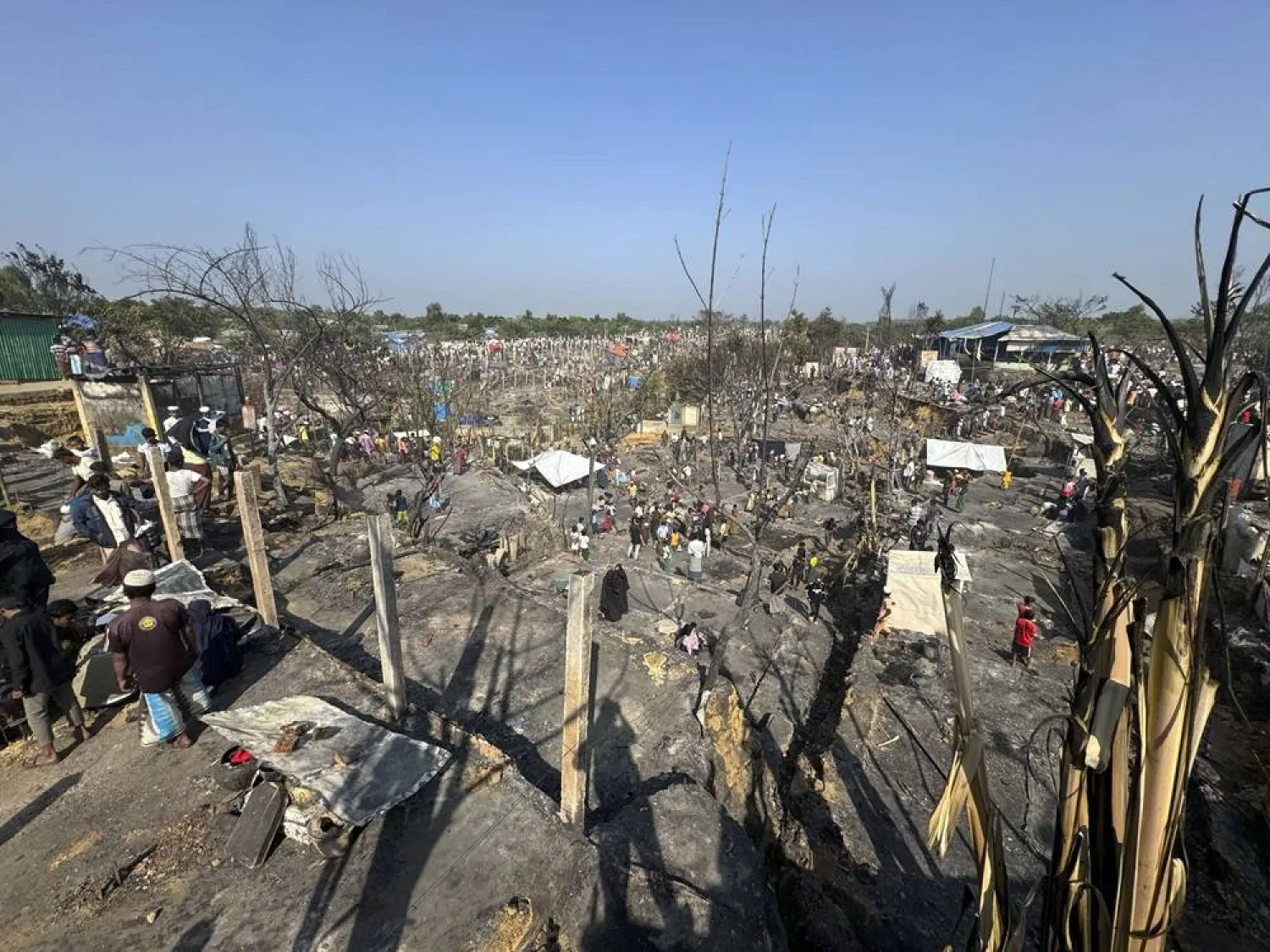
 Rohingya refugees look on after a midnight fire raced through their refugee camp at Kutupalong in Cox's Bazar district, Bangladesh, Sunday, Jan. 7, 2024. (AP)
Rohingya refugees look on after a midnight fire raced through their refugee camp at Kutupalong in Cox's Bazar district, Bangladesh, Sunday, Jan. 7, 2024. (AP)
TT

Out of Options, Rohingya are Fleeing Myanmar and Bangladesh by Boat Despite Soaring Death Toll

 Rohingya refugees look on after a midnight fire raced through their refugee camp at Kutupalong in Cox's Bazar district, Bangladesh, Sunday, Jan. 7, 2024. (AP)
Rohingya refugees look on after a midnight fire raced through their refugee camp at Kutupalong in Cox's Bazar district, Bangladesh, Sunday, Jan. 7, 2024. (AP)

Across a treacherous stretch of water, the Rohingya came by the thousands, then died by the hundreds. And though they know the dangers of fleeing by boat, many among this persecuted people say they will not stop — because the world has left them with no other choice.
Last year, nearly 4,500 Rohingya — two-thirds of them women and children — fled their homeland of Myanmar and the refugee camps in neighboring Bangladesh by boat, the United Nations’ refugee agency reported. Of those, 569 died or went missing while crossing the Bay of Bengal and Andaman Sea, the highest death toll since 2014, The Associated Press said.
The numbers mean one out of every eight Rohingya who attempted the crossing never made it, the United Nations High Commissioner for Refugees said last week.
Yet despite the risks, there are no signs the Rohingya will stop. On Thursday, Indonesian officials said another boat carrying Rohingya refugees landed in the country’s northern province of Aceh.
Fishermen provided food and water to 131 Rohingya, mostly women and children, who had been on board, said Marzuki, the leader of the local tribal fishing community, who like many Indonesians goes by one name.
Some passengers told officials they had been at sea for weeks and their boat's engine had broken down, leaving them adrift, said Lt. Col. Andi Susanto, commander of the navy base in Lhokseumawe.
“Southeast Asian waters are one of the deadliest stretches in the world and a graveyard for many Rohingya who have lost their lives,” says Babar Baloch, UNHCR’s spokesperson for Asia and the Pacific. “The rate of Rohingya who are dying at sea without being rescued — that’s really alarming and worrying.”
Inside the squalid refugee camps in Bangladesh, where more than 750,000 ethnic Rohingya Muslims fled in 2017 following sweeping attacks by Myanmar’s military, the situation has grown increasingly desperate. Not even the threat of death at sea is enough to stop many from trying to traverse the region’s waters in a bid to reach Indonesia or Malaysia.
“We need to choose the risky journey by boat because the international community has failed their responsibility,” says Mohammed Ayub, who is saving up money for a spot on one of the rickety wooden fishing boats traffickers use to ferry passengers 1,800 kilometers (1,100 miles) from Bangladesh to Indonesia.
Global indifference toward the Rohingya crisis has left those languishing in the overcrowded camps with few alternatives to fleeing. Because Bangladesh bans the Rohingya from working, their survival is dependent upon food rations, which were slashed last year due to a drop in global donations.
Returning safely to Myanmar is virtually impossible for the Rohingya, because the military that attacked them overthrew Myanmar’s democratically elected government in 2021. And no country is offering the Rohingya any large-scale resettlement opportunities.
Meanwhile, a surge in killings, kidnappings and arson attacks by militant groups in the camps has left residents fearing for their lives. And so, starving, scared and out of options, they continue to board the boats.
Ayub has lived in a sweltering, cramped shelter for more than six years in a camp where security and sanitation are scarce, and hope even scarcer. There is no formal schooling for his children, no way for him to earn money, no prospects for returning to his homeland and no refuge for his family amid spiraling gang violence.
“Of course I understand how dangerous the boat journey by sea is,” Ayub says. “We could die during the journey by boat. But it depends on our fate. ... It’s better to choose the dangerous way even if it’s risky, because we are afraid to stay in the camps.”
Two hundred of the people who died or went missing at sea last year were aboard one boat that left Bangladesh in November. Eyewitnesses on a nearby boat told The Associated Press that the missing vessel, which was crowded with babies, children and mothers, broke down and was taking on water before it drifted off during a storm as its passengers screamed for help. It has not been seen since.
It was one of several distressed boats that the region’s coastal countries neglected to save, despite the United Nations refugee agency's requests for those countries to launch search and rescue missions.
“When no action is taken, lives are lost,” says UNHCR’s Baloch. “If there is no hope restored in Rohingya lives either in Myanmar or in Bangladesh, there are no rescue attempts, (then) sadly we could see more desperate people dying in Southeast Asian seas under the watch of coastal authorities who could act to save lives.”
Six of Mohammed Taher’s family members were aboard the boat that vanished in November, including his 15-year-old brother, Mohammed Amin, and two of Taher’s nephews, ages 3 and 4. Their ultimate destination was Malaysia, a Muslim-majority country where many Rohingya seek relative safety.
Taher and his parents now struggle to sleep or eat, and spend their days agonizing over what became of their loved ones. Taher’s mother saw a fortune teller who said her relatives were still alive. Taher, meanwhile, dreamed that the boat made it to shore, where his relatives took refuge in a school and were able to bathe in warm water. But he remains unconvinced their journey ended so happily.
And so he has vowed to tell everyone to stay off the boats, no matter how unbearable life on land has become.
“I will never leave by boat on this difficult journey,” Taher says. “All the people who reached their destination are saying that it’s horrific traveling by boat.”
Yet such warnings are often futile. Ayub is now preparing to sell his daughter’s jewelry to help pay for his spot on a boat. While he is frightened by the stories of those who didn’t make it, he is motivated by the stories of those who did.
“Nobody would consider taking a risk by boat on a dangerous journey if they had better opportunities,” he says. “Fortunately, some people did reach their destination and got a better life. I am staying positive that Allah will save us.”



4 Years into Russia’s Full-Scale Invasion of Ukraine, a Look at the War by the Numbers 

A resident walks at the site of the Russian drone strike, amid Russia's attack on Ukraine, near the city of Chornomorsk, Odesa region, Ukraine February 23, 2026. (Reuters)
TT

4 Years into Russia’s Full-Scale Invasion of Ukraine, a Look at the War by the Numbers 

A resident walks at the site of the Russian drone strike, amid Russia's attack on Ukraine, near the city of Chornomorsk, Odesa region, Ukraine February 23, 2026. (Reuters)

Russia’s invasion of Ukraine four years ago launched Europe’s biggest conflict since World War II, causing immense suffering for civilians and harrowing ordeals for soldiers while rewriting the post-Cold War security order.

The fighting enters its fifth year on Tuesday, and it shows no signs of stopping any time soon.

The US has brokered talks with delegations from Moscow and Kyiv as part of the Trump administration's yearlong push for peace. But reconciling key differences, such as the future of Russian-occupied Ukrainian land and postwar security for Ukraine, has thwarted progress.

Meanwhile, thousands of each countries’ troops have died on the battlefield, and Ukrainian civilians have been battered by Russian aerial strikes that have brought years of power outages and water cuts.

Here’s a look at the conflict, by the numbers, since the full-scale invasion on Feb. 24, 2022.

1.8 million The upper end of the estimated number of soldiers killed, wounded or missing on both sides, according to a report last month by the Center for Strategic and International Studies, a think tank.

It estimated that Russia suffered 1.2 million casualties, including up to 325,000 troop deaths, between February 2022 and December 2025 — what it said was the largest number of troop deaths for any major power in any conflict since World War II.

Russia has not released figures on battlefield deaths since January 2023, when it said more than 80 soldiers were killed in a Ukrainian strike, bringing the total military deaths Moscow has confirmed to just over 6,000.

CSIS estimated that Ukraine has seen 500,000 to 600,000 military casualties, including up to 140,000 deaths.

Ukrainian President Volodymyr Zelenskyy said earlier this month that 55,000 Ukrainian troops have died in the war. Many are missing, he said.

Neither Moscow nor Kyiv gives timely data on military losses. Independent verification is not possible.

14,999 The UN Human Rights Monitoring Mission’s count for civilian deaths in Ukraine since Russia’s all-out invasion, though it says that is likely an underestimate. More than 40,600 civilians were injured over the same period, it said in a December report.

The war has killed at least 763 children, according to the UN.

Last year was the deadliest for civilians in Ukraine since 2022. The conflict killed 2,514 civilians and injured 12,142 in the country in 2025 — a 31% increase in civilian casualties over 2024, it said.

19.4% The percentage of Ukrainian land occupied by Russia, according to the Institute for the Study of War.

Over the past year, Russia has gained just 0.79% of Ukraine’s territory in the grinding war of attrition, the Washington-based think tank said in calculations provided earlier this month to The Associated Press, underscoring the little progress Moscow's forces have made despite huge costs in troops and armor.

Before Russia’s all-out invasion, it controlled nearly 7% of Ukraine, including Crimea and parts of the Donetsk and Luhansk regions in the east, as Moscow-backed separatists fought the Ukrainian army, according to Ukrainian officials and Western analysts.

13% The percentage drop in foreign military aid to Kyiv last year compared with the annual average between 2022 and 2024, according to Germany’s Kiel Institute, which tracks assistance to Kyiv.

US President Donald Trump stopped sending American weapons paid for by the US to Ukraine after he took office just over a year ago. European countries, striving to make up the difference, increased their military aid last year by 67% compared with the 2022-2024 period, the institute said in a report this month.

Foreign humanitarian and financial aid to Ukraine fell by 5% last year in comparison with the average in the previous three years, it said.

5.9 million The number of Ukrainian civilians who have left their country.

Some 5.3 million of those people have found refuge in Europe, according to a report this month from the UN office in Ukraine.

Additionally, around 3.7 million Ukrainians forced out of their homes have moved elsewhere within the country, the UN said in December.

Ukraine's prewar population was more than 40 million.

2,851 The number of Russian attacks that affected the provision of medical care in Ukraine, according to the World Health Organization. The figure covers the period from the full-scale invasion through Feb. 11.

The attacks include 2,347 strikes on health care facilities, as well as ones that damaged vehicles and the storage of medical supplies.


Iran: Any US Attack Including Limited Strikes Would be 'Act of Aggression'

Vehicles move along a highway near Tehran's landmark Azadi (Freedom) Tower in Tehran on February 23, 2026. (Photo by ATTA KENARE / AFP)
TT

Iran: Any US Attack Including Limited Strikes Would be 'Act of Aggression'

Vehicles move along a highway near Tehran's landmark Azadi (Freedom) Tower in Tehran on February 23, 2026. (Photo by ATTA KENARE / AFP)

Iran said Monday that any US attack, including limited strikes, would be an "act of aggression" that would precipitate a response, after President Donald Trump said he was considering a limited strike on Iran.

"With respect to your first question concerning the limited strike, I think there is no limited strike," foreign ministry spokesman Esmaeil Baqaei said at a briefing in Tehran attended by an AFP journalist.

"An act of aggression would be regarded as an act of aggression. Period. And any state would react to an act of aggression as part of its inherent right of self-defense ferociously so that's what we would do."

Trump said Friday he was considering a limited strike if Tehran did not reach a deal with the United States.

"I guess I can say I am considering that," he replied following a question from reporters.

The two countries concluded a second round of indirect talks in Switzerland on Tuesday under Omani mediation, against the backdrop of a major US military build-up in the region.

Further talks, confirmed by Iran and Oman but not by the United States, are scheduled for Thursday.

Foreign Minister Abbas Araghchi is leading the negotiations for Iran, while the United States is represented by envoy Steve Witkoff and Trump's son-in-law Jared Kushner.

Trump is wondering why Iran has not "capitulated" in the face of Washington's military deployment, Witkoff said in an interview with Fox News broadcast on Sunday.

Baqaei responded Monday by saying that Iranians had never capitulated at any point in their history.


India Tells Citizens to Leave Iran

An elderly Iranian man rides a bicycle next to an anti-US mural in Tehran, Iran, 23 February 2026. EPA/ABEDIN TAHERKENAREH
TT

India Tells Citizens to Leave Iran

An elderly Iranian man rides a bicycle next to an anti-US mural in Tehran, Iran, 23 February 2026. EPA/ABEDIN TAHERKENAREH

India's foreign ministry urged its citizens Monday to leave Iran, against a backdrop of fears of a possible US strike on Tehran.

"In view of the evolving situation in Iran, Indian nationals who are currently in Iran... are advised to leave Iran by available means of transport, including commercial flights," the Indian Embassy in Tehran said in a post on social media.

India's foreign ministry estimates there are usually around 10,000 citizens in Iran.

Iran said Monday that any US attack, including limited strikes, would be an "act of aggression" that would precipitate a response, after President Donald Trump said he was considering a limited strike on Iran.

The two countries concluded a second round of indirect talks on Iran’s nuclear program in Switzerland on Tuesday under Omani mediation, against the backdrop of a major US military build-up in the region.

Further talks, confirmed by Iran and Oman but not by the United States, are scheduled for Thursday.

Iran has indicated ‌it is prepared to make concessions on its nuclear program if the US met certain demands.