


British Union of Journalists Condemns Iran for Trials against Journalists in Absentia

Britain’s National Union of Journalists (NUJ) demanded on Friday action against Iran after documents revealed secret trials of journalists working for Persian language media abroad. (BBC)
TT

British Union of Journalists Condemns Iran for Trials against Journalists in Absentia

Britain’s National Union of Journalists (NUJ) demanded on Friday action against Iran after documents revealed secret trials of journalists working for Persian language media abroad. (BBC)

Britain’s National Union of Journalists (NUJ) demanded on Friday action against Iran after documents revealed secret trials of journalists working for Persian language media abroad.

In a statement, NUJ said Iran has sentenced ten journalists affiliated with BBC Persian in London, along with others associated with Iran International, Manoto TV, Gem TV, Voice of America, and Prague-based Radio Farda (Radio Free Europe/Radio Liberty).

“Journalists were tried and convicted in absentia, and no one was even aware that the secret proceedings had taken place,” the Union noted.

Michelle Stanistreet, NUJ general secretary, said: “This is yet more evidence of the all-out war on Iranian journalists inside the country and abroad by the Iranian government.”

She said it was deeply shocking that a state can act in this abhorrent way, putting journalists and their families in real danger in a flagrant abuse of press freedom.

Stanistreet affirmed that the Union we will be contacting the UK’s government and the UN and “ask that the wider international community speak out against this outrageous weaponizing of journalists.”

“Particularly worrying is the use by the regime of red notices through Interpol which can inhibit the movement of these journalists, as they travel abroad for work or to meet with family in third countries,” she added.

The secret trials were revealed after the hacking group, Edalat-e Ali, published a database of Tehran Judiciary's criminal cases, which includes some details of three million public and secret cases.

None of those “convicted” journalists knew about this case until the documents were hacked and published which showed they were tried in absentia, without legal representation or access to the indictment, according to NUJ.

Earlier this week, on the eve of the launch of campaigning for Iran’s legislative elections, hackers from Edalat-e Ali announced they confiscated millions of files and documents after breaching the servers of the Iranian judiciary.

Weeks prior, the group had hacked the website of the Iranian parliament.

Edalat-e Ali had previously hacked the surveillance cameras of Iranian prisons, as well as government websites, including the website of the Iranian President.



Russia's Lavrov Warns against Any New US Strike on Iran

FILE PHOTO: Russia's Foreign Minister Sergei Lavrov speaks during an annual press conference in Moscow, Russia, January 14, 2025. REUTERS/Evgenia Novozhenina/File Photo
TT

Russia's Lavrov Warns against Any New US Strike on Iran

FILE PHOTO: Russia's Foreign Minister Sergei Lavrov speaks during an annual press conference in Moscow, Russia, January 14, 2025. REUTERS/Evgenia Novozhenina/File Photo

Russian Foreign Minister Sergei Lavrov, in ‌an interview made public on Wednesday, said that any new US strike on Iran would have serious consequences and called for restraint to find a solution to enable Iran to pursue a peaceful nuclear program.

Lavrov's interview with Saudi Arabia's Al-Arabiya television was aired a day after US and Iranian negotiators held indirect talks in Geneva to head off a new mounting crisis between Washington and Tehran, Reuters said.

"The consequences are not good. There have already been strikes on Iran on ‌nuclear sites ‌under the control of the International Atomic ‌Energy ⁠Agency. From what ⁠we can judge there were real risks of a nuclear incident," Lavrov said in the interview, which was posted on his ministry's website.

"I am carefully watching reactions in the region from Arab countries, Gulf monarchies. No one wants an increase in tension. Everyone understands this is playing with fire."

Boosting ⁠tensions, he said, could undo the ‌positive steps of recent years, including ‌improved relations between Iran and nearby countries, notably Saudi Arabia.

A senior ‌US official told Reuters on Wednesday that Iran was ‌expected to submit a written proposal on how to resolve its standoff with the United States after the talks in Geneva.

US national security advisers met in the White House on Wednesday and ‌were told all US military forces deployed to the region should be in place ⁠by mid-March, ⁠the official said.

The United States wants Iran to give up its nuclear program, and Iran has adamantly refused and denied it is trying to develop an atomic weapon.

Lavrov said Arab countries were sending signals to Washington "clearly calling for restraint and a search for an agreement that will not infringe on Iran's lawful rights and ... guarantee that Iran has a purely peaceful nuclear enrichment program".

Russia, he said, remained in close, regular contact with Iran's leaders "and we have no reason to doubt that Iran sincerely wants to resolve this problem on the basis of observing the Nuclear Non-Proliferation Treaty".


AI Cannot Be Left to 'Whims of a Few Billionaires', UN Chief Says

India's Prime Minister Narendra Modi speaks with United Nations Secretary-General Antonio Guterres during a welcoming ceremony at AI Impact Summit, in New Delhi, India, February 18, 2026. India's Press Information Bureau/Handout via REUTERS
TT

AI Cannot Be Left to 'Whims of a Few Billionaires', UN Chief Says

India's Prime Minister Narendra Modi speaks with United Nations Secretary-General Antonio Guterres during a welcoming ceremony at AI Impact Summit, in New Delhi, India, February 18, 2026. India's Press Information Bureau/Handout via REUTERS

UN chief Antonio Guterres warned technology leaders Thursday of the risks of artificial intelligence, saying its future cannot be left to "the whims of a few billionaires".

Speaking at a global AI summit in India, the UN chief called on tech tycoons to support a $3 billion global fund to ensure open access to the fast-advancing technology for all.

"AI must belong to everyone," he said.

"The future of AI cannot be decided by a handful of countries -- or left to the whims of a few billionaires," he added, warning the world risked deepening inequality unless urgent steps were taken.

"Done right, AI can... accelerate breakthroughs in medicine, expand learning opportunities, strengthen food security, bolster climate action and disaster preparedness and improve access to vital public services," he said.

"But it can also deepen inequality, amplify bias and fuel harm."

The UN has set up an AI scientific advisory body to help countries make decisions about the revolutionary technology.

Guterres warned that people must be protected from exploitation, and that "no child should be a test subject for unregulated AI".

He pressed for global guardrails to ensure oversight and accountability, and the creation of "Global Fund on AI" to build basic capacity.

"Our target is $3 billion," he told the conference, which includes national leaders as well as tech CEOs, including Sam Altman of OpenAI and Google's Sundar Pichai.

"That's less than one percent of the annual revenue of a single tech company. A small price for AI diffusion that benefits all, including the businesses building AI."

Without investment, "many countries will be logged out of the AI age", exacerbating global divides, he said.

He also cautioned that as AI's energy and water demands soar, data centers must switch to clean power, rather than "shift costs to vulnerable communities".


US Military Tells Trump It's ‘Ready’ to Strike Iran as Soon as Saturday

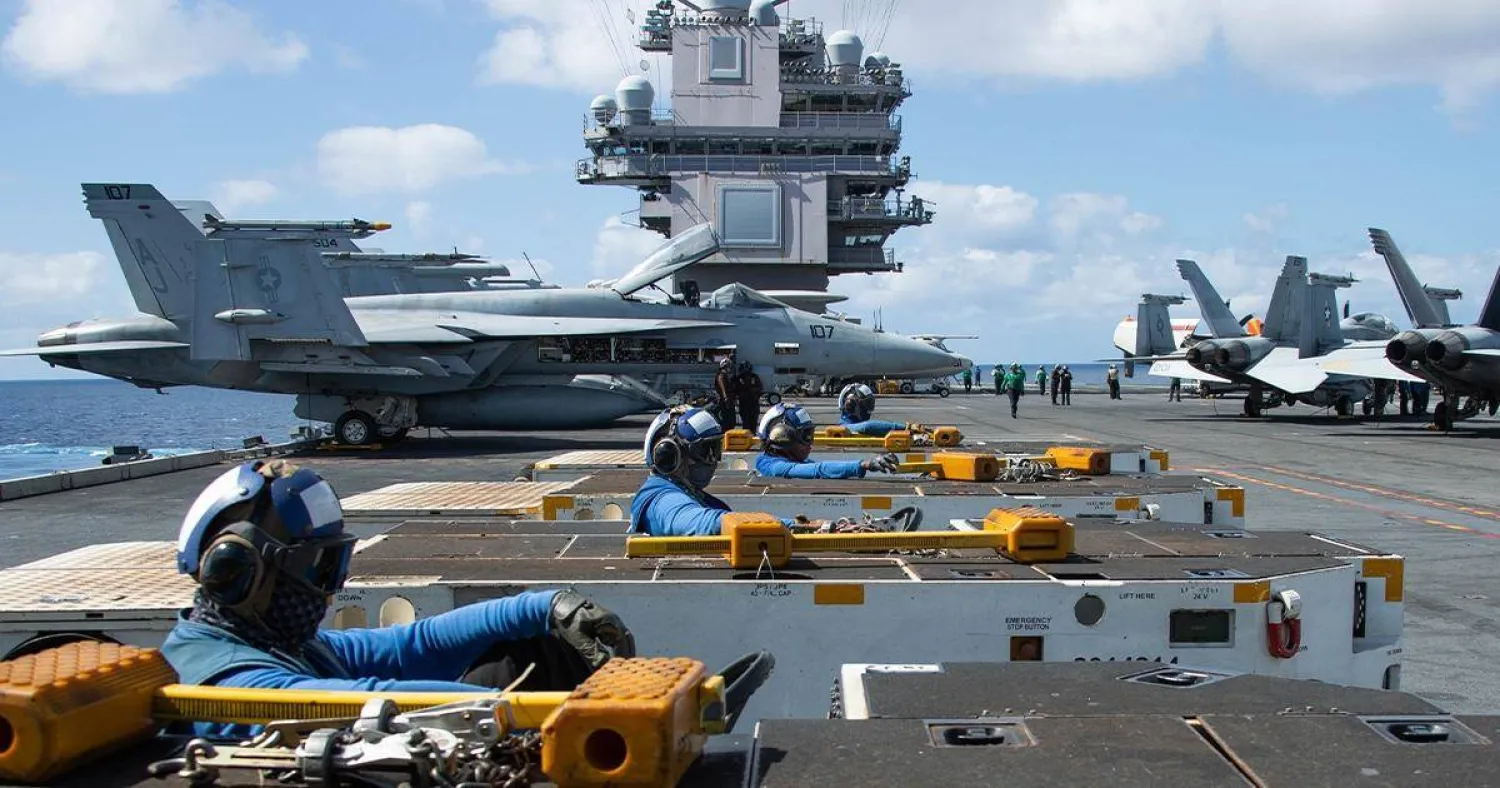
A shot showing personnel preparations aboard the US aircraft carrier "Gerald Ford" (US Navy)
TT

US Military Tells Trump It's ‘Ready’ to Strike Iran as Soon as Saturday

A shot showing personnel preparations aboard the US aircraft carrier "Gerald Ford" (US Navy)

Top national security officials have told US President Donald Trump the military is ready for potential strikes on Iran as soon as Saturday, but the timeline for any action is likely to extend beyond this weekend, sources familiar with the discussions told CBS News.

Trump has not yet made a final decision about whether to strike, said the officials, who spoke under condition of anonymity to discuss sensitive national matters.

The conversations have been described as fluid and ongoing, as the White House weighs the risks of escalation and the political and military consequences of restraint, added CBS.

Over the next three days, the Pentagon is moving some personnel temporarily out of the Middle East region — primarily to Europe or back to the United States — ahead of potential action or counterattacks by Iran if the US were to move ahead with its operation, according to multiple officials.

It's standard practice for the Pentagon to shift assets and personnel ahead of a potential US military activity and doesn't necessarily signal an attack on Iran is imminent, one of the sources told CBS.

Contacted by CBS News on Wednesday afternoon, a Pentagon spokesperson said they had no information to provide.

Iran was discussed in the White House Situation Room on Wednesday, a US official and a senior military official told CBS News. All military forces deployed to the region are expected to be in place by mid-March.

Axios had also said that a war between the United States and Iran is looming — and there are several factors suggesting President Trump might push the button soon.

On Wednesday, Iran's top diplomat Abbas Araghchi said that Tehran was "drafting" a framework for future talks with the United States, as the US energy secretary said Washington would stop Iran's nuclear ambitions "one way or another".