
Ukraine’s Top Diplomat Tells Skeptics at UN His Country Will Win the War

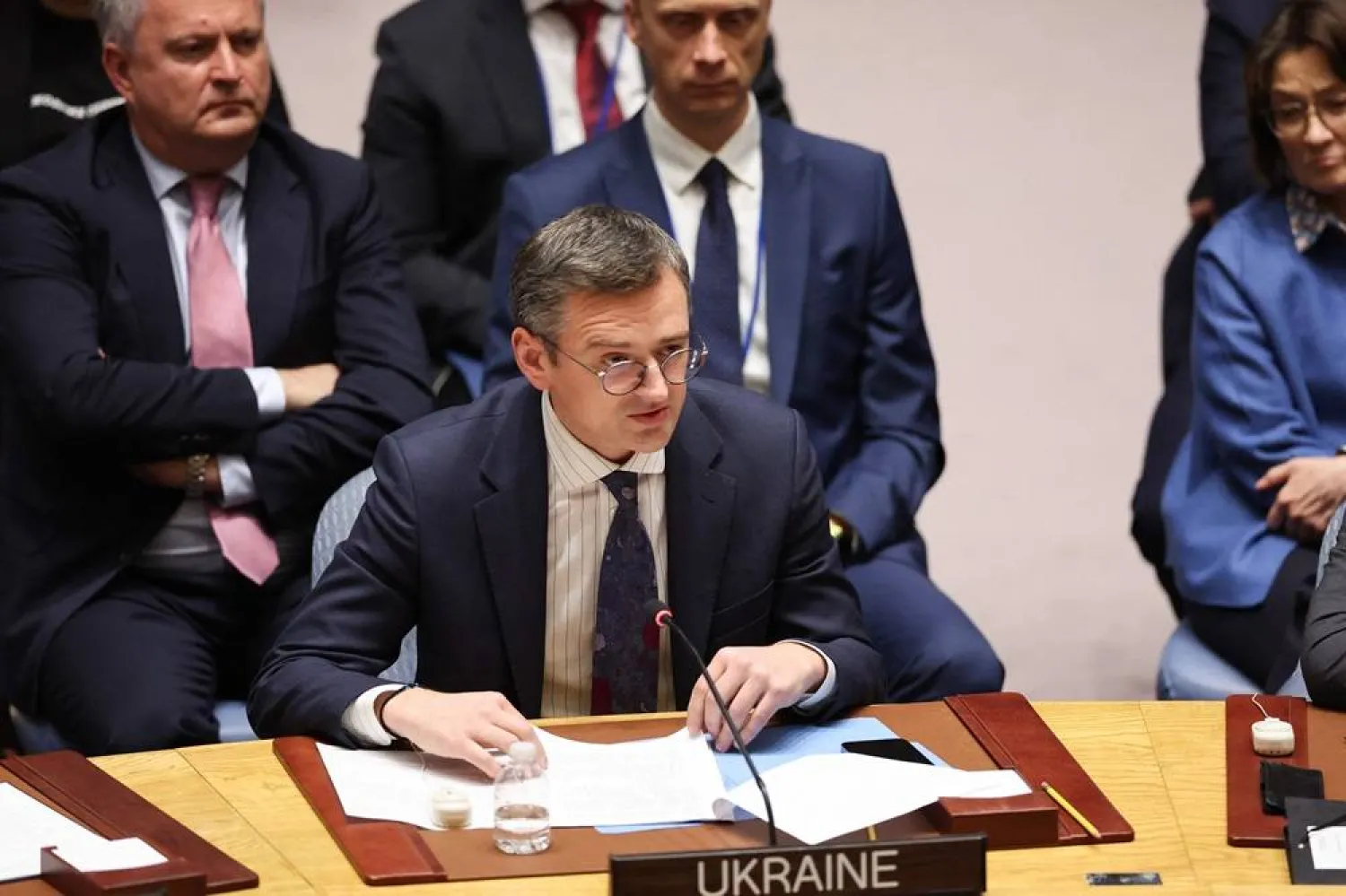
Ukrainian Foreign minister Dmytro Kuleba speaks during the UN General Assembly meeting on the "temporarily occupied territories of Ukraine" marking the second anniversary of the Russian invasion, at the UN Headquarters in New York City on February 23, 2024. (AFP)
TT

Ukraine’s Top Diplomat Tells Skeptics at UN His Country Will Win the War

Ukrainian Foreign minister Dmytro Kuleba speaks during the UN General Assembly meeting on the "temporarily occupied territories of Ukraine" marking the second anniversary of the Russian invasion, at the UN Headquarters in New York City on February 23, 2024. (AFP)

Ukraine’s foreign minister on Friday told skeptics who believe Ukraine can’t win the war with Russia that they will be proven wrong: “Ukraine will win the war.”

Dmytro Kuleba, speaking at the United Nations on the eve of the second anniversary of Russia's invasion, urged the world's nations to stand behind Ukraine. If they do, he said, victory will come “sooner rather than later.”

Russia’s UN Ambassador, Vassily Nebenzia, countered by repeating Moscow's claim that it didn't start the conflict. He blamed the West for fomenting it, accused Ukraine of being a tool of Western geopolitical ambitions, and vowed that Russia's “special military operation” won’t end until its goals are achieved.

Those goals — stated on Feb. 24, 2022, the day Russian troops crossed the border — include the de-militarization of Ukraine and ensuring its “neutral status.”

The UN General Assembly and the Security Council are marking the anniversary with ministerial meetings as President Volodymyr Zelenskyy pleads for more US military aid and Russian forces make new gains in eastern Ukraine.

The General Assembly has become the most important UN body dealing with Ukraine because the Security Council, which is charged with maintaining international peace and security, is paralyzed by Russia’s veto power. Assembly resolutions are not legally binding, unlike Security Council resolutions, but they serve as a barometer of world opinion.

Addressing the 193-member assembly, Kuleba recalled that over 140 nations supported resolutions backing Ukraine and calling for Russian forces to withdraw. But, he said, “Moscow’s aim is to destroy Ukraine and they’re quite outspoken about it.”

He said countries now saying Ukraine should negotiate with Russia and end the war are either “ill-informed” or didn't follow events after 2014, when Russia seized Crimea and backed an armed rebellion in eastern Ukraine. The two countries, he said, held approximately 200 rounds of negotiations and made 20 cease-fire agreements.

“All of these peace efforts ended two years ago, when Russia tore apart the Minsk process and launched its full-scale invasion,” Kuleba said. “Why would anyone suggest today that following the same logic will bring us to a different result?”

Zelenskyy’s 10-point peace plan is “the only serious peace proposal on the table,” Kuleba said, calling on other countries to add their diplomatic weight to it. The plan calls for expelling Russian forces, establishing a special tribunal to prosecute alleged Russian war crimes and building a European-Atlantic security architecture with guarantees for Ukraine.

When Russia invaded, diplomats and experts didn’t believe Ukraine would survive. Speaking to reporters, Kuleba said he wanted to make one point clear.

“Today, the same people do not believe that Ukraine can win this war,” he said. “They turned wrong once, and they will turn wrong again. Ukraine survived the invasion. Ukraine will win the war. And if we act collectively and jointly this will happen ... sooner rather than later.”

Nebenzia slammed Zelenskyy's plan.

“It is nothing other than an ultimatum to Russia and an attempt to lure as many countries as possible into endless meetings on this utopian project at any price possible,” he said.

At the General Assembly, where representatives of 64 countries are scheduled to speak, there was strong support for Ukraine.

Britain’s Foreign Secretary David Cameron said he recognized that there is a sense of fatigue with the war and a compromise might seem attractive, but he said Russian President Vladimir Putin isn't seeking compromise.

“Rather, this is a neo-imperialist bully who believes might is right,” he said. “If Putin were to eke out some kind of win, the rest of the world would suffer, too. What starts in Ukraine would not end there.”

Poland’s Foreign Minister Radoslaw Sikorski told the assembly: “Only our resolve can deter the neo-imperial delusions that may arise in any part of the world.”

“We need to stay the course until Mr. Putin understands that the days of European imperialism are gone for good,” he said.

Swiss Foreign Minister Ignazio Cassis said at Ukraine’s request his government will organize a high-level peace conference by the summer. He invited all nations to attend and work “to find common ground for peace” based on the UN Charter, and the sovereignty and territorial integrity of Ukraine.

Neither the assembly nor the council took any action to mark the anniversary. But before the council meeting, Kuleba read a statement from more than 50 countries, while surrounded by their ministers and ambassadors, condemning Russia’s aggression, its “flagrant violation of international law,” and its attacks on civilians and the infrastructure they need to survive, “which may constitute war crimes.”

UN Secretary-General Antonio Guterres briefed the council, saying Russia's full-scale invasion of Ukraine violated the UN Charter and international law and, two years later, “the war in Ukraine remains an open wound at the heart of Europe.”

He called the invasion “a dangerous precedent,” stressing that newly independent countries in Africa didn't change borders established by colonial powers “with the stroke of a pen” because they knew it would open “a Pandora's box.”

The UN chief said the path to peace is respect for the UN Charter's underlying principles of sovereignty and territorial integrity, warning that the war is deepening geopolitical divides.

“The danger of the conflict escalating and expanding is very real,” he said.

China’s UN Ambassador Zhang Jun, whose country is a Russian ally, said Beijing respects the sovereignty and territorial integrity of Ukraine and all other countries, and urged stepped-up peace efforts. He also stressed that “the legitimate security concerns of all countries” must be respected, and criticized NATO’s eastward expansion — which Moscow has strongly opposed.

Germany's Foreign Minister Annalena Baerbock told the Security Council: “Putin is making clear every day, every hour ... that he does not want to negotiate peace. He wants to complete his conquest.”

And US Ambassador Linda Thomas-Greenfield said that through all of Russia's “lies, Putin has tried to rewrite history, to justify the unjustifiable, to break the will of the Ukrainian people, and to break the will of the international community.”

“We cannot let that happen,” she said.


US Military Tells Trump It's ‘Ready’ to Strike Iran as Soon as Saturday

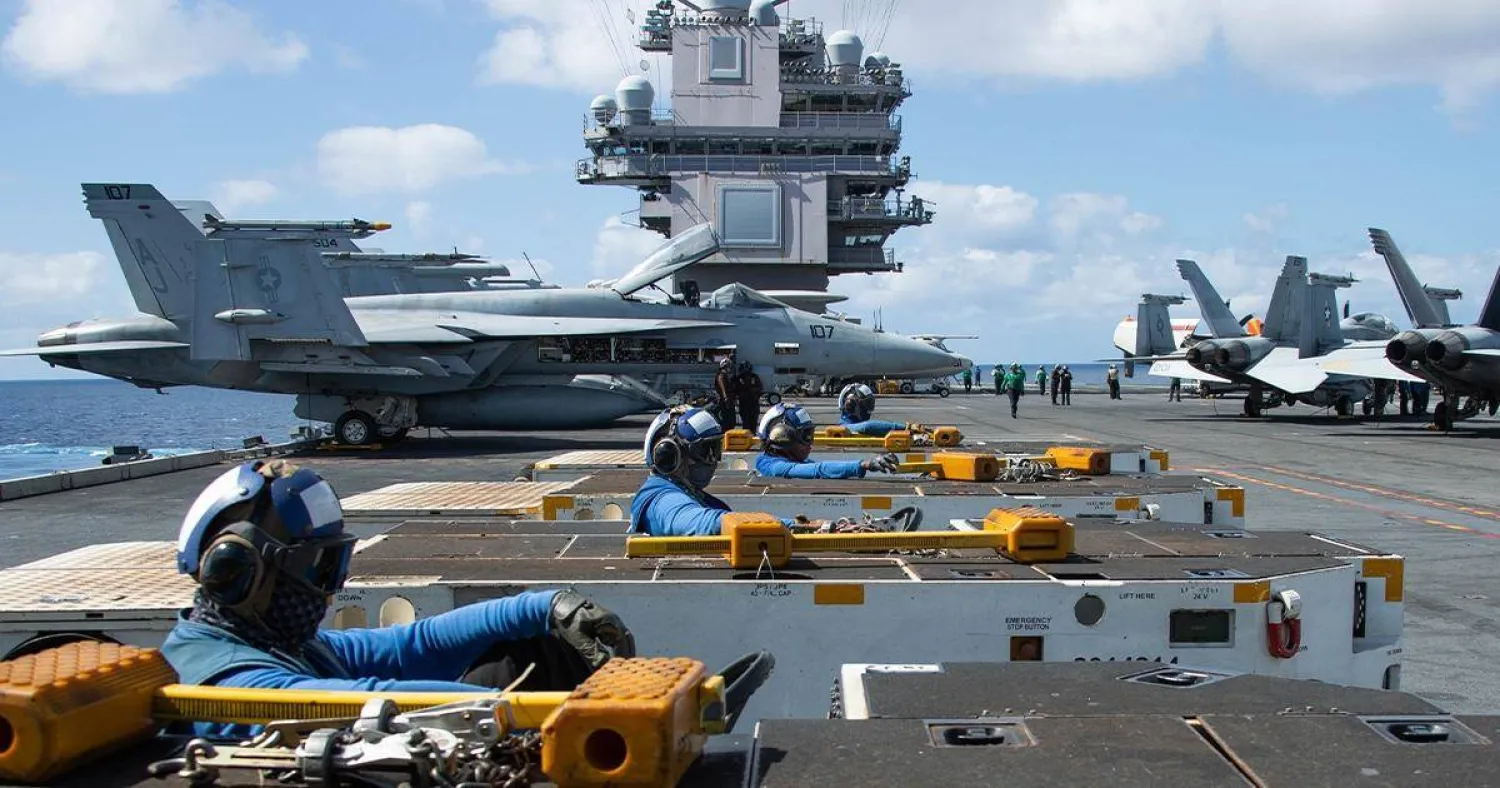
A shot showing personnel preparations aboard the US aircraft carrier "Gerald Ford" (US Navy)
TT

US Military Tells Trump It's ‘Ready’ to Strike Iran as Soon as Saturday

A shot showing personnel preparations aboard the US aircraft carrier "Gerald Ford" (US Navy)

Top national security officials have told US President Donald Trump the military is ready for potential strikes on Iran as soon as Saturday, but the timeline for any action is likely to extend beyond this weekend, sources familiar with the discussions told CBS News.

Trump has not yet made a final decision about whether to strike, said the officials, who spoke under condition of anonymity to discuss sensitive national matters.

The conversations have been described as fluid and ongoing, as the White House weighs the risks of escalation and the political and military consequences of restraint, added CBS.

Over the next three days, the Pentagon is moving some personnel temporarily out of the Middle East region — primarily to Europe or back to the United States — ahead of potential action or counterattacks by Iran if the US were to move ahead with its operation, according to multiple officials.

It's standard practice for the Pentagon to shift assets and personnel ahead of a potential US military activity and doesn't necessarily signal an attack on Iran is imminent, one of the sources told CBS.

Contacted by CBS News on Wednesday afternoon, a Pentagon spokesperson said they had no information to provide.

Iran was discussed in the White House Situation Room on Wednesday, a US official and a senior military official told CBS News. All military forces deployed to the region are expected to be in place by mid-March.

Axios had also said that a war between the United States and Iran is looming — and there are several factors suggesting President Trump might push the button soon.

On Wednesday, Iran's top diplomat Abbas Araghchi said that Tehran was "drafting" a framework for future talks with the United States, as the US energy secretary said Washington would stop Iran's nuclear ambitions "one way or another".


Satellite Images Show Iran Repairing and Fortifying Sites amid US Tensions

A satellite image shows tunnel entrances covered with soil at Isfahan nuclear complex, in Isfahan, Iran, February 10, 2026. Vantor/Handout via REUTERS
TT

Satellite Images Show Iran Repairing and Fortifying Sites amid US Tensions

A satellite image shows tunnel entrances covered with soil at Isfahan nuclear complex, in Isfahan, Iran, February 10, 2026. Vantor/Handout via REUTERS

Satellite images show that Iran has recently built a concrete shield over a new facility at a sensitive military site and covered it in soil, experts say, advancing work at a location reportedly bombed by Israel in 2024 amid tensions with the US.

Images also show that Iran has buried tunnel entrances at a nuclear site bombed by the US during Israel's 12-day war with Iran last year, fortified tunnel entrances near another, and has repaired missile bases struck in the conflict.

They offer a glimpse of Iranian activities at some of the sites at the center of tensions with Israel and the US, as Washington seeks to negotiate a deal with Tehran on its nuclear program while threatening military action if talks fail.

Some 30 km (20 miles) southeast of Tehran, the Parchin complex is one of Iran's most sensitive military sites. Western intelligence has suggested Tehran carried out tests relevant to nuclear bomb detonations there more than two decades ago.

Iran has always denied seeking atomic weapons. Israel reportedly struck Parchin in October 2024.

Satellite imagery taken before and after that attack shows extensive damage to a rectangular building at Parchin, and apparent reconstruction in images from November 6, 2024.

Imagery from October 12, 2025 shows development at the site, with the skeleton of a new structure visible and two smaller structures adjacent to it. Progress is apparent in imagery from November 14, with what appears to be a metallic roof covering the large structure.

But imagery from December 13 shows the facility partly covered. By February 16, it cannot be seen at all, hidden by what experts say is a concrete structure.

The Institute for Science and International Security (ISIS), in a January 22 analysis of satellite imagery, pointed to progress in the construction of a "concrete sarcophagus" around a newly built facility at the site, which it identified as Taleghan 2.

ISIS reported in November that imagery showed "ongoing construction and the presence of what appears to resemble a long, cylindrical chamber, maybe a high-explosives containment vessel, likely measuring approximately 36 meters long and 12 meters in diameter placed inside a building".

"High-explosive containment vessels are critical to the development of nuclear weapons," ISIS added, "but can also be used in many other conventional weapons development processes."

William Goodhind, a forensic imagery analyst with Contested Ground, said the roof had a similar hue to the surrounding area, adding: "It has most likely been covered with dirt to obscure the concrete color."

ISIS founder David Albright wrote on X: "Stalling the negotiations has its benefits: Over the last two to three weeks, Iran has been busy burying the new Taleghan 2 facility ... More soil is available and the facility may soon become a fully unrecognizable bunker, providing significant protection from aerial strikes."

TUNNEL ENTRANCES BURIED AT ISFAHAN NUCLEAR COMPLEX

The Isfahan complex is one of three Iranian uranium-enrichment plants bombed by the United States in June.

In addition to facilities that are part of the nuclear fuel cycle, Isfahan includes an underground area where diplomats say much of Iran's enriched uranium has been stored.

Satellite images taken in late January showed new efforts to bury two tunnel entrances at the complex, ISIS reported on January 29. In a February 9 update, ISIS said a third entrance had also been backfilled with soil, meaning all entrances to the tunnel complex were now "completely buried".

A February 10 image shows all three tunnels buried, Goodhind said.

ISIS reported on February 9 that "backfilling the tunnel entrances would help dampen any potential airstrike and also make ground access in a special forces raid to seize or destroy any highly enriched uranium that may be housed inside difficult".

TUNNEL ENTRANCES FORTIFIED AT COMPLEX NEAR NATANZ SITE

ISIS has reported that satellite images point to ongoing efforts since February 10 to "harden and defensively strengthen" two entrances to a tunnel complex under a mountain some 2 km (1.2 miles) from Natanz - the site that holds Iran's other two uranium enrichment plants.

Imagery shows "ongoing activity throughout the complex related to this effort, involving the movement of numerous vehicles, including dump trucks, cement mixers, and other heavy equipment", ISIS wrote.

Iran's plans for the facility, called Pickaxe Mountain, are unclear, ISIS said.

SHIRAZ SOUTH MISSILE BASE

About 10 km (6 miles) south of Shiraz in southern Iran, this is one of 25 primary bases capable of launching medium-range ballistic missiles, according to Alma Research and Education Center, an Israeli organization. Alma assessed the site had suffered light, above-ground damage in last year's war.

A comparison of images taken on July 3, 2025 and January 30 shows reconstruction and clearance efforts at the main logistics and likely command compound at the base, Goodhind said.

"The key takeaway is that the compound has yet to return to its full operational capacity from prior to the airstrikes."

QOM MISSILE BASE

Some 40 km north of the city of Qom, this base suffered moderate above-ground damage, according to Alma.

A comparison of images taken between July 16, 2025, and February 1 shows a new roof over a damaged building. The roof repairs appear to have begun on November 17 and were most likely complete 10 days later, Goodhind said.


Iranian Mourning Ceremonies Prompt New Crackdowns in Echo of 1979 Revolution

Iranians walk on a street in Tehran, Iran, 16 February 2026. (EPA)
TT

Iranian Mourning Ceremonies Prompt New Crackdowns in Echo of 1979 Revolution

Iranians walk on a street in Tehran, Iran, 16 February 2026. (EPA)

Iranians have returned to the streets this week to mourn those killed by security forces during last month's anti-government demonstrations, sparking some new crackdowns in an echo of the 1979 revolution that brought down the US-backed Shah.

The anti-Shah revolutionaries turned Shiite Muslim memorial processions 40 days after each death into new protests, which prompted renewed violence from the authorities and fresh "martyrs" for the cause.

The clerical establishment's opponents, deploying the same tactics after five decades, have yet to match the momentum of those times, but Iran's clerical rulers, threatened with military attack by US President Donald Trump over their nuclear and security policies, have demonstrated their concern.

They deployed security forces to some cemeteries and invited citizens to attend state-organized 40-day "Chehelom" ceremonies on Tuesday after apologizing to "all those affected" by violence they blamed on people described as "terrorists".

"They tried to prevent history repeating itself by holding these ceremonies in mosques across ‌the country. To ‌prevent any gatherings of angry families in cemeteries, but they failed," said one rights activist ‌in ⁠Iran who declined ⁠to be named for fear of retribution.

SECURITY FORCES CLASH WITH MOURNERS

Videos circulating on social media showed families holding their own memorials across Iran on Tuesday, 40 days after security forces began two days of widespread shooting that human rights groups say killed thousands of protesters.

Some of Tuesday's memorials turned into wider anti-government protests and some were met with deadly force.

In the Kurdish town of Abdanan in Ilam province, witnesses and activists said security forces opened fire on hundreds of mourners gathered at a cemetery.

Videos showed people scattering as gunfire rang out amid chants of "Death to the dictator", a reference to Iran's Supreme Leader Ali Khamenei.

Reuters journalists verified that ⁠the videos were filmed at the cemetery. They were unable to verify the date but ‌found no versions posted before Tuesday: eyewitnesses and activists said that was when ‌people gathered at the cemetery were fired upon.

Hengaw, a Kurdish Iranian rights group, said at least three people were injured and nine ‌arrested in Abdanan. Similar clashes were reported in Mashhad and Hamedan. Sources in Iran said internet access was heavily restricted ‌in those cities.

WEDNESDAY IS 40 DAYS SINCE HEIGHT OF JANUARY PROTESTS

More mourning ceremonies were expected to be taking place on Wednesday, 40 days since the deadliest two days of the January unrest, although communications restrictions meant that it was not immediately possible to tell how many or their outcome.

January's unrest grew from modest economic protests in December among traders in Tehran's Grand Bazaar into the gravest threat to ‌Iran's theocracy in nearly five decades, with protesters calling for ruling clerics to step down.

Authorities cut internet access, blaming "armed terrorists" linked to Israel and the United States ⁠for the violence, and have arrested ⁠journalists, lawyers, activists, human rights advocates and students, rights groups say.

Iranian officials have told Reuters the leadership is worried a US strike could erode its grip on power by fueling more protests. Repression, inequality, corruption and the sponsorship of proxies abroad are the main grievances.

"How long can they kill people to stay in power? People are angry, people are frustrated," said government employee Sara, 28, from the central city of Isfahan.

"The Islamic Republic has brought nothing but war, economic misery and death to my country".

Trump has deployed aircraft carriers, fighter jets, guided-missile destroyers and other capabilities to the Middle East for a possible attack if talks to limit Iran's nuclear program and weaken its foreign proxies do not yield results.

Even without a US attack, continued isolation from Western sanctions would likely fuel further public anger.

In 1979, the anti-Shah revolt in provincial towns and villages was amplified by oil workers whose strikes cut most of Iran's revenue, and bazaar merchants who funded the rebel clerics.

This time there have been no reports of either, but people have adopted some of the small-scale tactics, chanting “Allah is great” and “Death to the dictator”, often from rooftops, during nightly demonstrations, according to witnesses and social media posts.