

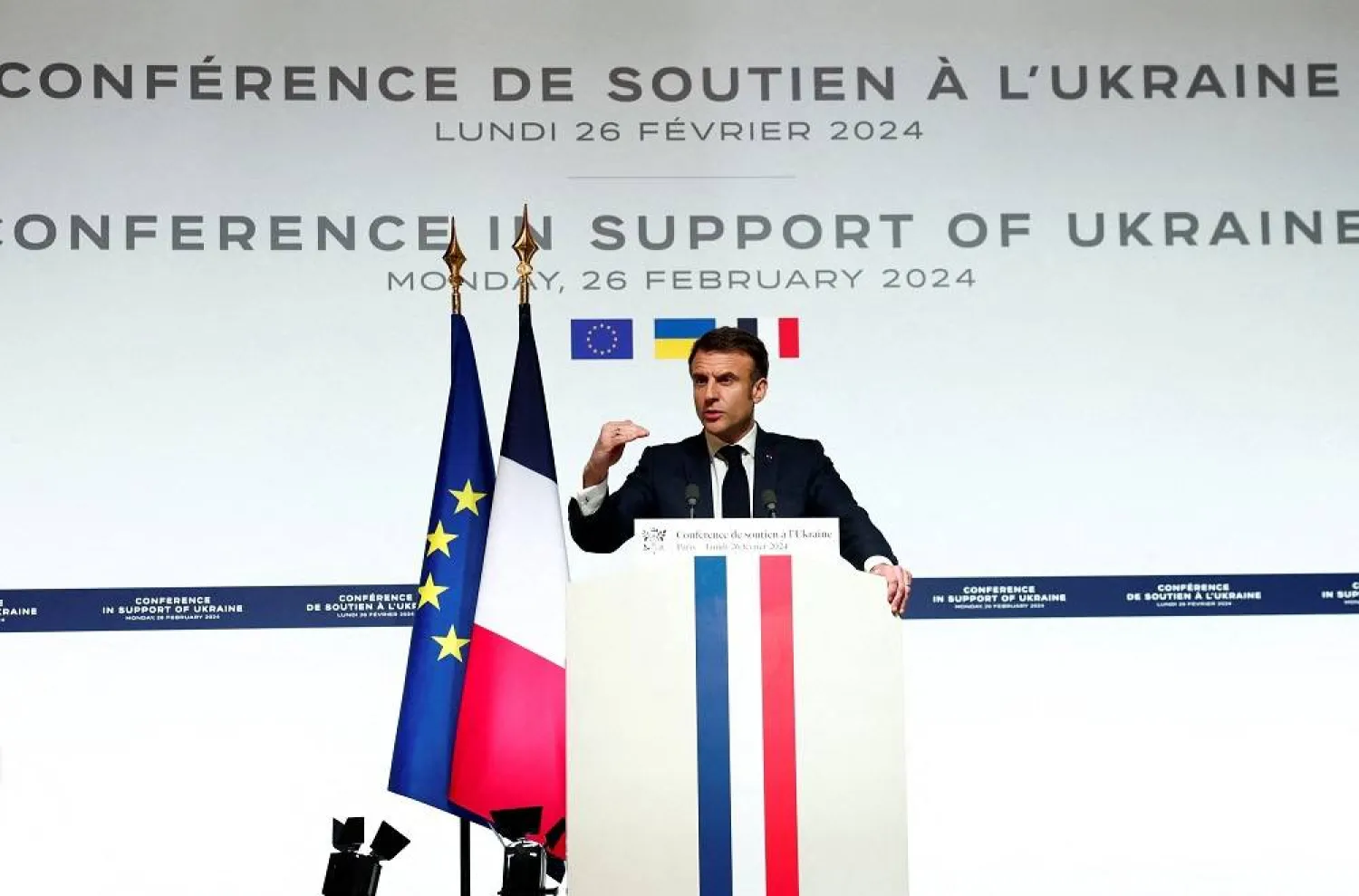

France’s Macron Doesn’t Rule out Sending Western Troops to Ukraine in Future 

French President Emmanuel Macron speaks during a press conference at the end of the international conference aimed at strengthening Western support for Ukraine, at the Elysee presidential palace in Paris, on February 26, 2024. (AFP)
TT

France’s Macron Doesn’t Rule out Sending Western Troops to Ukraine in Future 

French President Emmanuel Macron speaks during a press conference at the end of the international conference aimed at strengthening Western support for Ukraine, at the Elysee presidential palace in Paris, on February 26, 2024. (AFP)

French President Emmanuel Macron said Monday that sending Western troops on the ground in Ukraine is not "ruled out" in the future after the issue was debated at a gathering of European leaders in Paris, as Russia’s full-scale invasion grinds into a third year.

The French leader said that "we will do everything needed so Russia cannot win the war" after the meeting of over 20 European heads of state and government and other Western officials.

"There’s no consensus today to send in an official, endorsed manner troops on the ground. But in terms of dynamics, nothing can be ruled out," Macron said in a news conference at the Elysee presidential palace.

Macron declined to provide details about which nations were considering sending troops, saying he prefers to maintain some "strategic ambiguity."

The meeting included German Chancellor Olaf Scholz and Poland's President Andrzej Duda as well as leaders from the Baltic nations. The United States was represented by its top diplomat for Europe, James O’Brien, and the UK by Foreign Secretary David Cameron.

Duda said the most heated discussion was about whether to send troops to Ukraine and "there was no agreement on the matter. Opinions differ here, but there are no such decisions."

Poland's president said he hopes that "in the nearest future, we will jointly be able to prepare substantial shipments of ammunition to Ukraine. This is most important now. This is something that Ukraine really needs."

Macron earlier called on European leaders to ensure the continent's "collective security" by providing unwavering support to Ukraine in the face of tougher Russian offensives on the battlefield in recent months.

"In recent months particularly, we have seen Russia getting tougher," Macron said.

Macron cited the need to solidify security to head off any Russian attacks on additional countries in the future. Estonia, Lithuania and Latvia as well as much larger Poland have been considered among possible targets of future Russian expansionism. All four countries are staunch supporters of Ukraine.

Estonia’s foreign minister said earlier this month that NATO has about three or four years to strengthen its defenses.

In video speech, Ukraine President Volodymyr Zelenskyy called on the leaders gathered in Paris to "ensure that Putin cannot destroy our achievements and cannot expand his aggression to other nations."

Several European countries, including France, expressed their support for an initiative launched by the Czech Republic to buy ammunition and shells outside the EU, participants to the meeting said.

Dutch Prime Minister Mark Rutte said his country decided to provide over 100 million euros for that purpose.

In addition, a new coalition is to be launched to further "mobilize" nations with capabilities to deliver medium and long-range missiles, Macron said, as France announced last month the delivery of 40 additional long-range Scalp cruise missiles.

European nations are worried that the US will dial back support as aid for Kyiv is teetering in Congress. They also have concerns that former US President Donald Trump might return to the White House and change the course of US policy on the continent.

The Paris conference comes after France, Germany and the UK recently signed 10-year bilateral agreements with Ukraine to send a strong signal of long-term backing as Kyiv works to shore up Western support.



IAEA Head: 'Very Strong' Nuclear Verification Needed in Iran after War

26 June 2026, Japan, Tokio: International Atomic Energy Agency (IAEA) Director General Rafael Mariano Grossi addresses the media during a press conference at the Japan National Press Club. Photo: Rodrigo Reyes Marin/ZUMA Press Wire/dpa
TT

IAEA Head: 'Very Strong' Nuclear Verification Needed in Iran after War

26 June 2026, Japan, Tokio: International Atomic Energy Agency (IAEA) Director General Rafael Mariano Grossi addresses the media during a press conference at the Japan National Press Club. Photo: Rodrigo Reyes Marin/ZUMA Press Wire/dpa

"Very strong" verification is needed in Iran following the Middle East conflict to ensure that it does not develop nuclear weapons, the UN atomic watchdog chief said on Friday.

International Atomic Energy Agency (IAEA) head Rafael Grossi's remarks come as the United States and Iran negotiate a broader agreement to end the war, with Tehran's nuclear program a key sticking point.

"I think the objective of this (recent US-Iran preliminary) agreement is to ensure that there is no development of nuclear weapons in Iran. The government of Iran has declared quite clearly that this is not their intention," Grossi told reporters in Japan.

"But of course intentions are not enough. We have to have a very strong verification system in place... as soon as is practicable," AFP quoted the IAEA chief as saying.

Grossi said the watchdog had also "barely initiated" talks with Iran following its preliminary agreement with the United States about what to do with Tehran's uranium stockpile.

"Initial conversations have taken place... We expect this work to pick up soon," Grossi said.

Before the conflict, the IAEA estimated that Iran had 440 kilograms (970 pounds) of uranium enriched to 60 percent.

That is close to the 90 percent needed to make a bomb and well above the 3.67-percent limit set by a now-defunct 2015 agreement with Iran.

Iran suspended cooperation with the IAEA after Israel and the United States launched a previous wave of attacks in June 2025, and its inspectors have not seen the material since.

Under the terms of the preliminary agreement between Tehran and Washington, this stockpile is meant to be "downblended" under IAEA supervision.

Grossi said the "widespread impression" was that the stockpile remains where it was before June 2025 near Iran's Isfahan facility.

However, that facility was bombed and Iran said that it does not plan to allow the IAEA to inspect sites that were attacked.

Grossi also said on Friday that an alternative to diluting could be shipping the enriched uranium out of Iran.

"The memorandum of understanding, as you may have noted, includes the possibility of downblending as one alternative," Grossi said.

"It could also be shipped out directly. It would perhaps be more complicated, but there are a few technical alternatives to deal with the material," he said.

Iran has consistently denied seeking to acquire an atomic bomb, while remaining adamant about its right to operate a full-scale civilian nuclear program.

Before the 12-day war in 2025, Iran as a signatory to the nuclear non-proliferation treaty -- unlike Israel, which is widely assumed to have atomic weapons -- allowed the IAEA to inspect its nuclear sites under its safeguards deal with the Vienna-based body.

Iran agreed a landmark nuclear deal with six big powers in 2015 limiting its nuclear program in exchange for sanctions relief, but US President Donald Trump walked away from the agreement during his first term.


Report: Rate of People Dying in ICE Custody Highest in Over Decade

Federal agents detain an individual after exiting immigration court at the Jacob K Javits Federal Building in New York City on July 23, 2025 (AFP)
TT

Report: Rate of People Dying in ICE Custody Highest in Over Decade

Federal agents detain an individual after exiting immigration court at the Jacob K Javits Federal Building in New York City on July 23, 2025 (AFP)

The rate of people dying in Immigration and Customs Enforcement (ICE) custody has reached its highest level in over a decade, two rights groups said on Thursday.

According to a joint report by Human Rights Watch and Physicians for Human Rights, at least 52 deaths have been reported in ICE holding facilities since US President Donald Trump's second term began in January 2025.

Trump has made combating illegal immigration a top priority of his second term.

“We have seen the death rate in ICE custody skyrocket,” Reagan Williams, a HRW researcher who co-authored the report, told AFP.

“Instead of taking action to address this crisis and protect the lives and health of those in custody, we’ve seen the administration pour its resources into subjecting more and more people to prolonged detention,” she said.

From January 2025 to January 2026, the annual mortality rate in ICE custody was up 140% compared with a year earlier – an increase disproportionate to the higher detainee population, the report said.

A spokesperson for the US Department of Homeland Security, which oversees ICE, denied the reported spike in deaths.

“Consistent with data over the last decade, death rates in custody under the Trump administration are 0.009% of the detained population,” he said.

But June 25’s report found that, as immigration detention centers have grown, medical care has been lagging, partly due to crowding and people spending longer in custody.

“As bed space has rapidly expanded, we have maintained a higher standard of care than most prisons that hold US citizens – including providing access to proper medical care,” the spokesperson said. "For many illegal aliens, this is the best healthcare they have received their entire lives,” he added.


Japan Cancels 120 Flights as Twin Storms Approach

This picture taken and released by Taiwan's Central News Agency (CNA) on June 26, 2026, shows firefighters using an inflatable rescue boat to evacuate residents through floodwaters after heavy overnight rain caused severe flooding from approaching typhoon Mekkhala in Tainan, Taiwan. (Photo by YANG SIH-RUEI / CNA / AFP)
TT

Japan Cancels 120 Flights as Twin Storms Approach

This picture taken and released by Taiwan's Central News Agency (CNA) on June 26, 2026, shows firefighters using an inflatable rescue boat to evacuate residents through floodwaters after heavy overnight rain caused severe flooding from approaching typhoon Mekkhala in Tainan, Taiwan. (Photo by YANG SIH-RUEI / CNA / AFP)

Japanese airlines cancelled more than 100 flights on Friday as two tropical storms barreled towards the archipelago, with authorities advising evacuations in some areas because of possible flooding and landslides.

Severe tropical storm Mekkhala was downgraded from a typhoon but still carried gusts of up to 144 kilometers (89 miles) per hour, according to forecasters, with heavy rain already pounding parts of southern and western Japan.

The weather system was expected to skirt the islands of Kyushu and Shikoku over the weekend and potentially converge with tropical storm Higos, which was also swirling further out in the Pacific.

That could result in the atmospheric phenomenon known as the Fujiwhara effect when two storms interact, making forecasting their movements and strengths more difficult.

Japan Airlines and All Nippon Airways cancelled a total of 120 flights to and from the southern regions of Okinawa and Kagoshima, AFP reported.

The Kyoto region advised several thousand residents to evacuate, warning of potential landslides, as footage from public broadcaster NHK showed a raging brown river running through the area.

Officials in Kyoto and Osaka said water levels in rivers were rising and warned that vigilance was required because of the threat of flooding.

Automaker Toyota suspended operations at a plant in Kyushu because of road closures caused by heavy rain, while Nissan also said it planned to halt some production lines, Kyodo News reported.

The Japanese military also cancelled the planned maiden flight of a V-22 Osprey transport aircraft to Miyako Island that was part of joint exercises with the United States, Kyodo said.

A motorist maneuvers during a downpour of rain in Taipei, Taiwan, 25 June 2026. EPA/RITCHIE B. TONGO

In Taiwan, more than 1,600 people were evacuated from their homes, and schools and offices were shut in several areas, as Mekkhala triggered torrential rain, floods and landslides across the island.

No casualties were recorded, but authorities warned on Friday of potentially dangerous debris flows in mountainous areas of Hualien county in the east as well as in Kaohsiung and Pingtung in the south, where the weather forecasting agency said as much as 88cm (34.6 inches) of rain had fallen since Thursday.

Scores of people living downstream from a recently detected barrier lake in a rugged area of Hualien have left their homes, a local official said. Some train lines were suspended.