


Asylum Bids in EU Reach 7-year High with Syrians, Afghans Topping List

An Italian Coast Guard ship carrying illegal immigrants rescued at sea passes near a tourist boat on the Sicilian island of Lampedusa, Italy, on September 18, 2023 (Reuters)
TT

Asylum Bids in EU Reach 7-year High with Syrians, Afghans Topping List

An Italian Coast Guard ship carrying illegal immigrants rescued at sea passes near a tourist boat on the Sicilian island of Lampedusa, Italy, on September 18, 2023 (Reuters)

Asylum applications in the EU surged to over one million last year, a seven-year high, with Syrians then Afghans remaining the top groups seeking protection, the bloc's asylum agency said Wednesday.

The data from the European Union Agency for Asylum (EUAA) means the number of asylum-seekers in 2023 neared a level last seen in 2015-2016, when hundreds of thousands of people -- many of them Syrians fleeing civil war -- sought refuge.

Immigration, including of asylum seekers, is a headline issue for Europe as it heads for elections in June.

Far-right nationalist parties arguing for tougher entry criteria are predicted to increase their representation in the European Parliament, AFP reported.

Germany, the EU country receiving the biggest number of asylum applications in 2023 -- around 29 percent of the total -- has been roiled by the issue.

Members of that country's far-right AfD party -- soaring in the polls -- last year met extremists to discuss expelling immigrants and "non-assimilated citizens" according to a report by investigative outlet Correctiv. That sparked big counter demonstrations in Berlin and elsewhere against racism.

According to the EUAA, a total 1.14 million asylum applications were registered last year across the 27-nation European Union plus its Schengen-associated nations Norway and Switzerland.

That was an 18 percent increase over 2022 and confirmed an upward trend evident since 2020, as the EU emerged from the coronavirus pandemic during which travel was curbed.

Germany's 334,000 asylum applications received was double that of France's 167,000, and also far above Italy's 136,000.

Across the EU, Syrians submitted 181,000 applications.

Afghans lodged 114,000 which, though they were the second-biggest group, was 11 percent lower than for 2022.

There were 101,000 applications from Turkish nationals -- an 82 percent rise over the previous year -- with most lodged in Germany.

Spain saw a third more applications from Venezuelans and Colombians, at more than 60,000 for each group. They are often able to enter Spain regularly, without needing visas.

Around half that number was recorded for Moroccans, applying mostly in Austria, and for Egyptians, most of them in Italy.

Smaller numbers of Guineans and Ivorians sought asylum, mostly in France.

While Germany received nearly one in three of lodged asylum bids, it was Cyprus, followed by Austria and Greece that had the highest proportion in relation to their much smaller populations.

The EUAA noted that Hungary -- whose nationalist government is opposed to an EU drive to share responsibilities for arriving asylum-seekers -- received a mere 30 asylum applications in 2023.

That was likely because Hungary requires asylum-seekers to make a "declaration of intent at a Hungarian embassy in a non-EU country before they can enter the country" to apply, it said.

Not all applications made across the EU are approved.

The EUAA said the overall recognition rate last year was 43 percent, which was the highest since 2016 -- but results are highly correlated to nationality.

Syrians and Afghans were often granted protection -- in 80 percent and 61 percent of cases, respectively -- though the status of that protection varied.

Syrians over the past few years have tended not be classed as refugees but rather given subsidiary protection, which allows them to stay but with more obstacles to acquiring citizenship or getting permanent residency.

For Afghans, refugee status was being generally approved, reflecting the persecution many face in their country since 2021 under Taliban rule.

For Turkish nationals, the recognition rate in the EU has "significantly" decreased since 2019, the EUAA said, with only a quarter of applications winning protection.



AI Cannot Be Left to 'Whims of a Few Billionaires', UN Chief Says

India's Prime Minister Narendra Modi speaks with United Nations Secretary-General Antonio Guterres during a welcoming ceremony at AI Impact Summit, in New Delhi, India, February 18, 2026. India's Press Information Bureau/Handout via REUTERS
TT

AI Cannot Be Left to 'Whims of a Few Billionaires', UN Chief Says

India's Prime Minister Narendra Modi speaks with United Nations Secretary-General Antonio Guterres during a welcoming ceremony at AI Impact Summit, in New Delhi, India, February 18, 2026. India's Press Information Bureau/Handout via REUTERS

UN chief Antonio Guterres warned technology leaders Thursday of the risks of artificial intelligence, saying its future cannot be left to "the whims of a few billionaires".

Speaking at a global AI summit in India, the UN chief called on tech tycoons to support a $3 billion global fund to ensure open access to the fast-advancing technology for all.

"AI must belong to everyone," he said.

"The future of AI cannot be decided by a handful of countries -- or left to the whims of a few billionaires," he added, warning the world risked deepening inequality unless urgent steps were taken.

"Done right, AI can... accelerate breakthroughs in medicine, expand learning opportunities, strengthen food security, bolster climate action and disaster preparedness and improve access to vital public services," he said.

"But it can also deepen inequality, amplify bias and fuel harm."

The UN has set up an AI scientific advisory body to help countries make decisions about the revolutionary technology.

Guterres warned that people must be protected from exploitation, and that "no child should be a test subject for unregulated AI".

He pressed for global guardrails to ensure oversight and accountability, and the creation of "Global Fund on AI" to build basic capacity.

"Our target is $3 billion," he told the conference, which includes national leaders as well as tech CEOs, including Sam Altman of OpenAI and Google's Sundar Pichai.

"That's less than one percent of the annual revenue of a single tech company. A small price for AI diffusion that benefits all, including the businesses building AI."

Without investment, "many countries will be logged out of the AI age", exacerbating global divides, he said.

He also cautioned that as AI's energy and water demands soar, data centers must switch to clean power, rather than "shift costs to vulnerable communities".


US Military Tells Trump It's ‘Ready’ to Strike Iran as Soon as Saturday

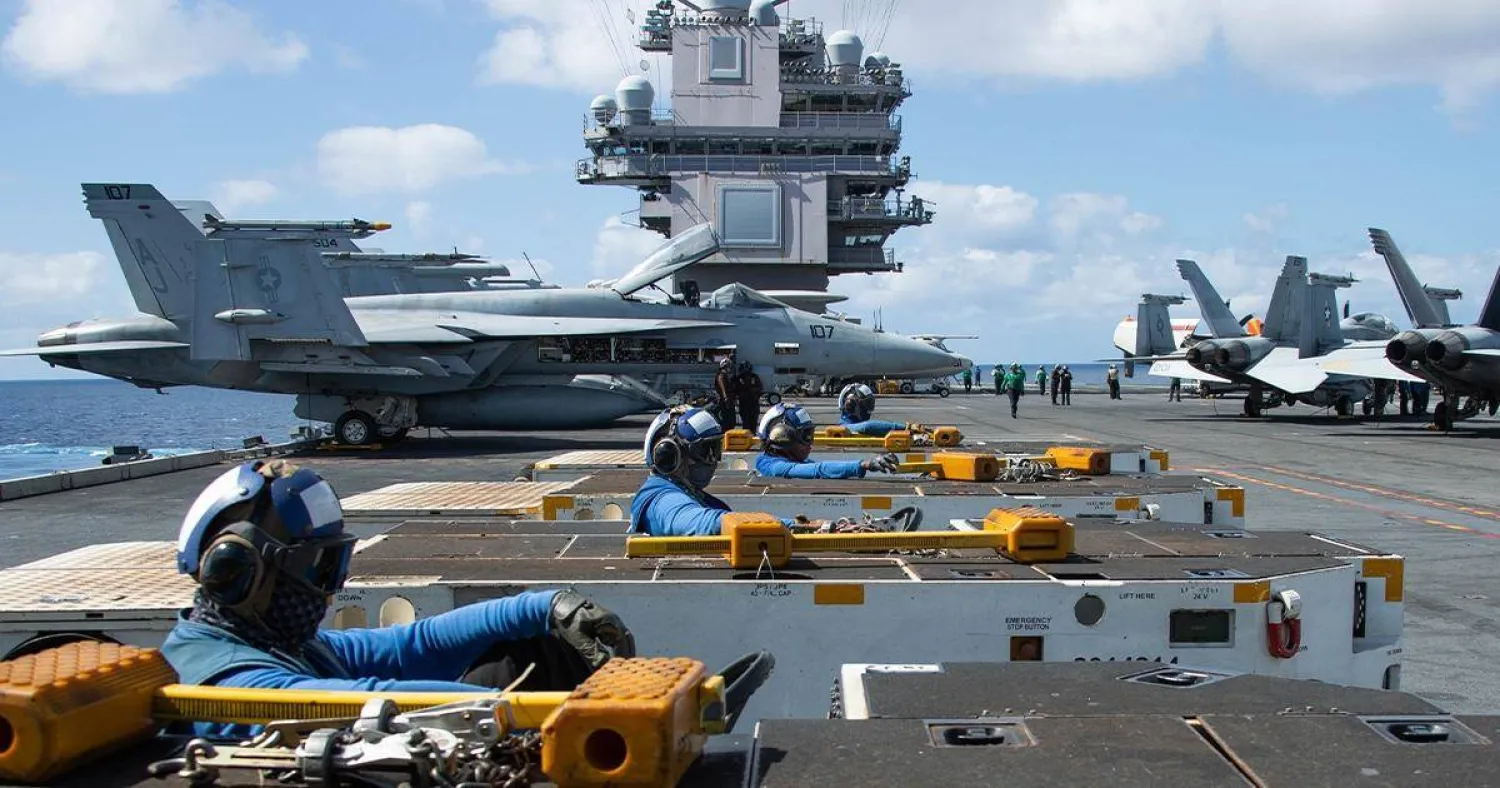
A shot showing personnel preparations aboard the US aircraft carrier "Gerald Ford" (US Navy)
TT

US Military Tells Trump It's ‘Ready’ to Strike Iran as Soon as Saturday

A shot showing personnel preparations aboard the US aircraft carrier "Gerald Ford" (US Navy)

Top national security officials have told US President Donald Trump the military is ready for potential strikes on Iran as soon as Saturday, but the timeline for any action is likely to extend beyond this weekend, sources familiar with the discussions told CBS News.

Trump has not yet made a final decision about whether to strike, said the officials, who spoke under condition of anonymity to discuss sensitive national matters.

The conversations have been described as fluid and ongoing, as the White House weighs the risks of escalation and the political and military consequences of restraint, added CBS.

Over the next three days, the Pentagon is moving some personnel temporarily out of the Middle East region — primarily to Europe or back to the United States — ahead of potential action or counterattacks by Iran if the US were to move ahead with its operation, according to multiple officials.

It's standard practice for the Pentagon to shift assets and personnel ahead of a potential US military activity and doesn't necessarily signal an attack on Iran is imminent, one of the sources told CBS.

Contacted by CBS News on Wednesday afternoon, a Pentagon spokesperson said they had no information to provide.

Iran was discussed in the White House Situation Room on Wednesday, a US official and a senior military official told CBS News. All military forces deployed to the region are expected to be in place by mid-March.

Axios had also said that a war between the United States and Iran is looming — and there are several factors suggesting President Trump might push the button soon.

On Wednesday, Iran's top diplomat Abbas Araghchi said that Tehran was "drafting" a framework for future talks with the United States, as the US energy secretary said Washington would stop Iran's nuclear ambitions "one way or another".


Satellite Images Show Iran Repairing and Fortifying Sites amid US Tensions

A satellite image shows tunnel entrances covered with soil at Isfahan nuclear complex, in Isfahan, Iran, February 10, 2026. Vantor/Handout via REUTERS
TT

Satellite Images Show Iran Repairing and Fortifying Sites amid US Tensions

A satellite image shows tunnel entrances covered with soil at Isfahan nuclear complex, in Isfahan, Iran, February 10, 2026. Vantor/Handout via REUTERS

Satellite images show that Iran has recently built a concrete shield over a new facility at a sensitive military site and covered it in soil, experts say, advancing work at a location reportedly bombed by Israel in 2024 amid tensions with the US.

Images also show that Iran has buried tunnel entrances at a nuclear site bombed by the US during Israel's 12-day war with Iran last year, fortified tunnel entrances near another, and has repaired missile bases struck in the conflict.

They offer a glimpse of Iranian activities at some of the sites at the center of tensions with Israel and the US, as Washington seeks to negotiate a deal with Tehran on its nuclear program while threatening military action if talks fail.

Some 30 km (20 miles) southeast of Tehran, the Parchin complex is one of Iran's most sensitive military sites. Western intelligence has suggested Tehran carried out tests relevant to nuclear bomb detonations there more than two decades ago.

Iran has always denied seeking atomic weapons. Israel reportedly struck Parchin in October 2024.

Satellite imagery taken before and after that attack shows extensive damage to a rectangular building at Parchin, and apparent reconstruction in images from November 6, 2024.

Imagery from October 12, 2025 shows development at the site, with the skeleton of a new structure visible and two smaller structures adjacent to it. Progress is apparent in imagery from November 14, with what appears to be a metallic roof covering the large structure.

But imagery from December 13 shows the facility partly covered. By February 16, it cannot be seen at all, hidden by what experts say is a concrete structure.

The Institute for Science and International Security (ISIS), in a January 22 analysis of satellite imagery, pointed to progress in the construction of a "concrete sarcophagus" around a newly built facility at the site, which it identified as Taleghan 2.

ISIS reported in November that imagery showed "ongoing construction and the presence of what appears to resemble a long, cylindrical chamber, maybe a high-explosives containment vessel, likely measuring approximately 36 meters long and 12 meters in diameter placed inside a building".

"High-explosive containment vessels are critical to the development of nuclear weapons," ISIS added, "but can also be used in many other conventional weapons development processes."

William Goodhind, a forensic imagery analyst with Contested Ground, said the roof had a similar hue to the surrounding area, adding: "It has most likely been covered with dirt to obscure the concrete color."

ISIS founder David Albright wrote on X: "Stalling the negotiations has its benefits: Over the last two to three weeks, Iran has been busy burying the new Taleghan 2 facility ... More soil is available and the facility may soon become a fully unrecognizable bunker, providing significant protection from aerial strikes."

TUNNEL ENTRANCES BURIED AT ISFAHAN NUCLEAR COMPLEX

The Isfahan complex is one of three Iranian uranium-enrichment plants bombed by the United States in June.

In addition to facilities that are part of the nuclear fuel cycle, Isfahan includes an underground area where diplomats say much of Iran's enriched uranium has been stored.

Satellite images taken in late January showed new efforts to bury two tunnel entrances at the complex, ISIS reported on January 29. In a February 9 update, ISIS said a third entrance had also been backfilled with soil, meaning all entrances to the tunnel complex were now "completely buried".

A February 10 image shows all three tunnels buried, Goodhind said.

ISIS reported on February 9 that "backfilling the tunnel entrances would help dampen any potential airstrike and also make ground access in a special forces raid to seize or destroy any highly enriched uranium that may be housed inside difficult".

TUNNEL ENTRANCES FORTIFIED AT COMPLEX NEAR NATANZ SITE

ISIS has reported that satellite images point to ongoing efforts since February 10 to "harden and defensively strengthen" two entrances to a tunnel complex under a mountain some 2 km (1.2 miles) from Natanz - the site that holds Iran's other two uranium enrichment plants.

Imagery shows "ongoing activity throughout the complex related to this effort, involving the movement of numerous vehicles, including dump trucks, cement mixers, and other heavy equipment", ISIS wrote.

Iran's plans for the facility, called Pickaxe Mountain, are unclear, ISIS said.

SHIRAZ SOUTH MISSILE BASE

About 10 km (6 miles) south of Shiraz in southern Iran, this is one of 25 primary bases capable of launching medium-range ballistic missiles, according to Alma Research and Education Center, an Israeli organization. Alma assessed the site had suffered light, above-ground damage in last year's war.

A comparison of images taken on July 3, 2025 and January 30 shows reconstruction and clearance efforts at the main logistics and likely command compound at the base, Goodhind said.

"The key takeaway is that the compound has yet to return to its full operational capacity from prior to the airstrikes."

QOM MISSILE BASE

Some 40 km north of the city of Qom, this base suffered moderate above-ground damage, according to Alma.

A comparison of images taken between July 16, 2025, and February 1 shows a new roof over a damaged building. The roof repairs appear to have begun on November 17 and were most likely complete 10 days later, Goodhind said.