British Government Blames China for Two ‘Malicious’ Cyberattacks

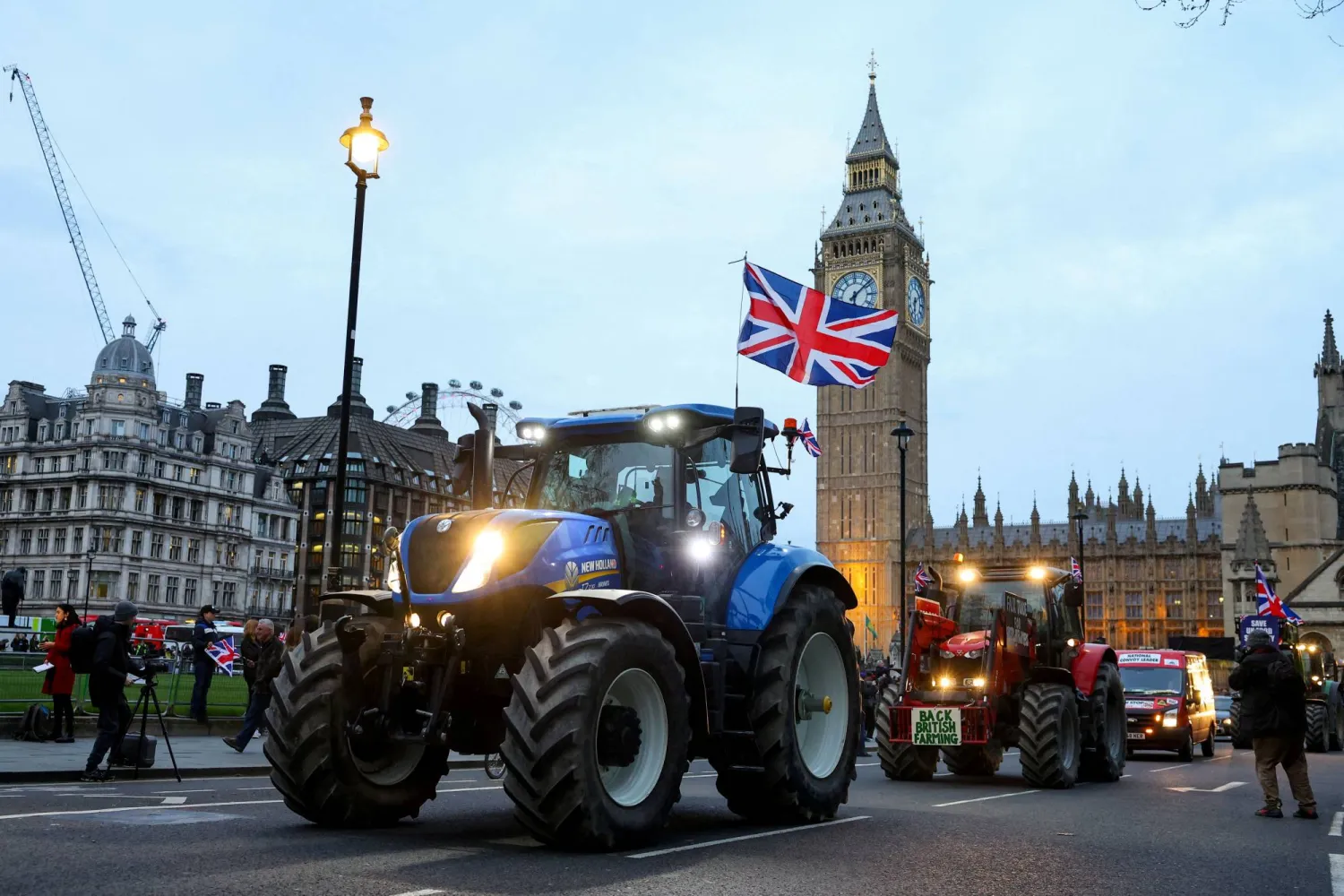
Farmers drive tractors through central London to protest against issues including food imports, as part of demonstrations from growers around the world, in London, Britain, March 25, 2024. REUTERS/Toby Melville
TT

British Government Blames China for Two ‘Malicious’ Cyberattacks

Farmers drive tractors through central London to protest against issues including food imports, as part of demonstrations from growers around the world, in London, Britain, March 25, 2024. REUTERS/Toby Melville

The UK has accused Beijing-linked organizations of orchestrating two “malicious” cyber campaigns on the Electoral Commission and parliamentarians between 2021 and 2022.

Deputy Prime Minister Oliver Dowden told MPs that the attacks in 2021 and 2022 had compromised the Electoral Commission and UK parliamentary accounts, including those of lawmakers critical of China, according to AFP.

Britain has already sanctioned two individuals and one company linked to the group suspected of orchestrating the campaign against parliamentarians.

In a statement, the UK said Monday the country's Electoral Commission systems were “highly likely” compromised by a Chinese entity between 2021 and 2022. It added that the compromise had not affected the security of elections.

The UK has strengthened its defenses against cyberattacks, especially since the National Security Act offers the government, parliament and law enforcement agencies the needed tools to disrupt such hostile activities.

British home secretary James Cleverly said, “It is reprehensible that China sought to target our democratic institutions.”

“China's attempts at espionage did not give them the results they wanted and our new National Security Act has made the UK an even harder target,” he said, insisting the upcoming elections were “robust and secure.”

The Chinese embassy in Britain hit back, calling the claim “completely unfounded” and accusing London of “malicious slander.”

The British government is attempting to strike a delicate balance between trying to neutralize security threats posed by China while maintaining or even enhancing engagement in some areas such as trade, investment and climate change.

Britain has spent the last year trying to improve ties with China after the relationship sunk to its lowest point in decades under former Prime Minister Boris Johnson, when London restricted some Chinese investment over national security worries and expressed concern over a crackdown on freedoms in Hong Kong.

But there has been growing anxiety about China’s alleged espionage activity in Britain, particularly ahead of a general election expected later this year.

Dan Lomas, an intelligence and security analyst at the University of Nottingham, said Britain's decision to call Beijing out publicly showed the government was willing to challenge China.

It is “unlikely that sanctions and harsh words will significantly alter trade between the UK and China,” he said. “But we are going to see a war of words.”


Trump Says He Is Banning Media Outlets CNN, MS NOW, Politico from White House

The CNN booth at the White House after US President Donald J. Trump announced he would ban CNN, MS NOW, and Politico, from the White House in Washington, D.C., US, September 18, 2026. REUTERS/Evan Vucci
TT

Trump Says He Is Banning Media Outlets CNN, MS NOW, Politico from White House

The CNN booth at the White House after US President Donald J. Trump announced he would ban CNN, MS NOW, and Politico, from the White House in Washington, D.C., US, September 18, 2026. REUTERS/Evan Vucci

US President Donald Trump said on Friday he is banning three major news outlets – CNN, MS NOW and Politico – from the White House in his latest threat to the independent press.

The move is almost certain to face legal challenges as free speech experts said it conflicts with the US Constitution's First Amendment protections for free speech and a free press, Reuters said.

Trump accused the outlets of "reporting FAKE NEWS" in a social media post, and said they "shouldn't be able to constantly write or report FICTION and LIES when they're covering the President of the United States." Trump added, "Other Fake News Media Outlets to follow."

Representatives of all three outlets could be seen working in the White House on Friday afternoon following Trump's post. The White House was informing all three they would be banned from the White House grounds as of Saturday, Fox News reported, citing an unnamed senior White House official.

Trump said there was no specific incident that prompted the ban, telling reporters in the Oval Office, "It's really just cumulative stories over the past few years."

Trump added, "I don't have to let them into my, into the people's house."

When asked what he meant by ‌others "to follow," Trump mentioned ‌the New York Times and Washington Post as what he called "fake news."

The extent of the ban announced by ‌Trump ⁠was not immediately clear, ⁠and the legality of any move could depend on its scope.

Courts have given presidents broad discretion over selective access to events such as Oval Office meetings and small press pools, while broader exclusions from generally available White House press facilities or credentials could face stronger challenges under the First Amendment and constitutional protections for due process.

Trump's move came weeks ahead of the November 3 midterm elections in which Trump's fellow Republicans are defending narrow majorities in Congress. Reuters/Ipsos polls show the public souring on Republicans, as Trump's own approval ratings stand near historic lows amid the deeply unpopular Iran war he kicked off that has sent energy prices soaring.

DECADES OF TRADITION

The Trump administration has upended decades of tradition in dealings between the White House and press, cutting back the access many major news organizations have had to the ⁠president while elevating the presence of new media outlets seen as more sympathetic to the administration.

CNN in a statement ‌said it stands behind its journalists who cover the White House.

"We have a right under the ‌US Constitution to do that reporting without hindrance or interference from the government," CNN said in a statement. "Should the ban which President Trump threatened go ahead, it would be ‌an illegal assault on that fundamental and constitutionally protected right."

Politico said on X that it would "continue to fairly report on this White House and future ‌ones."

"We will vigorously defend our First Amendment rights against any attempt to restrict them," Politico said.

MS NOW declined to comment.

"It's difficult to imagine a more blatant violation of the First Amendment than Trump banning news outlets from the People's House for criticizing the government," Seth Stern, chief of advocacy at Freedom of the Press Foundation, said in a statement.

Jameel Jaffer, executive director of the Knight First Amendment Institute at Columbia University, said the First Amendment prohibits the president from punishing journalists because he does not like their coverage.

"If ‌President Trump means to expel these news organizations from the White House press pool, his action is doubly unconstitutional because the press pool is a 'public forum' under the First Amendment, which means the president can't exclude ⁠journalists from it on the basis ⁠of their viewpoints," Jaffer said in a statement.

TABLOID HISTORY

Trump rose to fame as a New York developer skilled in getting the city's tabloid newspapers to cover his social life, and went on to build his profile as a reality television personality before making a serious push into politics.

Since his successful 2016 campaign, Trump has regularly criticized the press, stepping up his complaints during his second term in office. He has repeatedly urged broadcasters to drop comedy or news programs he dislikes or which have joked about or criticized him or his administration, calling on the Federal Communications Commission to strip disfavored broadcast stations of their licenses.

Trump has filed several lawsuits against the press, including the Wall Street Journal, the New York Times, the BBC and the Des Moines Register. The suits can have a chilling effect. His defamation suits against ABC and CBS were settled for $15 million and $16 million, respectively.

In his first term, Trump's White House sought to revoke or suspend the credentials of Playboy correspondent Brian Karem and CNN's Jim Acosta, but federal judges ordered their White House press passes restored.

Since returning to the presidency in January 2025, Trump has openly badgered reporters, particularly from US television networks.

Last year, he also banned the Associated Press from the usual pool of reporters that cover his movements because the news agency did not adopt Trump's preferred name for the Gulf of Mexico, which Trump has instructed executive branch employees to refer to as the Gulf of America.



US and Denmark Reach Deal on Greenland, Trump Says

US President Donald Trump (AFP/Getty)
TT

US and Denmark Reach Deal on Greenland, Trump Says

US President Donald Trump (AFP/Getty)

The United States, Denmark and Greenland have entered into an agreement for the US to develop a significant military presence on Greenland, while prohibiting US adversaries from building their own bases on the island, Donald Trump said on Friday.

In a Truth Social post, the US president wrote that no US enemies would be able to make sensitive investments on the island without the approval of the United States and that the agreement had no expiry date.

"At my direction, we worked with representatives of Denmark and Greenland to guarantee that the United States will FOREVER have the complete ability to do what is necessary ‌in Greenland in order ‌to secure and defend the security of Greenland, and the United States ‌of ⁠America," Trump wrote.

Earlier ⁠on Friday, Reuters exclusively reported that the US and Denmark were closing in on a deal that would result in an increased US military presence in Greenland, an autonomous territory of Denmark, but would stop well short of Trump's long-held dream of acquiring the island for the United States.

The US already has nearly total overflight and basing rights in Greenland due to a 1951 treaty.

Trump's announcement suggests he was nonetheless pleased with the outcome of the negotiations and that he might not revive his territorial claims, at least in the near future. He said, without elaborating, that ⁠the US would soon be rolling out a large military presence on the ‌island, which already hosts one Space Force base in its remote ‌northwest.

"This is a dream come true for the United States of America," Trump wrote.

EXTENT OF AGREEMENT REMAINS UNCLEAR

The Danish ‌prime minister's office said on Friday that the agreement would strengthen North Atlantic and Arctic security.

Greenland's prime ‌minister, Jens-Frederik Nielsen, said in a statement that the agreement recognized Greenland's interests and the Arctic island's place in international cooperation. "This benefits us all," he said.

Much was unclear as of Friday night, including whether any new US bases would be constructed as a result of the agreement. Trump's Truth Social posts about negotiations or agreements often lack context or specifics.

Imran Bayoumi, ‌a former Pentagon official now with the Atlantic Council think tank, said it would be new if the US can build bases without the approval of ⁠Greenland or Denmark but that ⁠largely "it seems that Washington could have achieved a lot of these objectives through diplomacy and dialogue without straining the broader US-NATO relationship.”

It was also unclear how the agreement would be received in Greenland, an autonomous territory of Denmark. The island's residents aspire to independence and have bristled at US attempts to assert control.

In a separate statement, US Secretary of State Marco Rubio said that the deal "permanently and completely" addressed Washington's national security concerns with respect to the island.

"Greenland will forever be part of the strategic defense area of North America and exclude any adversary from it and the surrounding area," he wrote.

A State Department official, speaking on condition of anonymity to discuss specific terms, said the deal prohibits non-NATO countries from building a base in Greenland and will allow only the US and its allies to make unspecified "sensitive investments." The official said the agreement grants the US permanent access, basing and overflight rights, and would continue to apply even if Greenland becomes independent.


Trump Signs Bill Authorizing Sweeping Russia Sanctions

US President Donald Trump attends the signing ceremony for an executive order on mail ballots, in the Oval Office of the White House in Washington, DC, March 31, 2026. (Reuters)
TT

Trump Signs Bill Authorizing Sweeping Russia Sanctions

US President Donald Trump attends the signing ceremony for an executive order on mail ballots, in the Oval Office of the White House in Washington, DC, March 31, 2026. (Reuters)

US President Donald Trump signed a bill on Friday authorizing new sanctions designed to pressure Russia over its war in Ukraine, after Congress gave its approval after months of delay.

Washington is pushing to revive a mediated path towards ending the conflict as Moscow intensifies attacks against Ukraine, even though much of its attention -- and munitions -- are focused on the ongoing war against Iran.

The legislation, which US lawmakers approved this week, takes aim at Russia's energy and defense sectors, alongside President Vladimir Putin and other senior officials.

It also targets Moscow's so-called shadow fleet of tankers used to evade Western sanctions, and allows Trump the authority to impose tariffs of up to 100 percent on major buyers of Russian oil and gas.

That could potentially cover China and India, and furthers efforts to cut off revenue financing Moscow's war.

The Republican-led House of Representatives passed the package by a 262-159 vote on Wednesday.

The bill would also target companies and foreign actors supporting Russia's military, and extend sanctions involving Iran.

But the broad powers to impose tariffs sparked an unusual split among Democrats, who largely support Ukraine but have resisted handing Trump wider authority over trade.

- Tougher pressure -

Ukrainian President Volodymyr Zelensky earlier hailed the legislation as "symbolic" and thanked US lawmakers.

The bill is "an extremely powerful tool that can stop this terrorist war and bring Russia to the point where it has to make peace," Zelensky wrote on X.

"Sanctions must be strong so that all efforts for peace -- including our joint diplomatic efforts with the United States, Europe, and our other friends -- can succeed," he added.

India said on Thursday it would continue buying oil "through diversified sourcing."

New Delhi -- which counts Russia as one of its most important strategic partners -- has navigated the energy crisis sparked by the US-Iran conflict in part by turning to Moscow, despite pressure from Western countries.

Supporters of the legislation argued that tougher economic pressure is needed against Moscow, which launched its full-scale invasion of Ukraine in February 2022.

The Congress vote was celebrated by pro-Ukraine activists, who pointed to continuing Russian attacks, including drone strikes on Wednesday on civilian transport in the south that officials in Kyiv said killed five people.

Trump has generally preferred to retain control over sanctions and tariffs rather than have Congress dictate policy, helping delay the measure for more than a year.

The president's signing of the bill comes a week before he is due to meet with his Chinese counterpart Xi Jinping in Washington.