


Biden Welcomes PM Kishida, Praises Japan’s Growing Clout on International Stage

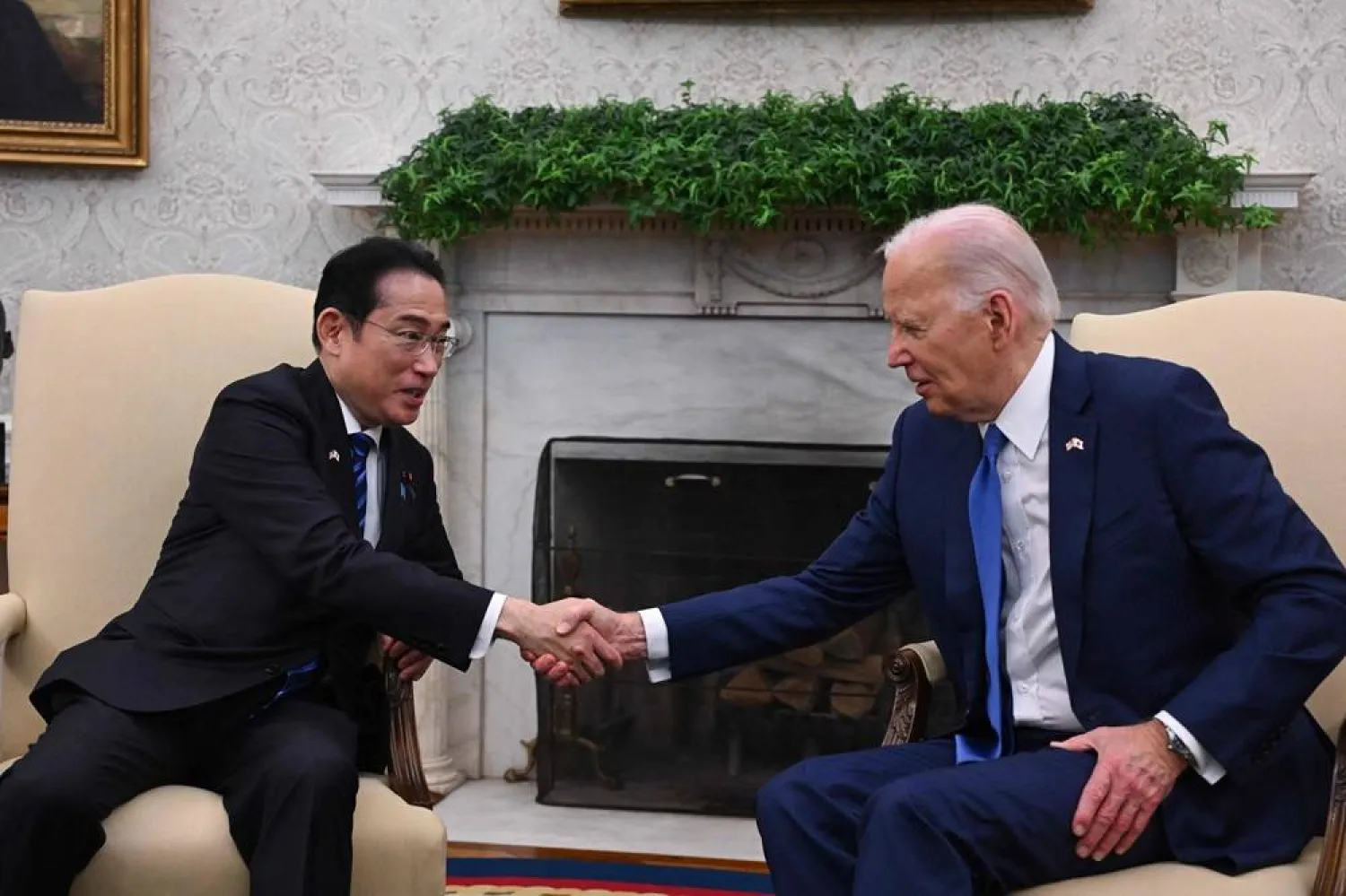
US President Joe Biden shakes hands with Japanese Prime Minister Fumio Kishida in the Oval Office of the White House in Washington, DC, on April 10, 2024. (AFP)
TT

Biden Welcomes PM Kishida, Praises Japan’s Growing Clout on International Stage

US President Joe Biden shakes hands with Japanese Prime Minister Fumio Kishida in the Oval Office of the White House in Washington, DC, on April 10, 2024. (AFP)

President Joe Biden hailed Prime Minister Fumio Kishida for bold leadership as he welcomed the Japanese leader to the White House on Wednesday for talks on the delicate security situation in the Pacific and for a glitzy state dinner.

Kishida’s official visit completes the administration’s feting of the leaders of the Quad, the informal partnership between the US, Japan, Australia and India that the White House has focused on elevating since Biden took office. As administration officials put it, they saved the most pivotal relationship for last.

“The unbreakable alliance between Japan and the United States is the cornerstone of peace, security and prosperity in the Indo-Pacific and around the world,” Biden said as he welcomed Kishida to a pomp filled arrival ceremony on the White House South Lawn.

The visit also marks the realization of Japan’s transformation from regional player to that of global influencer — with senior Biden administration officials noting appreciatively there is little the US does across the globe that Tokyo doesn’t support. They pointed to Japan’s eagerness to take a leading role in trying to bolster Ukraine against Russia’s invasion and with the flow of humanitarian aid into Gaza.

“The cooperation between our countries bound together by common values and commitment has become a global one with the scope and depth covering outer space and the deep sea,” Kishida said.

“Today the world faces more challenges and difficulties than ever before. Japan will join hands with our American friends and together we will lead the way in tackling the challenges of the Indo-Pacific region and the world, while tirelessly developing the relationship.”

Kishida also announced that Japan is giving 250 cherry trees to the US to mark America's coming 250th birthday in 2026.

Biden and Kishida are both confronting difficult political headwinds on the home front while trying to navigate increasingly complicated problems on the global stage. Like Biden, Kishida has been dogged by low approval ratings for much of his tenure.

Biden's reelection effort has been shadowed by an American electorate anxious about inflation, unease among some Democrats over his handling of the Israel-Hamas war, and concerns about whether at 81 he's too old to serve another four years. The US economy got another blip of dour data on Wednesday with the government reporting that consumer inflation ticked up last month, boosted by gas, rents, auto insurance and other items.

Kishida, meanwhile, is dealing with a Japanese economy that slipped to the world’s fourth-largest after it contracted in the last quarter of 2023 and fell behind Germany. Polls in Japan show that support for Kishida, who was elected in 2021, has plunged as he deals with a political funds corruption scandal within his ruling Liberal Democratic Party.

“For President Biden, this is, of course, a chance to highlight and cement progress in the relationship, the most important bilateral alliance in the Indo-Pacific. It’s a chance to sustain urgency and momentum in this relationship,” said Christopher Johnstone, a former national security official in the Biden administration who is now the Japan Chair at the Center for Strategic and International Studies. “For Kishida, it’s a chance to showcase his ties to the US, to prop up support at home.”

There are differences in the US-Japan relationship. The visit comes after Biden announced last month that he opposes the planned sale of Pittsburgh-based US Steel to Nippon Steel of Japan. Biden argued in announcing his opposition that the US needs to “maintain strong American steel companies powered by American steelworkers.”

The leaders were holding Oval Office talks and a joint press conference before the formal dinner, which will include a post-meal performance by singer-songwriter Paul Simon, a favorite of both Kishida and first lady Jill Biden.

The Bidens hosted Kishida and his wife for dinner Tuesday evening, taking the couple to BlackSalt, a seafood restaurant in a tony neighborhood in the nation's capital.

The couples also exchanged gifts. The Bidens presented Kishida with a three-legged table handmade by a Japanese American-owned company in Pennsylvania. The president also gave Kishida a custom-framed lithograph and a two-volume LP set autographed by Billy Joel. Jill Biden gave Yuko Kishida a soccer ball signed by the US women’s national team and the Japanese women’s national team.

Kishida gave Biden Wajima-Nuri lacquerware coffee cups as well as pens and Okinawan coffee beans. Yuko Kishida gifted Jill Biden a matching Takaoka copperware necklace, bracelet and earrings. The visitors gave the Bidens Nintendo items, including a stuffed Mario, Luigi, Princess Peach and Yoshi.

The leaders were expected to announce plans to upgrade US-Japan military relations, with both sides looking to tighten cooperation amid concerns about North Korea's nuclear program and China's increasing military assertiveness in the Pacific.

Kishida and Biden are also expected to confirm Japan’s participation in NASA’s Artemis moon program as well as its contribution of a moon rover developed by Toyota Motor Corp. and the inclusion of a Japanese astronaut in the mission. The leaders are also expected to announce artificial intelligence and semiconductor initiatives as well as new educational partnerships, according administration officials.

Biden heaped praise on Japan for its significant increase in defense spending and has tightened cooperation on economic and security matters throughout Kishida's tenure.

Japan was quick to step up in the aftermath of Russia’s invasion of Ukraine, join the US and other Western allies in mounting aggressive sanctions on Moscow, and Japanese automakers Mazda, Toyota and Nissan announced their withdrawal from Russia.

Tokyo has been one of the largest donors to Kyiv since Russia’s invasion, and Japan has surged its defense spending amid concern about China’s military assertiveness.

As part of its increased defense, Japan agreed to acquire US-made Tomahawks and other long-range cruise missiles that can hit targets in China or North Korea under a more offensive security strategy. Japan, Britain and Italy also began a collaboration on a next-generation jet fighter project.

“The prime minister is a visionary and courageous leader,” Biden said. “When Russia began its brutal invasion of Ukraine two years ago, he did not hesitate to condemn sanctions and isolate Russia and provide billions assistance to Ukraine.”

Biden also credited Kishida and South Korean President Yoon Suk Yeol for working to repair frosty relations between Tokyo and Seoul. Relations have rapidly thawed over the last two years amid shared concerns about China’s assertiveness in the Pacific and North Korea’s persistent nuclear threats. Biden last year hosted the two leaders at the presidential retreat at Camp David in Maryland’s Catoctin Mountains.

The Japan-South Korea relationship is a delicate one because of differing views of World War II history and Japan’s colonial rule over the Korean Peninsula.

Kishida will remain in Washington on Thursday to take part in a US-Japan-Philippines summit, at which China's increasing aggressive action in the region will loom large over the talks.

Relations between China and the Philippines have been repeatedly tested by skirmishes involving the two nations’ coast guard vessels in the disputed South China Sea. Chinese coast guard ships also regularly approach disputed Japanese-controlled East China Sea islands near Taiwan.

“The main intent of this trilateral agreement is for us to be able to continue to flourish, to be able to help one another, and ... to keep the peace in the South China Sea and the freedom of navigation in the South China Sea,” Philippine President Ferdinand Marcos Jr. told reporters before departing for Washington on Wednesday.



Georgia Arrests Two Foreigners Trying to Purchase Uranium

FILE PHOTO: A block with the symbol, atomic number and mass number of Uranium (U) element, in this illustration taken January 21, 2026. REUTERS/Dado Ruvic/Illustration/File Photo
TT

Georgia Arrests Two Foreigners Trying to Purchase Uranium

FILE PHOTO: A block with the symbol, atomic number and mass number of Uranium (U) element, in this illustration taken January 21, 2026. REUTERS/Dado Ruvic/Illustration/File Photo

Georgia has ‌detained two people who attempted to purchase $3 million worth of uranium and a cache of a radioactive isotope found in nuclear weapons testing programs, the national security service said on Thursday.

Two foreign nationals from unspecified countries were arrested in the city of Kutaisi, the State Security Service said in a statement.

"They were planning to ‌illegally purchase ‌nuclear material uranium and radioactive ‌substance ⁠Cesium 137 for $3 ⁠million and illegally transport it to the territory of another country," Reuters quoted it as saying.

It said other foreigners had been arriving in Georgia in recent weeks with the aim of purchasing and transporting the nuclear and ⁠radioactive materials, without elaborating further.

The ‌statement did ‌not specify the quantity of materials the individuals were ‌attempting to procure. There were ‌no details on the substances' origin or potential destination.

Cesium 137 is a radioactive isotope present primarily in the aftermath of nuclear weapons testing ‌and nuclear power plant accidents such as the Chernobyl disaster in ⁠then-Soviet ⁠Ukraine in 1986.

The security of nuclear materials was one of the biggest concerns after the 1991 fall of the Soviet Union, of which Georgia was part. There have been several serious incidents involving the illicit trade in nuclear materials in Georgia over recent decades.

Most recently, three Chinese citizens were arrested in the capital Tbilisi for attempting to purchase two kilograms of "nuclear material" uranium.


Former South Korean President Yoon Receives Life Sentence for Imposing Martial Law

FILE PHOTO: South Korea’s impeached President Yoon Suk Yeol attends the fourth hearing of his impeachment trial over his short-lived imposition of martial law at the Constitutional Court in Seoul, South Korea, 23 January 2025. JEON HEON-KYUN/Pool via REUTERS/File Photo
TT

Former South Korean President Yoon Receives Life Sentence for Imposing Martial Law

FILE PHOTO: South Korea’s impeached President Yoon Suk Yeol attends the fourth hearing of his impeachment trial over his short-lived imposition of martial law at the Constitutional Court in Seoul, South Korea, 23 January 2025. JEON HEON-KYUN/Pool via REUTERS/File Photo

Former South Korean President Yoon Suk Yeol was sentenced to life in prison for his brief imposition of martial law in a dramatic culmination to the country’s biggest political crisis in decades.

Yoon was ousted from office after a baffling attempt to overcome an opposition-controlled legislature by declaring martial law and sending troops to surround the National Assembly on Dec. 3, 2024, The Associated Press said.

Judge Jee Kui-youn of the Seoul Central District Court said he found Yoon guilty of rebellion for mobilizing military and police forces in an illegal attempt to seize the liberal-led Assembly, arrest politicians and establish unchecked power for a “considerable” time.

Martial law crisis recalled dictatorial past Yoon’s martial law imposition, the first of its kind in more than four decades, harkened back to South Korea’s past military-backed governments when authorities occasionally proclaimed emergency decrees that allowed them to station soldiers, tanks and armored vehicles on streets or at public places such as schools to prevent anti-government demonstrations.

As lawmakers rushed to the National Assembly, Yoon’s martial law command issued a proclamation declaring sweeping powers, including suspending political activities, controlling the media and publications, and allowing arrests without warrants.

The decree lasted about six hours before being lifted after a quorum of lawmakers managed to break through a military blockade and unanimously voted to lift the measure.

Yoon was suspended from office on Dec. 14, 2024, after being impeached by lawmakers and was formally removed by the Constitutional Court in April 2025. He has been under arrest since last July while facing multiple criminal trials, with the rebellion charge carrying the most severe punishment.

Yoon's lawyers reject conviction Yoon Kap-keun, one of the former president’s lawyers, accused Jee of issuing a “predetermined verdict” based solely on prosecutors’ arguments and said the “rule of law” had collapsed. He said he would discuss whether to appeal with his client and the rest of the legal team.

Yoon Suk Yeol told the court the martial law decree was only meant to raise public awareness of how the liberals were paralyzing state affairs, and that he was prepared to respect lawmakers if they voted against the measure.

Prosecutors said it was clear Yoon was attempting to disable the legislature and prevent lawmakers from lifting the measure through voting, actions that exceeded his constitutional authority even under martial law.

In announcing Yoon and Kim’s verdicts, Jee said the decision to send troops to the National Assembly was key to his determination that the imposition of martial law amounted to rebellion.

“This court finds that the purpose of (Yoon’s) actions was to send troops to the National Assembly, block the Assembly building and arrest key figures, including the National Assembly speaker and the leaders of both the ruling and opposition parties, in order to prevent lawmakers from gathering to deliberate or vote,” Jee said. “It’s sufficiently established that he intended to obstruct or paralyze the Assembly’s activities so that it would be unable to properly perform its functions for a considerable period of time.”

Protesters rally outside court

As Yoon arrived in court, hundreds of police officers watched closely as Yoon supporters rallied outside a judicial complex, their cries rising as the prison bus transporting him drove past. Yoon’s critics gathered nearby, demanding the death penalty.

There were no immediate reports of major clashes following the verdict.

A special prosecutor had demanded the death penalty for Yoon Suk Yeol, saying his actions posed a threat to the country’s democracy and deserved the most serious punishment available, but most analysts expected a life sentence since the poorly-planned power grab did not result in casualties.

South Korea has not executed a death row inmate since 1997, in what is widely seen as a de facto moratorium on capital punishment amid calls for its abolition.

Other officials sentenced for enforcing martial law

The court also convicted and sentenced several former military and police officials involved in enforcing Yoon’s martial law decree, including ex-Defense Minister Kim Yong Hyun, who received a 30-year jail term for his central role in planning the measure and mobilizing the military.

Last month, Yoon was sentenced to five years in prison for resisting arrest, fabricating the martial law proclamation and sidestepping a legally mandated full Cabinet meeting before declaring the measure.

The Seoul Central Court has also convicted two members of Yoon’s Cabinet in other cases. That includes Prime Minister Han Duck-soo, who received a 23-year prison sentence for attempting to legitimize the decree by forcing it through a Cabinet Council meeting, falsifying records and lying under oath. Han has appealed the verdict.

Yoon is the first former South Korean president to receive a life sentence since former military dictator Chun Doo-hwan, who was sentenced to death in 1996 for his 1979 coup, a bloody 1980 crackdown on pro-democracy protesters in Gwangju that left more than 200 people dead or missing, and corruption.

The Supreme Court later reduced his sentence to life imprisonment, and he was released in late 1997 under a special presidential pardon. He died in 2021.


UK Condemns 10-year Sentence for British Couple in Iran

(FILES) A handout photograph released in London on August 4, 2025 by the family of Craig and Lindsay Foreman, shows Craig and Lindsay at Naqsh-e Jahan Square, or Shah Square, with the Shah Mosque in the background, in Isfahan, Iran, at an undated time. (Photo by FAMILY HANDOUT / AFP)
TT

UK Condemns 10-year Sentence for British Couple in Iran

(FILES) A handout photograph released in London on August 4, 2025 by the family of Craig and Lindsay Foreman, shows Craig and Lindsay at Naqsh-e Jahan Square, or Shah Square, with the Shah Mosque in the background, in Isfahan, Iran, at an undated time. (Photo by FAMILY HANDOUT / AFP)

British foreign minister Yvette Cooper on Thursday condemned as "totally unjustifiable" the 10-year sentence given to a British couple in Iran for spying, saying the government would continue to press for their release.

Craig and Lindsay Foreman had been charged with espionage after Iran accused them of gathering information in several parts of the country.

"We will pursue this case relentlessly with the Iranian government until we see ‌Craig and Lindsay ‌Foreman safely returned to the UK and reunited with ‌their ⁠family," Reuters quoted Cooper as saying in ⁠a statement.

The Foremans were arrested on January 3 of last year while travelling through Iran on a global motorcycle journey. Iranian state media announced their detention the following month over espionage charges and they have now been held for more than 13 months.

Joe Bennett, Lindsay's son, said in a separate statement the couple had appeared at a three-hour trial ⁠on October 27, in which they were not allowed to ‌present a defense.

"We have seen no ‌evidence to support the charge of espionage," he said, adding that the family ‌was deeply concerned about the couple's welfare and the lack of transparency ‌in the judicial process.

Bennett called on the British government to "act decisively and use every available avenue" to secure their release.

The Iranian embassy in London did not immediately respond to a request for comment on the sentencing.

According to a family ‌statement, the couple have been held for extended periods without being able to communicate. They have had limited or ⁠delayed access ⁠to legal representation, periods of solitary confinement and delays in receiving funds for basic necessities. They also reported disrupted or cancelled consular visits.

Cooper, whose office did not comment on the disruption, said they would continue to provide consular assistance.

Lindsay Foreman has been held in the women's section of Tehran's Evin Prison, while her husband Craig has been held in its political wing.

Iran's Revolutionary Guards have in recent years detained foreign and dual nationals, typically on espionage or national security charges.

Human rights organizations say the authorities use such arrests as leverage in disputes with other countries, a practice they describe as part of a broader pattern of politically motivated detentions. Tehran has rejected those accusations and said the cases involved legitimate security concerns.