Bishop and Priest Wounded in Stabbing in Sydney Church, Police Say

A black ribbon is projected onto the Sydney Opera House on April 15, 2024, as a mark of respect for the victims of the Westfield Bondi Junction shopping mall attack. (AFP)
TT

Bishop and Priest Wounded in Stabbing in Sydney Church, Police Say

A black ribbon is projected onto the Sydney Opera House on April 15, 2024, as a mark of respect for the victims of the Westfield Bondi Junction shopping mall attack. (AFP)

At least four people including a bishop were wounded in a knife attack during a service at a church in a suburb of Sydney on Monday, police and witnesses said, triggering clashes between angry residents and police.

It was the second reported mass stabbing in just three days in Sydney after six people were killed in a knife attack at a mall in the Bondi area.

Officers arrested a man and took him to an undisclosed location following the attack in Wakeley, about 30 km (18 miles) west of Sydney's central business district.

A large crowd quickly gathered outside the church after the attack, throwing rocks at police and demanding they bring out the perpetrator, according to two witnesses.

Police fired pepper spray as they pushed back people onto nearby streets, according to a Reuters journalist. More than 100 police officers were ultimately called in to deal with the unrest, and two were taken to hospital with injuries.

Monday's attack happened during a service at an Assyrian church called "Christ The Good Shepherd Church."

Videos of the incident circulating online showed the bishop of the church, Mar Mari Emmanuel, standing at the altar of the church and speaking to worshippers as another man wearing a black jumper walks towards him and attacks him.

Horrified members of the congregation scream as the man stabs the priest several time in the chest, the videos show.

The church streamed the sermons live on its social media page. The motive of the attack is unknown.

The church said in a Facebook post that Emmanuel and a priest, Father Isaac Royel, were among the injured.

"We ask for your prayers at this time. It is the Bishop's and Father's wishes that you also pray for the perpetrator," the post said.

The wounded suffered non-life threatening injuries and were being treated by paramedics, police said.

The New South Wales ambulance service said at least four people were injured including a man in his 50s who was taken to hospital in a serious condition.

"There was so much anger because the bishop is loved by them, he’s loved by myself as well, he preaches about the Lord and we love the Lord," said a local resident who gave her name as Canny, and who saw the bishop put in an ambulance.

Emmanuel was ordained a priest in 2009 and then a bishop in 2011, according to the church's website. The bishop appears to be a popular figure on social media, with clips of his sermons garnering millions of views on platforms including TikTok.

Emmanuel became well known for his hardline views during the pandemic, local media reported at the time, with the bishop describing COVID lockdowns as "mass slavery".

A recent sermon posted online by fans shows him claim the United Nations was founded by Satan.

The attack drew condemnation from figures in the city's Jewish and Muslim communities.

The Australian National Imams Council said the attacks were "horrifying and have no place in Australia, particularly at places of worship and toward religious leaders".

"Extremely concerning scenes at a Sydney church," the Australian Jewish Association said in a social media post.

"Our thoughts are with our Assyrian friends."

New South Wales state Premier Chris Minns said in a social media post: "It's important that the community remain calm and continue to listen and act to the directions of Police and Emergency Services."


IRGC Media: Technical Modifications to Allow Iran Develop Missiles that Reach US

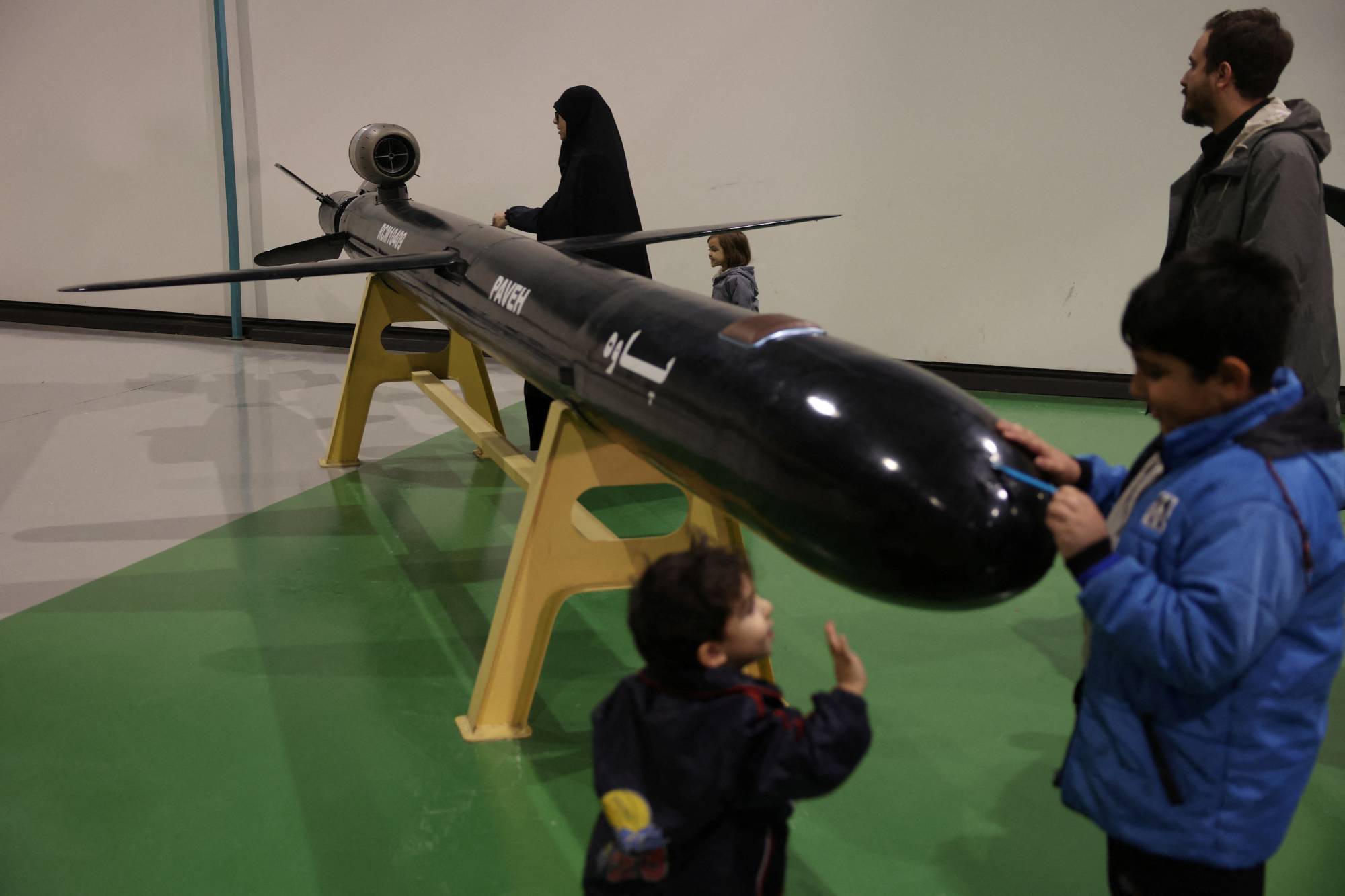
People visit the Revolutionary Guard Corps (IRGC) Aerospace Force Museum in Tehran, Iran, November 4, 2026. Majid Asgaripour/WANA (West Asia News Agency) via REUTERS
TT

IRGC Media: Technical Modifications to Allow Iran Develop Missiles that Reach US

People visit the Revolutionary Guard Corps (IRGC) Aerospace Force Museum in Tehran, Iran, November 4, 2026. Majid Asgaripour/WANA (West Asia News Agency) via REUTERS

Iran on Saturday said it could introduce technical modifications to its long-range missiles, enabling them to reach US territory.

Tasnim News agency, the Revolutionary Guard Corps (IRGC) affiliated media outlet, said modifications to the Khorramshahr-4’s warhead could increase its range to 3,000 or 4,000 kilometers by reducing the weight of its warhead to 1,500-kilogram instead of 2,000.

It said a modified version of the missile would reach US bases and those of its allies in eastern and southeastern Europe, as well as central Europe.

Also, the news agency said Iran would develop an intercontinental ballistic missile with a range of approximately 10,000 kilometers to reach the US East Coast, including areas near Washington and New York, and more than 13,000 kilometers to cover the entire US territory.

Tasnim noted that such modification “is possible at present” using the IRGC’s satellite launch vehicles, including the Qased, Zuljanah and Qaem systems, constructing underground “missile cities,” and developing a warhead capable of withstanding re-entry into the Earth's orbit.

Opened Lock

Last week, Supreme Leader Mojtaba Khamenei issued an order to respond to threats of any scale or type with an “immediate and effective response without geographical restrictions.”

Khamenei issued the directives during his first publicly announced meeting with senior military commanders since taking office.

Tasnim on Saturday admitted that former Leader Ali Khamenei had restricted the range of ballistic missiles manufactured in the country to 2,000 kilometers.

It said by “abusing our patience,” Iran’s “enemies unlocked a key aspect of its offensive capabilities.”

Last week, Iran’s Revolutionary Guard Corps spokesman General Hossein Mohebbi confirmed the removal of the 2,000-kilometer range restriction.

“That restriction has been lifted for us,” he declared, without specifying a new range or whether Iran possessed missiles exceeding the previous limit. He promised to demonstrate those capabilities “in practice.”

In August 2025, Iranian lawmaker Amir Hayat-Moqaddam told local media that Tehran has been developing long-range strike capabilities for two decades. He warned that “perhaps our next missile will hit Washington directly. We can target America from the sea.”

Also, Iranian lawmaker Kamran Ghazanfari claimed in early November that Iran developed intercontinental ballistic missiles capable of hitting Europe and the United States.

People visit the Revolutionary Guard Corps (IRGC) Aerospace Force Museum in Tehran, Iran, November 4, 2026. Majid Asgaripour/WANA (West Asia News Agency) via REUTERS

Stealth Cruise Missile

Meanwhile, Iranian state television displayed an inspection of a strategic missile facility belonging to the IRGC.

It aired footage on Tuesday describing the underground complex as a new “missile city.”

A military analyst said on his page that the Guards’ missile unit had “quietly” unveiled two new missiles, but that “their unveiling is significant” to those who “monitor and analyze.”

He described the first one as Iran’s “first stealth cruise missile,” noting that its jet engine—which had been mounted externally on previous cruise missiles, making them easier to detect—is now housed inside the body.

The second, he said, is a ballistic missile that combines the warhead of the “Fattah” hypersonic missile with the “Khyber Shikan 2” missile, explaining that the range of the “Fattah” has increased from about 1,400 kilometers to nearly 2,000 kilometers.

Iranian state television aired footage on Tuesday of Armed Forces Chief of Staff Maj. Gen. Ali Abdollahi during his inspection of a strategic missile facility belonging to the IRGC.

It reported the unveiling of new weapons, including a “surprise” missile, without disclosing its name, range or specifications. Iranian media revealed neither the facility’s location nor the date of the visit.

Treats Expand to Europe

Meanwhile, Iran’s hardline newspaper Kayhan said on Wednesday that Tehran would expand threats against US bases beyond the region, including facilities in Europe and neighboring countries if a new war resumes.

“By removing the geographical limits on threats, the enemy should hear the roar of new missiles at US bases thousands of kilometers away in Germany, Britain, Albania, Greece, Cyprus and some neighboring countries,” said the newspaper, which is published under the supervision of the supreme leader’s representative.

Despite claiming it restricts its missile range, Iran in March reportedly tried and failed to hit the joint US-UK base at Diego Garcia, in the Indian Ocean, some 4,000 kilometers away from Iran.

No War No Peace State

US President Donald Trump has told senior advisers in recent days that he may hold off on attacking Iran if the US faces no new provocations, according to three people familiar with the matter.

Trump has alternated between threats of escalating the war with new strikes and winding down hostilities, and current and former officials say he does not appear to have made up his mind about how to resolve the unpopular conflict, which he launched in February with Israel.

But in meetings with his national security advisers and after a series of intelligence briefings, Trump said he was considering holding off on strikes, said the people, who, like others interviewed for this story, spoke on condition of anonymity.

He has also indicated sympathy for allies in the region who have asked him not to return to a full-fledged war.

At the same time, the US military is ready to escalate if needed, three more people ⁠familiar with US planning said.

A third aircraft carrier is moving into the Middle East in the coming days to replace one of the two currently operating in the region, but all three carriers could stay if needed, the people said.

Trump could opt to bomb Iran's underground nuclear facilities, one of the people familiar with Trump's calls with several leaders said. But the US has already struck those facilities, and it is unclear whether further strikes would be successful.
US intelligence agencies have ⁠assessed that renewed strikes would not significantly shift Iran’s demands in negotiations, two US officials said.


Netanyahu Vows to Eliminate Iran Threat ‘Once and for All’

10 November 2026, Israel, Jerusalem: Caretaker Israeli Prime Minister Benjamin Netanyahu delivers a speech on the sidelines of the opening session of the new Knesset. (dpa)
TT

Netanyahu Vows to Eliminate Iran Threat ‘Once and for All’

10 November 2026, Israel, Jerusalem: Caretaker Israeli Prime Minister Benjamin Netanyahu delivers a speech on the sidelines of the opening session of the new Knesset. (dpa)

Israel's caretaker prime minister Benjamin Netanyahu on Saturday reiterated his calls for a national unity government with his opponent Gadi Eisenkot, as well as his vow to eliminate the threat from Iran.

A meeting with Eisenkot on Thursday "only strengthened the conviction that it is essential to form a national unity government" to guarantee Israel's security, Netanyahu said in a video statement, adding that such a government could "eliminate the Iranian threat once and for all".


Ukraine’s Zelenskiy Escalates Criticism of SpaceX Over Speed Caps

Ukraine's President Volodymyr Zelenskiy holds a press briefing in Copenhagen November 10, 2026. (AFP)
TT

Ukraine’s Zelenskiy Escalates Criticism of SpaceX Over Speed Caps

Ukraine's President Volodymyr Zelenskiy holds a press briefing in Copenhagen November 10, 2026. (AFP)

Ukraine's President Volodymyr Zelenskiy ‌escalated his criticism of SpaceX on Saturday, saying speed restrictions on its military-grade Starshield satellite terminals had dangerous political implications and undermined critical air defenses.

Zelenskiy said Starshield terminals operating in temporarily Russian-occupied territories of Ukraine had been limited to a maximum speed of 161 kph for the past five days, hampering Ukraine's military capabilities.

The Ukrainian Defense Ministry has raised the issue with SpaceX at the ‌institutional level, ‌Zelenskiy said.

"The restrictions have now ‌been ⁠in place for ⁠five days. They say it is some kind of technical issue. We do not believe that is the case," Zelenskiy told reporters in remarks released by his office on Saturday.

"If you impose restrictions there, you are already partially recognizing the temporarily ⁠occupied territories as not ours. And ‌that is why I ‌believe we have the right to raise this ‌issue and restore the speed – so that there ‌are no restrictions at all."

Zelenskiy said the speed restrictions made it more difficult for Ukrainian air defense units to intercept Russian jet-powered drones and made Ukrainian cities ‌more vulnerable. He said he had ordered his top military and foreign ministry ⁠officials ⁠to address the issue and seek clarification.

SpaceX has pushed back against the allegations, denying that it introduced new restrictions or made any changes to its satellite operations.

It is the second such outage in recent weeks. In mid-October, Ukrainian officials said that SpaceX limited the speed of Starlink and its Starshield communication systems to about 160 kph (100 mph) amid tensions with US President Donald Trump's administration over Ukrainian attacks on Russian oil refineries. Service was then restored on October 24.