Jurors in Trump's Hush Money Trial Zero in on Testimony of Key Witnesses as Deliberations Resume

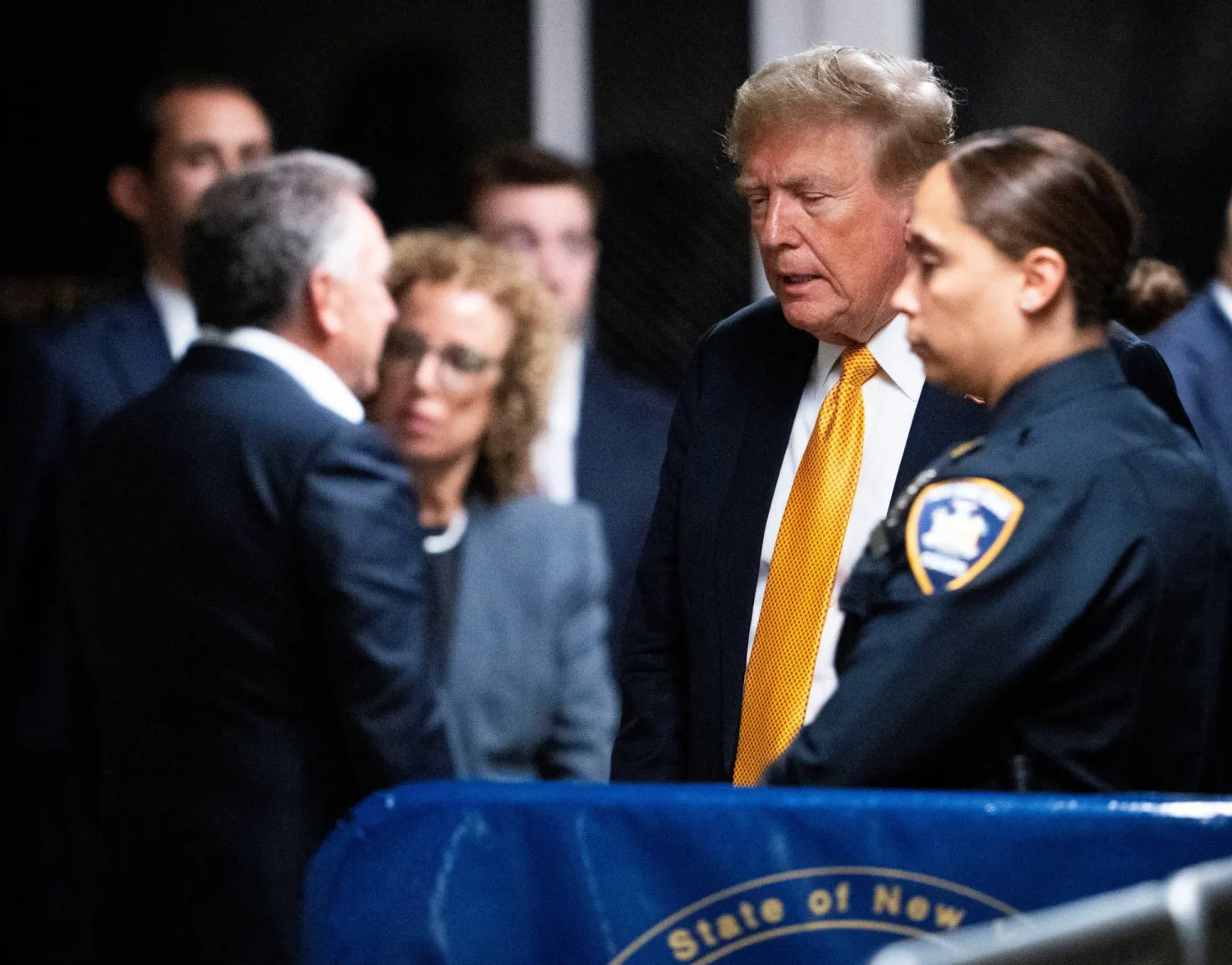
After huddling with his lawyers, Republican presidential candidate, former US President Donald Trump walks out of the courtroom to make remarks to the media, as the 12 jurors begin deliberating at his criminal trial at the New York State Supreme Court in New York, New York, Wednesday, May, 29, 2024. Doug Mills/Pool via REUTERS
TT

Jurors in Trump's Hush Money Trial Zero in on Testimony of Key Witnesses as Deliberations Resume

After huddling with his lawyers, Republican presidential candidate, former US President Donald Trump walks out of the courtroom to make remarks to the media, as the 12 jurors begin deliberating at his criminal trial at the New York State Supreme Court in New York, New York, Wednesday, May, 29, 2024. Doug Mills/Pool via REUTERS

The jury in Donald Trump’s hush money trial is to resume deliberations Thursday after asking to rehear potentially crucial testimony about the alleged hush money scheme at the heart of the history-making case.
The 12-person jury deliberated for about 4 1/2 hours on Wednesday without reaching a verdict, said The Associated Press.
Besides asking to rehear testimony from a tabloid publisher and Trump's former lawyer and personal fixer, the jury also requested to revisit at least part of the judge's hourlong instructions that were meant to guide them on the law.
It's unclear how long the deliberations will last. A guilty verdict would deliver a stunning legal reckoning for the presumptive Republican presidential nominee as he seeks to reclaim the White House while an acquittal would represent a major win for Trump and embolden him on the campaign trail. Since verdicts must be unanimous, it's also possible the case ends in a mistrial if the jury can't reach a consensus after days of deliberations.
Trump struck a pessimistic tone after leaving the courtroom following the reading of jury instructions, repeating his assertions of a “very unfair trial” and saying: “Mother Teresa could not beat those charges, but we'll see. We'll see how we do."
He remained inside the courthouse during deliberations, where he posted on his social media network complaints about the trial and quoted legal and political commentators who view the case in his favor. He did not testify in his own defense, a fact the judge told jurors they could not take into account.
Trump is charged with 34 counts of falsifying business records at his company in connection with an alleged scheme to hide potentially embarrassing stories about him during his 2016 Republican presidential election campaign.
The charge, a felony, arises from reimbursements paid to then-Trump lawyer Michael Cohen after he made a $130,000 hush money payment to porn actor Stormy Daniels to silence her claims that she and Trump had sex in 2006. Trump is accused of misrepresenting Cohen’s reimbursements as legal expenses to hide that they were tied to a hush money payment.
Trump has pleaded not guilty and contends the Cohen payments were for legitimate legal services. He has also denied the alleged extramarital sexual encounter with Daniels.
To convict Trump, the jury would have to find unanimously that he created a fraudulent entry in his company’s records, or caused someone else to do so, and that he did so with the intent of committing or concealing another crime.
The crime prosecutors say Trump committed or hid is a violation of a New York election law making it illegal for two or more conspirators “to promote or prevent the election of any person to a public office by unlawful means.”
While the jury must unanimously agree that something unlawful was done to promote Trump’s election campaign, they don’t have to be unanimous on what that unlawful thing was.
The jurors — a diverse cross-section of Manhattan residents and professional backgrounds — often appeared riveted by testimony in the trial, including from Cohen and Daniels. Many took notes and watched intently as witnesses answered questions from Manhattan prosecutors and Trump’s lawyers.
Jurors started deliberating after a marathon day of closing arguments in which a prosecutor spoke for more than five hours, underscoring the burden the district attorney's office faces in needing to establish Trump's guilt beyond a reasonable doubt.
The Trump team need not establish his innocence to avoid a conviction but must instead bank on at least one juror finding that prosecutors have not sufficiently proved their case.
In their first burst of communication with the court, jurors asked to rehear testimony from Cohen and former National Enquirer publisher David Pecker about an August 2015 meeting with Trump at Trump Tower where the tabloid boss agreed to be the “eyes and ears” of his fledgling presidential campaign.
Pecker testified that the plan included identifying potentially damaging stories about Trump so they could be squashed before being published. That, prosecutors say, was the beginning of the catch-and-kill scheme at the heart of the case.
Jurors also want to hear Pecker’s account of a phone call he said he received from Trump in which they discussed a rumor that another outlet had offered to buy former Playboy model Karen McDougal’s alleged story that she had a yearlong affair with Trump in the mid-2000s. Trump has denied the affair.
Pecker testified that Trump told him, “Karen is a nice girl” and asked, “What do you think I should do?” Pecker said he replied: “I think you should buy the story and take it off the market.” He added that Trump told him he doesn’t buy stories because they always get out and that Cohen would be in touch.
The publisher said he came away from the conversation thinking Trump was aware of the specifics of McDougal’s claims. Pecker said he believed the story was true and would have been embarrassing to Trump and his campaign if it were made public.
The National Enquirer’s parent company, American Media Inc., eventually paid McDougal $150,000 for the rights to her story in an agreement that also included writing and other opportunities with its fitness magazine and other publications.
The fourth item jurors requested is Pecker’s testimony about his decision in October 2016 to back out of an agreement to sell the rights to McDougal’s story to Trump through a company Cohen had established for the transaction, known as an “assignment of rights.”
“I called Michael Cohen, and I said to him that the agreement, the assignment deal is off. I am not going forward. It is a bad idea, and I want you to rip up the agreement,” Pecker testified. “He was very, very, angry. Very upset. Screaming, basically, at me.”
Pecker testified that he reiterated to Cohen that he wasn’t going forward with the agreement.
He said that Cohen told him: “The boss is going to be very angry at you.”



Netanyahu Says India's Modi to Visit Israel Wednesday

Indian PM Narendra Modi shakes hands with Israeli PM Benjamin Netanyahu during an exchange of cooperation agreements in a ceremony in Jerusalem July 5, 2017. (Reuters)
TT

Netanyahu Says India's Modi to Visit Israel Wednesday

Indian PM Narendra Modi shakes hands with Israeli PM Benjamin Netanyahu during an exchange of cooperation agreements in a ceremony in Jerusalem July 5, 2017. (Reuters)

India's Prime Minister Narendra Modi will visit Israel on Wednesday, his counterpart Benjamin Netanyahu announced, saying the trip will help forge a new alliance to counter what he described as "radical" adversaries.

"On Wednesday, the Prime Minister of India, Narendra Modi, will arrive here; he will deliver a speech in the Knesset," Netanyahu said Sunday at the opening of a cabinet meeting, referring to Israel's parliament.

The premier hailed growing ties between the two countries, according to AFP.

"The fabric of relations has grown tighter, and (Modi) is coming here so that we can tighten it even more," he said, mentioning cooperation in the economic, diplomatic and security spheres.

Modi visited Israel as prime minister in 2017, before Netanyahu made a reciprocal visit to India the following year.

Netanyahu said the Israel-India axis will be part of a wider regional alliance to counter common "radical" adversaries.

"In the vision I see before me, we will create an entire system, essentially a 'hexagon' of alliances around or within the Middle East," the Israeli leader said.

Arch-foes Israel and Iran also faced each other in a first direct confrontation last June in a 12-day war in which the Israeli and US militaries targeted Tehran's nuclear facilities and ballistic missile arsenal.

"All of these nations share a different perception, and our cooperation can yield great results and, of course, ensure our resilience and our future," Netanyahu said of the emerging alliance.


Iranian Students Rally for Second Day as Fears of War with US Mount

People walk near a mural featuring images of Iran's Supreme Leader Ayatollah Ali Khamenei and leader of Iran's 1979 Islamic Revolution Ayatollah Ruhollah Khomeini, on a street in Tehran, Iran, February 17, 2026. Majid Asgaripour/WANA (West Asia News Agency) via REUTERS
TT

Iranian Students Rally for Second Day as Fears of War with US Mount

People walk near a mural featuring images of Iran's Supreme Leader Ayatollah Ali Khamenei and leader of Iran's 1979 Islamic Revolution Ayatollah Ruhollah Khomeini, on a street in Tehran, Iran, February 17, 2026. Majid Asgaripour/WANA (West Asia News Agency) via REUTERS

Iranian students gathered for fresh pro- and anti-government rallies Sunday commemorating those killed in recent protests, as fears loomed of renewed conflict with the United States over the country's nuclear programme.

The initial demonstrations were sparked in December by economic hardship in the sanctions-hit country, but quickly expanded into mass anti-government protests that marked one of the largest challenges to the Islamic republic's clerical leadership in years.

US President Donald Trump had initially cheered on the protesters, threatening to intervene on their behalf as authorities launched a deadly crackdown, but his threats soon shifted to Iran's nuclear programme, which the West believes is aimed at developing atomic weapons, AFP reported.

Washington and Tehran have since returned to the negotiating table, but Trump has simultaneously pursued a major military build-up in the Middle East aimed at pressuring Iran to cut a deal.

Following campus rallies commemorating the protest dead on Saturday, the Fars news agency on Sunday published videos of fresh crowds of dozens of people waving Iranian flags and carrying memorial photographs at universities in the capital Tehran.

One showed a rowdy gathering at Sharif University of Technology shouting "death to the shah" -- a reference to the monarchy ousted by the 1979 Islamic revolution -- as they faced off with another group, with men in uniforms between them.

Fars said there had been "tensions" at at least three universities in Tehran where some students chanted "anti-establishment" slogans.

Iran International, a media outlet based outside the country and branded a "terrorist" organization by Tehran, shared a video on social media of students holding up the pre-revolution flag at Sharif University, as well as videos of rallies at other institutions of higher learning.

A video geolocated by AFP of what appeared to be the demonstration at Sharif University showed a large crowd chanting anti-government slogans as they thronged around students waving the flag of the toppled monarchy.

The authorities acknowledge more than 3,000 deaths in the unrest, including members of the security forces and bystanders, but say the violence was caused by "terrorist acts" fuelled by Iran's enemies.

The US-based Human Rights Activists News Agency (HRANA), however, has recorded more than 7,000 killings in the crackdown, the vast majority protesters, though the toll may be far higher.

- Negotiations -

Representatives of the US and Iran recently met in Geneva for a second round of Oman-mediated nuclear talks, with Iran promising to send a draft proposal for a deal to avert military action in the coming days.

Axios reported on Sunday, citing an unnamed senior US official, that if Iran submitted its proposal in the next 48 hours, Washington was ready to meet again "in Geneva on Friday in order to start detailed negotiations to see if we can get a nuclear deal".

The US has dispatched two aircraft carriers to the region, along with other jets and ships, and has also shored up its air defenses in the Middle East.

Trump's chief Middle East negotiator Steve Witkoff said Saturday in a Fox News interview that the president was questioning why Iran had not yet given in to US pressure.

"He's curious as to why they haven't... I don't want to use the word 'capitulated', but why they haven't capitulated," he said.

"Why, under this pressure, with the amount of seapower and naval power over there, why haven't they come to us and said, 'We profess we don't want a weapon, so here's what we're prepared to do'?"

Iran has long denied it is trying to produce nuclear weapons, but insists on its right to enrich uranium for civilian purposes.

- Fears of war -

A previous round of nuclear diplomacy last year was interrupted by Israel's surprise bombing campaign against the Islamic republic.

That sparked a 12-day conflict in June that the US briefly joined with strikes on nuclear facilities

Iran has maintained that it will defend itself in the event of any new attack.

Despite the latest talks, Iranians' fears of a new conflict have grown.

"I don't sleep well at night even while taking pills," Tehran resident Hamid told AFP, saying he worried for his "family's health... my kids and grandchildren".

IT technician Mina Ahmadvand, 46, believes that "at this stage, war between Iran and the US as well as Israel is inevitable and I've prepared myself for that eventuality".

"I don't want war to happen, but one should not fool around with the realities on the ground."

The concerns have prompted several foreign countries to urge their citizens to leave Iran, including Sweden, Serbia, Poland and Australia, which warned "commercial flights are currently available but this could change quickly".


France to Summon US Ambassador Charles Kushner over US Comments on Activist’s Death

The French national flag is raised at a French embassy, December 17, 2024. (Reuters)
TT

France to Summon US Ambassador Charles Kushner over US Comments on Activist’s Death

The French national flag is raised at a French embassy, December 17, 2024. (Reuters)

France will summon US Ambassador Charles Kushner to protest comments by the Trump administration over the beating death of a far-right activist, the foreign affairs minister said.

Jean-Noel Barrot was reacting to a statement by the State Department’s Counterterrorism Bureau, which posted on X that “reports, corroborated by the French Minister of the Interior, that Quentin Deranque was killed by left-wing militants, should concern us all.”

Deranque, a far-right activist, died of brain injuries last week from a beating in the French city of Lyon. He was attacked during a fight on the margins of a student meeting where a far-left lawmaker, Rima Hassan, was a keynote speaker, The AP news reported.

His killing highlighted a climate of deep political tensions ahead of next year’s presidential vote. French President Emmanuel Macron called for calm on Saturday as some 3,000 people joined a march in Lyon organized by far-right groups to pay tribute to Deranque.

“We reject any instrumentalization of this tragedy, which has plunged a French family into mourning, for political ends,” Barrot said. “We have no lessons to learn, particularly on the issue of violence, from the international reactionary movement.”

The State Department said in its post that “violent radical leftism is on the rise and its role in Quentin Deranque’s death demonstrates the threat it poses to public safety. We will continue to monitor the situation and expect to see the perpetrators of violence brought to justice.”

Seven people have been handed preliminary charges. The Lyon public prosecutor’s office requested that each of them be charged with intentional homicide, aggravated violence and criminal conspiracy. Six of the accused were charged on all three counts. The seventh was charged with complicity in intentional homicide, aggravated violence and criminal conspiracy.

Barrot said he has other topics to discuss with Kushner, including US decisions to impose sanctions on Thierry Breton, a former EU commissioner responsible for supervising social media rules, and Nicolas Guillou, a French judge at the International Criminal Court.

Barrot said both are targeted by “unjustified and unjustifiable” sanctions.

The Foreign Affairs Ministry did not say when the meeting will take place.

Kushner had already been summoned in August last year over his letter to Macron alleging the country did not do enough to combat antisemitism. France’s foreign officials met with a representative of the US ambassador since the diplomat did not show up.