

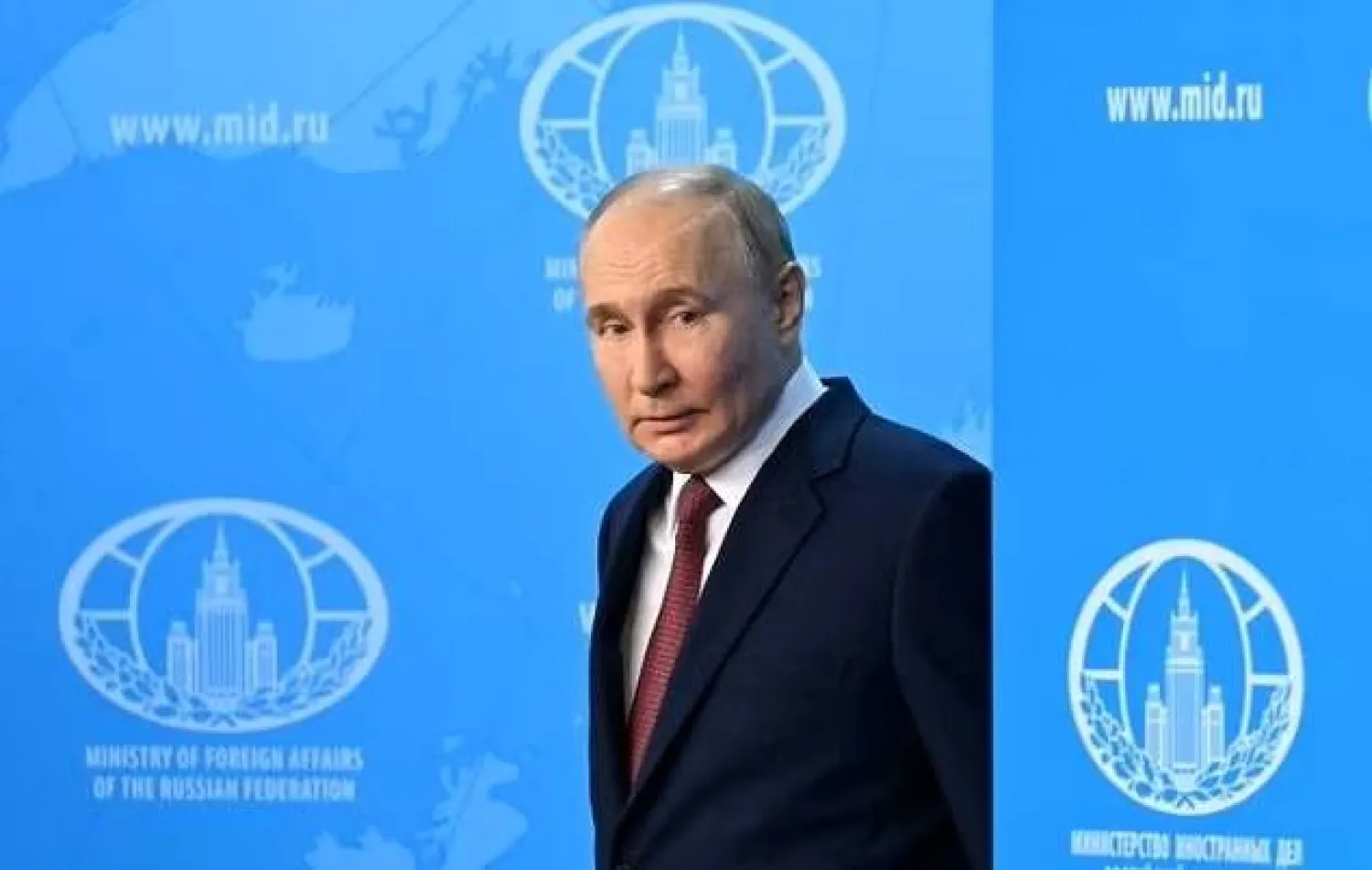

Putin Signs Deals With Vietnam in Bid to Shore Up Ties in Asia

Russia's President Vladimir Putin, who soon begins a visit to North Korea, last traveled to the isolated country in 2000. NATALIA KOLESNIKOVA / AFP
TT

Putin Signs Deals With Vietnam in Bid to Shore Up Ties in Asia

Russia's President Vladimir Putin, who soon begins a visit to North Korea, last traveled to the isolated country in 2000. NATALIA KOLESNIKOVA / AFP

Russian President Vladimir Putin signed a series of deals with his Vietnamese counterpart To Lam on Thursday, during a state visit that comes as Moscow is seeking to bolster ties in Asia to offset growing international isolation over its military actions in Ukraine.
The two signed agreements to further cooperation on education, science and technology, oil and gas exploration and health. They also agreed to work on a roadmap for a nuclear science and technology center in Vietnam, The Associated Press said.
Following the talks, Putin said that the two countries share an interest in “developing a reliable security architecture” in the Asia-Pacific Region based on not using force and peacefully settling disputes with no room for “closed military-political blocs.”
This was echoed by Vietnam's new President To Lam, who said they seek to further “further cooperate in defense and security to cope with non-traditional security challenges” while implementing energy projects and expanding investments. He also congratulated Putin on his re-election and praised Russia's “domestic political stability.”
The agreements between Russia and Vietnam were not as substantial as an agreement Putin signed with North Korean leader Kim Jong Un the previous day, pledging mutual aid in the event of invasion said Nigel Gould-Davies, a senior fellow for Russia and Eurasia with the International Institute for Strategic Studies in London, and a former British ambassador to Belarus.
Putin arrived in Hanoi early Thursday morning from North Korea, where he and North Korean leader Kim Jong Un signed an agreement that pledges mutual aid in the event of war. The strategic pact that could mark the strongest connection between Moscow and Pyongyang since the end of the Cold War comes as both face escalating standoffs with the West.
Putin also met Vietnam’s most powerful politician, Communist Party General Secretary Nguyen Phu Trong, as well as Prime Minister Pham Minh Chinh, according to the official Vietnam News Agency. He is also scheduled to meet parliamentary chief Tran Thanh Man.
Putin drove to Vietnam’s Presidential Palace on Thursday afternoon, where he was greeted by school children waving Russian and Vietnamese flags. There, he shook hands with and embraced Lam before a bilateral meeting and a joint briefing to the media.
Russia is keen to maintain “close and effective cooperation” in energy, industry, technology, education, security and trade, Russian Ambassador to Vietnam Gennady S. Bezdetko said on Wednesday, according to Vietnamese official media.
The trip has resulted in a sharp rebuke from the US Embassy in the country.
Much has changed since Putin's last visit to Vietnam in 2017. Russia now faces a raft of US-led sanctions for its invasion of Ukraine. In 2023, the International Criminal Court in Hague issued an arrest warrant for Putin for war crimes. The Kremlin rejected it as “null and void,” stressing that Moscow doesn’t recognize the court's jurisdiction.
Putin's recent visits to China and now North Korea and Vietnam are attempts to “break the international isolation,” said Nguyen Khac Giang, an analyst at Singapore’s ISEAS-Yusof Ishak Institute.
The US and its allies have expressed growing concerns over a possible arms arrangement in which Pyongyang provides Moscow with badly needed munitions for its use in Ukraine, in exchange for economic assistance and technology transfers that could enhance the threat posed by Kim’s nuclear weapons and missile program.
Both countries deny accusations of weapons transfers, which would violate multiple UN Security Council sanctions that Russia previously endorsed.
Meanwhile, Russia is important to Vietnam for two reasons, Giang said: It is the biggest supplier of military equipment to the Southeast Asian nation, and Russian oil exploration technologies help maintain its sovereignty claims in the contested South China Sea.
“Russia is signaling that it is not isolated in Asia despite the Ukraine war, and Vietnam is reinforcing a key traditional relationship even as it also diversifies ties with newer partners,” said Prashanth Parameswaran, a fellow with the Wilson Center’s Asia Program.
It is unlikely that Vietnam will supplying significant quantities of weapons to Russia, because that would risk progress the country has made with NATO members on military equipment, particularly the US, which has donated naval patrol vessels and is in talks to supply aircraft, said Ridzwan Rahmat, a Singapore-based analyst with the defense intelligence company Janes.
“There is progress that you wouldn’t have imagined just 10 years ago,” he said. “So I would imagine Vietnam wouldn’t want to take a risk, inviting the wrath of Western countries by supplying the Russians.”
Hanoi and Moscow have had diplomatic relations since 1950, and this year marks 30 years of a treaty establishing “friendly relations” between Vietnam and Russia.
Evidence of this long relationship and its influence can be seen in Vietnamese cities like the capital, where the many Soviet-style apartment blocks are now dwarfed by skyscrapers and a statue of Vladimir Lenin, the founder of the Soviet Union, stands in a park where kids skateboard every evening. Many of the Communist Party's top leadership in Vietnam studied in Soviet universities, including party chief Trong.
In an article written for Nhan Dan, the official newspaper of Vietnam’s Communist Party, Putin vowed to deepen the ties between Moscow and Hanoi and hailed Vietnam as a “strong supporter of a fair world order based on international law, on the principles of equality of all states and non-interference in their domestic affairs.”
He also thanked “Vietnamese friends for their balanced position on the Ukrainian crisis,” in the article released by the Kremlin.
Given Putin's international isolation, Vietnam is doing the Russian leader a “huge favor and may expect favors in return,” wrote Andrew Goledzinowski, the Australian ambassador to Vietnam, on social media platform X. He said that it would have been hard for Vietnam to decline the visit since Putin was already in Asia and Vietnam has historical ties with the former Soviet Republic, but said that it was unlikely that the two would be strategic partners again. “Vietnam will always act in Vietnam’s interests and not anyone else’s,” he wrote.
Vietnam's pragmatic policy of “bamboo diplomacy” — a phrase coined by Trong referring to the plant's flexibility, bending but not breaking in the shifting headwinds of global geopolitics — is being increasingly tested.
A manufacturing powerhouse and an increasingly important player in global supply chains, Vietnam played host to both U.S. President Joe Biden and the leader of rival China, Xi Jinping, in 2023.
The visit was important for Hanoi on a diplomatic level, said Gould-Davies, the former ambassador.
“Perhaps for Vietnam it’s a matter of just showing that it’s able to maintain this very agile balance of its bamboo diplomacy,” he said. “Already in the course of a year they’ve hosted visits by the heads of state of the three most powerful countries in the world, which is pretty impressive."
Similarly, for Russia the visit seems to have been more about optics than anything else, he said, as Moscow seeks to engage and influence other countries, particularly in the so-called Global South.



Trump to Remove Vietnam from Restricted Tech List

(FILES) US President Donald Trump holds a chart as he delivers remarks on reciprocal tariffs during an event in the Rose Garden entitled "Make America Wealthy Again" at the White House in Washington, DC, on April 2, 2025. (Photo by Brendan SMIALOWSKI / AFP)
TT

Trump to Remove Vietnam from Restricted Tech List

(FILES) US President Donald Trump holds a chart as he delivers remarks on reciprocal tariffs during an event in the Rose Garden entitled "Make America Wealthy Again" at the White House in Washington, DC, on April 2, 2025. (Photo by Brendan SMIALOWSKI / AFP)

US President Donald Trump told Vietnam's top leader To Lam he would "instruct the relevant agencies" to remove the country from a list restricted from accessing advanced US technologies, Vietnam's government announced Saturday.

The two leaders met in person for the first time at the White House on Friday, after Lam attended the inaugural meeting of Trump's "Board of Peace" in Washington, said AFP.

"Donald Trump said he would instruct the relevant agencies to soon remove Vietnam from the strategic export control list," Hanoi's Government News website said.

The two countries were locked in protracted trade negotiations when the US Supreme Court ruled many of Trump's sweeping tariffs were illegal.

Three Vietnamese airlines announced nearly $37 billion in purchases this week, in a series of contracts signed with US aerospace companies.

Fledgling airline Sun PhuQuoc Airways placed an order for 40 of Boeing's 787 Dreamliners, a long-haul aircraft, with an estimated total value of $22.5 billion, while national carrier Vietnam Airlines placed an $8.1 billion order for around 50 Boeing 737-8 aircraft.

When Trump announced his "Liberation Day" tariffs in April, Vietnam had the third-largest trade surplus with the US of any country after China and Mexico, and was targeted with one of the highest rates in Trump's tariff blitz.

But in July, Hanoi secured a minimum 20 percent tariff with Washington, down from more than 40 percent, in return for opening its market to US products including cars.

Trump signed off on a global 10-percent tariff on Friday on all countries hours after the Supreme Court ruled many of his levies on imports were illegal.


NORAD Intercepts 5 Russian Aircraft near Alaska, Though Military Says There Was No Threat

An F-16 fighter jet takes off (file photo - Reuters)
TT

NORAD Intercepts 5 Russian Aircraft near Alaska, Though Military Says There Was No Threat

An F-16 fighter jet takes off (file photo - Reuters)

Military jets were launched to intercept five Russian aircraft that were flying in international airspace off Alaska’s western coast, but military officials said Friday the Russian aircraft were not seen as provocative.

The North American Aerospace Defense Command said it detected and tracked two Russian Tu-95s, two Su-35s and one A-50 operating near the Bering Strait on Thursday, The Associated Press said.

In response, NORAD launched two F-16s, two F-35s, one E-3 and four KC-135 refueling tankers to intercept, identify and escort the Russian aircraft until they departed the area, according to a release from the command.

“The Russian military aircraft remained in international airspace and did not enter American or Canadian sovereign airspace,” according to the NORAD statement. It also noted this kind of activity “occurs regularly and is not seen as a threat.”

The Russian aircraft were operating in an area near the Bering Strait, a narrow body of water about 50 miles (80 kilometers) wide separating the Pacific and Arctic oceans, called the Alaskan Air Defense Identification Zone.

Such zones begin where sovereign airspace ends. While it’s international airspace, all aircraft are required to identify themselves when entering zones in the interest of national security, NORAD said.

The command used satellites, ground and airborne radars and aircraft to detect and track aircraft

NORAD is headquartered at Peterson Space Force Base, Colorado, but has its Alaska operations based at Joint Base Elmendorf-Richardson in Anchorage.


Trump Unleashes Personal Assault on 'Disloyal' Supreme Court Justices

US President Donald Trump speaks during a press conference in the Brady Press Briefing Room of the White House in Washington, DC, on February 20, 2026. (Photo by Mandel NGAN / AFP)
TT

Trump Unleashes Personal Assault on 'Disloyal' Supreme Court Justices

US President Donald Trump speaks during a press conference in the Brady Press Briefing Room of the White House in Washington, DC, on February 20, 2026. (Photo by Mandel NGAN / AFP)

US President Donald Trump launched an extraordinary personal attack Friday on the Supreme Court justices who struck down his global tariffs, including two of his own appointees, and claimed they were being "swayed by foreign interests."

"I'm ashamed of certain members of the court, absolutely ashamed, for not having the courage to do what's right for our country," Trump told reporters at a White House press conference.

"They're very unpatriotic and disloyal to our Constitution," he said, deriding them at one point as "fools and lap dogs."

The Supreme Court has overwhelmingly sided with Trump since he took office in January of last year, and the tariffs ruling was the first major setback for the Republican president before the conservative-dominated court.

Asked if he regretted nominating justices Amy Coney Barrett and Neil Gorsuch -- who both voted against him -- to the top court, Trump said he did not "want to say whether or not I regret."

"I think their decision was terrible," he said. "I think it's an embarrassment to their families if you want to know the truth, the two of them."

Chief Justice John Roberts, Coney Barrett and Gorsuch, all conservatives, joined with the court's three liberals in the 6-3 ruling that Trump's sweeping global tariffs were illegal.

Trump heaped praise on the conservative justices who voted to uphold his authority to levy tariffs -- Clarence Thomas, Samuel Alito and Brett Kavanaugh, a Trump appointee.

He thanked the three "for their strength and wisdom, and love of our country."

Trump in particular singled out Kavanaugh, who wrote a 63-page dissent to the tariffs ruling, calling him a "genius" and saying he was "so proud of him."

- 'You're going to find out' -

The president also alleged there was foreign influence behind the ruling.

"It's my opinion that the court has been swayed by foreign interests," he said. "I think that foreign interests are represented by people that I believe have undue influence.

"They have a lot of influence over the Supreme Court, whether it's through fear or respect or friendships, I don't know," he said.

Asked by a reporter if he had evidence of foreign influence on the court, Trump replied: "You're going to find out."

Vice President JD Vance added his voice to the condemnation of the tariffs ruling, calling it "lawlessness from the court, plain and simple."

Tensions between the White House and the Supreme Court are not new -- a frustrated president Franklin D Roosevelt once proposed expanding the court to pack it with Democratic loyalists.

But Steven Schwinn, a constitutional law professor at the University of Illinois Chicago, said Trump's "gratuitous and ad homineum attacks" on individual justices reveal "his fundamental misunderstanding of the separation of powers."

"He seems to believe that any good-faith disagreement with his own interpretation of the law is, by definition, illegitimate," Schwinn told AFP.

"At the same time, he lacks any serious interpretation of the law of his own, except to say that the law is what he wants it to be. This is not how a democracy works."

Trump was also asked whether the six justices who voted against him would be welcome at next week's State of the Union speech before Congress.

"Three are happily invited," the president said.

The others are "invited, barely," he said, before adding "I couldn't care less if they come."