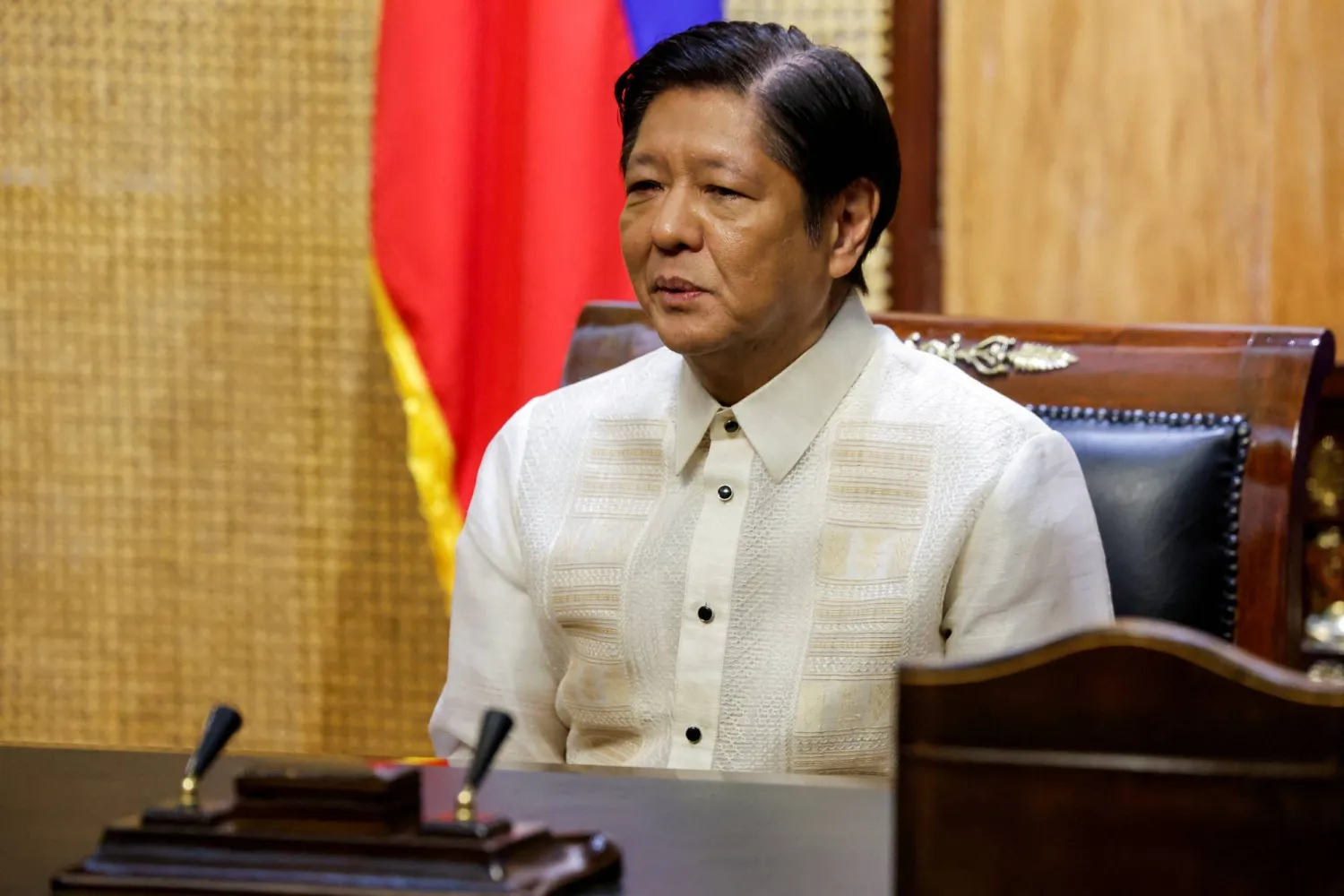
President: Philippines Not in Business of Instigating Wars

FILE PHOTO: Philippines' President Ferdinand Marcos Jr. looks on as he meets with US Secretary of State Antony Blinken, at Malacanang Palace in Manila, Philippines, March 19, 2024. REUTERS/Evelyn Hockstein/Pool/File Photo
TT

President: Philippines Not in Business of Instigating Wars

FILE PHOTO: Philippines' President Ferdinand Marcos Jr. looks on as he meets with US Secretary of State Antony Blinken, at Malacanang Palace in Manila, Philippines, March 19, 2024. REUTERS/Evelyn Hockstein/Pool/File Photo

Philippine President Ferdinand Marcos Jr said on Sunday his country is not in the business of instigating wars and will always aim to settle disputes peacefully, amid escalating maritime confrontations with China.
"In defending the nation, we stay true to our Filipino nature that we would like to settle all these issues peacefully," Marcos said in a speech to troops of the Western Command unit in charge of overseeing the South China Sea.
Philippine navy personnel and the Chinese coast guard had their latest clash during a routine resupply mission by Manila in the South China Sea last week, in which it said a sailor was severely injured and vessels damaged.
China's Coast Guard personnel carrying knives and spears looted firearms and "deliberately punctured" Philippine boats involved in the mission, the Philippine military said.
China disputed the Philippine account, with a foreign ministry spokesperson saying on Thursday the necessary measures taken were lawful, professional and beyond reproach.
Marcos, who did not name China in his speech, commended the troops for exercising restraint "amidst intense provocation", and said his country would always exercise its freedoms and rights in line with international law.
"In the performance of our duties, we will not resort to the use of force or intimidation, or deliberately inflict injury or harm to anyone," Reuters quoted Marcos as saying. "We stand firm. Our calm and peaceful disposition should not be mistaken for acquiescence."
Recent maritime run-ins between China and the Philippines, a US treaty ally in Southeast Asia, have made the highly strategic South China Sea a potential flashpoint between Washington and Beijing.
The United States has condemned China's actions and reaffirmed its ironclad defense commitments against any attack on Philippine aircraft or vessels in the South China Sea under their mutual defense treaty.
But the Philippines said on Friday there was no reason to invoke the treaty because China's actions, which security officials have described as escalatory, could not be classified as an "armed attack".
China claims almost the entire South China Sea, a conduit for more than $3 trillion of annual shipborne commerce, including parts claimed by the Philippines, Vietnam, Indonesia, Malaysia and Brunei.
In 2016, the Permanent Court of Arbitration in The Hague said China's claims had no legal basis, a decision Beijing has rejected.
"We are not in the business to instigate wars - our great ambition is to provide a peaceful and prosperous life for every Filipino," Marcos said. "We refuse to play by the rules that force us to choose sides in a great power competition."



No Sign of War Winding Down in Mideast as Friday Dawns with Attacks across Region

Smoke rises from the site of a strike in Tehran on April 1, 2026.  (Photo by AFP) /
Smoke rises from the site of a strike in Tehran on April 1, 2026. (Photo by AFP) /
TT

No Sign of War Winding Down in Mideast as Friday Dawns with Attacks across Region

Smoke rises from the site of a strike in Tehran on April 1, 2026.  (Photo by AFP) /
Smoke rises from the site of a strike in Tehran on April 1, 2026. (Photo by AFP) /

There was little sign Friday of the war in the Mideast winding down as Israel said it faced incoming fire from Iran, Kuwait and Bahrain reported being under attack, and Iran said eight people were killed while celebrating the close of Persian new year near a major bridge hit by a US strike.

Tehran continued to demonstrate its ability to strike its neighbors even as US President Donald Trump claimed the threat from the country was nearly eliminated and cheered the collapse of the bridge on Thursday, reportedly the tallest in the Middle East.

Iran decried the strike on the bridge, which also injured 95 people celebrating Nature Day, when Iranians gather for picnics and other celebrations outdoors on the last day of Nowruz, the Persian new year.

“Striking civilian infrastructure only conveys the defeat and moral collapse of an enemy in disarray,” Iran’s Foreign Minister Abbas Araghchi wrote Thursday in a post on X.

Iran’s attacks on Gulf states along with its chokehold on the Strait of Hormuz have disrupted the world’s energy supplies with effects far beyond the Middle East. That has proved to be Iran’s greatest strategic advantage in the war. Britain held a call with nearly three dozen countries about how to reopen the strait once the fighting is over.

Trump has insisted the strait can be taken by force — but said it is not up to the US to do that. In an address to the American people Wednesday night, he encouraged countries that depend on oil from Hormuz to “build some delayed courage” and go “take it.”

Before the US and Israel started the war on Feb. 28 with strikes on Iran, the waterway was open to traffic and 20% of all traded oil passed through it.

Iran continues to strike Israel and Gulf countries

Iran responded defiantly to Trump’s speech, in which the American president claimed US military action had been so decisive that “one of the most powerful countries” is “really no longer a threat.”

A spokesman for Iran’s military, Lt. Col. Ebrahim Zolfaghari, insisted Thursday that Tehran maintains hidden stockpiles of arms, munitions and production facilities. He said facilities targeted so far by US strikes are “insignificant.”

Trump, in his address, said US “core strategic objectives are nearing completion.”

Iran state media reported the attack on the B1 bridge, which was still under construction, citing authorities in Alborz province.

Trump posted footage on social media showing what he said was the collapse of Iran's biggest bridge and threatening, “Much more to follow.” It was not immediately clear if the footage Trump shared was the B1 bridge.

In Lebanon — where Israel has launched a ground invasion against Iran-backed Hezbollah militants — Israeli strikes killed 27 people over 24 hours, the Health Ministry said.

More than 1,900 people have been killed in Iran during the war, while 19 have been reported dead in Israel. More than two dozen people have died in Gulf states and the occupied West Bank, while 13 US service members have been killed.

More than 1,300 people have been killed and more than 1 million displaced in Lebanon. Ten Israeli soldiers have also died there.

Nearly three dozen nations talk about securing the Strait of Hormuz Iranian attacks on about two dozen commercial ships, and the threat of more, have halted nearly all traffic in the waterway that connects the Arabian Gulf to the open ocean.

Since March 1, traffic through the strait has dropped 94% over the same period last year, according to the Lloyds List Intelligence shipping data firm. Two ships are confirmed to have paid a fee, the firm said, while others were allowed through based on agreements with their home governments.

Saudi Arabia piped about 1 billion barrels of oil away from the Strait of Hormuz in March, according to maritime data firm Kpler, while Iraq said Thursday that it had started to truck oil across Syria to avoid the strait.

The 35 countries that spoke Thursday signed a declaration last month demanding Iran stop blocking the strait.

Thursday’s talks were focused on political and diplomatic measures, but British Foreign Secretary Yvette Cooper said military planners from an unspecified number of countries will also plot ways to ensure security once fighting ends, including potential mine-clearing work and “reassurance” for commercial shipping.

No country appears willing to try to open the strait by force while the war is raging. French President Emmanuel Macron, while on a visit to South Korea, called a military operation to secure the waterway “unrealistic.”

But there is a concern that Iran might limit traffic through the waterway even after US and Israeli attacks cease.

Oil prices rise again even as Trump suggests the war could end soon

The conflict is driving up prices for oil and natural gas, roiling stock markets, pushing up the cost of gasoline and threatening to make a range of goods, including food, more expensive.

Oil prices remained elevated, however, at $111.54 for a barrel of US crude, having soared following Trump’s address. That's up about 50% from Feb. 28.

Though the oil and gas that typically transits the strait is primarily sold to Asian nations, Japan and South Korea were the only two countries from the region joining Thursday's call about the strait. The supply of jet fuel has also been interrupted, with consequences for travel worldwide.


Iran Hangs 18-Year-Old Over Protests in Latest Wartime Execution, Say Activists

Iranians walk at a park on Nature Day, amid the US-Israeli conflict with Iran, in Tehran, Iran, April 2, 2026. Majid Asgaripour/WANA (West Asia News Agency) via Reuters
TT

Iran Hangs 18-Year-Old Over Protests in Latest Wartime Execution, Say Activists

Iranians walk at a park on Nature Day, amid the US-Israeli conflict with Iran, in Tehran, Iran, April 2, 2026. Majid Asgaripour/WANA (West Asia News Agency) via Reuters

Iranian authorities Thursday executed a teenager convicted over January protests after a fast-track trial rights groups labelled as "grossly unfair", as the country ramps up executions during the war with the US and Israel.

Amir Hossein Hatami, 18, was sentenced to death in February along with six others by a Tehran revolutionary court and was hanged at dawn in the notorious Ghezel Hesar prison outside the capital, according to Norway-based NGO Iran Human Rights.

The Iranian judiciary's Mizan Online website said he acted "against national security" on behalf of Israel and the United States by breaking into "a military center and destroying it in order to seize the weapons stored there" during the protests.

But Amnesty International said it was "outraged by the arbitrary execution of the teenage protester", adding the trial was "grossly unfair" and that he had been sentenced to death less than a month after his arrest.

Hatami is the fourth man to be executed over protests that broke out in Iran in late December against the rising cost of living before evolving into nationwide anti-government demonstrations. The protests peaked on January 8 and 9 and were met with a crackdown that activists say left thousands dead.

On March 19, authorities executed three men convicted of killing police in the protests, including 19-year-old Saleh Mohammadi, a wrestler who took part in international competitions.

This week, authorities have hanged four men convicted on charges of rebellion for membership in the banned People's Mujahedin of Iran (MEK) after their sentences were upheld by the supreme court.

Hatami "was subjected to torture and sentenced based on forced confessions in a grossly unfair trial before the revolutionary Court," said IHR director Mahmood Amiry-Moghaddam.

"In the past two weeks alone, three protesters and four political prisoners have been executed, and hundreds more remain at imminent risk," he added. IHR said that just 84 days had elapsed between his arrest and execution.

- 'Tool of repression' -

The seven were accused of setting fire to a base belonging to the Basij militia -- a volunteer force of the Revolutionary Guards -- in Tehran during the protests.

But defense lawyers accused plainclothes forces of trapping protesters inside a building, locking the doors, and themselves starting the fire.

Amnesty International said that the execution showed the judiciary is "a tool of repression sending individuals to the gallows to spread fear and exacting revenge on those demanding fundamental political change".

IHR said the seven men had been convicted in the fast track-trial -- just a month after their arrest -- by the court presided over by the notorious judge Abolqasem Salavati.

Salavati was sanctioned in 2019 by the United States, which said he is known as the "Judge of Death" for his frequent death sentences.

The executions came amid Iran's war with Israel and the United States which erupted on February 28 with strikes that killed the Islamic republic's supreme leader, Ali Khamenei.

"Hundreds more now face imminent executions in the coming days and weeks," warned Amiry-Moghaddam.


Austria Denies US Use of Airspace for Iran Military Operations

18 March 2026, ---: A US Navy F/A-18E Super Hornet with the Tomcatters of Strike Fighter Squadron 31 launches from the flight deck of the Ford-class aircraft carrier USS Gerald R. Ford in support of Operation Epic Fury. (Navy Handout/US Navy/Planet Pix via ZUMA Press Wire/dpa)
TT

Austria Denies US Use of Airspace for Iran Military Operations

18 March 2026, ---: A US Navy F/A-18E Super Hornet with the Tomcatters of Strike Fighter Squadron 31 launches from the flight deck of the Ford-class aircraft carrier USS Gerald R. Ford in support of Operation Epic Fury. (Navy Handout/US Navy/Planet Pix via ZUMA Press Wire/dpa)

Austria has denied the United States use of its airspace for military operations against Iran due to Austria's neutrality law, the country's defense ‌ministry said ‌on Thursday.

A spokesperson ‌for ⁠the ministry confirmed ⁠a report from Austrian news agency APA that the US had made "several" flyover requests to ⁠Austria, without specifying ‌how ‌many.

All US flyover requests ‌of a military ‌nature relating to the conflict in Iran had been rejected, the spokesperson ‌said.

Austria applies the same principle to ⁠other ⁠countries that are engaged in military conflict, the spokesperson added.

Individual cases were reviewed in consultation with the Austrian foreign ministry, the APA report noted.